 Quran
Quran
Every memorizer remembers the feeling — that moment when the words of Allah begin to settle not just in memory, but somewhere deeper. Quran hifz quotes have carried generations of memorizers through late nights, difficult passages, and moments of doubt, reminding them that this path is unlike any other.
Whether you’re memorizing your first juz or pushing through the final stretch, the words of the Prophet ﷺ, the Quran, and the scholars of Islam can renew your motivation and strengthen your connection with Hifz. This article brings together powerful Hafiz Quran quotes drawn from authentic hadith, Quranic verses, and respected Islamic scholars — with Arabic text, source references, and reflections on what each one means for the memorizer today.
Quran Hifz Quotes from the Prophet Muhammad ﷺ
The Prophet ﷺ spoke about the Quran and its memorizers with a clarity and warmth that still reaches across centuries. These hadiths are among the most cited in Islamic scholarship when discussing hifz — and for good reason. They don’t just describe the reward; they reshape how you see yourself as a memorizer.
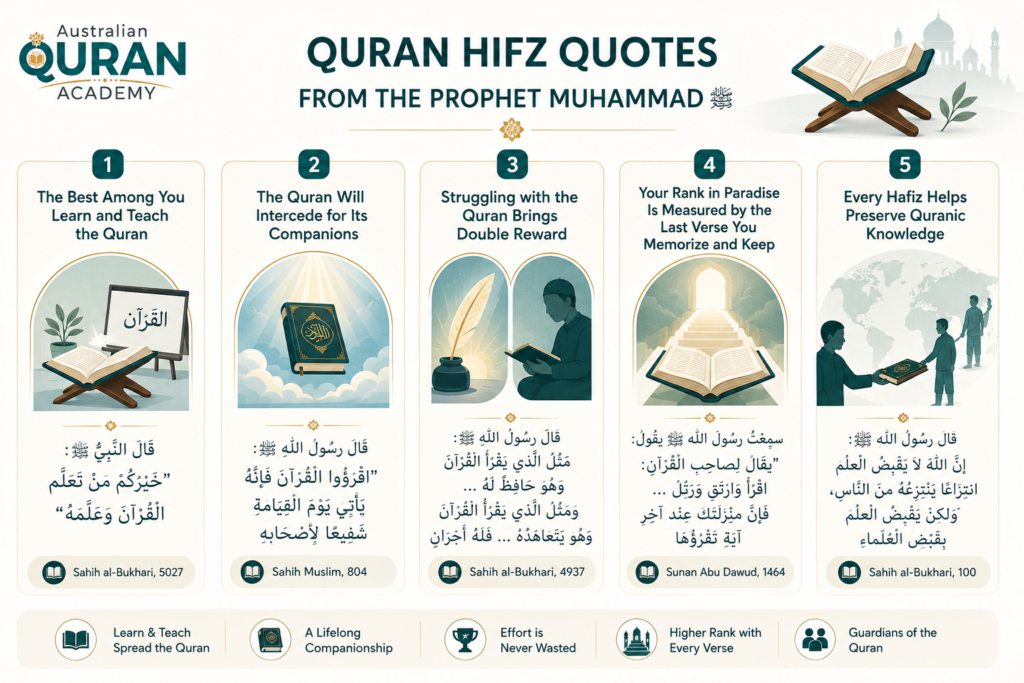
1. The Best Among You Learn and Teach the Quran
Of all the titles a person could earn in this life, the Prophet ﷺ named one above the rest. It belongs not to kings or scholars of worldly knowledge, but to those who dedicate themselves to the Quran.
قَالَ النَّبِيُّ صَلَّى اللَّهُ عَلَيْهِ وَسَلَّمَ: “خَيْرُكُمْ مَنْ تَعَلَّمَ الْقُرْآنَ وَعَلَّمَهُ”
“The best among you are those who learn the Quran and teach it.” — Sahih al-Bukhari, 5027
The Prophet ﷺ placed learners and teachers of the Quran above all others with a single, unambiguous statement. What makes this one of the most cited Quran hifz quotes is the pairing: learn and teach. The journey of hifz doesn’t end with the final page — it circles back when you take someone else’s hand and lead them through what you know. Every hafiz is, in some sense, carrying a responsibility to pass it forward.
2. The Quran Will Intercede for Its Companions
On the Day when every worldly connection will fail and every achievement will count for nothing, the memorizer will have one companion standing beside them. This hadith tells you exactly who that companion is.
قَالَ رَسُولُ اللَّهِ صَلَّى اللَّهُ عَلَيْهِ وَسَلَّمَ: “اقْرَؤُوا الْقُرْآنَ فَإِنَّهُ يَأْتِي يَوْمَ الْقِيَامَةِ شَفِيعًا لِأَصْحَابِهِ”
“Recite the Quran, for it will come as an intercessor for its companions on the Day of Resurrection.” — Sahih Muslim, 804
The word aṣḥāb — companions — is deliberate. The Quran doesn’t intercede for those who simply owned a copy. It intercedes for its companions: those who kept it close, recited it regularly, and lived beside it. The hafiz who maintains their memorization, who doesn’t let the Quran go abandoned, earns that companionship. This is among the most cited hafiz Quran quotes because it reframes what hifz actually is — not an achievement you complete, but a relationship you sustain.
3. Struggling with the Quran Brings Double Reward
Some students worry that their recitation isn’t fluent enough, that they stumble too often, that they don’t deserve to be called a memorizer yet. The Prophet ﷺ addressed both the strong and the struggling in the same breath.
قَالَ رَسُولُ اللَّهِ صَلَّى اللَّهُ عَلَيْهِ وَسَلَّمَ: “مَثَلُ الَّذِي يَقْرَأُ الْقُرْآنَ وَهُوَ حَافِظٌ لَهُ مَعَ السَّفَرَةِ الْكِرَامِ الْبَرَرَةِ، وَمَثَلُ الَّذِي يَقْرَأُ الْقُرْآنَ وَهُوَ يَتَعَاهَدُهُ وَهُوَ عَلَيْهِ شَدِيدٌ، فَلَهُ أَجْرَانِ”
“The one who is proficient in the Quran will be with the noble, righteous scribing angels. And the one who recites the Quran and struggles with it, finding it difficult, will have a double reward.” — Sahih al-Bukhari, 4937
This hadith contains a gift for every type of memorizer. For the one who has mastered their hifz: they are raised to the rank of the noble angelic scribes. For the one still struggling — tongue stumbling, passage refusing to stick — they receive two rewards. The message is clear: no effort in hifz is ever wasted. If you’re finding it hard right now, know that the difficulty itself is being counted.
4. Your Rank in Paradise Is Measured by the Last Verse You Memorize and Keep
If you’ve ever wondered whether the number of verses you memorize actually matters in the Hereafter, the Prophet ﷺ answered that question directly — and the answer should change how you approach every revision session.
سَمِعْتُ رَسُولَ اللَّهِ صَلَّى اللَّهُ عَلَيْهِ وَسَلَّمَ يَقُولُ: “يُقَالُ لِصَاحِبِ الْقُرْآنِ: اقْرَأْ وَارْتَقِ وَرَتِّلْ كَمَا كُنْتَ تُرَتِّلُ فِي الدُّنْيَا، فَإِنَّ مَنْزِلَتَكَ عِنْدَ آخِرِ آيَةٍ تَقْرَؤُهَا”
“It will be said to the companion of the Quran: ‘Read, and ascend, and recite as you used to recite in the world — for your station will be at the last verse you recite.'” — Sunan Abu Dawud, 1464
Among all the powerful hafiz Quran quotes, this one gives hifz a direct, measurable weight in the Hereafter. Your rank in Paradise rises with each verse you memorized and maintained. This is why scholars of hifz always emphasize: don’t rush quantity at the expense of retention. Every ayah you truly own — that stays with you at the time of death — is a step higher in Jannah. The station is set at the last verse you recite, which means what you preserve matters more than what you once memorized and forgot.
5. Every Hafiz Helps Preserve Quranic Knowledge
We often think of hifz as a personal journey — one student, one Quran, one goal. But this hadith reveals what every hafiz is actually doing on behalf of the entire ummah, whether they realize it or not.
قَالَ رَسُولُ اللَّهِ صَلَّى اللَّهُ عَلَيْهِ وَسَلَّمَ: “إِنَّ اللَّهَ لَا يَقْبِضُ الْعِلْمَ انْتِزَاعًا يَنْتِزِعُهُ مِنَ النَّاسِ، وَلَكِنْ يَقْبِضُ الْعِلْمَ بِقَبْضِ الْعُلَمَاءِ”
“Allah does not take away knowledge by removing it from the hearts of people. Rather, He takes it away by taking away the scholars.” — Sahih al-Bukhari, 100
Every hafiz is a guardian. The Quran was preserved through exactly this chain — one heart memorizing and transmitting to the next. This hadith makes visible what every memorizer is actually doing: they are part of the living preservation of divine speech. The tradition of hifz is not a relic; it is the mechanism by which Allah’s word has reached us intact for over 1,400 years.
Quran Verses About Knowledge, Reflection, and Memorization
The Quran contains powerful verses about reading, seeking knowledge, reflecting on revelation, and developing greater awareness of Allah. For a Hafiz or anyone pursuing Hifz, these verses provide important reminders about the purpose behind learning and preserving the words of Allah.
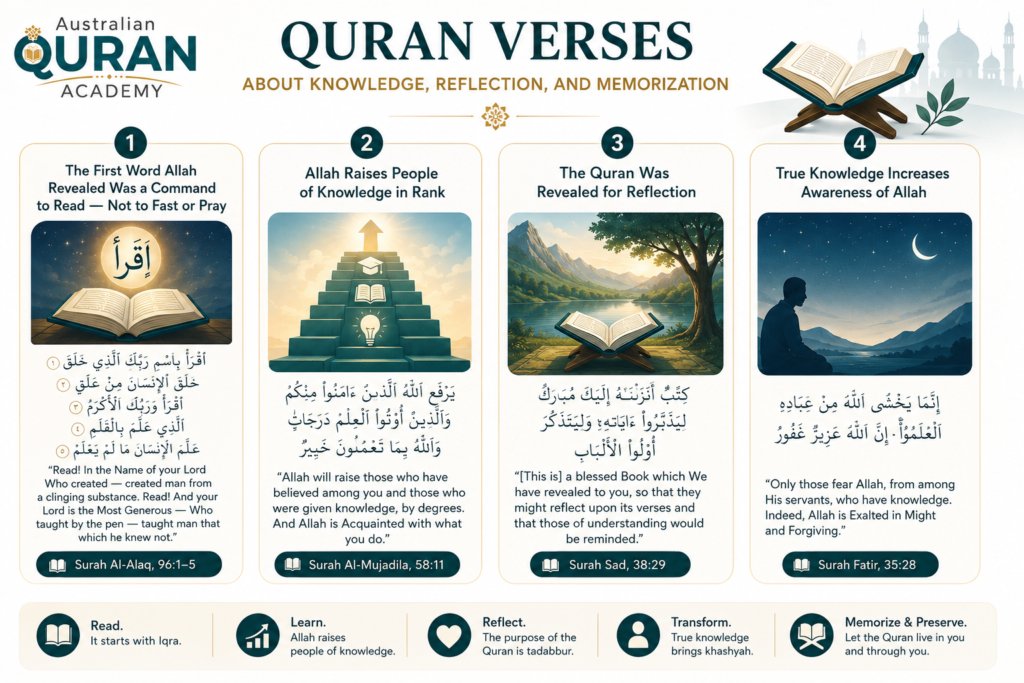
1. The First Word Allah Revealed Was a Command to Read — Not to Fast or Pray
Before any rule of fiqh, before any pillar of worship, before any detail of law — Allah opened His final revelation with a single word. What that word was tells you everything about the place of the Quran in a Muslim’s life.
ٱقۡرَأۡ بِٱسۡمِ رَبِّكَ ٱلَّذِي خَلَقَ ﴿١﴾ خَلَقَ ٱلۡإِنسَٰنَ مِنۡ عَلَقٍ ﴿٢﴾ ٱقۡرَأۡ وَرَبُّكَ ٱلۡأَكۡرَمُ ﴿٣﴾ ٱلَّذِي عَلَّمَ بِٱلۡقَلَمِ ﴿٤﴾ عَلَّمَ ٱلۡإِنسَٰنَ مَا لَمۡ يَعۡلَمۡ ﴿٥﴾
“Read! In the Name of your Lord Who created — created man from a clinging substance. Read! And your Lord is the Most Generous — Who taught by the pen — taught man that which he knew not.” — Surah Al-Alaq, 96:1–5
The very first word revealed to the Prophet ﷺ was Iqra — read. Not “pray,” not “fast,” but read. The command is given twice in five verses, signaling that engaging with the word of Allah is not a one-time instruction but a permanent orientation. For the memorizer, this is the foundation: hifz begins with reading, goes deeper into holding the words, and then into letting those words hold you.
2. Allah Raises People of Knowledge in Rank
Every memorizer wonders at some point: does this effort matter beyond the personal? Does Allah see what it costs to sit with these pages day after day? This verse answers that directly.
يَرۡفَعِ ٱللَّهُ ٱلَّذِينَ ءَامَنُواْ مِنكُمۡ وَٱلَّذِينَ أُوتُواْ ٱلۡعِلۡمَ دَرَجَٰتٍۚ وَٱللَّهُ بِمَا تَعۡمَلُونَ خَبِيرٌ
“Allah will raise those who have believed among you and those who were given knowledge, by degrees. And Allah is Acquainted with what you do.” — Surah Al-Mujadila, 58:11
The word darajāt — degrees, ranks — appears without an upper limit. The Quran does not say some elevation; it says Allah raises the people of knowledge in ways He alone measures. For the hafiz, this verse is a direct promise: memorizing and maintaining the Quran is an act of carrying ‘ilm in its most sacred form. The raising is both in this life — in wisdom and in character — and in the next.
If you want to start building that foundation with your family, Australian Quran Academy’s weekend Quran classes offer a consistent, guided environment to take that first step together.

3. The Quran Was Revealed for Reflection
Many students measure their hifz progress in pages completed and chapters crossed off. But Allah revealed the purpose of this book in a single verse — and completion is not the whole of it.
كِتَٰبٌ أَنزَلۡنَٰهُ إِلَيۡكَ مُبَٰرَكٌ لِّيَدَّبَّرُوٓاْ ءَايَٰتِهِۦ وَلِيَتَذَكَّرَ أُوْلُواْ ٱلۡأَلۡبَٰبِ
“[This is] a blessed Book which We have revealed to you, so that they might reflect upon its verses and that those of understanding would be reminded.” — Surah Sad, 38:29
The Arabic tadabbur — translated here as “reflect” — means to follow something to its furthest depth, to trace it to where it leads. Allah did not reveal the Quran to be recited on autopilot. This verse is a reminder that the goal of hifz is not the completion; it’s the transformation that comes when the words settle into the mind and begin producing action. The memorizer who pairs retention with reflection is fulfilling the full purpose of this book.
Read also: Who Is a Hafiz? Meaning, Status, and Where the World’s Huffaz Live
4. True Knowledge Increases Awareness of Allah
There is a test that every hafiz can apply to their own memorization — not a written exam, but an internal one. This verse describes exactly what genuine engagement with the Quran is supposed to produce in the heart.
إِنَّمَا يَخۡشَى ٱللَّهَ مِنۡ عِبَادِهِ ٱلۡعُلَمَٰٓؤُاْۗ إِنَّ ٱللَّهَ عَزِيزٌ غَفُورٌ
“Only those fear Allah, from among His servants, who have knowledge. Indeed, Allah is Exalted in Might and Forgiving.” — Surah Fatir, 35:28
This verse defines the end state of genuine knowledge: khashyah — a reverential awe of Allah that grows with understanding, not shrinks from it. The hafiz who knows thousands of verses but feels no increased closeness to Allah should return to this ayah. True hifz should produce exactly what this verse describes: a person who fears Allah more deeply because they have come to know Him more truly through His own speech. If memorization is not changing the person, the process needs to go deeper.
See Us in Action!
Curious about what our online classrooms look like? Watch the short clips below to see how our interactive, one-on-one sessions bring learning to life with real-time feedback and engaging teaching methods.
Start Your Quranic Journey in Australia
Join our leading online academy and learn with expert tutors through a structured, personalized curriculum.
Book Your Free TrialHafiz e Quran Quotes from the Scholars of Islam
The great scholars of Islamic history left behind reflections on hifz, recitation, and the Quran that cut through centuries with the same sharpness they had when first spoken. These hafiz e Quran quotes are not scripture, but they carry the weight of lived expertise — men who spent their lives in service to the words of Allah.
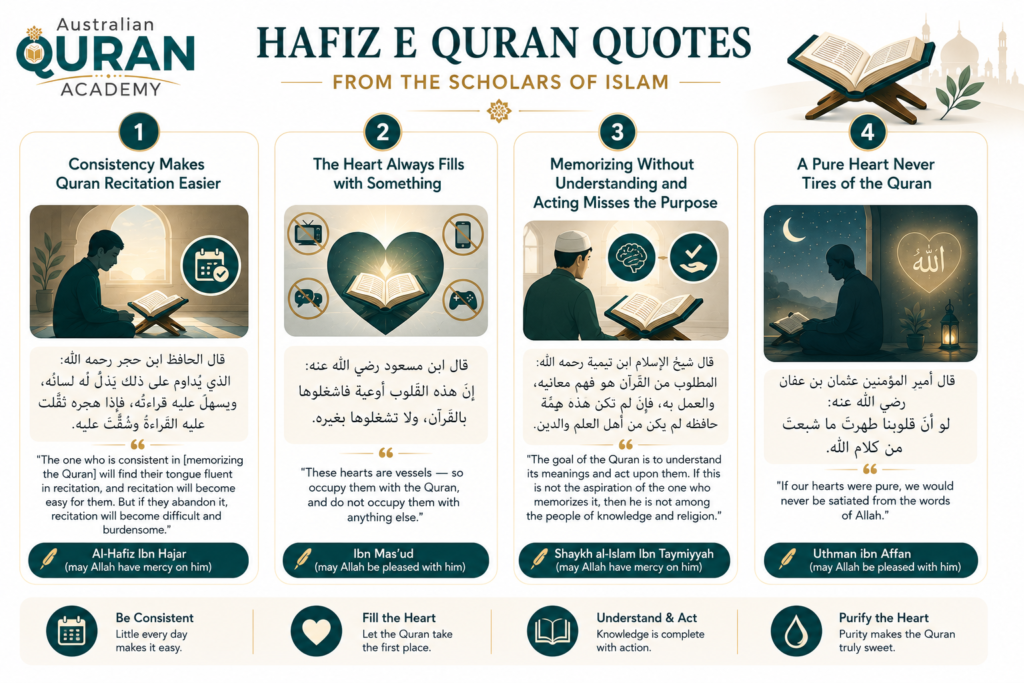
1. Consistency Makes Quran Recitation Easier
Every hafiz who has taken a break from revision knows the feeling of returning to a passage that once felt solid, only to find it has grown unfamiliar. Ibn Hajar named exactly this reality — and explained what causes it.
قال الحافظ ابن حجر رحمه الله: الذي يُداوم على ذلك يَذِلُّ له لسانُه، ويسهل عليه قراءتُه، فإذا هجره ثقُلت عليه القراءةُ وشقَّت عليه.
“The one who is consistent in [memorizing the Quran] will find their tongue fluent in recitation, and recitation will become easy for them. But if they abandon it, recitation will become difficult and burdensome.” — Al-Hafiz Ibn Hajar (may Allah have mercy on him)
Ibn Hajar articulates what every hafiz discovers through experience: the tongue follows consistency. Daily review — even a single page — maintains familiarity with the sounds and sequences. Skip for a week, and the words feel slippery. This is not only a spiritual observation; it is a practical law of hifz. Build the habit before you feel like it, and the habit will carry you when you don’t.
2. The Heart Always Fills with Something — Choose the Quran Before Something Else Does
The human heart doesn’t stay empty. It fills with whatever it is given — news, noise, worry, distraction. Ibn Mas’ud understood this, and he left advice for the believer that is as relevant today as it was in the first generation of Islam.
قال ابن مسعود رضي الله عنه: إن هذه القلوب أوعية فاشغلوها بالقرآن، ولا تشغلوها بغيره.
“These hearts are vessels — so occupy them with the Quran, and do not occupy them with anything else.” — Ibn Mas’ud (may Allah be pleased with him)
Ibn Mas’ud was among the closest companions to the Prophet ﷺ in matters of the Quran. His analogy is direct: the heart has a capacity, and what you pour in fills it. The hafiz who saturates their mind with the Quran leaves less room for distraction and wandering thought. This is not asceticism — it is architecture. Fill the vessel deliberately, because something will always fill it.
3. Memorizing Without Understanding and Acting Upon the Quran Misses Its Entire Purpose
A student can complete the Quran in memorization and still miss its entire point. Ibn Taymiyyah — one of the most rigorous minds in Islamic intellectual history — stated this plainly, and without softening it.
قال شيخ الإسلام ابن تيمية رحمه الله: المطلوب من القرآن هو فهم معانيه، والعمل به، فإن لم تكن هذه هِمَّةَ حافظه لم يكن من أهل العلم والدين.
“The goal of the Quran is to understand its meanings and act upon them. If this is not the aspiration of the one who memorizes it, then he is not among the people of knowledge and religion.” — Shaykh al-Islam Ibn Taymiyyah (may Allah have mercy on him)
Ibn Taymiyyah’s words are not a criticism — they are a compass. Hifz without tadabbur and ‘amal (reflection and action) is memorization of sounds, not of guidance. Among the most searching hafiz e Quran quotes in English the tradition has produced, this one asks the memorizer a direct question: Am I memorizing to understand and live by this? The answer shapes everything about how the journey goes.
Read also: How to Memorize the Quran Without Forgetting in Australia? – 15 Steps That Actually Work
4. A Pure Heart Never Tires of the Quran
There are days when sitting with the Quran feels heavy, when motivation is low and the session feels like a duty rather than a gift. Uthman ibn Affan — who recited the entire Quran in a single night’s prayer — looked at that feeling and named its source.
قال أمير المؤمنين عثمان بن عفان رضي الله عنه: لو أن قلوبنا طهرت ما شبعت من كلام الله.
“If our hearts were pure, we would never be satiated from the words of Allah.” — Uthman ibn Affan (may Allah be pleased with him)
Uthman ibn Affan, the third Caliph, looked at his own heart and saw room for more purity. If he saw that gap, the rest of us have work to do. This quote reframes the moments when hifz feels heavy: perhaps it is not the Quran that is difficult, but the distance between the heart and its purest state. The path back is through the Quran itself — more of it, not less.
Structured, regular recitation practice is exactly what Australian Quran Academy’s Quran recitation classes are built around — helping students develop exactly this consistency under the guidance of qualified teachers.
Inside Our Virtual Classrooms
We believe in full transparency and proven quality. Take a look at these actual snippets from our live classes to experience our modern learning platform, patient instructors, and interactive student participation.
Begin Your Hifz Journey with Australian Quran Academy
The quotes above describe a rank, a relationship, and a responsibility. The first step toward all three is learning to read the words of Allah correctly — with proper pronunciation, with confidence, and with the foundation that real memorization requires.
Australian Quran Academy offers structured Quran classes with qualified teachers, flexible scheduling, and a beginner-friendly approach designed for students at every level.
Our Quran Courses
- Quran Online Academy
- Quran Recitation Classes
- Quran Reading Classes
- Online Quran Classes for Kids
- Quran Classes for Adults
- Quran Classes for Female/Sisters
- Learn Quran Course for Beginners
- Quran Memorization (Hifz) Course
- Hifz Classes for Adults
- Quran Memorization and Hifz Course for Kids
- Quran Hifz Course for Ladies
- Quran Ijazah Program
- Quran Qirat Learning Course
- Quran Tafsir Course
- Noorani Qaida Course
- Noorani Qaida Course for Kids
- Weekend Quran Classes
- Intensive Quran Course
- Al-Azhar Quran Course
- Online Tajweed Classes
- Tajweed Course for Kids
- Tajweed Course for Adults
- Tajweed Course for Ladies
Start Your Quranic Journey in Australia
Join our leading online academy and learn with expert tutors through a structured, personalized curriculum.
Book Your Free Trial
Conclusion
Quran hifz quotes — from the Prophet ﷺ, from the Quran itself, and from the scholars who gave their lives to this tradition — all point in one direction: this is a path worth walking, and worth walking completely. Not just reaching the final page of the Quran, but carrying it with understanding, maintaining it with consistency, and allowing it to reshape the person who holds it.
The hafiz is not simply someone who has memorized 604 pages. They are a living vessel of divine speech, a guardian of the chain of preservation, and — according to the Prophet ﷺ himself — among the best of people. These 13 quotes are not wall decorations; they are tools for the road. Return to them when the path gets hard.
Read also: The Benefits, Virtues, and Rewards of Memorizing the Quran
FAQs
What are the best Quran hifz quotes for motivation?
The most motivating Quran hifz quotes come directly from hadith. The Prophet ﷺ said that the companion of the Quran will be told in Paradise: “Read and ascend — your rank is at the last verse you recite” (Sunan Abu Dawud, 1464). This reframes every page memorized as a permanent step higher in the Hereafter.
What does “hafiz e Quran” mean?
Hafiz e Quran — from the Arabic ḥāfiẓ (حافظ), meaning “guardian” or “one who preserves” — refers to a person who has committed the entire Quran to memory. The title reflects both the spiritual rank and the ongoing responsibility of maintaining and transmitting the text with accuracy.
Are there Quranic verses that encourage memorization?
Yes. While the Quran does not use the word “memorize” explicitly, it commands repeated reading (Iqra, Surah Al-Alaq, 96:1–5), deep reflection (tadabbur, Surah Sad, 38:29), and sustained connection with the divine word. The entire tradition of hifz is grounded in these commands.
What do Islamic scholars say about consistent Quran revision?
Al-Hafiz Ibn Hajar stated that consistent review makes recitation fluent and easy, while abandoning it makes recitation heavy and burdensome. Scholars across history have treated daily revision (murāja’ah) not as optional maintenance but as the hafiz’s core obligation to their memorization.
Why do powerful hafiz Quran quotes help during difficult memorization?
They shift the memorizer’s frame of reference. When a passage won’t stick, recalling that “the one who struggles and finds it difficult has a double reward” (Sahih al-Bukhari, 4937) turns the difficulty itself into an act of worship. The quotes don’t remove the hardship — they give it meaning.

Leave a Reply