 Quran
Quran
Every surah committed to memory is not simply an intellectual achievement — it is a spiritual transaction between the servant and Allah. The benefits, virtues, and rewards of memorizing the Quran are precisely documented: they span this life and the next, extending from the memorizer to their parents, their family, and their entire community.
From authentic Prophetic narrations to fourteen centuries of scholarly consensus, Hifz stands as one of the most honored pursuits a Muslim can undertake. Whether you are a parent considering this path for your child, an adult beginning your journey, or a student mid-way through memorization, understanding these rewards transforms every session from routine into a profound act of spiritual investment.
This guide walks through 14 documented benefits, virtues, and rewards of Quran memorization — grounded in authentic hadith, classical scholarship, and real cognitive and spiritual outcomes for students of Hifz.
1. Memorizing the Quran Builds a Lifelong Connection with Allah’s Words
One of the greatest benefits of memorizing the Quran is simply carrying the words of Allah with you wherever you go.
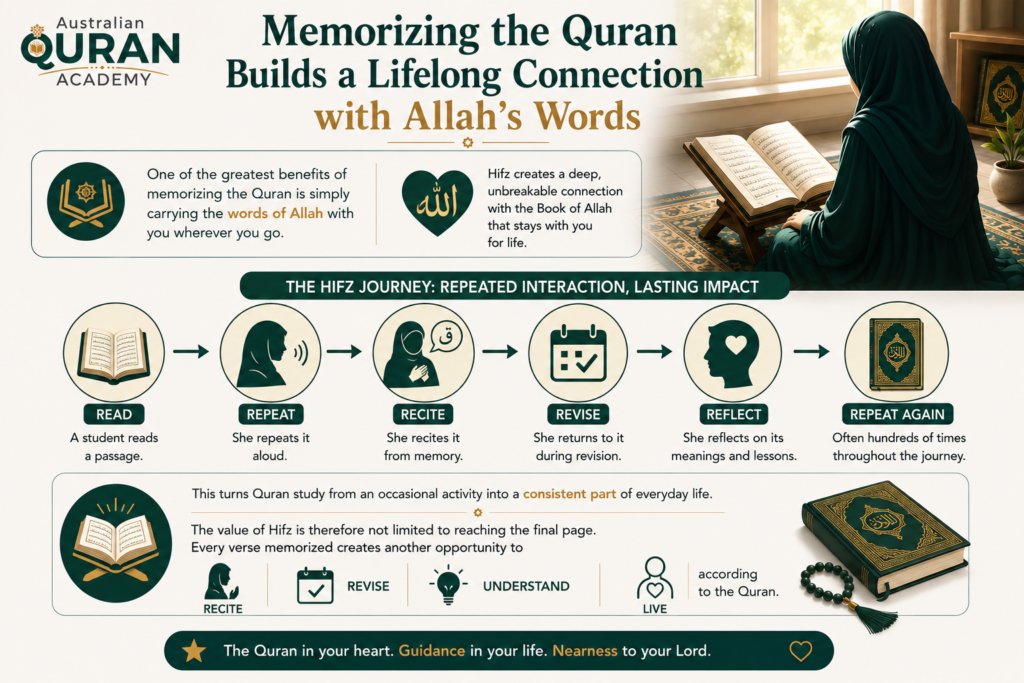
Hifz requires repeated interaction with the Quran. A student reads a passage, repeats it, recites it from memory, returns to it during revision, and often reflects on it hundreds of times throughout the memorization process.
This turns Quran study from an occasional activity into a consistent part of everyday life The value of Hifz is therefore not limited to reaching the final page. Every verse memorized creates another opportunity to recite, revise, understand, and live according to the Quran.
2. Proficiency in Quran Recitation Carries an Exceptional Reward
One of the most elevated rewards of memorizing the Quran is the company it earns on the Day of Judgment. The Prophet ﷺ described the status of the proficient Hafiz directly:
الَّذِي يَقْرَأُ الْقُرْآنَ وَهُوَ مَاهِرٌ بِهِ مَعَ السَّفَرَةِ الْكِرَامِ الْبَرَرَةِ، وَالَّذِي يَقْرَؤُهُ وَيَشْتَدُّ عَلَيْهِ فَلَهُ أَجْرَانِ
“The one who is proficient in reciting the Quran will be with the honorable, obedient scribes (angels), and the one who recites the Quran and finds it difficult to recite, doing his best, will have a double reward.” — Sahih al-Bukhari 4937
The word māhir (proficient) refers specifically to the Hafiz who recites smoothly, correctly, and with consistent practice — a standard reached through structured memorization. Being compared to the noble scribing angels is not a metaphor; it is a documented, promised rank.
This hadith is unique in that it honors both positions simultaneously. The fluent Hafiz stands with the angels. The struggling reciter earns double reward — one for the recitation, one for the effort and perseverance. Neither position is without honor. This is among the most reassuring dimensions of the virtues of memorizing the Quran: the rewards begin at the very first labored verse, not only at completion.
Our programs include Quranic Arabic courses for students who want to understand what they memorize — one of the most effective ways to deepen retention and spiritual connection — alongside dedicated Hifz tracks for every level.

3. Every Letter Memorized Earns Ten Good Deeds
The reward for memorizing the Quran begins the moment the lips move. The Prophet ﷺ established this principle with arithmetic precision:
مَنْ قَرَأَ حَرْفًا مِنْ كِتَابِ اللَّهِ فَلَهُ بِهِ حَسَنَةٌ وَالْحَسَنَةُ بِعَشْرِ أَمْثَالِهَا لاَ أَقُولُ الم حَرْفٌ وَلَكِنْ أَلِفٌ حَرْفٌ وَلاَمٌ حَرْفٌ وَمِيمٌ حَرْفٌ
“Whoever recites a letter from the Book of Allah will be credited with a good deed, and that good deed will be multiplied tenfold. I do not say that Alif-Lam-Meem is one letter — Alif is a letter, Lam is a letter, and Meem is a letter.” — Sunan al-Tirmidhi 2910
The Quran contains approximately 330,000 letters. A Hafiz who recites the full Quran once earns the equivalent of over 3,000,000 good deeds in a single recitation — at the minimum tenfold rate, before Allah’s additional multiplication for sincerity, Tajweed, and consistency.
The unique advantage of the Hafiz is access. A non-memorizer depends on a physical Mushaf. The Hafiz can recite at any moment — walking, waiting, resting — without needing a copy. Every waking hour becomes a potential source of multiplied hasanat. This arithmetic of mercy is one of the most structurally significant reward for memorizing the Quran.
4. The Quran Intercedes for Its Companions on the Day of Judgment
Among the most spiritually significant virtues of memorizing the Quran is what happens on the Day of Judgment. The Prophet ﷺ described this intercession in explicit terms:
اقْرَءُوا الْقُرْآنَ فَإِنَّهُ يَأْتِي يَوْمَ الْقِيَامَةِ شَفِيعًا لِأَصْحَابِهِ
“Read the Quran, for it will come as an intercessor for its companions on the Day of Resurrection.” — Sahih Muslim 804
In a separate narration in the same collection, the Prophet ﷺ described Surah Al-Baqarah and Surah Al-Imran appearing on the Day of Judgment like two clouds or two flocks of birds — shading their companion and arguing in their favor before Allah.
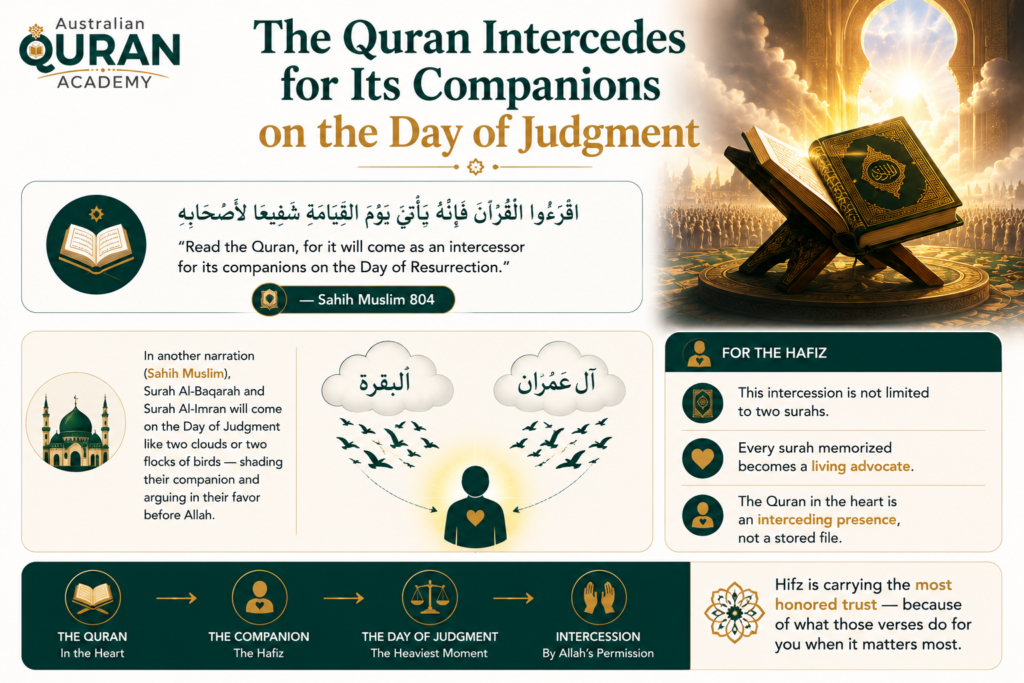
For the Hafiz, this intercession is not limited to two surahs. Every surah memorized becomes a living advocate. The Quran in the heart is an interceding presence, not a stored file. This is why classical scholars described Hifz as carrying the most honored trust a human being can hold — because of what those memorized verses do for the believer at the heaviest moment they will ever face.
5. The Hafiz Recites and Ascends Through the Ranks of Jannah
The reward for memorizing the Quran in the afterlife is uniquely dynamic. The Prophet ﷺ described what will be said to the Hafiz on the Day of Judgment:
يُقَالُ لِصَاحِبِ الْقُرْآنِ اقْرَأْ وَارْقَ وَرَتِّلْ كَمَا كُنْتَ تُرَتِّلُ فِي الدُّنْيَا فَإِنَّ مَنْزِلَكَ عِنْدَ آخِرِ آيَةٍ تَقْرَأُ بِهَا
“It will be said to the companion of the Quran: Recite and ascend, and recite as you used to recite in the world, for your station will be at the last verse you recite.” — Sunan Abu Dawud 1464
The Quran has 6,236 verses. Every verse memorized in this life is a permanent vault — converted into a degree of elevation in the highest of all gardens. Memorization is not a one-time achievement; it is a permanent deposit.
This is also why even partial memorization earns proportional reward. Students who have completed Juz’ Amma are already building their station in Jannah, verse by verse. Those who memorize all 604 pages ascend to the very top.
Read also: Who Is a Hafiz? Meaning, Status, and Where the World’s Huffaz Live
6. Parents Can Receive a Special Honor Through Their Child’s Quran Learning
The benefits associated with learning the Quran can extend beyond the student A narration reported in Sunan Abu Dawud describes a special reward for the parents of someone who learns the Quran and acts according to it.
مَنْ قَرَأَ الْقُرْآنَ وَتَعَلَّمَهُ وَعَمِلَ بِهِ أُلْبِسَ يَوْمَ الْقِيَامَةِ تَاجًا مِنْ نُورٍ ضَوْءُهُ كَضَوْءِ الشَّمْسِ وَيُكْسَى وَالِدَاهُ حُلَّتَيْنِ
“Whoever memorizes the Quran and acts upon it, his parents will be crowned with a light brighter than the sun on the Day of Resurrection.” — Sunan Abu Dawud 1453
This hadith places the parents of the Hafiz among those directly honored by Allah — a reward tied not to their own deeds alone, but to the child they raised toward the Quran.

This highlights an important principle: parents who encourage their children to learn, recite, understand, and live by the Quran may share in the blessings of that upbringing.
For many Muslim parents, this makes supporting a child’s Hifz journey about much more than academic achievement.
The goal is not simply to produce a child who can recite hundreds of pages from memory. It is to help nurture a person whose life remains connected to the Quran.
7. Memorizing the Quran Builds a Shield Against the Fire
Among the benefits of Quran memorization is the protection it provides from the Fire — not through ritual alone, but through a three-part mechanism that scholars have documented:
- Intercession (Shafa’ah): The Quran argues on behalf of the Hafiz before Allah, as established in Sahih Muslim 804.
- Increased Taqwa: The sustained discipline of daily memorization and revision reinforces consciousness of Allah in every hour of the day.
- Guarded conduct: Carrying the Quran in the chest raises accountability. A Hafiz who recites the words of Allah while knowingly violating them experiences a spiritual dissonance that classical scholars describe as a protective mechanism in itself.
The Hafiz who recites sincerely builds a living relationship with the Words of Allah that becomes a barrier between them and the punishment. This is not superstition — it is the logical consequence of what scholars have consistently described: the Quran in the heart is an active, ongoing connection, not a passive credential.
See Us in Action!
Curious about what our online classrooms look like? Watch the short clips below to see how our interactive, one-on-one sessions bring learning to life with real-time feedback and engaging teaching methods.
Start Your Quranic Journey in Australia
Join our leading online academy and learn with expert tutors through a structured, personalized curriculum.
Book Your Free Trial8. The Hafiz Holds the Legal Right to Lead Any Congregation in Prayer
The benefits of memorizing the Quran extend into the communal life of Muslims. Islamic jurisprudence is explicit: the most qualified person to lead prayer is the one with the most Quran memorized. The Prophet ﷺ said:
يَؤُمُّ الْقَوْمَ أَقْرَؤُهُمْ لِكِتَابِ اللَّهِ
“The one who knows the most Quran should lead the people in prayer.” — Sahih Muslim 673
This right is confirmed in all four major schools of Islamic jurisprudence — Hanafi, Maliki, Shafi’i, and Hanbali. It is not merely a social honor; it is a legal position tied directly to the quantity and quality of Quran memorized.
In Muslim communities worldwide — particularly in Western countries where Huffaz are a scarce and deeply valued resource — this responsibility is concrete. Every masjid, every Ramadan Tarawih, every Janazah prayer requires a Hafiz to stand at the front. For students who believe their Hifz will only benefit them personally, this reward is a reminder that their memorization serves an entire congregation.
Read also: Quran Hifz Quotes That Every Hafiz Should Carry in Their Heart
9. Hifz Strengthens Memory and Sharpens Cognitive Discipline
Among the measurable, real-world benefits of memorizing the Quran is its documented impact on cognitive function. Systematic Quran memorization requires a student to engage multiple cognitive systems simultaneously:
- Phonemic processing — precise recognition and production of Arabic sounds not native to the learner’s language
- Sequential memory — maintaining exact verse and surah order across hundreds of pages
- Self-monitoring — catching and correcting errors in real time during recitation
- Spaced retrieval practice — the revision system at the heart of Hifz methodology
These are all recognized memory-strengthening mechanisms in cognitive science. Spaced retrieval practice in particular — reviewing material at increasing intervals — is one of the most researched and validated techniques for long-term memory retention. Hifz programs use this method as standard, which means students are training a world-class memory system while memorizing the Quran.
Students who maintain consistent daily memorization sessions — even as short as 20 minutes — report noticeably sharper focus in academic and professional settings within the first few weeks. If you’re considering Quran classes for adults, this cognitive benefit is one of the most immediately observable outcomes of structured Hifz.

10. Quran Memorization Carries Documented Health and Psychological Benefits
The Quran describes itself as a healing:
وَنُنَزِّلُ مِنَ الْقُرْآنِ مَا هُوَ شِفَاءٌ وَرَحْمَةٌ لِّلْمُؤْمِنِينَ
“And We send down of the Quran that which is healing and mercy for the believers.” — Quran 17:82
Beyond the spiritual dimension, consistent Quranic recitation and memorization are associated with measurable psychological benefits:
- Reduced anxiety and stress levels — rhythmic, breath-regulated recitation activates the parasympathetic nervous system
- Improved concentration and sustained attention across tasks
- Greater emotional resilience in managing daily pressures
- A documented calming effect linked to the production of alpha waves during recitation, similar to the brain states associated with mindfulness practice
These are not incidental by-products of Hifz — they are compounding benefits that grow with the consistency of the practice. A Hafiz who recites daily does not experience these as occasional relief; they become a baseline state of greater calm and presence.
11. Reciting Quran in the Home Fills It with Light and Barakah
The rewards of memorizing and reciting the Quran extend to the physical and spiritual environment of the household. The Prophet ﷺ said:
نَوِّرُوا بُيُوتَكُمْ بِتِلاَوَةِ الْقُرْآنِ
“Illuminate your homes by reciting the Quran in them.” — Al-Bayhaqi, Shu’ab al-Iman
Homes where the Quran is recited regularly are described in multiple narrations as places where angels descend, blessings increase, and the household is guarded from harm. The Prophet ﷺ contrasted this with homes where no Quran is recited — likened to a graveyard in their spiritual emptiness.
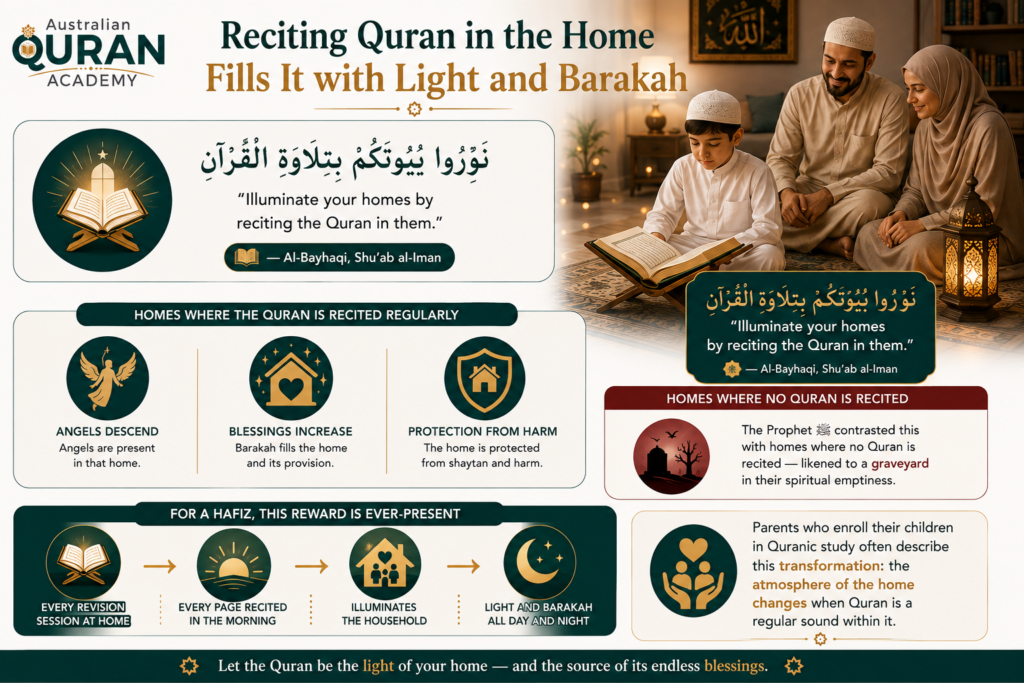
For a Hafiz, this reward is ever-present. Every revision session at home — every page recited in the morning before the family wakes — illuminates the household. Parents who enroll their children in Quranic study often describe this transformation: the atmosphere of the home changes when Quran is a regular sound within it.
12. Teaching Others and Raising a Hafiz Is Perpetual Sadaqah Jariyah
One of the most far-reaching benefits of Quran memorization is the chain of reward it creates. A Hafiz who teaches others — or raises a child to become a Hafiz — earns reward from every recitation of every student, indefinitely. The Prophet ﷺ said:
خَيْرُكُمْ مَنْ تَعَلَّمَ الْقُرْآنَ وَعَلَّمَهُ
“The best of you are those who learn the Quran and teach it.” — Sahih al-Bukhari 5027
This narration places the Quran teacher at the pinnacle of virtue in the Muslim community. Teaching does not require formal credentials to begin. Every parent who reads Quran with their child, every student who helps a sibling, and every Hafiz who mentors a beginner participates in this highest rank.
For parents, this is one of the most impactful forms of Sadaqah Jariyah available. Raising a child to become a Hafiz means the parent continues to receive reward from every verse that child recites, every prayer they lead, and every person they teach — long after the parent has passed.
13. A Hafiz Can Intercede for Ten Family Members
Classical scholars, including Ibn Qudamah and Al-Qurtubi, have narrated that a Hafiz who acts upon the Quran will be granted the ability to intercede for ten family members on the Day of Judgment.
This reward transforms memorization from a personal spiritual investment into a communal one. The Hafiz who completes the Quran and lives by its teachings becomes a means of salvation not only for themselves, but for the people around them. Consider what this means for a family: if even one member commits to Hifz with sincerity, an entire household may benefit from their intercession on the heaviest day.
This is among the most frequently cited motivations for adult learners — particularly those who begin Hifz with aging parents or young children in mind. The benefits of memorizing the Quran are never contained to the memorizer alone.
Read also: How to Memorize the Quran Without Forgetting in Australia? – 15 Steps That Actually Work
14. Hifz Opens the Path to Teaching and Ijazah Certification
One of the practical long-term rewards of completing Quran memorization is the ability to obtain an Ijazah — a formal, chain-transmitted certification connecting the certified student to the Prophet ﷺ through an unbroken line of memorizers and teachers.
Earning an Ijazah requires three conditions:
- Completing the full Quran with accurate Tajweed throughout
- Reciting the entire Quran before a certified Ijazah instructor who verifies the chain
- Demonstrating consistent accuracy and retention across all 604 pages
Once certified, a Hafiz with Ijazah can teach Quran with the authority of a transmitted, verified chain — one of the most respected qualifications in Islamic learning. This opens doors to formal community teaching, leading Tarawih and Tahajjud prayers, and a lasting form of Sadaqah Jariyah that continues as long as students carry forward what they learned.
For students building toward this path, Quran reading classes form the essential foundation — because correct, Tajweed-compliant recitation must be established before memorization of this standard can begin.

Inside Our Virtual Classrooms
We believe in full transparency and proven quality. Take a look at these actual snippets from our live classes to experience our modern learning platform, patient instructors, and interactive student participation.
Begin Your Hifz Journey with Australian Quran Academy
The 15 rewards, benefits, and virtues covered in this article are not reserved for scholars or children alone — they are available to every Muslim who commits sincerely to the Words of Allah. What makes the difference is guidance, structure, and the right teacher.
Australian Quran Academy pairs you with certified Quran nstructors who have guided students of all ages and backgrounds toward memorization. Whether you are an adult beginning with Juz’ Amma, a parent enrolling your child, or an advanced student preparing for Ijazah, there is a structured path for you.
[Book Your Free Trial Session]
Our Quran Courses
- Quran Online Academy
- Quran Recitation Classes
- Quran Reading Classes
- Online Quran Classes for Kids
- Quran Classes for Adults
- Quran Classes for Female/Sisters
- Learn Quran Course for Beginners
- Quran Memorization (Hifz) Course
- Hifz Classes for Adults
- Quran Memorization and Hifz Course for Kids
- Quran Hifz Course for Ladies
- Quran Ijazah Program
- Quran Qirat Learning Course
- Quran Tafsir Course
- Noorani Qaida Course
- Noorani Qaida Course for Kids
- Weekend Quran Classes
- Intensive Quran Course
- Al-Azhar Quran Course
- Online Tajweed Classes
- Tajweed Course for Kids
- Tajweed Course for Adults
- Tajweed Course for Ladies
Start Your Quranic Journey in Australia
Join our leading online academy and learn with expert tutors through a structured, personalized curriculum.
Book Your Free Trial
Conclusion
The benefits, virtues, and rewards of memorizing the Quran are specific, documented, and permanent. From being ranked with the noble angels, to ascending through Jannah verse by verse, to interceding for ten family members, to crowning parents with light brighter than the sun — every surah held in the heart is a guarantee from Allah Himself.
The benefits of Quran memorization are never contained to the memorizer. They ripple outward to parents, family, community, and generations not yet born. The virtues of memorizing the Quran touch this life — in sharpened memory, calmer homes, and community leadership — and the next, in the stations of Jannah that no earthly achievement can match.
Begin where you are. Memorize what you can. Trust that none of it goes unrecorded.
Frequently Asked Questions
Does the reward for memorizing the Quran apply to partial memorization?
Yes. The Prophet ﷺ confirmed that the station in Jannah is determined by the last verse recited — meaning even partial memorization earns proportional elevation. Every surah memorized counts, and the ten hasanat per letter applies from the very first recitation session. Students who have completed Juz’ Amma are already holding surahs that will argue on their behalf and provide ascension in Jannah.
Is there a specific reward for the parents of a Hafiz?
Yes. According to a hadith in Sunan Abu Dawud (1453), the parents of a Hafiz who memorizes and acts upon the Quran will be crowned with a light brighter than the sun on the Day of Resurrection. This reward is specific to the parents of the Hafiz and is among the most cited motivations for students who begin memorization with their parents in mind.
What is the difference between the reward for reading and the reward for memorizing the Quran?
Both carry ten good deeds per letter, as established in Sunan al-Tirmidhi 2910. The Hafiz, however, has access to this reward continuously — without a Mushaf, at any hour, in any state of movement or travel. The Hafiz can also lead prayer, complete full Tarawih, perform multiple Khatmahs in Ramadan, and earn Ijazah certification — privileges structurally unavailable without memorization.
Can adults realistically earn these rewards through Hifz?
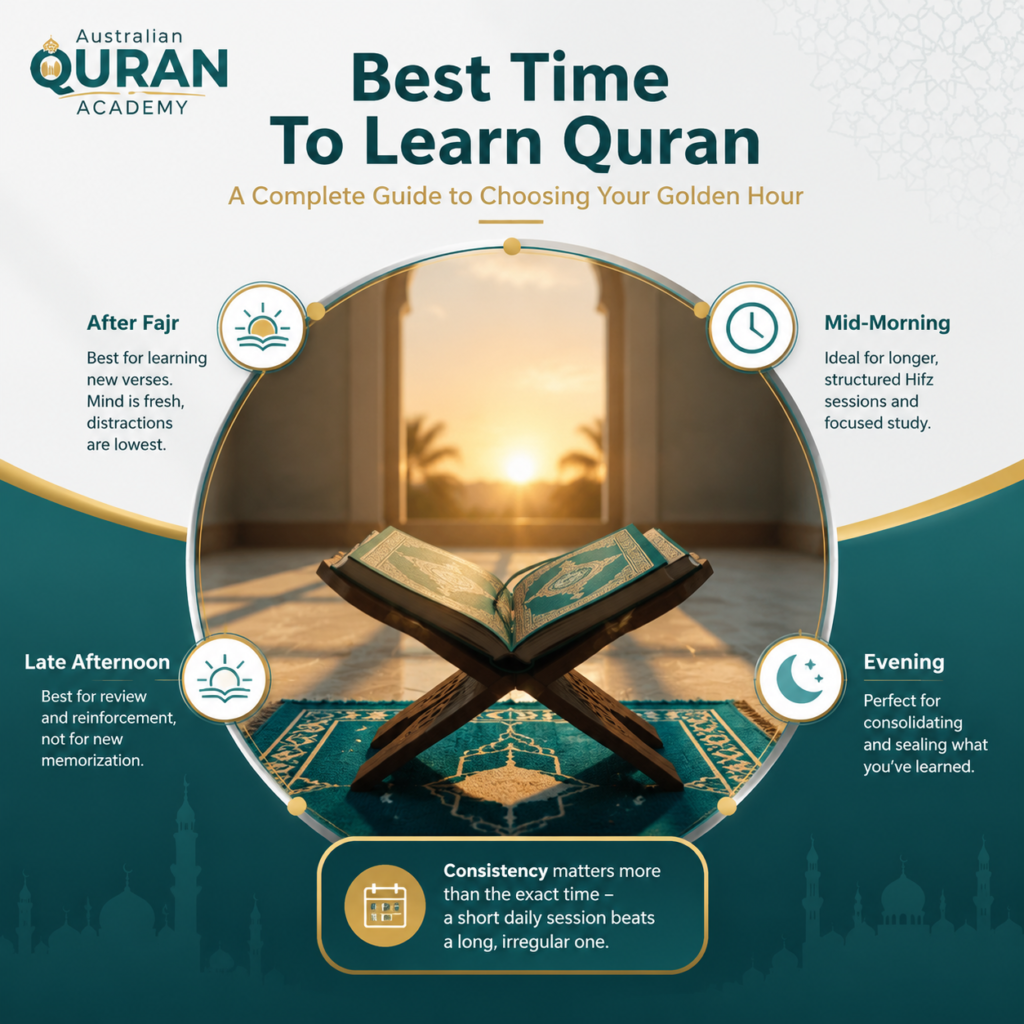
Yes. Memorizing the Quran as an adult is achievable with a structured program and a qualified instructor who understands adult learning psychology. The most effective approach for busy adults is a consistent daily window of 20–30 minutes — ideally after Fajr — for new memorization, with a separate 10–15 minute evening session for revision. Many adults working full-time complete portions of the Quran within months using this method.
Does reciting Quran with Tajweed increase the reward?
Reciting with Tajweed fulfills an obligation — Allah commands: “Recite the Quran with measured recitation” (Al-Muzzammil 73:4). Fulfilling this obligation adds reward beyond the base hasanat per letter. The fluent Hafiz who recites with Tajweed also earns the rank described in Sahih al-Bukhari 4937 — companionship with the noble scribing angels. Building Tajweed correctly from the start is significantly easier than correcting entrenched errors later.
How does memorizing the Quran benefit a Muslim’s mental and physical health?
Consistent Quranic memorization is associated with improved memory retention, sharper sustained focus, reduced anxiety, and greater emotional resilience. The rhythmic, breath-regulated nature of recitation activates calming neurological responses. Students across age groups — from children as young as 6 to adults in their 50s — report noticeably improved concentration and a greater sense of inner calm within the first weeks of consistent daily Hifz.





Leave a Reply