 Quran
Quran
| Key Takeaway |
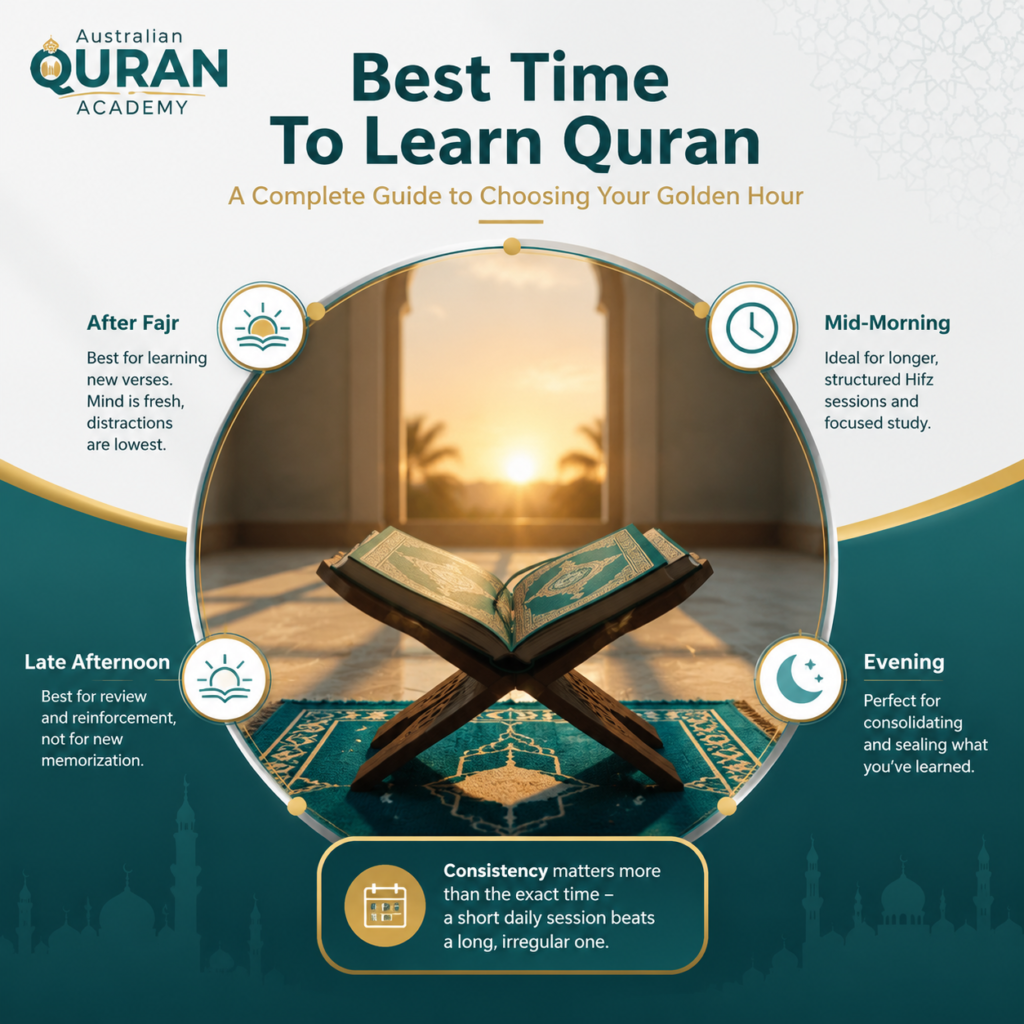
| The best time to learn Quran is generally right after Fajr, when the mind is rested and distractions are lowest. |
| Mid-morning suits longer, structured Hifz sessions once the morning rush has settled. |
| Late afternoon (post-Asr) is better for reviewing previously learned verses than for new memorization. |
| Evening (post-Maghrib or Isha) is ideal for consolidating what was learned earlier in the day. |
| Consistency matters more than the exact clock time — a short daily session beats a long, irregular one. |
Many students ask the same question before they even open the mus’haf: when is the best time to learn Quran? The honest answer is that no single hour works for everyone, but certain windows of the day consistently offer sharper focus, quieter surroundings, and better retention than others.
This guide breaks down the four main time windows Muslims use for Quran study — morning, mid-morning, afternoon, and evening — and explains the reasoning behind each one, drawing on Prophetic tradition and how memory actually works.
By the end, you’ll be able to identify the best time to learn Quran based on your own schedule rather than someone else’s routine.
1. After Fajr
The period immediately after Fajr prayer is a specific window: the time between dawn and sunrise, when the household is still quiet and the mind hasn’t yet absorbed the day’s distractions.
[image: illustration of a student reading Quran at sunrise]
This isn’t only a modern preference. The Prophet Muhammad (peace be upon him) prayed, “O Allah, bless my nation in their early morning” (Ibn Majah), and the Quran itself references the recitation of dawn directly:
أَقِمِ الصَّلَاةَ لِدُلُوكِ الشَّمْسِ إِلَىٰ غَسَقِ اللَّيْلِ وَقُرْآنَ الْفَجْرِ ۖ إِنَّ قُرْآنَ الْفَجْرِ كَانَ مَشْهُودًا
“Establish prayer at the decline of the sun until the darkness of the night and the Quran of dawn. Indeed, the recitation of dawn is ever witnessed.” (Al-Isra 17:78)
That witnessing — described in the verse as attended “by the angels of the night and the day” — is one reason so many teachers point new students toward this hour first.
Why The Brain Performs Better After Fajr?
Sleep consolidates short-term memory, so the hours right after waking are typically when detailed recall is sharpest.
This is the window best suited to learning new verses or working through a difficult passage, rather than simply reviewing material you already know. It’s also the time when correct pronunciation (makharij) is easiest to focus on, since fatigue hasn’t yet set in.
If your child or your own schedule can accommodate it, students enrolled in our Quran Classes in Australia often report that their post-Fajr sessions produce the fastest new memorization, precisely because distractions are lowest at this hour.
2. Mid-Morning
Not everyone can commit to Fajr, and that’s fine — the goal is to find the best time to learn Quran that you can actually sustain, not the one that looks best on paper.
Mid-morning, after the initial rush of the day has settled but before energy dips toward noon, is a strong second option. This window suits people teaching children at home, or anyone who wants a longer, uninterrupted block for Hifz work.
How To Structure A Mid-Morning Session?
Mid-morning sessions work best when they’re broken into segments rather than one long stretch.
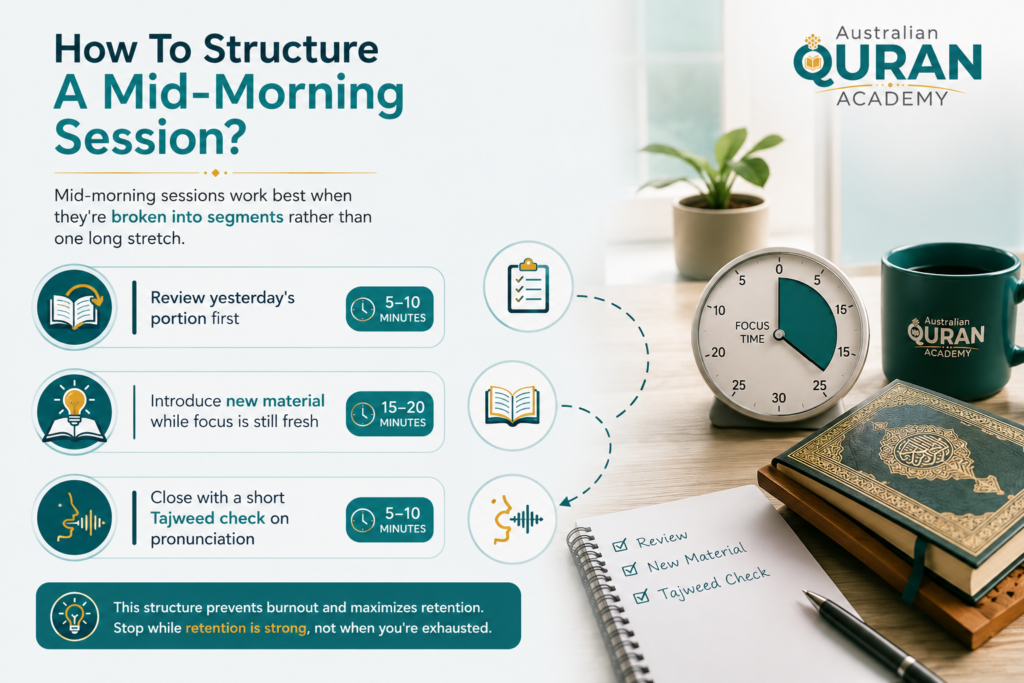
- Review yesterday’s portion first (5–10 minutes)
- Introduce new material while focus is still fresh (15–20 minutes)
- Close with a short Tajweed check on pronunciation
This structure keeps a child or adult student from burning out mid-session, which is the single most common mistake we see in home study plans — parents extend the session past the point of diminishing returns instead of stopping while retention is still strong.
Families following a homeschool-style routine sometimes pair this window with our Learn Quran for Beginners in Australia course, which is built around short, structured blocks rather than long unstructured reading.
3. Late Afternoon (Post-Asr)
If your only realistic window is after work or school, late afternoon — roughly the period around and after Asr — is a workable option, but it comes with a limitation worth naming plainly: this is not the strongest time for learning brand-new material.
By mid-to-late afternoon, mental fatigue from the day’s activities has usually set in. That doesn’t make the session pointless — it makes it a different kind of session.
Use this window primarily to retain and reinforce short portions you’ve already learned, rather than pushing through new verses.
How Do I Make Afternoon Study Effective?
Recite aloud rather than silently. Vocalizing activates more of the brain than silent reading, which helps offset the natural afternoon dip in alertness. Reciting while sitting upright, rather than lying down or slouched, also helps maintain concentration during this lower-energy window.
Adults balancing work and study often lean on this time slot, which is one reason our Islamic Studies Courses for Adults in Australia schedule review-focused sessions specifically around this part of the day — it matches how working students actually have time to show up.
See Us in Action!
Curious about what our online classrooms look like? Watch the short clips below to see how our interactive, one-on-one sessions bring learning to life with real-time feedback and engaging teaching methods.
Start Your Quranic Journey in Australia
Join our leading online academy and learn with expert tutors through a structured, personalized curriculum.
Book Your Free Trial4. Evening (Post-Maghrib or Isha)
The Quran references the night far more than any other time of day — roughly 103 mentions, compared to about 12–13 for Fajr and 14 for the evening (‘ashiy). Read together, these references point to a rhythm: begin a larger portion in the morning, review it in small pieces through the day, and seal it at night.
Evening sessions, after Maghrib or Isha, suit this final “sealing” step well. The pace of the household usually slows down at this point, and for many families it becomes a shared moment — a parent listening to a child’s recitation, or reviewing the week’s portion together before bed.
If your child is just starting to build Arabic letter recognition alongside their Quran study, evening is also a natural time to combine short recitation review with our Arabic Lessons for Kindergarten in Australia, since younger learners tend to respond well to a calm, low-pressure close to the day.
Read Also: can i learn quran by myself in Australia
How To Choose The Best Time To Learn Quran?
Choosing the right window isn’t about finding a universal winner — it’s about matching a time slot to your own energy and schedule, then testing it long enough to know if it works.
Start by ruling out extremes. If you’re rarely alert before 8am, don’t force a Fajr slot just because it’s the most recommended — you’ll spend the session fighting drowsiness instead of learning. Likewise, if evenings are when your household is loudest, that’s not the moment to expect deep focus from a child.

Memory research backs a flexible approach rather than a single fixed hour. The brain tends to be sharper for short-term detail in the morning, and better at consolidating new information with existing knowledge from the afternoon into the evening.
That’s an argument for using more than one window rather than defending a single “correct” time — a larger portion in the morning, light review at midday, and consolidation at night mirrors the pattern found in the Quran’s own references to time.
Here’s the point most guides miss: the exact hour matters less than whether you can repeat it. A student who studies for 15 focused minutes every day at 4pm will outperform one who studies for an hour at 5am twice a month.
Build the schedule around a time you will actually protect, not the time that sounds most impressive.
At Australian Quran Academy, our teachers work with students to test two or three of these windows over the first couple of weeks and settle on whichever one the student can sustain — because the best time to learn Quran is ultimately the one you don’t skip.

If you’re not sure where to start with Arabic pronunciation before locking in a fixed schedule, our Learning Arabic for Non-Arabic Speakers in Australia course is designed to build that foundation first, so your chosen study window is spent on Quran itself rather than on decoding letters.
Inside Our Virtual Classrooms
We believe in full transparency and proven quality. Take a look at these actual snippets from our live classes to experience our modern learning platform, patient instructors, and interactive student participation.
Start Your Quranic Journey in Australia
Join our leading online academy and learn with expert tutors through a structured, personalized curriculum.
Book Your Free TrialStart Learning At The Time That Works For You
Australian Quran Academy builds every class around your schedule, not a fixed timetable. Whether your best window is right after Fajr or a quiet slot after Maghrib, our certified teachers will help you build a routine you can actually keep.

Whether your best window is right after Fajr, a mid-morning block, or a quiet slot after Maghrib, our certified teachers will help you turn that window into a routine you’ll still be following in six months, not six days.
Choose the course that matches where you are right now:
- Quran Recitation Classes
- Quran Reading Classes
- Online Quran Classes for Kids
- Quran Classes for Adults
- Quran Classes for Female/Sisters
- Learn Quran for Beginners
- Quran Memorization (Hifz) Course
- Hifz Classes for Adults
- Quran Memorization and Hifz for Kids
- Quran Hifz for Ladies
- Quran Ijazah Program
- Quran Qirat Learning Course
- Quran Tafsir Course

Start Your Quranic Journey in Australia
Join our leading online academy and learn with expert tutors through a structured, personalized curriculum.
Book Your Free TrialConclusion
The best time to learn Quran isn’t a fixed hour handed down from a single study or tradition — it’s a window that matches your energy, your schedule, and your ability to show up consistently.
The period after Fajr remains the most commonly recommended starting point because of its quiet and mental clarity, mid-morning suits longer structured sessions, late afternoon works for review when mornings aren’t possible, and evening is well suited to consolidating what you’ve already learned.
Whichever window you choose, consistency will do more for your progress than the clock ever will.
Frequently Asked Questions
Below are answers to the questions students ask most often when trying to settle on a study schedule.
1. Is Fajr really the best time to learn Quran?
Fajr is widely recommended because the mind is rested and distractions are lowest, and it’s supported by Prophetic tradition and a direct Quranic reference to dawn recitation. It isn’t mandatory, though — it’s simply the window with the fewest obstacles for most people.
2. Can children memorize Quran effectively in the afternoon?
Yes, but afternoon sessions for children work best for review rather than new memorization, since fatigue from school or play has usually set in by then. Short, aloud recitation helps maintain focus during this window.
3. How long should a daily Quran session be?
15–30 minutes of focused, consistent practice is generally more effective than a single long session done irregularly. The exact length matters less than whether the session happens at the same time each day.
4. What if I can’t study in the morning at all?
Choose the time you can protect every day, even if it’s evening or late afternoon. A dependable slot you’ll actually use beats an ideal slot you keep missing.
5. Does the Quran mention specific times of day for a reason?
Yes — night is mentioned far more often than any other time period, alongside references to dawn and evening, suggesting a rhythm of learning in the morning, reviewing through the day, and consolidating at night.








Leave a Reply