 Quran
Quran

Every Hifz student eventually faces the same fear: reciting a page confidently one day, then staring blankly at it the next. For Muslims in Australia, that fear comes with an extra layer of difficulty — most cities don’t have a local Hifz academy within driving distance, class times need to work across multiple time zones, and work, school, or family life leave little room for long study sessions.
The good news is that forgetting the Quran is rarely a memory problem. It’s a system problem. Students who build a consistent, structured routine — even a short one — retain far more than students who rely on long, irregular sessions. This guide breaks that system down into 15 practical steps, built specifically around the realities of studying Hifz from Australia: time-zone gaps, busy schedules, and limited access to in-person teachers.
1. Fix One Daily Time for Hifz — and Build It Around Your Australian Schedule
The brain memorizes best on a fixed rhythm. Random timing weakens recall and increases mistakes, while a set daily slot trains the mind to enter focus mode automatically.
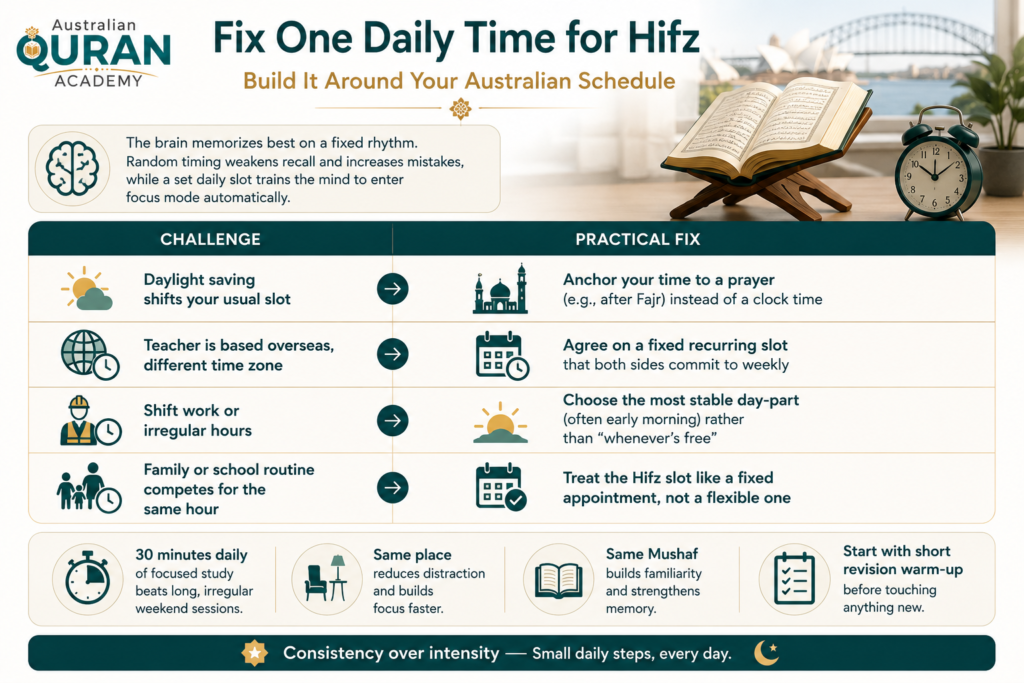
For students in Australia, this takes a bit more planning than it might elsewhere:
| Challenge | Practical Fix |
| Daylight saving shifts your usual slot | Anchor your time to a prayer (e.g., after Fajr) instead of a clock time |
| Teacher is based overseas, different time zone | Agree on a fixed recurring slot that both sides commit to weekly |
| Shift work or irregular hours | Choose the most stable day-part (often early morning) rather than “whenever’s free” |
| Family or school routine competes for the same hour | Treat the Hifz slot like a fixed appointment, not a flexible one |
Even 30 focused minutes daily outperforms a long, irregular weekend session. Sit in the same place, use the same Mushaf, and start with a short revision warm-up before touching anything new — over time, the mind starts preparing itself before you even open the Quran.
2. Revise More Than You Memorise, Every Single Day
New memorization without heavy revision is the fastest way to lose ground. A clear ratio protects the effort you’ve already put in:
- Revise old lessons before touching new Ayahs
- Give more time to older Juz’ than to recent ones
- Recite without looking, to test real strength rather than surface familiarity
- Mark weak spots the moment you notice them — don’t wait until the end of the session
- Keep revising daily, even on days when you’re short on time
Students who revise daily forget less, feel more confident, and progress steadily instead of cramming under pressure before a class or test.
3. Link New Ayahs to the Ones Before Them
Disconnected memorization can become difficult to recall under pressure. Hifz becomes stronger when each new Ayah is connected naturally to what was memorized before it.
Before starting a new lesson, recite the last two or three Ayahs from the previous session. Then add the first new Ayah and repeat them together until the transition feels smooth. Continue the same process with each new Ayah rather than memorizing every verse as an isolated section.
This creates stronger continuity between verses, reduces hesitation, and makes the memorized passage easier to recall during later revision.
If you’d like structured, one-on-one guidance built around your own schedule, Australian Quran Academy‘s Hifz course for adults pairs you with a teacher for consistent correction and a personalized revision plan — book a free trial session to see how it fits into your week.
4. Use One Mushaf Only — Even If You Study Online
Visual memory plays an important role in Hifz. Using the same Mushaf helps the mind associate each Ayah with a fixed position on the page, including its line breaks and word placement.
Whether you memorize from a printed Mushaf or a digital Quran app, keep the format consistent throughout your Hifz journey. Avoid frequently changing the script, font, page layout, or app. If you use both print and digital versions, choose one as your primary source for memorization and use the other mainly for reading or listening.
This consistency strengthens visual recall and can make it easier to remember the sequence of Ayahs, particularly when reciting to a teacher or during Salah.
Read also: The Benefits, Virtues, and Rewards of Memorizing the Quran
5. Recite What You’ve Memorized in Your Daily Salah
Salah turns memorization into active, living practice. Reciting from memory during prayer forces real recall — there’s no Mushaf to glance at.
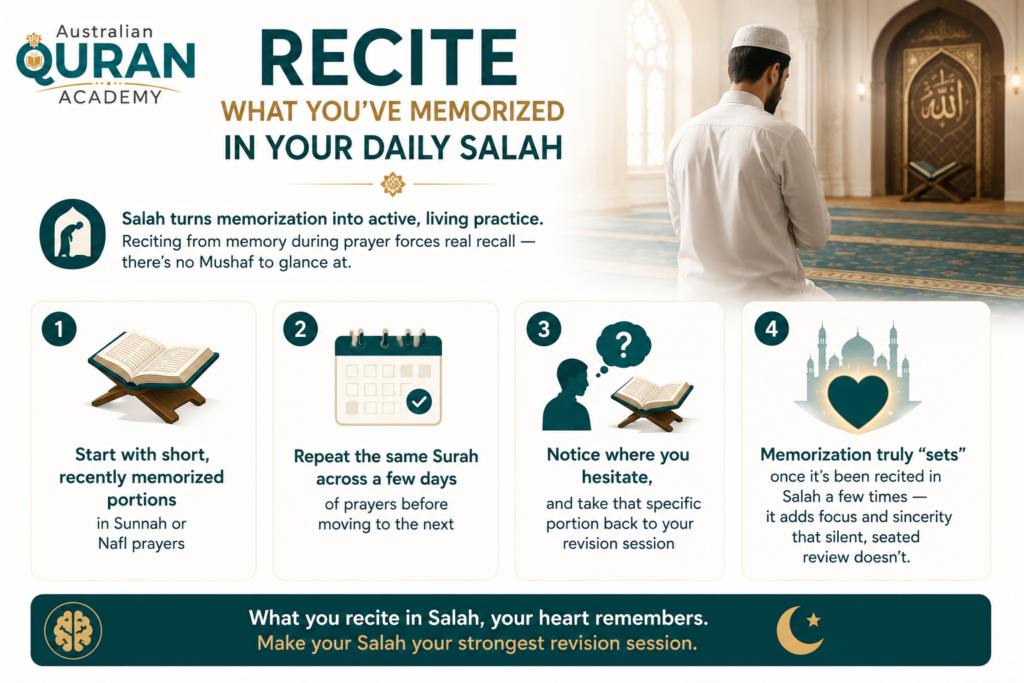
A simple way to build this in:
- Start with short, recently memorized portions in Sunnah or Nafl prayers
- Repeat the same Surah across a few days of prayers before moving to the next
- Notice where you hesitate, and take that specific portion back to your revision session
Many students find their memorization only truly “sets” once it’s been recited in Salah a few times — it adds focus and sincerity that silent, seated review doesn’t.
6. Read Slowly With Clear Tajweed Before You Read Fast
Fast repetition builds short-term memory. Slow, clear reading — where the tongue, ear, and mind work together — builds memory that lasts.
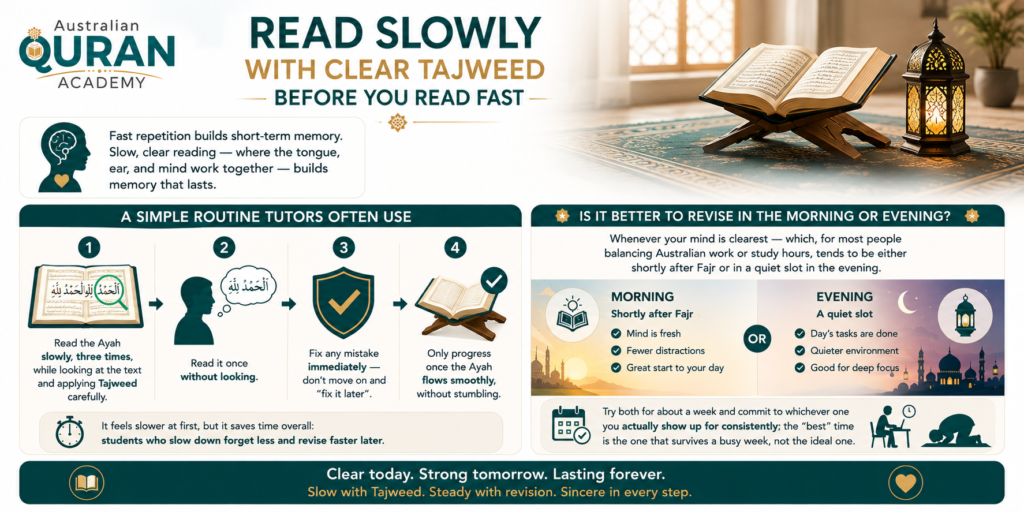
A simple routine tutors often use:
- Read the Ayah slowly, three times, while looking at the text and applying Tajweed carefully
- Read it once without looking
- Fix any mistake immediately — don’t move on and “fix it later”
- Only progress once the Ayah flows smoothly, without stumbling
It feels slower at first, but it saves time overall: students who slow down at this stage forget less and revise faster later.
Is It Better to Revise in the Morning or Evening?
Whenever your mind is clearest — which, for most people balancing Australian work or study hours, tends to be either shortly after Fajr or in a quiet slot in the evening. Try both for about a week and commit to whichever one you actually show up for consistently; the “best” time is the one that survives a busy week, not the theoretically ideal one.
7. Correct Mistakes One Ayah at a Time
Repeating a whole page to fix one shaky line wastes time and buries the actual problem. Smart revision targets only the weak spot.
| Task | How to Do It | Result |
| Identify weak Ayahs | Recite without looking | Clear problem areas surface |
| Mark mistakes | Note exactly where you pause or slip | Focused, specific fixing |
| Repeat alone | 10–15 calm, isolated repeats | Strong recall of that section |
| Reconnect | Join it back with the nearby Ayahs | Smooth flow restored |
This is far more efficient than re-reading an entire page hoping the weak line “sorts itself out” along the way.
See Us in Action!
Curious about what our online classrooms look like? Watch the short clips below to see how our interactive, one-on-one sessions bring learning to life with real-time feedback and engaging teaching methods.
Start Your Quranic Journey in Australia
Join our leading online academy and learn with expert tutors through a structured, personalized curriculum.
Book Your Free Trial8. Listen to One Qari Daily, Not Several
Listening supports memorization even on tired days when active review feels difficult. One consistent Qari builds a stable rhythm and correct sound pattern in your ear.
A simple listening routine:
- Listen once before starting memorization
- Listen again after memorizing the new lesson
- Play the recitation during a commute, walk, or downtime
- Follow along silently, without needing to look at the text
Switching reciters often unsettles the internal “tune” your memory relies on — consistency here reinforces memory, Tajweed, and confidence with very little extra effort.
Read also: Quran Hifz Quotes That Every Hafiz Should Carry in Their Heart
9. Use a Quran Memorization App to Track Weak Spots
Apps bring structure between formal sessions — particularly useful for students in Australia whose scheduled time with a teacher may only be once or twice a week.
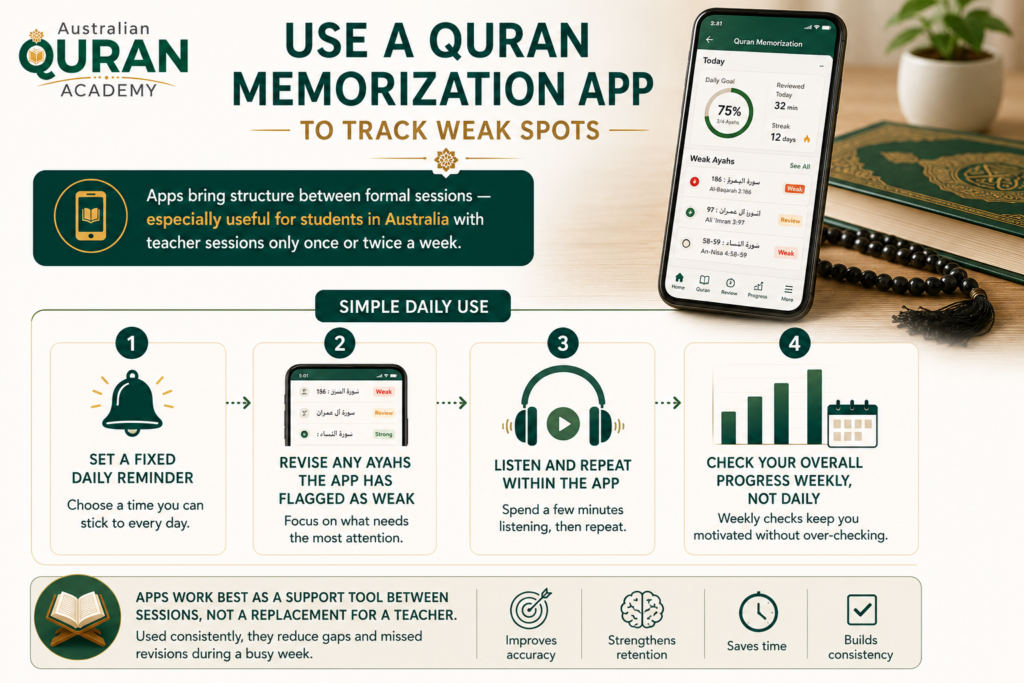
Simple daily use:
- Set a fixed daily reminder
- Revise any Ayahs the app has flagged as weak
- Listen and repeat within the app for a few minutes
- Check your overall progress weekly, not daily (to avoid over-checking)
Apps work best as a support tool between sessions, not a replacement for a teacher — used consistently, they reduce gaps and missed revisions during a busy week.
10. Join a Structured Online Hifz Program Built for Your Time Zone
This is often the missing piece specifically for Muslims in Australia: distance from in-person Hifz academies, and the difficulty of self-correcting recitation mistakes without trained feedback.
A trained teacher spots errors early and builds a genuine revision system around you — rather than leaving you to guess whether your Tajweed and memorization are actually correct. An online Hifz course built around Australian time zones solves this directly: consistent weekly sessions, correction from a qualified teacher, and clear, trackable targets instead of unstructured self-study.

11. Build a Sabaq–Sabaqi–Manzil Rotation
A tiered review system prevents both overload and neglect:
| Tier | What It Covers | Frequency |
| Sabaq | Today’s new lesson | Daily |
| Sabaqi | The past 5–7 days of recent lessons | Daily, focused |
| Manzil | All previously memorized Juz’, in rotation | Spread across the week |
Instead of saving the Manzil for a single weekend block, distribute it — one portion per day — so no single session becomes overwhelming, and older memorization gets refreshed before it has a chance to fade.
12. Practice Reciting Without the Mushaf
Reciting only while seated with the Mushaf nearby creates a fragile, location-bound memory. Testing recall under varied conditions makes memorization flexible and retrievable anywhere.
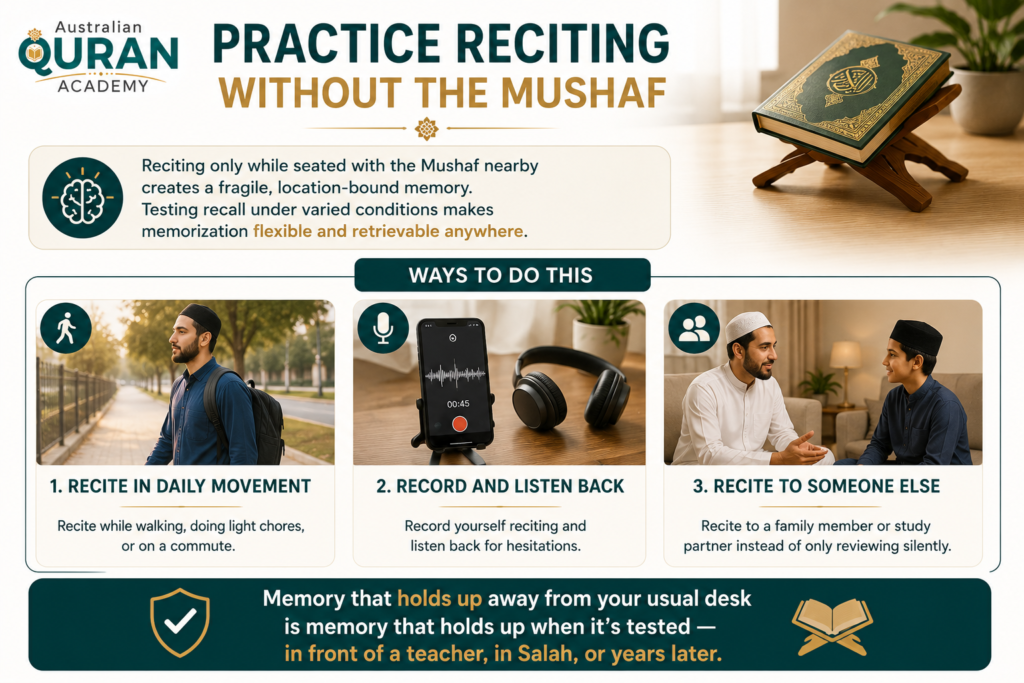
Ways to do this:
- Recite while walking, doing light chores, or on a commute
- Record yourself reciting and listen back for hesitations
- Recite to a family member or study partner instead of only reviewing silently
Memory that holds up away from your usual desk is memory that holds up when it’s tested — in front of a teacher, in Salah, or years later.
13. Study Basic Meaning and Context Alongside Memorization
Understanding the general meaning of a passage creates an additional memory anchor beyond visual and auditory repetition. Before memorizing a Surah or passage, read a short summary or basic Tafsir to understand its main theme and context.
Pay attention to whether the verses discuss a story, rulings, descriptions, warnings, or another central theme. This understanding can help you anticipate how the passage develops and make the sequence of Ayahs easier to recall.
Meaning and context are particularly useful when dealing with similarly worded verses in different parts of the Quran. Knowing what each passage is discussing helps reduce confusion and strengthens long-term recall.
14. Protect Your Sleep — It’s Part of the System, Not a Luxury
Memory consolidation happens during sleep, so sacrificing rest for extra late-night revision can make Hifz more difficult rather than more effective. Consistent, sufficient sleep should therefore be treated as part of a healthy memorization routine.
Try completing your final review shortly before going to sleep, then return to the same material for a light revision the following morning. This “review, sleep, review” pattern gives the brain time to strengthen what was learned overnight while reinforcing it again the next day.
Rather than extending revision when you are exhausted, prioritize regular sleep and focused review when your mind is alert.
Read also: Who Is a Hafiz? Meaning, Status, and Where the World’s Huffaz Live
15. If Your Weekdays Are Too Full, Build Consistency Around Weekend Sessions
Many students in Australia — university students, parents, and full-time professionals alike — find weekday consistency genuinely difficult to hold on their own.
A dedicated weekend Quran class can anchor the week even when weekday routine slips:
| What a Weekend Session Provides | Why It Matters |
| A fixed check-in with a teacher | Prevents small errors from becoming permanent habits |
| Review of the week’s progress | Catches gaps before they widen |
| An adjusted revision plan | Keeps the plan realistic instead of guilt-driven |
| Accountability | You’re far more likely to keep daily micro-sessions if someone is expecting your recitation |
Weekday micro-sessions (even 15–20 minutes) plus one solid weekend check-in is often more sustainable than trying to hold a perfect daily routine entirely alone.
Why Do People Memorize the Quran but Still Forget It Later?
Forgetting after memorizing is almost never a memory problem — it’s a system problem. Common causes include:
- Focusing heavily on new lessons while under-investing in revision
- Changing timing, Mushaf, or method too often
- No longer reciting memorized portions in Salah
- Long gaps between review sessions
- Rushing through recitation instead of reading with focus
When revision is planned, mistakes get fixed early, and memorized Surahs stay in active use, forgetting naturally reduces. Strong Hifz depends on routine, not pressure or speed.
How Can I Make My Quran Memorization Stay Strong Long Term?
Long-term Hifz stays strong through small, repeatable daily actions rather than intense but irregular effort:
- One fixed daily time for Hifz and revision
- More revision than new memorization
- Regular use of memorized Surahs in Salah
- Isolated correction of weak Ayahs, rather than repeating whole pages
- Daily listening and staying connected to the Mushaf, even briefly
When the Quran becomes part of daily life rather than a separate task, it stays firm and easy to recall — even after a genuinely busy week.
Inside Our Virtual Classrooms
We believe in full transparency and proven quality. Take a look at these actual snippets from our live classes to experience our modern learning platform, patient instructors, and interactive student participation.
Start Your Hifz Journey with Australian Quran Academy
You don’t have to build your Hifz routine alone. Australian Quran Academy provides structured online Quran classes for students who want qualified guidance, regular correction, and a learning schedule that fits around life in Australia.
Whether you’re beginning Quran reading, improving your Tajweed, or working toward memorizing the entire Quran, the Academy offers guided learning for different ages and levels. Start with the program that matches your current level and build your Quran journey one consistent step at a time.
Our Quran Courses
- Quran Online Academy
- Quran Recitation Classes
- Quran Reading Classes
- Weekend Quran Classes
- Intensive Quran Course
- Al-Azhar Quran Course
- Online Tajweed Classes
- Tajweed Course for Kids
- Tajweed Course for Adults
- Tajweed Course for Ladies
Start Your Quranic Journey in Australia
Join our leading online academy and learn with expert tutors through a structured, personalized curriculum.
Book Your Free Trial
Conclusion
Memorizing the Quran without forgetting is not about having an exceptional memory or progressing as quickly as possible. Strong Hifz comes from consistency: revising more than you memorize, correcting weak Ayahs early, using the same Mushaf, and keeping the Quran part of your daily routine.
Even a small amount of focused practice each day can build lasting results. Keep your goals realistic, protect your revision time, and seek guidance when you need correction. The aim is not simply to complete Hifz, but to preserve what you have memorized for years to come.
Frequently Asked Questions
1. How can I memorize the Quran without forgetting it?
Prioritize revision over new memorization. Review older portions every day, correct weak Ayahs individually, and avoid adding too much new material until previous lessons are secure.
2. How much Quran should I memorize each day?
There is no single amount that works for everyone. A few Ayahs memorized and revised consistently are better than a full page learned quickly and forgotten. Choose an amount you can maintain alongside daily revision.
3. What is the best time to memorize the Quran?
Choose a time when your mind is alert and distractions are limited. For many students, this is after Fajr or during a quiet evening period. More importantly, try to use the same time consistently.
4. Can I memorize the Quran online with a teacher?
Yes. Online Hifz classes allow students to recite directly to a teacher, receive correction, and follow a structured memorization and revision plan. This can be particularly useful when qualified local teachers are difficult to access.
5. How do I keep my Hifz strong after memorizing the Quran?
Continue daily Muraja’ah even after completing Hifz. Rotate through older Juz’, recite memorized Surahs in Salah, regularly test yourself without looking at the Mushaf, and address weak passages as soon as they appear.



Leave a Reply