 Quran
Quran
Every printed copy of the Quran can be destroyed. The Quran itself cannot be lost — because millions of human beings carry every one of its 6,236 verses, word for word, permanently in memory. These are the Huffaz, and understanding who a Hafiz is means understanding one of the most extraordinary intellectual and spiritual traditions in human history.
A Hafiz is a Muslim who has memorized the complete Quran — from Surah Al-Fatiha to Surah An-Nas — with correct Arabic pronunciation, and who maintains that memorization through lifelong daily revision. The title describes not a past achievement but an ongoing responsibility.
This article covers the full picture: the precise meaning of the title, what Islam says about its status, how many Huffaz exist worldwide, and a country-by-country breakdown of where they are concentrated across every region on earth.
What Does It Mean to Be a Hafiz of the Quran?
A Hafiz is a Muslim who has memorized the entire Quran with precision, correct Tajweed, and consistent revision — not someone who completed memorization once and then moved on.
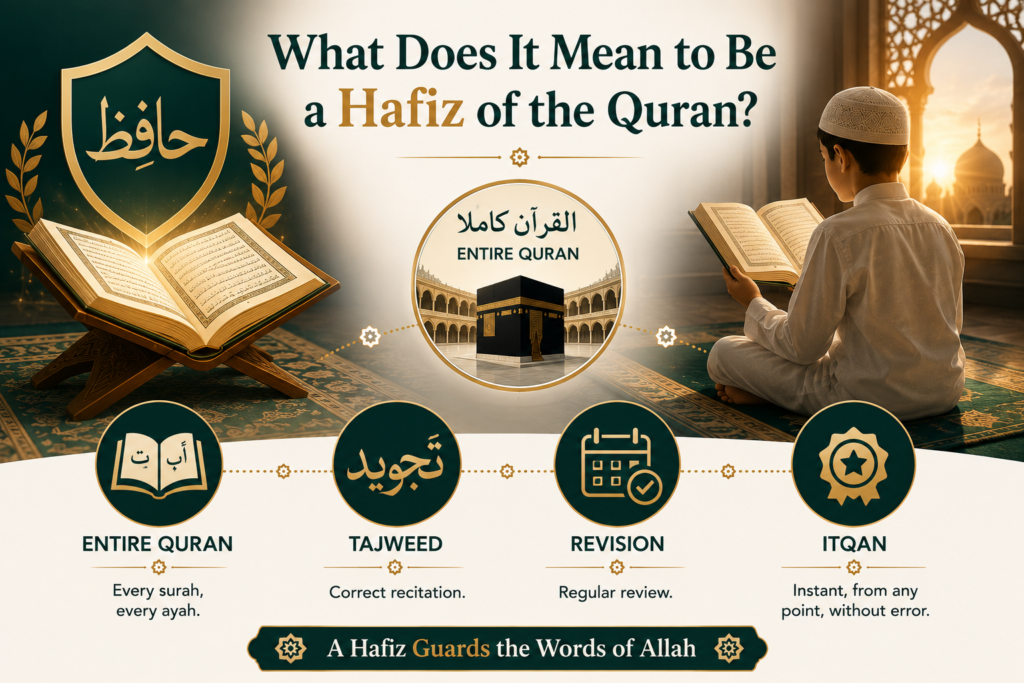
The definition carries a specific threshold. Memorizing individual chapters for daily prayer is common among Muslims. A Hafiz is defined by completion of the whole Quran, every surah and every ayah held firmly in memory at all times, recitable from any point without consulting a Mushaf.
Hafiz Meaning in English
The word Hafiz (حافظ) derives from the Arabic root Hifz (حفظ), meaning to guard, protect, and preserve against loss or change. In English, the closest accurate translation is “guardian” or “protector” — not “memorizer.” This distinction matters because it captures the role, not just the act. A Hafiz guards the words of Allah from distortion and forgetting, in the same way the Companions of the Prophet ﷺ did before a single printed Quran existed.
The phrase “Quran memorizer” describes what a Hafiz did. “Guardian of the Quran” describes what a Hafiz is.
Hifz Versus Itqan — Why Memorizing Once Is Not Enough?
Islamic scholarship draws a firm line between Hifz (memorization) and Itqan (mastery). Itqan means the memorization is so solid that any verse can be recited instantly, from any starting point, without hesitation or error. A person who completed the Quran three years ago but no longer revises has lost Itqan — and, by scholarly consensus, can no longer hold the title of Hafiz in its proper sense.
The classical scholars phrased it directly: “The Quran escapes from the chest faster than a camel escapes from its tether.” This is why daily revision — Muraja’ah — is not maintenance. It is the practice that makes someone a Hafiz rather than someone who used to be one.
If you are in Australia and serious about beginning or continuing your Hifz journey, structured online Hifz courses for adults provide certified instruction that fits around work and family commitments — no relocation, no compromise on quality.

Spiritual Status and Rewards of a Hafiz in Islam
Becoming a Hafiz of the Quran is considered a great honor in Islam. The rewards associated with memorizing, preserving, and living by the Quran extend beyond this life, with Islamic teachings describing special virtues for those devoted to the Book of Allah and honors that may also extend to their families.
The status of a Hafiz is not merely a matter of cultural respect. The Quran has been preserved across generations through recitation, teaching, written transmission, and the efforts of those who commit it to memory. Huffaz have played an important role in this tradition of preservation.
Rewards of Being a Hafiz
Among the greatest rewards associated with memorizing and remaining devoted to the Quran is the elevation in rank promised to the companion of the Quran in the Hereafter. The Prophet Muhammad ﷺ described this honor in the following hadith:
Arabic:
عَنْ عَبْدِ اللَّهِ بْنِ عَمْرٍو، عَنِ النَّبِيِّ ﷺ قَالَ:
«يُقَالُ لِصَاحِبِ الْقُرْآنِ: اقْرَأْ وَارْتَقِ وَرَتِّلْ كَمَا كُنْتَ تُرَتِّلُ فِي الدُّنْيَا، فَإِنَّ مَنْزِلَكَ عِنْدَ آخِرِ آيَةٍ تَقْرَؤُ بِهَا»
English:
“It will be said to the companion of the Quran: Recite and ascend, and recite as you used to recite in the world. Your rank will be at the last verse you recite.”
The hadith uses the expression Sahib al-Quran (صاحب القرآن) — “the companion of the Quran.” This points to more than completing memorization once. It reflects an enduring relationship with the Quran through memorization, regular recitation, revision, and adherence to its teachings.
For a Hafiz, this hadith provides powerful motivation to maintain what has been memorized. Hifz is therefore not simply about reaching the final surah; it is a lifelong commitment to keeping the Quran present in one’s memory and life.
Rewards for the Parents of a Hafiz
The blessings associated with learning and preserving the Quran can also extend to one’s parents. Islamic narrations describe special honor in the Hereafter for parents whose children learn the Quran and live according to its teachings.
This gives parents another reason to create an environment in which Quran learning can flourish. Supporting consistent lessons, encouraging daily Muraja’ah, and helping a child remain committed to their Hifz can all become part of a family’s long-term relationship with the Quran.
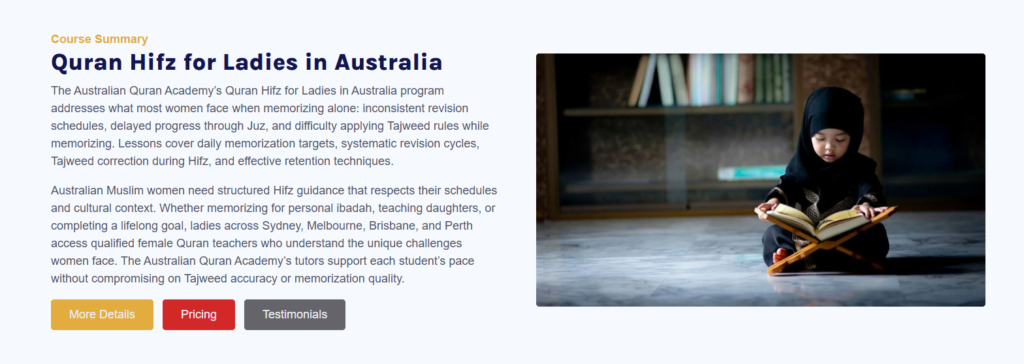
At the same time, Hifz is not an achievement reserved for children. Adults can pursue Quran memorization at any stage of life. For mothers and other female learners, dedicated Hifz courses for ladies provide a structured environment to work toward memorizing and maintaining the Quran themselves.
How Many Hafiz Are There in the World?
There is no official global registry of Huffaz, so the exact number is unknown. Estimates vary widely depending on whether they count only certified Huffaz with an Ijazah or anyone who has completed memorization under a qualified teacher.
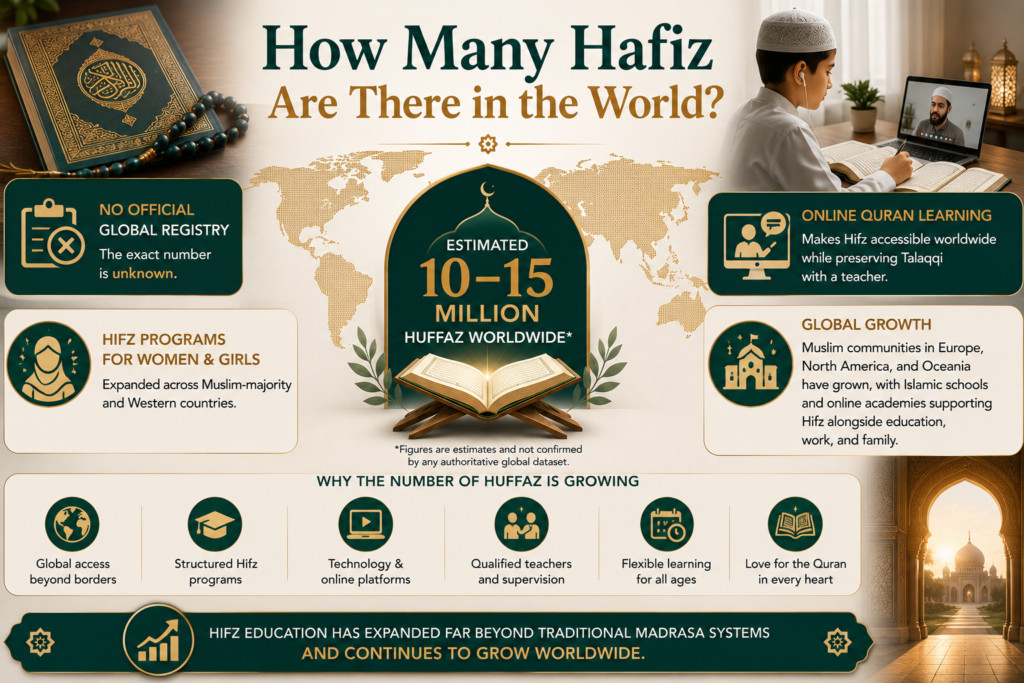
The number of Huffaz has grown significantly in recent decades. Online Quran learning has made Hifz accessible to students regardless of location while preserving Talaqqi — direct recitation and correction with a teacher. At the same time, structured Hifz programs for women and girls have expanded across Muslim-majority and Western countries.
Growth in Muslim communities across Europe, North America, and Oceania has also contributed, with Islamic schools and online academies allowing children and adults to combine Quran memorization with education, work, and family commitments.
While figures such as 10–15 million Huffaz worldwide are sometimes cited, there is no authoritative global dataset confirming this range. What is clear is that Hifz education has expanded far beyond traditional madrasa systems and continues to grow worldwide.
Read also: The Benefits, Virtues, and Rewards of Memorizing the Quran
See Us in Action!
Curious about what our online classrooms look like? Watch the short clips below to see how our interactive, one-on-one sessions bring learning to life with real-time feedback and engaging teaching methods.
Start Your Quranic Journey in Australia
Join our leading online academy and learn with expert tutors through a structured, personalized curriculum.
Book Your Free TrialCountries with the Most Hafiz
The global distribution of Huffaz generally follows Muslim population density, although strong Islamic education systems and cultural traditions also influence Hafiz numbers.
South Asia — The World’s Largest Hafiz Hub
Pakistan has one of the world’s largest Hafiz populations, supported by thousands of madrasas and dedicated Hifz programs.
Bangladesh produces large numbers of Huffaz through its extensive Qaumi madrasa network.
India has a strong Hifz tradition, particularly in states with large Muslim communities such as Uttar Pradesh, West Bengal, Kerala, and Telangana.
Nepal and Sri Lanka also maintain Hifz programs within their smaller Muslim communities.
Southeast Asia — A Growing Tradition
Indonesia has a rapidly growing Hafiz community supported by Islamic schools and national Quran competitions.
Malaysia and Brunei support structured Quran memorization through religious schools and government-backed programs.
The Philippines, Thailand, Myanmar, Cambodia, and Vietnam maintain smaller Hifz traditions within their Muslim communities.
The Arab World
Saudi Arabia has an extensive network of Tahfiz schools and supports Quran memorization programs internationally.
Egypt is a major center of Quranic education through Al-Azhar and is widely known for its tradition of Tajweed and Quran teaching.
Jordan, Iraq, Yemen, and Syria have long-established traditions of Quran memorization and Islamic scholarship.
Kuwait, Qatar, the UAE, Bahrain, Oman, Palestine, Lebanon, and Libya also maintain active Hifz programs.
North Africa
Morocco has a strong Quran-school tradition, with many children beginning Quranic education at an early age.
Mauritania is particularly renowned for its intensive culture of Quran memorization and traditional Islamic scholarship.
Algeria, Tunisia, Sudan, Djibouti, Somalia, and Comoros also have established Hifz traditions.
Sub-Saharan Africa
Nigeria has a large Hafiz community, particularly in its northern states, where Quranic education has deep historical roots.
Senegal, Mali, and Niger have centuries-old Quranic education traditions across the Sahel.
Ethiopia, Kenya, Tanzania, and Uganda maintain established Hifz programs within their Muslim communities.
Other African countries, including Ghana, Gambia, Guinea, Cameroon, South Africa, Mozambique, Zambia, and Zimbabwe, also have active or growing Hifz communities.
Central Asia, Iran, Turkey, and Afghanistan
Turkey has experienced a significant revival of Hifz education and supports Quran programs both domestically and abroad.
Iran and Afghanistan maintain strong Quran memorization traditions through religious schools and local communities.
Uzbekistan, Kazakhstan, Tajikistan, Kyrgyzstan, Turkmenistan, and Azerbaijan have also seen renewed interest in Hifz education.
Europe
The United Kingdom has one of Western Europe’s most developed Hifz networks, with Islamic schools and Tahfiz programs across major cities.
France, Germany, the Netherlands, Belgium, and Sweden have growing Hifz communities supported by Muslim diaspora populations.
Bosnia and Herzegovina, Kosovo, Albania, North Macedonia, Montenegro, and Serbia maintain established Balkan Quranic traditions.
Hifz programs are also present in Spain, Italy, Norway, Denmark, Switzerland, Austria, Finland, Ireland, and Portugal.
North America, South America, and Oceania
The United States and Canada have growing numbers of Huffaz through mosques, Islamic schools, and dedicated Hifz programs.
Brazil, Argentina, Venezuela, Colombia, and Trinidad and Tobago maintain smaller Hifz communities.
Australia has become an important Hifz center in Oceania, with programs available for children, adults, and women in major cities and online.
Read also: How to Memorize the Quran Without Forgetting in Australia? – 15 Steps That Actually Work
Who Can Become a Hafiz?
A Hafiz can be anyone: a child, an adult professional, a revert Muslim, or a student with no prior Arabic. Islam places no restriction of age, gender, or educational background on who may pursue Hifz.
The most pervasive misconception is that Hifz is only achievable before age 15, inside a full-time madrasa. This is factually wrong. Adults complete the Quran successfully every year worldwide. The difference is not ability — it is method. Adults generally benefit from shorter daily sessions, stronger integration of meaning alongside memorization, and a revision schedule designed for people with professional and family responsibilities.
Three Common Mistakes That Delay or Destroy Hifz
Successful Hifz depends not only on how much you memorize, but on how correctly and consistently you build and maintain it. These three common mistakes can significantly slow progress and weaken long-term retention.
Memorizing without a Tajweed foundation
A verse memorized with incorrect pronunciation is significantly harder to correct than to learn correctly from the start. The brain encodes both the words and the sounds together. Children especially need a correct pronunciation base — a structured Tajweed program for kids before moving to full memorization prevents months of remediation later.

Moving forward without securing old material
Focusing only on new pages while neglecting older Juz creates a permanent cycle where new memorization displaces old. A functional Hifz routine requires a fixed ratio — typically reviewing five or more previously memorized pages for every one new page learned.
Attempting Hifz without a qualified teacher
The Quranic transmission chain (Isnad) traces directly from the Prophet ﷺ. Self-taught memorization lacks the critical correction mechanism that a qualified teacher provides: the ability to catch errors the student does not hear in their own recitation. This is not optional. The method of Talaqqi — oral transmission from teacher to student — is built into the Islamic definition of how the Quran is correctly transmitted.
How Long Does It Take to Become a Hafiz?
Most students following a consistent, structured program complete Hifz in three to five years. Intensive programs with daily instruction under a dedicated teacher can reduce this to two years. Students learning part-time alongside school or work typically complete in five to seven years.
Speed is not a measure of quality. A Hifz completed in two years with solid Itqan outweighs a Hifz completed in one year with weak retention. The goal is a Hafiz, not a former Hafiz.
Inside Our Virtual Classrooms
We believe in full transparency and proven quality. Take a look at these actual snippets from our live classes to experience our modern learning platform, patient instructors, and interactive student participation.
Start Your Hifz Journey with Australian Quran Academy
Australian Quran Academy connects you with certified instructors trained in the same Azhar tradition that has preserved Quranic memorization for over a thousand years — delivered to your home, on a schedule that fits your life.
Whether you are an adult ready to begin from scratch, a woman seeking a dedicated female-taught program, or a parent building your child’s Tajweed foundation before formal Hifz, your course is available now.
Our Quran Courses
- Quran Online Academy
- Quran Recitation Classes
- Quran Reading Classes
- Online Quran Classes for Kids
- Quran Classes for Adults
- Quran Classes for Female/Sisters
- Learn Quran Course for Beginners
- Quran Memorization (Hifz) Course
- Hifz Classes for Adults
- Quran Memorization and Hifz Course for Kids
- Quran Hifz Course for Ladies
- Quran Ijazah Program
- Quran Qirat Learning Course
- Quran Tafsir Course
- Noorani Qaida Course
- Noorani Qaida Course for Kids
- Weekend Quran Classes
- Intensive Quran Course
- Al-Azhar Quran Course
- Online Tajweed Classes
- Tajweed Course for Kids
- Tajweed Course for Adults
- Tajweed Course for Ladies
Start Your Quranic Journey in Australia
Join our leading online academy and learn with expert tutors through a structured, personalized curriculum.
Book Your Free Trial
Conclusion
A Hafiz is a Muslim who guards the complete Quran in memory — not through a single past effort, but through correct recitation, disciplined daily revision, and conduct that reflects what the Quran teaches. The title is held continuously or not at all.
Globally, an estimated 10 to 15 million Muslims hold this title, led by Pakistan — which alone accounts for a significant share of the worldwide total — followed by Bangladesh, India, Indonesia, and the Arab world. Across North Africa, sub-Saharan Africa, Central Asia, Europe, North America, and Oceania, new Huffaz complete this journey every year, in countries that had almost none a generation ago. The tradition is not diminishing. It is accelerating.
Who is a Hafiz? Not a single age group, one gender, or one region of the world. It is anyone who takes on the greatest memorization undertaking in Islamic scholarship — and who renews that commitment every single day through revision, recitation, and the living of Quranic character.
Read also: Quran Hifz Quotes That Every Hafiz Should Carry in Their Heart
Frequently Asked Questions
What is the difference between a Hafiz and a Qari?
A Hafiz has memorized the entire Quran and maintains that memorization through regular revision. A Qari is trained specifically in the art of melodious, technically precise recitation, including the seven or ten recognized Qira’at (modes of recitation). The two titles describe different competencies — memory versus recitation artistry — and the same person can hold both.
Can a woman become a Hafiz?
Yes. A female Hafiz is called a Hafiza (حافظة) in Arabic, and women have memorized the Quran throughout Islamic history. Today, millions of women hold this title across Pakistan, Bangladesh, Egypt, Malaysia, Indonesia, and Western countries. Dedicated female-taught programs provide an appropriate and structured environment for women and girls to complete the same journey.
How many Hafiz are there in the world?
Estimates place the total between 10 and 15 million, though no single official count exists. Pakistan is consistently cited as home to the largest concentration — between 7 and 10 million — followed by Bangladesh, India, Indonesia, and the Arab world. The number has grown substantially over the past two decades due to the expansion of online education and women’s Hifz programs.
Is memorization without Tajweed considered valid?
No. Islamic scholars are clear that memorization without correct Tajweed is incomplete. Incorrect pronunciation can alter the meaning of Quranic words — an error treated with gravity in Islamic recitation. A Hafiz is expected to recite with the same precision in Makharij (articulation), Madd (elongation), and Ghunnah (nasalization) that was transmitted from the Prophet ﷺ through the unbroken chain of oral transmission.
At what age should someone begin Hifz?
There is no fixed correct age. Children typically begin between five and ten years old, when memory plasticity is strongest. Adults complete Hifz successfully at any age — including their forties, fifties, and beyond. What determines success more than age is consistent daily practice, a qualified teacher, and a revision system suited to the student’s schedule.
What is Muraja’ah, and how often must a Hafiz do it?
Muraja’ah is the ongoing daily revision that maintains memorization after Hifz is complete. Without it, even a solid Hifz weakens within weeks. Most scholars recommend completing a full review of all 30 Juz at least once a month, which requires approximately one Juz of revision per day. A Hafiz who stops revising for more than a few weeks will notice measurable memory loss — which is why Muraja’ah is understood as the true definition of holding the title, not simply having completed it.





Leave a Reply