 Quran
Quran
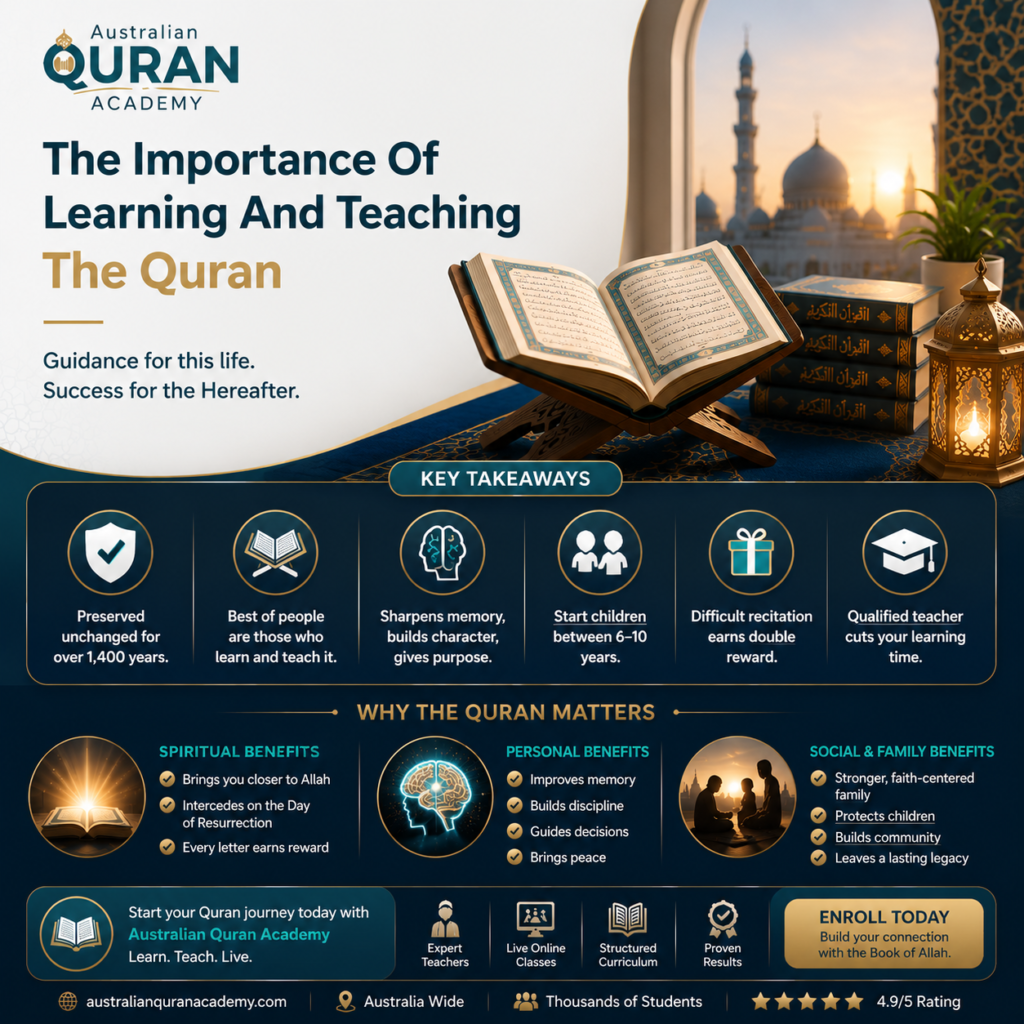
| Key Takeaway |
| The Quran is the only divine scripture preserved unchanged for over 1,400 years — learning it connects you to an unbroken chain of transmission. |
| The Prophet (ﷺ) named those who learn and teach the Quran as the best among Muslims — making it the highest act of worship you can pursue. |
| Learning the Quran sharpens memory, builds moral character, and gives life a clear sense of purpose — benefits that go far beyond the spiritual. |
| Starting children between ages 6 and 10 is the optimal memorisation window — earlier exposure builds the love that fuels later learning. |
| Adults who find recitation difficult receive double the reward — it is never too late to begin or return. |
| A qualified teacher from Australian Quran Academy cuts your learning time significantly and ensures you build the right habits from day one. |
The Prophet Muhammad (ﷺ) said: “The best among you are those who learn the Quran and teach it.” (Bukhari). In a single sentence, Islam establishes a complete hierarchy of virtue — and places the Quran at its summit.
Yet for many Muslims living in Western countries, including Australia, the Quran often becomes a background presence rather than a daily reality. Children grow up without a strong connection to it. Adults feel it is too late to start. Parents hope someone else will fill the gap.
The importance of learning and teaching the Quran is not a religious formality — it is a complete program for personal development, family cohesion, cognitive growth, and eternal reward.
This article covers every dimension of that importance, drawing on authentic hadith, scholarly insight, and practical guidance for Muslim families today.
At Australian Quran Academy, we work with students across Australia to build that connection — from complete beginners to those pursuing memorisation — and we see daily what happens when this relationship with the Quran is built properly.
A. The Importance of Learning and Teaching the Quran: What It Actually Means?
The Arabic verb ta’allama (to learn) and ‘allama (to teach) appear together in one of the most cited hadith in Islamic education.
That pairing is not accidental — Islam treats learning and teaching the Quran as a single, inseparable act of worship. You are incomplete in one without the other.
The Quran is not simply a religious text to be recited on occasions. It is, as Ibn Khaldun wrote, the foundation upon which all Islamic learning is built — “the Quran became the origin of instruction upon which every subsequent skill was built.”
This means engaging with the Quran is the root from which all other Islamic and personal development grows.
Understanding the importance of learning and teaching the Quran requires looking at it across three levels: its spiritual rewards, its personal benefits, and its social function.
1. The Quran Is Divine Guidance, Not Just Religious Text
The Quran describes itself in Surah Al-Isra (17:9): “Indeed, this Quran guides to that which is most suitable.” It is not a collection of rituals — it is a comprehensive framework covering theology, ethics, family law, social justice, and personal conduct.
Every Muslim who learns the Quran gains access to a complete moral and practical code. The Quran contains detailed rulings on marriage, inheritance, contracts, and conflict — alongside the broad principles of justice, mercy, and truthfulness that govern all of them.
This is the only book where legal precision and spiritual depth exist in the same verse.
2. The Quran Remains Unchanged After 1,400 Years
The Quran was revealed between 610 CE and 632 CE and has remained textually identical ever since — a preservation unmatched by any other religious scripture. This is not incidental.
The Quran itself states in Surah Al-Hijr (15:9): “Indeed, it is We who sent down the Quran and indeed, We will be its guardian.”
That preservation has been maintained through two channels: written transmission and human memorisation. Every generation of Huffaz (those who memorise the Quran) has been a living safeguard of the text.
When you memorise or teach the Quran, you participate in a 1,400-year chain of transmission — one of the most remarkable facts in the history of any civilisation.
Read Also: how to learn quran quickly in Australia
B. Spiritual Benefits of Learning the Quran
The rewards for engaging with the Quran are documented across multiple authentic hadith, and they span both this life and the hereafter.
1. The Quran Brings You Closer to Allah
Reciting the Quran is described in several hadith as a direct conversation with Allah. The Prophet (ﷺ) explained that during Surah Al-Fatihah, recited in every prayer, Allah responds to each verse the worshipper recites — “My slave has praised Me… My slave has extolled Me.” This is not a monologue. It is dialogue.
Abu Hurairah (may Allah be pleased with him) reported that the Prophet (ﷺ) said:
“Any group of people that assemble in one of the Houses of Allah to recite the Book of Allah, learning and teaching it, tranquility will descend upon them, mercy will engulf them, angels will surround them, and Allah will make mention of them to those in His proximity.” (Muslim).
The act of gathering to learn or teach the Quran is itself an act that earns divine acknowledgement.
2. The Quran Will Intercede on the Day of Resurrection
Abu Umamah (may Allah be pleased with him) narrated that the Prophet (ﷺ) said: “Recite the Quran, for it will come as an intercessor for its reciters on the Day of Resurrection.” (Muslim).
This is not a metaphor — Islamic scholarship treats Quranic intercession as a concrete reality on the Day of Judgement.
3. Every Letter Carries a Reward
The Prophet (ﷺ) said: “Whoever recites a letter from the Book of Allah, he will receive one good deed as ten good deeds like it. I do not say that Alif Lam Meem is one letter, but rather Alif is a letter, Lam is a letter, and Meem is a letter.” (Tirmidhi).
The accumulation of reward from regular Quranic recitation is among the most efficient acts of worship available to a Muslim.
If you are looking for a practical way to build your scale of good deeds — the Quran is it. Australian Quran Academy offers structured recitation courses for adults and children at all levels, making that daily practice accessible regardless of where you live in Australia.
Read also: How To Learn The Qirat Of The Quran In Australia? A Complete Guide

See Us in Action!
Curious about what our online classrooms look like? Watch the short clips below to see how our interactive, one-on-one sessions bring learning to life with real-time feedback and engaging teaching methods.
Start Your Quranic Journey in Australia
Join our leading online academy and learn with expert tutors through a structured, personalized curriculum.
Book Your Free TrialC. Personal and Cognitive Benefits of Learning the Quran
The importance of learning and teaching the Quran extends beyond the spiritual into measurable personal development.
1. The Quran Develops Character and Moral Clarity
The Quran does not simply list rules — it builds character. Its verses cultivate patience (sabr), gratitude (shukr), humility (tawadu’), and forgiveness (‘afw) through narrative, command, and example. A child raised on Quranic values has an internal ethical framework that functions independently of external pressure.
Importantly, the Quran gives a reason for every moral instruction. It does not command justice without explaining why justice serves humanity. This rational moral grounding is what makes Quranic character education more durable than rule-based approaches alone.
Read also: Interactive Quran Learning In Australia – The Complete Guide For Families And Adults
2. The Quran Sharpens Memory and Cognitive Ability
Research on Quranic memorisation consistently shows improvements in working memory, concentration, and pattern recognition.
Dr. Muhammad Ratib Al-Nabulsi notes that children who are exposed to the Quran from before birth — while still in the womb — demonstrate heightened receptivity to it in early childhood. The cognitive infrastructure built through Quranic memorisation transfers directly into academic performance.
This is one reason why beginning Quran education early is not just a religious preference — it is a cognitive investment. Arabic lessons for Kindergarten in Australia at Australian Quran Academy are designed around exactly this early-stage development.
3. It Gives Life Meaning and Purpose
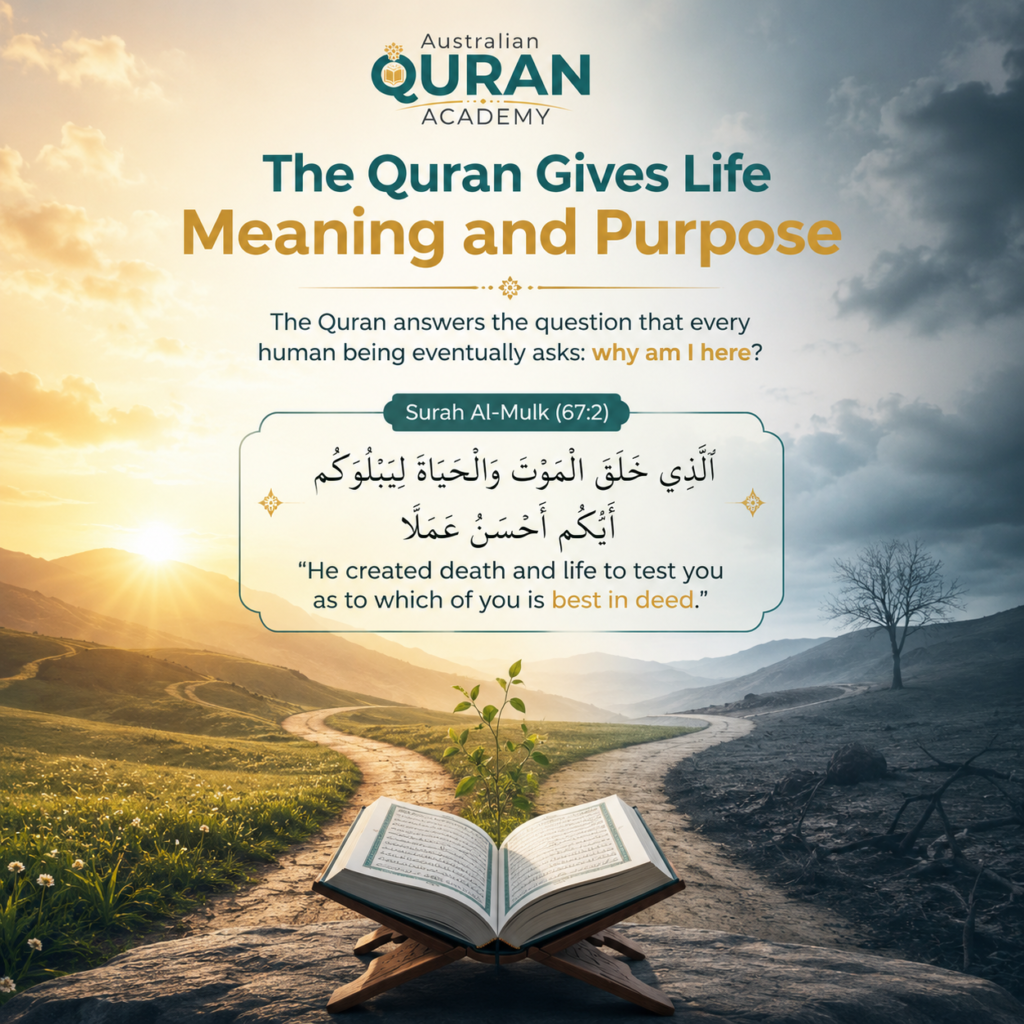
The Quran answers the question that every human being eventually asks: why am I here? Surah Al-Mulk (67:2) states: “He created death and life to test you as to which of you is best in deed.” That single verse reframes suffering, ambition, loss, and effort — all of it becomes meaningful within a framework of purposeful testing.
Muslims who engage regularly with the Quran report greater resilience in adversity precisely because the Quran does not promise an easy life — it promises that difficulty has meaning and that Allah’s mercy accompanies every trial.
D. The Importance of Teaching the Quran
Learning and teaching are inseparable in the Islamic framework — and the rewards for teaching carry their own specific weight.
1. The Teacher’s Reward Is Continuous
The Prophet (ﷺ) said: “Allah and His angels and the inhabitants of the heavens and the earth, even the ant in its hole and even the fish, send blessings upon the one who teaches people goodness.” (Tirmidhi). Is there any goodness greater than what the teacher of the Quran imparts?
Every student who learns correctly from a qualified teacher, every child who reads the Quran fluently in prayer, every person whose life is guided by a verse they were taught — all of that flows back as reward to the teacher.
This is what Islamic scholars call sadaqah jariyah — continuous charity that outlasts a person’s life.
2. Teaching Preserves the Community
A community whose members teach the Quran to the next generation is a community that cannot lose its identity.
When Quranic education is outsourced entirely to mosques or left to chance, the result is a generation with cultural Muslim identity but no textual grounding.
Teaching the Quran within families and structured programmes is how Muslim communities in diaspora contexts — like Australia — maintain continuity across generations.
3. It Builds Social Bonds
Group Quran learning creates a specific kind of community that is difficult to build any other way. The Prophet (ﷺ) described angels surrounding those who gather to learn the Quran together, and tranquility descending upon them.
The social dimension of Quranic learning — whether in circles at the mosque or online Quran classes in Australia — fosters relationships built around something eternal rather than temporary shared interests.
Read Also:learn quran by heart in Australia
When and How to Start Children on the Quran?
Between ages three and five, children should be introduced to the Quran through listening, handling the Mushaf with respect, and hearing stories from the Quran. At this stage, the goal is not memorisation — it is building love and familiarity.
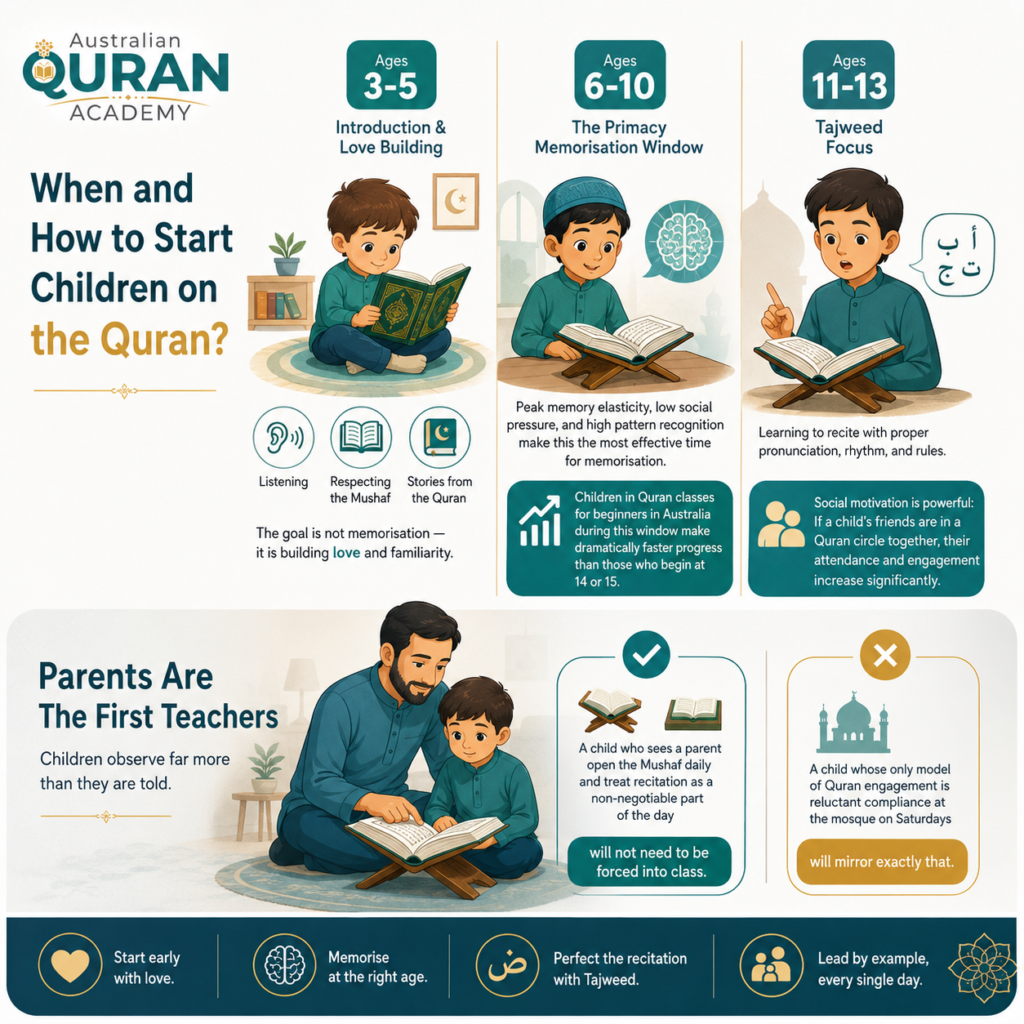
From age six to ten is the primary memorisation window. The child’s memory is at peak elasticity, social pressure to conform to peer behaviour is still low, and the neural pathways for pattern recognition are at their most receptive.
Children enrolled in Quran classes for beginners in Australia during this window make dramatically faster progress than those who begin at fourteen or fifteen.
From age eleven to thirteen, Tajweed becomes the focus — learning to recite with proper pronunciation, rhythm, and rules. At this age, social motivation is powerful: if a child’s friends are in a Quran circle together, their attendance and engagement increase significantly.
Many parents enrol children in Quran classes without participating in any Quranic learning themselves.
Children observe far more than they are told. A child who sees a parent open the Mushaf daily and treat recitation as a non-negotiable part of the day will not need to be forced into class.
A child whose only model of Quran engagement is reluctant compliance at the mosque on Saturdays will mirror exactly that.
The most effective intervention a parent can make is their own Quranic engagement. Learning Arabic for non-Arabic speakers in Australia is a practical starting point for parents who want to connect with the Quran more deeply and model that connection for their children.
How Adults Can Return to the Quran?
It is never too late. The Prophet (ﷺ) said: “Whoever recites the Quran with pauses and finds it difficult for him — he has two rewards.” (Bukhari). The one who struggles receives more reward than the one for whom it comes easily.
Adults who feel they have missed the window often avoid Quranic learning out of embarrassment. The reality is that adult learners bring advantages children do not have: patience, motivation, life context to understand Quranic themes, and the ability to study consistently.
Islamic studies courses for adults in Australia at Australian Quran Academy are designed specifically for this learner profile — no prior Arabic required, no judgment, no comparison with where you feel you should be.
Inside Our Virtual Classrooms
We believe in full transparency and proven quality. Take a look at these actual snippets from our live classes to experience our modern learning platform, patient instructors, and interactive student participation.
Start Your Quranic Journey in Australia
Join our leading online academy and learn with expert tutors through a structured, personalized curriculum.
Book Your Free TrialStart Learning Or Teaching The Quran With Australian Quran Academy
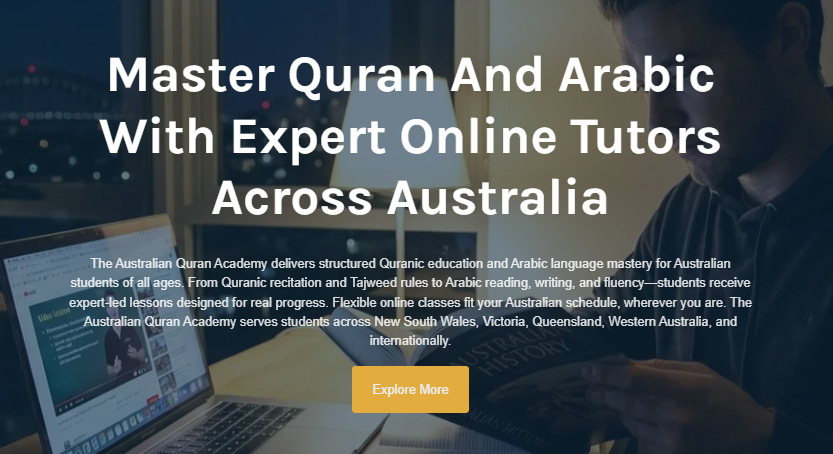
The importance of learning and teaching the Quran does not diminish with time or distance. Whether you are in Sydney, Melbourne, Brisbane, or rural Australia — access to qualified, certified instruction is available to you right now.
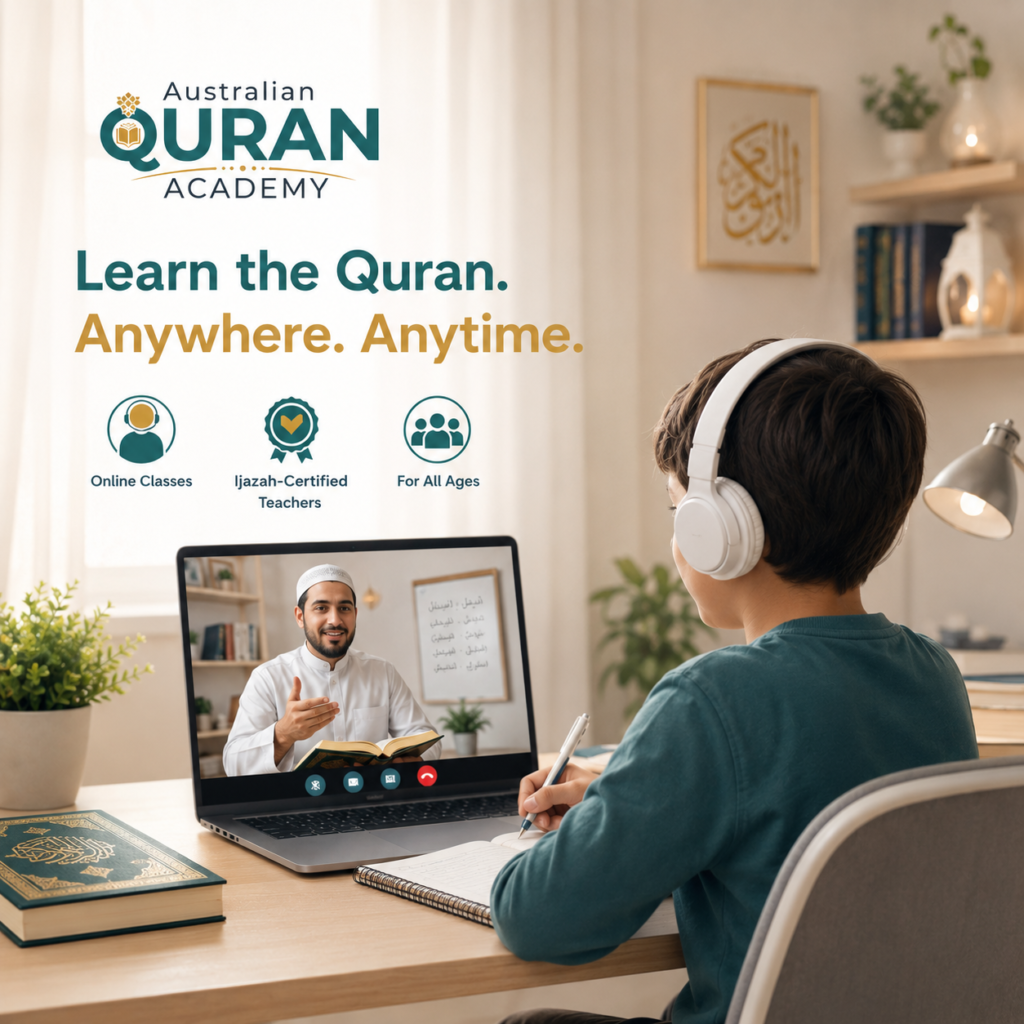
Australian Quran Academy connects Muslim families across Australia with experienced, Ijazah-certified teachers through structured online classes for every age and level.
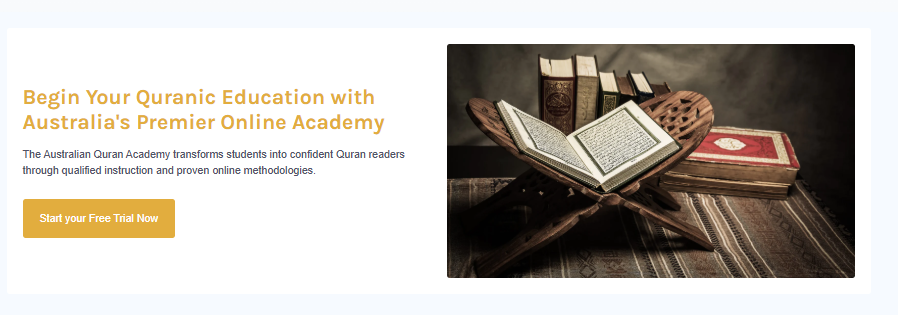
Children build a love of the Quran from the earliest years. Adults reconnect with confidence. Families grow together in something that lasts beyond this life.
Our Quran Courses:
- Quran Recitation Classes
- Quran Reading Classes
- Online Quran Classes for Kids
- Quran Classes for Adults
- Quran Classes for Female/Sisters
- Learn Quran for Beginners
- Quran Memorization (Hifz) Course
- Hifz Classes for Adults
- Quran Memorization and Hifz for Kids
- Quran Hifz for Ladies
- Quran Ijazah Program
Start Your Quranic Journey in Australia
Join our leading online academy and learn with expert tutors through a structured, personalized curriculum.
Book Your Free TrialConclusion
The importance of learning and teaching the Quran is not an abstract religious concept — it is a lived reality with consequences in this world and the next. It is guidance that does not go out of date, wisdom that applies to every generation, and a source of reward that continues long after the lesson ends.
For Muslim families in Australia, the practical question is not whether this matters — it clearly does. The question is how to make it a consistent reality in daily life. That begins with one decision: to start, or to start again.
Whether you are a parent wanting to build this foundation for your children, an adult returning after years away, or someone beginning completely from scratch — Australian Quran Academy is here to make that journey structured, supported, and genuinely effective.
Frequently Asked Questions
Here are answers to the questions most commonly asked about the importance of learning and teaching the Quran, to help you take the right steps with confidence.
1. What is the importance of learning and teaching the Quran in Islam?
The Prophet (ﷺ) stated that the best Muslims are those who learn the Quran and teach it (Bukhari). Learning the Quran provides divine guidance, strengthens faith, purifies character, and brings rewards in this life and the hereafter. Teaching it multiplies that reward and preserves the Quran for future generations.
2. Is it too late to start learning the Quran as an adult?
It is never too late. The Prophet (ﷺ) affirmed a double reward for the adult who finds Quranic recitation difficult but persists. Adult learners bring motivation and life experience that make Quranic study deeply meaningful — structured beginner programmes make the process accessible at any age.
3. What age should children begin learning the Quran?
Exposure should begin from infancy through listening. Structured memorisation is most effective from age six to ten, when memory is most receptive. From age three to five, the focus should be building love and respect for the Quran rather than formal memorisation.
4. Does teaching the Quran earn ongoing reward after death?
Yes. Islamic scholarship classifies teaching the Quran as sadaqah jariyah — an act whose reward continues as long as the student benefits from what they were taught. Every correct recitation by a student flows back as reward to the teacher who taught them.
5. Why is it important to learn Quranic Arabic specifically?
The Quran was revealed in classical Arabic and has remained unchanged in that language for over 1,400 years. Understanding Quranic Arabic allows direct access to the original text without relying on translation, which always involves interpretation. It also connects the learner to the full linguistic and cultural heritage of the Quran.
6. How can Muslim families in Australia access quality Quran education?
Australian Quran Academy offers live, online Quran and Arabic classes for all ages and levels — from kindergarten through to adult programmes — taught by Ijazah-certified instructors. Classes are conducted via video conferencing, making professional Quranic education accessible to Muslim families anywhere in Australia.


Leave a Reply