 Quran
Quran
| Key Takeaway |
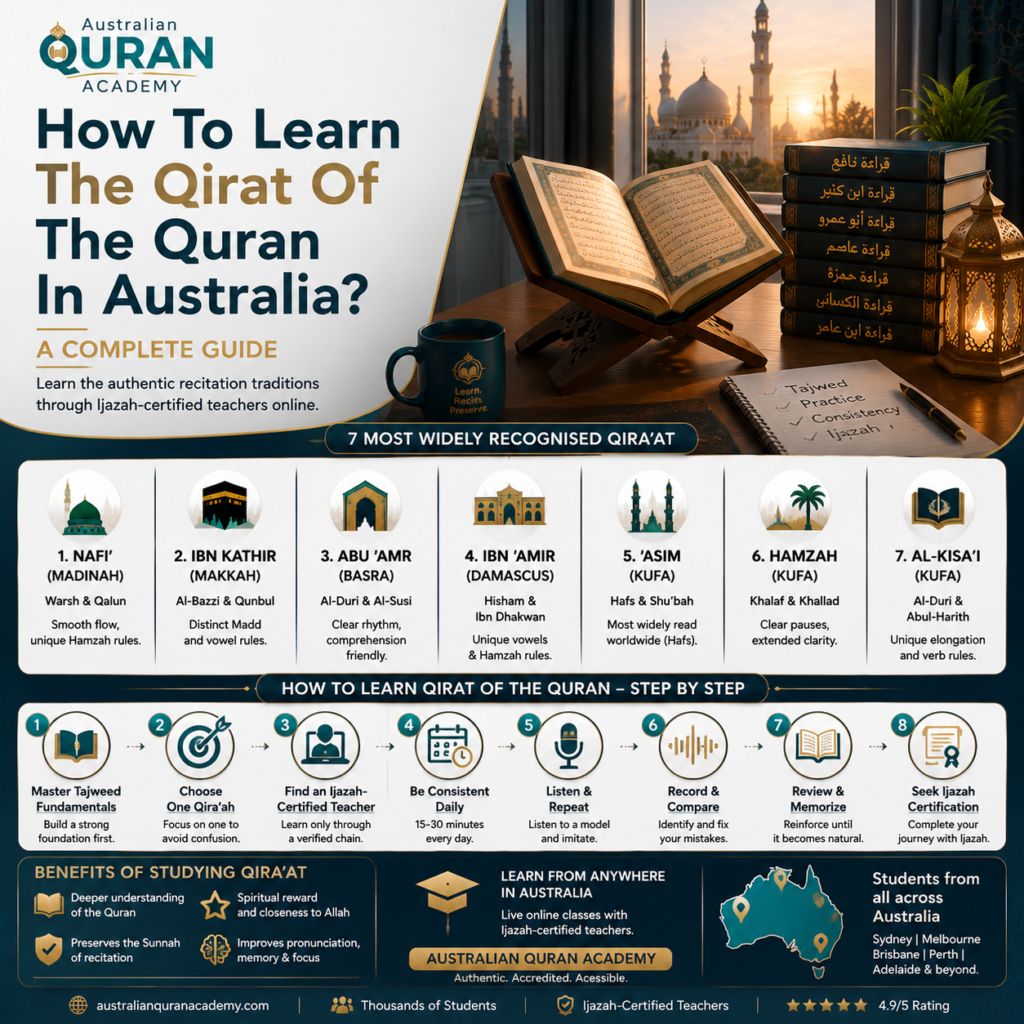
| Master Tajweed fundamentals first, skipping this step makes Qira’at study significantly harder later. |
| Start with one Qira’ah only, mixing multiple styles simultaneously leads to cross-contamination errors. |
| A teacher with verified Ijazah is not optional, Qira’at must be transmitted through an authenticated chain. |
| Daily 15–30 minute practice sessions beat occasional long ones for building phonetic muscle memory. |
| Recording yourself and comparing to a certified Qari is the fastest way to catch pronunciation errors. |
| Australian Quran Academy connects you with Ijazah-certified Qira’at teachers from anywhere in Australia. |
If you are wondering how to learn Qirat of the Quran in Australia, this guide covers exactly what you need — from understanding what Qira’at are, to finding a qualified Ijazah-certified teacher without leaving the country.
Most Muslims in Australia recite the Quran in one style their entire lives — Hafs ‘an Asim — without realising the Quran was authentically revealed in ten recognised recitation traditions, each with its own phonetic rules, vowel patterns, and chain of transmission stretching back to the Prophet Muhammad (PBUH).
Learning qirat of the Quran in Australia is now more accessible than ever, and this guide covers exactly what you need to know to start.
Whether you are a complete beginner building your first recitation habits or an advanced student seeking Ijazah certification, understanding the Qira’at opens a dimension of the Quran that most Muslims never encounter.
A. What Are Qira’at and Why Do They Exist?
Qira’at (singular: Qira’ah) refers to the ten authenticated modes of reciting the Quran, each transmitted through an unbroken chain of narration going back to the Companions of the Prophet (PBUH).
These are not human inventions or regional preferences — they are preserved oral traditions that the Prophet himself approved.
The hadith recorded in Sahih al-Bukhari (2419) captures this clearly: when Umar ibn al-Khattab heard Hisham ibn Hakim reciting Surah al-Furqan differently from how he had been taught, he brought him before the Prophet (PBUH).
The Prophet confirmed both recitations were valid, stating: “The Quran has been revealed in seven different ways, so recite it in the way that is easier for you.” (Sahih al-Bukhari)
These seven ahruf (modes) are the origin of the Qira’at system. Over time, scholars — most notably Ibn al-Jazari in his foundational work Nashr al-Qira’at al-‘Ashr — systematised ten canonical readings, each named after the imam who transmitted it and supported by two narrators.
For Australian Muslims specifically, understanding how to learn Qirat of the Quran in Australia starts with appreciating why these ten traditions exist — and why they are worth preserving.
Read also: Interactive Quran Learning In Australia – The Complete Guide For Families And Adults
B. The 7 Most Widely Recognised Types Of Qira’at
There are ten canonical Qira’at in total, but seven have the widest recognition and are most commonly studied. Here is a breakdown of each, including their geographic origin and distinguishing features.
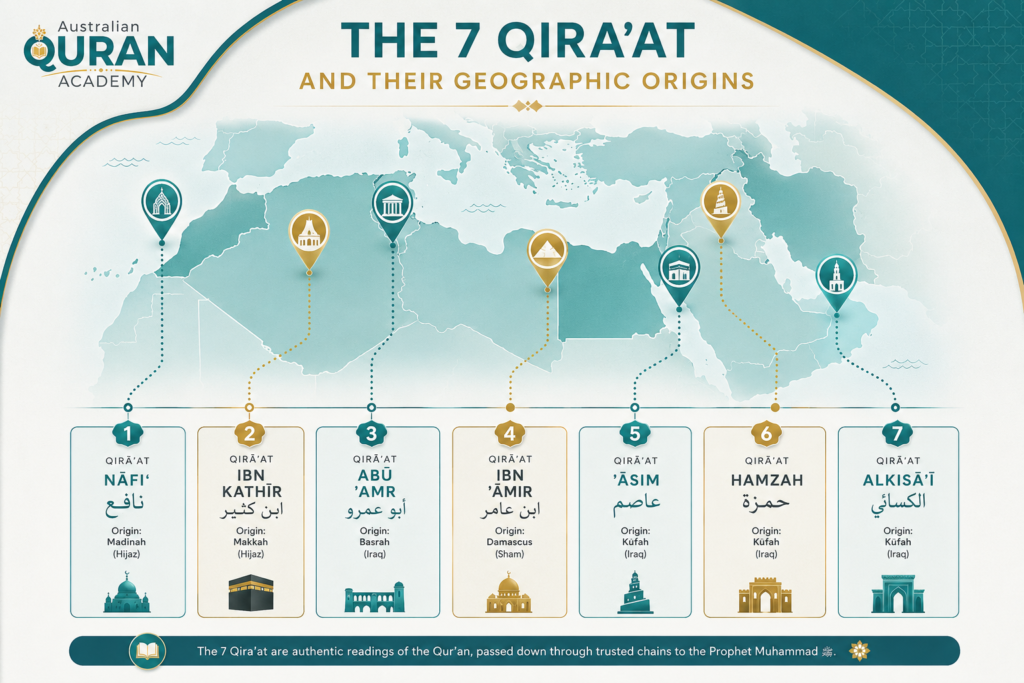
These seven are not ranked by importance — all are equally authentic. The choice of which to study first depends on your background and learning goal.
1. Qira’at Nafi’ (Madinah)
Qira’at Nafi’ originates from Madinah and is transmitted through two narrators: Warsh and Qalun. Warsh’s narration is the standard recitation across North and West Africa, including Morocco, Algeria, Tunisia, and Libya. Its characteristic feature is a smoother, more melodic vowel flow and a distinct treatment of Hamzah (the glottal stop), making it noticeably different from the Hafs style most Australians learn first.
2. Qira’at Ibn Kathir (Makkah)
Transmitted by Al-Bazzi and Qunbul, this Qira’ah originates from Makkah and reflects features of the Quraysh dialect. Its distinguishing characteristic is the handling of vowel elongation (Madd) and specific pronunciation patterns of certain letters — particularly in connected speech.
3. Qira’at Abu ‘Amr (Basra)
Narrated by Al-Duri and Al-Susi, this Qira’ah from Basra is known for its clarity and deliberate rhythmic pauses, which naturally aid comprehension. Al-Duri’s narration of Abu ‘Amr is also used for Abu Ja’far and Ya’qub in some transmission chains.
4. Qira’at Ibn ‘Amir (Damascus)
Ibn ‘Amir’s Qira’ah originates from Damascus and is narrated by Hisham and Ibn Dhakwan. It contains notable variations in vowel lengths and some differences in consonant articulation — including distinct rules around connected Hamzah — that set it apart from the Madinan and Kufan traditions.
5. Qira’at ‘Asim (Kufa)
This is the most widely practised Qira’ah in the world today. Transmitted by two narrators — Hafs and Shu’bah — it is the Hafs narration that is read across the Middle East, South Asia, Southeast Asia, and the vast majority of Muslim communities in Australia. If you have ever recited the Quran from a standard printed Mushaf, you have been using Hafs ‘an ‘Asim without knowing it.
6. Qira’at Hamzah (Kufa)
Narrated by Khalaf and Khallad, this Qira’ah is known for deliberate pauses and extended clarity at verse endings. Its rules around Hamzah substitution and Madd differ significantly from Hafs, making it a meaningful study for students who already have Hafs mastered.
7. Qira’at Al-Kisa’i (Kufa)
Also from Kufa, Al-Kisa’i’s Qira’ah is transmitted by Al-Duri and Abul-Harith. It is known for specific elongation rules and unique treatment of certain verb forms — offering students who study it a window into how grammatical and phonetic variation interplay in Quranic Arabic.
Inside Our Virtual Classrooms
We believe in full transparency and proven quality. Take a look at these actual snippets from our live classes to experience our modern learning platform, patient instructors, and interactive student participation.
Read also: What We Learn From the Quran? – 12 Main Lessons
Start Your Quranic Journey in Australia
Join our leading online academy and learn with expert tutors through a structured, personalized curriculum.
Book Your Free TrialC. How to Learn Qirat of the Quran in Australia? — Step by Step
Learning how to learn qirat of the Quran in Australia requires a structured approach, not just exposure to recordings. The process below is drawn from the method used by teachers holding formal Ijazah in multiple Qira’at.
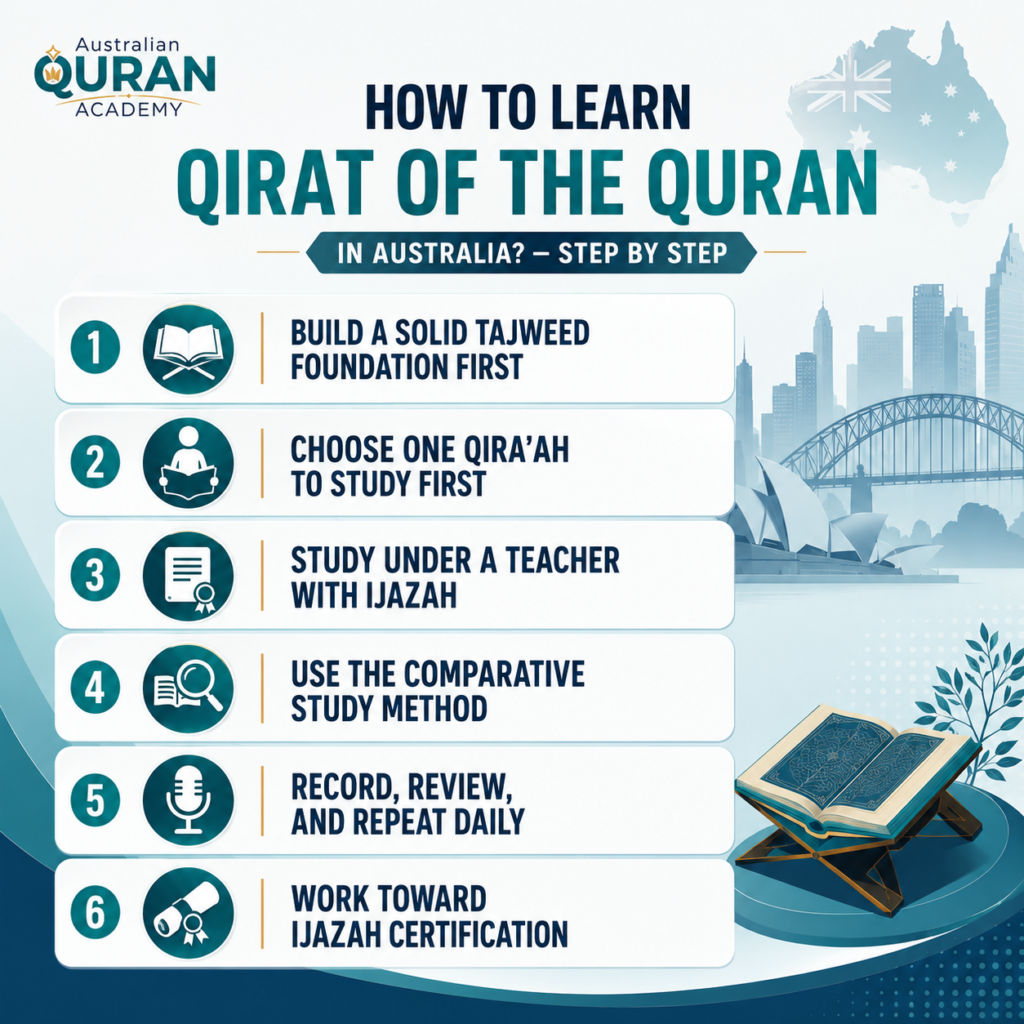
The most common mistake beginners make is skipping Tajweed and jumping straight into Qirat variants. The result is reciting the right words with the wrong sounds — an error that is difficult to correct later because the incorrect pronunciation becomes muscle memory.
Step 1 — Build A Solid Tajweed Foundation First
Every Qira’ah has its own Tajweed rules, but all ten share a common phonetic base: Makharij al-Huruf (precise articulation points of each letter) and Sifat al-Huruf (the characteristics that give each letter its distinct sound).
A student who cannot accurately articulate the difference between ح and ه, or who confuses Tafkheem and Tarqiq, will not be able to hear or reproduce the subtle distinctions between Qira’at.
Start with a Noorani Qaida course to build letter accuracy, then move into Tajweed rules covering Noon Sakinah, Meem Sakinah, Ghunnah, and the Madd categories. Only once you can recite Hafs ‘an ‘Asim without systematic errors are you technically ready for Qirat study.
Australian students looking for structured foundations can explore Quran Classes in Australia to build this base before advancing to Qira’at.
Step 2 — Choose One Qira’ah To Study First
Because each Qira’ah has its own distinct rules, trying to study multiple simultaneously leads to confusion and cross-contamination — a student begins mixing the Madd rules of Warsh with the Hamzah rules of Hafs, producing a recitation that belongs to neither tradition.
The recommended starting point for most Australian students is Warsh ‘an Nafi’, as it is the second most widely taught Qira’ah globally after Hafs and has excellent instructional resources.
Students with West African or Moroccan family backgrounds may find Warsh already familiar to them.
Step 3 — Study Under A Teacher With Ijazah In That Qira’ah
Qira’at cannot be learned from a book or a YouTube recording alone. The oral transmission chain (isnad) is not a formality — it is the verification mechanism that ensures what you are pronouncing matches the authenticated tradition.
A teacher without Ijazah in the specific Qira’ah you are studying cannot transmit it correctly, because they themselves have not received formal verification of their recitation.
When evaluating a teacher, ask two specific questions: which Qira’at does your Ijazah cover, and from which scholar did you receive it? A qualified teacher will answer immediately and specifically.
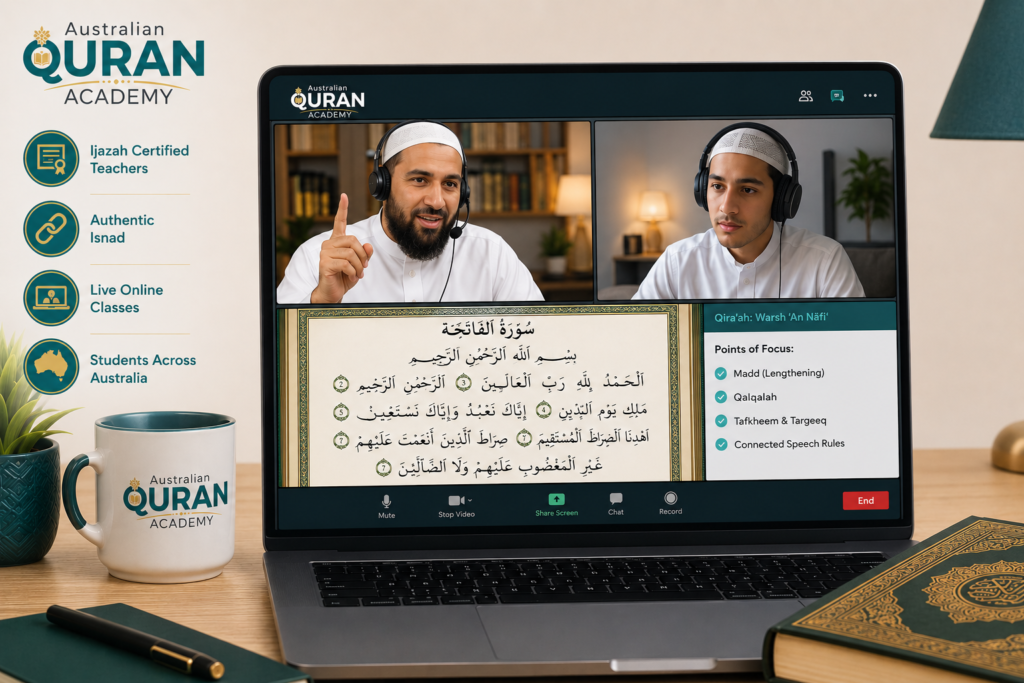
Australian Quran Academy connects students across Australia — including in Sydney, Melbourne, Brisbane, and Perth — with Ijazah-certified teachers for live online sessions.
This removes the geographic barrier that previously made Qira’at study nearly impossible outside of major Islamic learning centres.
If you are newer to Quran study and want to build your reading skills before advancing to Qira’at, Learn Quran for Beginners in Australia is the right starting point.
Step 4 — Use The Comparative Study Method
Once you have a working knowledge of Hafs and are beginning a second Qira’ah, the most effective learning technique is systematic comparison, verse by verse.
Take a passage you know well in Hafs and identify, with your teacher’s guidance, exactly where and how it differs in Warsh (or whichever Qira’ah you are studying).
The key classical text for this comparative study is Al-Taysir fil-Qira’at al-Sab by Al-Dani, which outlines the rules of the seven Qira’at in a structured format. For English-speaking students, Qira’at Made Easy by Dr. Ayman Swayd provides an accessible modern breakdown.
This comparative approach builds the analytical skill to identify Qirat differences independently — which is a requirement for Ijazah evaluation.
Step 5 — Record, Review, And Repeat Daily
Consistent short practice sessions outperform occasional long ones — a principle that applies to all skill acquisition and is especially true for Qira’at, where fine phonetic distinctions require ear training as much as rule memorisation. Fifteen to thirty minutes of focused daily recitation, recorded and reviewed, is more effective than two hours once a week.
Record your recitation on your phone, then compare it to a verified recording of a Qari in the same Qira’ah style. The ear catches errors the mind misses when you are reciting.
Step 6 — Work Toward Ijazah Certification
Ijazah in a Qira’ah is not just a credential — it is the formal confirmation that your recitation has been verified as authentic by a qualified scholar. It connects you directly to the chain of transmission that runs back to the Companions of the Prophet (PBUH).
To work toward Ijazah, you must complete the full recitation of the Quran in the target Qira’ah before a certified teacher, without systematic errors.
This process typically takes one to three years of consistent study for students who begin with a solid Hafs foundation — but the timeline varies significantly based on practice frequency and starting level.
Australian Quran Academy offers Ijazah-track programs specifically designed for Australian students who want to complete this process without travelling to Egypt or Saudi Arabia.
See Us in Action!
Curious about what our online classrooms look like? Watch the short clips below to see how our interactive, one-on-one sessions bring learning to life with real-time feedback and engaging teaching methods.
Start Your Quranic Journey in Australia
Join our leading online academy and learn with expert tutors through a structured, personalized curriculum.
Book Your Free TrialStart Learning Qirat of the Quran at Australian Quran Academy
Australian Quran Academy offers live, one-on-one Qirat instruction for students at every level — from those completing their Tajweed foundation to advanced reciters pursuing formal Ijazah certification.
Every teacher holds verified credentials in the Qira’at they teach, and sessions are scheduled to fit Australian time zones, including evenings and weekends.
You do not need to travel to Cairo or Madinah to access this level of instruction. Our students study from Sydney, Melbourne, Brisbane, Perth, Adelaide, and regional Australia — all through structured live sessions with qualified teachers.
Take your Quran recitation beyond Hafs — study authentic Qira’at with Ijazah-certified teachers from anywhere in Australia.
Our Quran Courses:
- Quran Qirat Learning Course
- Quran Tafsir Course
- Noorani Qaida Course
- Noorani Qaida Course for Kids
- Weekend Quran Classes
- Intensive Quran Course
- Al-Azhar Quran Course
- Online Tajweed Classes
- Tajweed Course for Kids
- Tajweed Course for Adults
- Tajweed Course for Ladies/Sisters
Start Your Quranic Journey in Australia
Join our leading online academy and learn with expert tutors through a structured, personalized curriculum.
Book Your Free TrialConclusion
Learning how to learn qirat of the Quran in Australia is now genuinely achievable — the geographic isolation that once made Qira’at study inaccessible for Muslim communities outside the Arab world no longer applies when qualified teachers are available online.
The key steps are: build your Tajweed foundation first, choose one Qira’ah to study systematically, find a teacher with verified Ijazah in that specific reading, and practice daily with recorded self-review.
The Qira’at are not an advanced elective for scholars — they are the preserved oral heritage of every Muslim community, transmitted unbroken from the Prophet (PBUH).
Engaging with them deepens your connection to the Quran in a way that no amount of translation study can replicate. Australian Quran Academy is here to guide you through that journey, step by step, from wherever you are in Australia.

Frequently Asked Questions About Learning Qirat of the Quran in Australia
Learning Qira’at raises specific questions for Australian students — about prerequisites, time commitment, and how online learning compares to in-person study. The answers below address the most common ones directly.
1. Do I need to memorise the Quran before studying Qira’at?
No, you do not need to be a Hafiz before studying Qira’at, but you must be able to recite fluently in Hafs ‘an ‘Asim with solid Tajweed. The prerequisite is recitation accuracy, not memorisation. Students who can read any passage of the Quran correctly in Hafs are technically ready to begin a second Qira’ah.
2. How long does it take to learn one Qira’ah in Australia?
Most students with a solid Hafs foundation take one to two years of consistent weekly lessons to reach a recitation standard sufficient for Ijazah evaluation in a second Qira’ah. The timeline shortens significantly with daily practice and longer weekly session time.
3. Can I learn Qira’at online if I live in a regional area of Australia?
How to learn Qirat of the Quran in Australia, whether in Sydney or a remote regional town — follows the same path: live online instruction with a qualified teacher is fully sufficient for Qira’at study.The oral transmission that validates the chain of narration occurs in a live session, not a physical classroom. Students in regional Queensland, rural Victoria, or remote Western Australia have the same access as those in major cities.
4. What is the difference between Qira’at and Tajweed?
Tajweed refers to the rules governing correct pronunciation in any Quranic recitation. Qira’at refers to the ten authenticated recitation traditions, each with its own set of Tajweed-level rules. Tajweed is the foundation; Qira’at study builds on top of it. You cannot learn Qira’at without first mastering Tajweed in at least one reading.
5. Which Qira’ah should an Australian student start with after Hafs?
Most Australian students are advised to begin with Warsh ‘an Nafi’, as it has the broadest instructional resources in English, is taught globally, and its differences from Hafs are systematic and well-documented. Students with North African family backgrounds often find Warsh partially familiar, which shortens the learning curve.
6. Does Australian Quran Academy offer Qirat courses for children?
Yes. Australian Quran Academy offers age-appropriate Quran and Arabic learning for children, starting with foundational Arabic and Quran reading skills. Young learners who build strong Arabic foundations early are well-positioned to begin Qira’at study as they advance. Explore Arabic Lessons for Kindergarten in Australia and Learning Arabic for Non-Arabic Speakers in Australia for younger and adult learners respectively. Adults can also benefit from Islamic Studies Courses for Adults in Australia to deepen their broader Islamic knowledge alongside Qirat study.


Leave a Reply