 Quran
Quran
| Key Takeaway |
| Interactive Quran learning is a two-way teaching method — students actively participate through real-time feedback, visual aids, and live exercises, not passive listening. |
| Traditional Quran classes work well inside Muslim-majority environments; in Australia’s minority context, interactive methods fill the cultural and motivational gap they leave. |
| The four learning channels — auditory, visual, kinesthetic, and social — all need to be activated in a session for retention to stick; interactive programs are designed to do exactly that. |
| Live one-on-one correction from a qualified teacher is the irreplaceable core of effective interactive Quran learning — apps and pre-recorded content cannot replicate it. |
| Use the three-question decision framework before enrolling: who is the learner, how flexible is your schedule, and does the program offer a free trial? |
| Australian Quran Academy connects learners of all ages and levels with live, interactive Quran teachers timed to Australian schedules — from anywhere in Australia. |
Learning the Quran in Australia presents a challenge that families in Muslim-majority countries rarely face: no masjid on the corner, no neighbourhood sheikh, no culture of daily Quran recitation surrounding your child from birth.
What you do have is a generation of dedicated Australian Muslim families who refuse to let distance, time zones, or busy schedules break the connection between their children and the Quran. Interactive Quran learning in Australia has made that possible — and this guide explains exactly how.
Whether you are a parent searching for the right program for your child or an adult ready to start or restart your own Quran journey, this guide covers what interactive Quran learning actually is, how it works, what options exist across Australia, and how to choose the right one.
What Is Interactive Quran Learning in Australia?
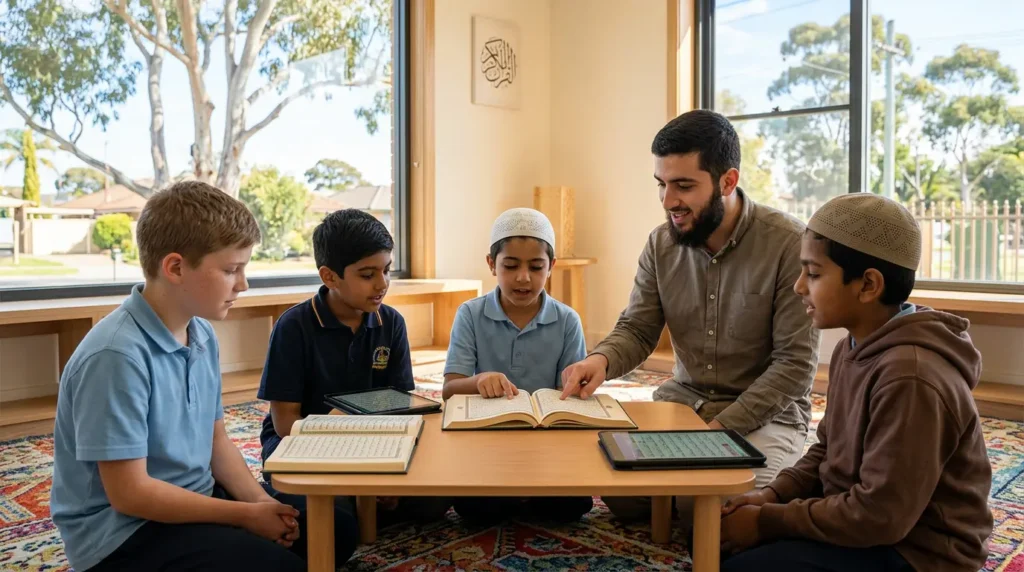
Interactive Quran learning is a two-way teaching method in which students actively participate in every session — through real-time feedback, visual and audio aids, discussion, exercises, and digital tools — rather than passively listening to one-way instruction.
In the Australian context, this matters more than in most places. Australian Muslim learners — children and adults alike — are growing up or living in an environment where Quran education competes with school, sport, screens, and a culture that does not reinforce Islamic practice outside the home.
A traditional model built on rote repetition and long passive sessions loses that competition. An interactive model, designed around how people actually learn, wins it.
The shift is not about technology for its own sake. It is about replacing a one-directional lecture with an experience where the learner’s voice, mistakes, questions, and progress are part of every lesson.
Read also: What We Learn From the Quran? – 12 Main Lessons
How Interactive Quran Learning Differs from Traditional Classes
Traditional Quran instruction, as it has been practised for centuries, works well when a student is embedded in a Quran-rich environment: Arabic spoken at home, Islamic culture present in the community, and daily recitation modelled by adults around them.
Most Australian Muslim families do not have that environment. That gap is exactly where interactive Quran learning in Australia fills the breach.
Traditional Vs. Interactive: A Direct Comparison
Not every Quran classroom looks the same — and the differences go deeper than whether the lesson happens on a screen or in a room.
The table below maps the key structural differences between traditional and interactive Quran learning, so you can see exactly where the gap lies and why it matters for learners in Australia.
| Feature | Traditional Classes | Interactive Quran Learning |
| Instruction style | One-way, teacher-to-student | Two-way, teacher and student exchange |
| Feedback timing | End of session or delayed | Immediate, during recitation |
| Learning aids | Mushaf and verbal correction | Audio, visual, digital whiteboard, games |
| Pacing | Same for all students | Adjusted to each individual learner |
| Student engagement | Passive listening | Active participation throughout |
| Motivation method | Obligation and repetition | Progress tracking, rewards, achievement |
| Suitability for Western context | Low (requires cultural scaffolding) | High (designed for independent learners) |
The practitioner observation worth noting here: the most common early dropout point in traditional Quran classes for children in Western minority contexts is not laziness or disinterest — it is the mismatch between passive instruction and a child who has never been taught that silence and listening are themselves a form of learning.
Interactive methods close that gap by meeting the learner where they are.
Read Also: best time to learn quran
Why Interactive Quran Learning Works?
Education research consistently shows that retention improves when more than one sense is engaged simultaneously. Interactive Quran learning applies this directly.
A student who hears a verse recited correctly, sees the letters highlighted on screen, repeats the recitation aloud, receives instant correction on a makhraj error, and then answers a short quiz about what they practised is engaging at least four distinct learning channels in a single session.
Compare that to hearing the teacher recite and attempting to copy — one channel, minimal feedback, low retention.
Read also: Can You Learn the Quran During Periods? A Complete Guide for Muslim Students
The Four Learning Channels Interactive Quran Programs Activate
Auditory: Listening to certified recitation and receiving real-time pronunciation feedback trains the ear before the tongue. Students who hear Tajweed correctly hundreds of times before being asked to produce it develop far more accurate recitation habits.
Visual: Arabic letter charts, colour-coded Tajweed rules, and highlighted verse segments help learners connect sounds to written forms faster. For students who did not grow up reading Arabic, visual scaffolding is not a crutch — it is essential groundwork.
Kinesthetic: Repetition drills, interactive games, and oral exercises give learners an active role in every session. Children especially need to do something, not just observe.
Social: Live one-on-one sessions with a teacher, or small group classes with peers, build accountability and motivation. Knowing a real person is waiting for you on screen at 6pm is a far stronger motivator than a pre-recorded video lesson you can pause indefinitely.
Read Also: Free Online Quran Classes for Beginners in Australia
See Us in Action!
Curious about what our online classrooms look like? Watch the short clips below to see how our interactive, one-on-one sessions bring learning to life with real-time feedback and engaging teaching methods.
Start Your Quranic Journey in Australia
Join our leading online academy and learn with expert tutors through a structured, personalized curriculum.
Book Your Free TrialInteractive Quran Learning Options Available Across Australia
Access to interactive Quran learning in Australia has expanded considerably. Families in Sydney, Melbourne, Brisbane, Perth, and regional areas now have multiple options across three formats.
1. Online 1-on-1 Tutoring (Available Australia-Wide)
This is the most flexible and widely used format for interactive Quran learning in Australia. Platforms and academies schedule sessions across Australian Eastern, Central, and Western time zones, meaning a family in Perth does not have to take a session at 5am to match a teacher in the Middle East.
Key features of quality online 1-on-1 programs:
- Live video sessions with real-time pronunciation correction
- Interactive whiteboards for visual Tajweed instruction
- Session recording options for self-revision between classes
- Certified female instructors available for sisters and girls
- Flexible session lengths suited to children’s shorter attention spans
Australian Quran Academy offers online Quran classes across Australia in exactly this format — live, personalised, timed to Australian schedules. Whether you are looking for Quran classes in Australia for your child or yourself, the one-on-one format ensures every minute of the session is addressed directly to you.
2. Specialised Interactive Academies
Several dedicated online academies serve the Australian Muslim community with structured curricula that go beyond basic recitation. These programs typically include:
- Progressive Tajweed courses with interactive oral assessments at each stage
- Noorani Qaida programs for absolute beginners — children and adults
- Memorisation (Hifz) programs with spaced repetition review cycles
- Audio-visual lesson boards with recorded session playback
For those beginning from zero, the Learn Quran for Beginners in Australia program at Australian Quran Academy provides a structured, interactive entry point — no prior knowledge required.
3. In-Person and Hybrid Options (Major Cities)
For families who prefer face-to-face instruction, Sydney offers established options including the ISRA Quran Academy in Prestons (NSW), which provides progressive Tajweed and recitation courses, and Quran College Bankstown (NSW), a community-focused centre with small group and individual classes at accessible pricing.
Hybrid models — combining weekly in-person sessions with online interactive practice between them — are increasingly popular for children who benefit from the social environment of a classroom but also need the personalised correction that group teaching cannot always provide.
Read Also: Free Online Quran Classes for Sisters in Australia
How to Choose the Right Interactive Quran Program in Australia
The most common mistake families make when searching for interactive Quran learning in Australia is selecting based on price or convenience alone, without checking whether the program’s interactive tools actually serve the learning objectives they care about.
Use this three-question decision framework before enrolling:
1. Who is the learner, and what do they need most right now?
A six-year-old needs gamification, short sessions, and a patient teacher who can hold attention. A teenager needs social accountability and clear progress milestones. An adult beginner needs explanation-heavy instruction and a low-pressure environment. The right interactive tools differ for each.
2. What level of flexibility does your schedule genuinely require?
Australian families in different states face different scheduling realities. A fully online program gives maximum flexibility; an in-person program gives structure and community. A hybrid program can offer both but requires more logistical coordination.
3. Does the program offer a trial session before commitment?
Any quality interactive Quran program will offer a free trial. If it does not, that is a red flag. A single trial session tells you more about teaching quality, interactivity, and the teacher-student dynamic than any brochure description.
Interactive Tools That Actually Make a Difference
Not all interactive tools contribute equally to Quran learning outcomes. The distinction matters: a tool that entertains without improving recitation accuracy is decoration, not education. Here is what the effective tools actually do.
1. Live Recitation Correction
A teacher who hears you mispronounce ض and immediately models the correct articulation point — showing where in the mouth the sound originates — corrects a mistake that, left uncorrected, becomes a deeply embedded habit. Pre-recorded apps cannot do this.
Live interaction with a qualified teacher is the irreplaceable core of effective interactive Quran learning.
2. Visual Tajweed Aids
Colour-coded Mushaf editions, letter articulation diagrams, and interactive whiteboard annotation help visual learners connect Tajweed rules to specific sounds. A rule explained verbally three times often lands immediately when paired with a diagram.
3. Gamified Progress Tracking
Reward systems, lesson badges, and recitation challenges work particularly well for children aged 5 to 14.
The key practitioner note here: gamification only works when the challenge level is calibrated correctly.
Too easy and the student is bored; too hard and they disengage. A skilled teacher adjusts the challenge in real time — another reason live instruction outperforms pre-recorded apps for children.
4. Spaced Repetition for Memorisation
For students pursuing Hifz or working to retain memorised Surahs, spaced repetition — reviewing material at increasing intervals before memory fades — is the single most evidence-backed memorisation technique available.
The best interactive programs for memorisation build review cycles into each session automatically.
Adults looking to deepen their engagement beyond recitation can explore Islamic Studies Courses for Adults in Australia alongside their Quran practice.
Read Also: best country to learn quran
Interactive Quran Learning for Children in Australia
Children represent the majority of Quran learners in Australia, and they are also the group for whom the choice of teaching method matters most.
A child who has a negative early experience with Quran education — boredom, fear, failure, or feeling left behind — can carry that resistance for years. An engaging, interactive experience does the opposite: it builds a lasting positive association with the Quran.
The interactive approach for children specifically includes:
- Short lesson segments (15–25 minutes is sufficient for under-10s)
- Animated Arabic letter modules for those starting the alphabet
- Recitation games and true/false Quran activities that make practice feel like play
- Storytelling-based learning that connects Quranic narratives to the child’s experience
- Progress badges and visible milestones so children can see how far they have come
For younger children beginning with the Arabic alphabet, Arabic Lessons for Kindergarten in Australia at Australian Quran Academy provides age-appropriate, interactive foundations.
For older beginners approaching Arabic as a language, Learning Arabic for Non-Arabic Speakers in Australia builds the linguistic comprehension that deepens Quran understanding over time.
Australian Quran Academy designs its children’s programs around the reality of how Australian children actually learn: short attention spans, high visual and auditory stimulation, and a need to feel achievement within each session — not just at the end of a long term.
Inside Our Virtual Classrooms
We believe in full transparency and proven quality. Take a look at these actual snippets from our live classes to experience our modern learning platform, patient instructors, and interactive student participation.
Start Your Quranic Journey in Australia
Join our leading online academy and learn with expert tutors through a structured, personalized curriculum.
Book Your Free TrialStart Your Interactive Quran Journey with Australian Quran Academy
You have been looking for a Quran program that fits Australian life — flexible scheduling, qualified teachers, real interaction, and an approach that works for your child or for you as an adult learner. Australian Quran Academy was built for exactly that.
Book your free trial class today. One session is all it takes to see the difference that genuinely interactive Quran teaching makes.
Our Quran Courses:
- Quran Classes for Female/Sisters
- Learn Quran Course for Beginners
- Quran Memorization (Hifz) Course
- Hifz Classes for Adults
- Quran Memorization and Hifz Course for Kids
- Quran Hifz Course for Ladies
- Quran Ijazah Program
- Quran Qirat Learning Course
- Quran Tafsir Course
- Noorani Qaida Course
- Noorani Qaida Course for Kids
- Weekend Quran Classes
- Intensive Quran Course
Start Your Quranic Journey in Australia
Join our leading online academy and learn with expert tutors through a structured, personalized curriculum.
Book Your Free TrialConclusion
Interactive Quran learning in Australia is not a trend — it is the appropriate response to the genuine challenge of raising connected, reciting, and understanding Quran learners in a non-Muslim-majority environment.
The tools matter less than the method: what works is live, two-way instruction from a qualified teacher, supported by visual aids, structured feedback, and a learning experience calibrated to the individual learner’s age and level.
Australian families now have real options across every format — fully online, in-person in Sydney and other cities, and hybrid models that combine both. The decision comes down to your learner’s needs, your schedule, and whether the program offers the genuine interactivity that produces results rather than the surface appearance of it.
Australian Quran Academy brings all of this together in one place, with teachers trained to work with Australian students across all time zones, ages, and starting levels.
Frequently Asked Questions About Interactive Quran Learning in Australia
Whether you are new to online Quran education or looking to switch programs, these questions address the most common decisions Australian Muslim families face.
What is interactive Quran learning and how is it different from regular classes?
Interactive Quran learning is a teaching method in which students actively participate in every session through real-time exercises, immediate feedback, visual aids, and two-way communication with a teacher — unlike traditional classes where students largely listen and repeat without structured engagement. The key difference is that mistakes are caught and corrected immediately, rather than being reinforced over weeks.
Is online interactive Quran learning effective for young children in Australia?
Yes. Online interactive Quran learning is highly effective for young children when sessions are short (15–25 minutes), structured around visual and audio engagement, and taught by a teacher experienced with children. Children aged 4 and above can begin successfully when the teaching method matches their developmental stage.
How do I know if an interactive Quran program is genuinely interactive or just a label?
Ask three questions before enrolling: Does the teacher correct pronunciation in real time during each session? Does the lesson use visual tools beyond a shared PDF? And does the program offer a free trial? A genuinely interactive program will say yes to all three — and the trial will demonstrate it within the first ten minutes.
Can adults with no Arabic background succeed in interactive Quran learning in Australia?
Absolutely. Adult beginners are well-served by interactive programs that offer step-by-step explanation, audio repetition, and a low-pressure environment for making and correcting mistakes. Many Australian adults have learned to recite accurately from zero within a few months of consistent interactive lessons.
What is the best age to start Quran learning for children in Australia?
Most children can begin with the Arabic alphabet and basic Quran recitation between ages 4 and 6, provided the teaching method is age-appropriate, gentle, and interactive. Starting early builds familiarity with Arabic sounds before the critical language acquisition window begins to close.
Does Australian Quran Academy offer classes for all levels?
Yes. Australian Quran Academy serves beginners, intermediate students, and advanced learners — children and adults — with programs covering Quran recitation, Tajweed, Arabic language, and Islamic studies, all delivered through live interactive sessions timed to Australian schedules.

Leave a Reply