 Quran
Quran

| Key Takeaways |
| Scholars differ on whether a woman can recite Quran from memory during her period |
| Touching a printed Mushaf during menstruation is restricted, with a narrow exception for teachers and students |
| Listening to Quran carries no restriction at all during your period |
| Reading Quran from a phone or tablet is treated differently from touching a physical Mushaf |
| You rarely need to pause your Quran learning entirely — there are permitted ways to keep progressing |
Many female students pause their studies the moment their period starts, worried they are doing something wrong.
This guide answers the question can we learn Quran during periods in plain terms, based on the classical scholarly positions on this issue.
It also covers the related question many students ask directly: can I learn Quran while on my period, including what is allowed with recitation, memorization, and physical copies of the Quran.
At Australian Quran Academy, this question comes up often from students enrolled in Quran Classes in Australia, so this article lays out the rulings clearly and explains how a student can keep progressing without interruption.
Can We Learn the Quran During Periods? Understanding the Scholarly Views
Scholars have held two different positions on this, and both are respected within Islamic jurisprudence. Understanding the reasoning behind each helps a student make an informed choice rather than guessing.
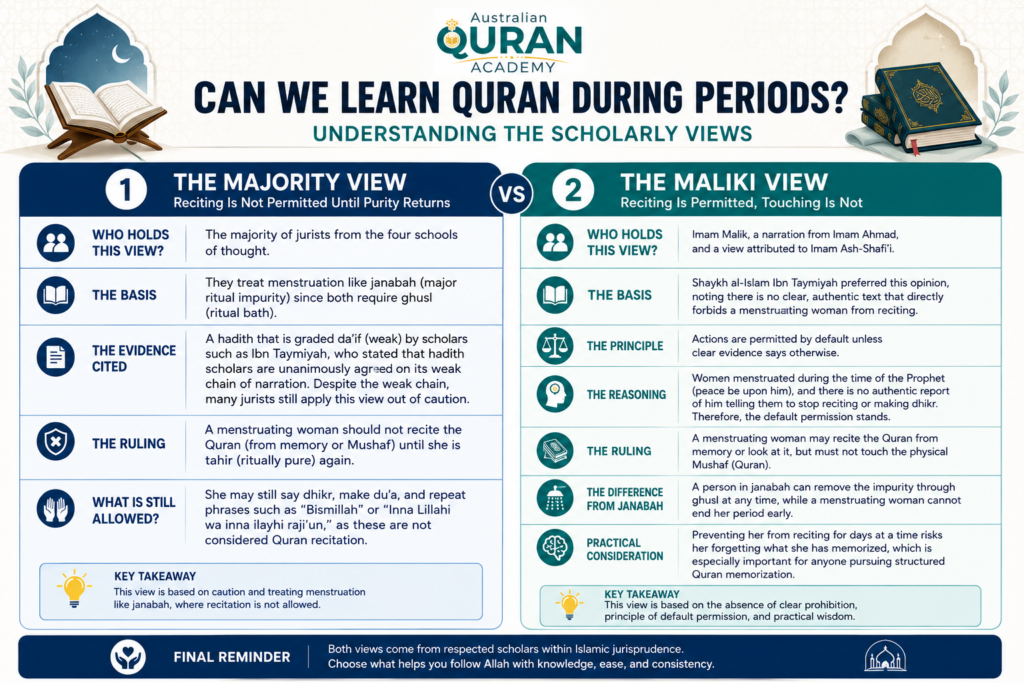
1. The Majority View: Reciting Is Not Permitted Until Purity Returns
The majority of jurists hold that a menstruating woman should not recite the Quran until she is tahir (ritually pure) again. This view treats menstruation similarly to the state of janabah (major ritual impurity following intercourse), since both require ghusl.
The main hadith cited for this position is graded da’if (weak) by scholars such as Ibn Taymiyah, who noted this was the unanimous agreement of hadith scholars regarding its chain of narration. Despite the weak chain, many jurists still apply this position out of caution.
Under this view, a woman may still say dhikr, make du’a, or repeat phrases like “Bismillah” or “Inna Lillahi wa inna ilayhi raji’un,” since these are not treated as an act of Quran recitation on their own.
2. The Maliki View: Reciting Is Permitted, Touching Is Not
Imam Malik, along with a narration from Imam Ahmad and a view attributed to Imam Ash-Shafi’i, held that a menstruating woman may recite the Quran, but without touching the physical Mushaf.
Shaykh al-Islam Ibn Taymiyah preferred this opinion, noting there is no clear, authentic text that directly forbids a menstruating woman from reciting.
This view rests on a key legal principle: actions are permitted by default unless clear evidence says otherwise.
Since women menstruated during the time of the Prophet (peace be upon him) and there is no authentic report of him telling them to stop reciting or making dhikr, the default permission stands.
This position also points out a real difference between janabah and menstruation: a person in janabah can remove the impurity through ghusl at any time, while a menstruating woman cannot end her period early.
Preventing her from reciting for days at a time risks her forgetting what she has memorized, which matters directly for anyone pursuing structured Quran memorization.
Read also: How To Learn Quran Quickly In Australia? 9 Steps That Actually Work
Students working through a structured program, such as those in Learn Quran for Beginners in Australia, often ask their teacher which view to follow.
This is exactly why the question of whether we can learn Quran during periods has no single verdict — both positions are supported by respected scholars, so a student is generally free to follow the opinion she is most confident in, ideally after asking a knowledgeable teacher or local scholar.
Inside Our Virtual Classrooms
We believe in full transparency and proven quality. Take a look at these actual snippets from our live classes to experience our modern learning platform, patient instructors, and interactive student participation.
Start Your Quranic Journey in Australia
Join our leading online academy and learn with expert tutors through a structured, personalized curriculum.
Book Your Free TrialCan I Learn Quran While on My Period? What Students Need to Know
Learning the Quran involves more than reciting from memory. It also involves touching a physical copy, listening to recordings, and using digital tools. Each of these is treated differently.
1. Touching The Physical Mushaf During Menstruation
The majority of scholars — across the Hanafi, Shafi’i, Hanbali, and Maliki schools — agree that touching the physical Mushaf is not permitted during menstruation. This is based on the verse:
لَّا يَمَسُّهُۥٓ إِلَّا ٱلْمُطَهَّرُونَ
“None shall touch it except the purified.” (Surah Al-Waqi’ah, 56:79)
This is also supported by the letter the Prophet (peace be upon him) sent to the people of Yemen through ‘Amr ibn Hazm, stating that no one should touch the Quran except one who is pure.
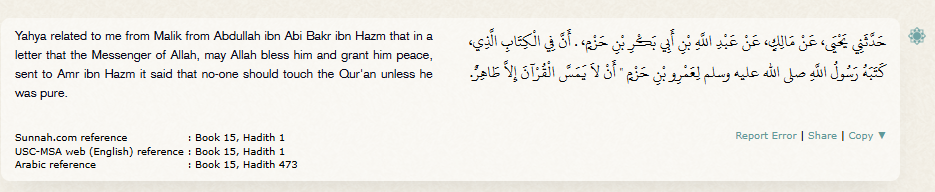
Al-Hafiz Ibn Hajar noted that a group of scholars accepted this letter as authentic due to how widely it was known and transmitted among early scholars of sirah.
There is one notable exception recognized by Maliki scholars: a teacher or student may touch the Mushaf, page, or a bound section of it during menstruation if it is genuinely needed for teaching or learning, since she has no way to remove this state of impurity the way someone in janabah can through ghusl or tayammum.
This exception is specifically tied to the purpose of instruction, not general reading.
Read also: The Importance Of Learning And Teaching The Quran
2. Listening And Memorization-Based Learning During Menstruation
Listening to Quran recitation carries no restriction at all during menstruation, regardless of which scholarly view a student follows.
A student can continue listening to her teacher, following along with recorded recitation, and reinforcing memorization purely by ear.
This matters practically: a student who is following the majority view and pausing active recitation can still keep her memorization from fading by listening daily, rather than stepping away from the Quran entirely for the length of her cycle.
3. Using Digital Quran Apps And Recordings
Reading Quran text from a phone or laptop screen is a separate case from touching a printed Mushaf.
Contemporary scholars, including Shaykh Abdul Rahman al-Barrak, have explained that a screen displays the letters as a temporary pattern of light rather than a fixed, physical script, so it is not treated the same as a bound copy of the Quran.
Based on this reasoning, a menstruating woman may read Quran text from a mobile phone, tablet, or laptop, and this is not considered “touching the Mushaf” in the legal sense.
This gives students a practical option: continue reading along on a screen during their period, even under the stricter view on physical copies.

This is one reason online learning has become useful for female students specifically — screen-based reading sidesteps the touching restriction entirely.
Students enrolled through Islamic Studies Courses for Adults in Australia can keep their weekly progress on track using this method without needing to handle a printed Mushaf.
Practical Guidance for Students and Teachers
A student does not need to memorize every scholarly opinion to handle this correctly. A few practical decision points cover most situations.
- If reciting from memory: follow the view you are most confident in, or ask your teacher
- If reading from a printed Mushaf: avoid direct touching unless you are teaching or learning and have no alternative
- If reading from a phone, tablet, or app: this is permitted under the reasoning that a screen is not a physical Mushaf
- If listening only: no restriction applies at all
One common mistake is assuming that because reciting is disputed, listening must also be restricted — it is not. Another is assuming a phone screen carries the same restriction as a printed copy, which contemporary scholarly reasoning does not support.
A third mistake is stopping all engagement with the Quran for the entire cycle out of over-caution, which can set back memorization progress unnecessarily.
Teachers at Australian Quran Academy generally guide students toward the option that keeps them engaged with their learning — listening, screen-based reading, or cautious recitation — rather than a full pause, since consistency matters more for retention than any single week off.

See Us in Action!
Curious about what our online classrooms look like? Watch the short clips below to see how our interactive, one-on-one sessions bring learning to life with real-time feedback and engaging teaching methods.
Start Your Quranic Journey in Australia
Join our leading online academy and learn with expert tutors through a structured, personalized curriculum.
Book Your Free TrialKeep Your Quran Learning on Track, Whatever Stage You’re At
A pause in recitation does not have to mean a pause in learning. With the right guidance, students can keep listening, reviewing, and progressing through their memorization goals every week of the month.

Australian Quran Academy pairs every student with a qualified teacher who explains these rulings clearly and structures lessons around them, so questions like this never derail your progress.
Our Quran Courses:
- Quran Recitation Classes
- Quran Reading Classes
- Online Quran Classes for Kids
- Quran Classes for Adults
- Quran Classes for Female/Sisters
- Learn Quran for Beginners
- Quran Memorization (Hifz) Course
- Hifz Classes for Adults
- Quran Memorization and Hifz for Kids
- Quran Hifz for Ladies
- Quran Ijazah Program
- Quran Qirat Learning Course
- Quran Tafsir Course

Start Your Quranic Journey in Australia
Join our leading online academy and learn with expert tutors through a structured, personalized curriculum.
Book Your Free TrialConclusion
The question of whether we can learn Quran during periods does not have one single answer — it depends on whether you are reciting, touching a physical Mushaf, listening, or reading from a screen.
The majority view pauses active recitation until purity returns, while the Maliki view, preferred by Ibn Taymiyah, permits recitation without touching the printed copy.
Touching a physical Mushaf remains restricted under nearly all schools of thought, with a narrow exception for teachers and students who have no alternative. Listening carries no restriction, and reading from a phone or tablet is generally treated differently from touching a bound Mushaf.
For a student asking can I learn Quran while on my period, the honest answer is: you have several permitted ways to keep learning, and stopping entirely is rarely necessary.
Speaking with a knowledgeable teacher, such as those guiding students through Learning Arabic for Non-Arabic Speakers in Australia or Quran memorization tracks, helps you apply the ruling you’re most comfortable with consistently.
Frequently Asked Questions
Here are direct answers to the most common questions students ask about learning Quran during their period.
1. Can we learn Quran during periods by listening only?
Yes, listening to Quran recitation is permitted during periods with no restriction under any scholarly view. You can follow along with recordings or a teacher’s recitation to maintain memorization even while pausing active recitation yourself.
2. Can I learn Quran while on my period using a phone or tablet?
Yes, reading Quran text from a phone, tablet, or laptop is generally permitted during your period. Scholars explain that a screen displays letters as a temporary digital pattern, not a fixed physical script, so it is not treated as touching the Mushaf.
3. Is it permitted to touch a printed Mushaf during my period?
No, touching a physical Mushaf during your period is not permitted according to the majority of scholars, based on Surah Al-Waqi’ah 56:79. The one exception is for teachers or students who need direct contact with the text for instruction and have no alternative.
4. Can a woman recite Quran from memory during her period?
This is disputed among scholars. The majority say recitation should wait until purity returns, while Imam Malik’s view, favored by Ibn Taymiyah, permits recitation from memory as long as the physical Mushaf is not touched.
5. Should I pause my Quran classes entirely during my period?
No, pausing entirely is usually unnecessary. Most students continue through listening, screen-based reading, or cautious recitation, depending on the scholarly view they follow, so weekly memorization progress does not have to stop.








Leave a Reply