 Quran
Quran

| Key Takeaway |
| There is no single “magic” dua for learning Quran — a collection of supplications covers different needs: ease, retention, focus, and spiritual connection. |
| Rabbi zidni ‘ilma (Surah Taha 20:114) is the most concise and powerful dua for knowledge, drawn directly from the Quran. |
| Specific times — the last third of the night, sujood, and after obligatory prayers — carry heightened acceptance of supplication in the Sunnah. |
| Dua works alongside practical method, not in place of it — revision, consistency, and qualified teaching remain essential. |
| Pairing your supplications with enrolment in a structured Quran learning programme dramatically accelerates both memorisation and retention. |
Every Muslim who has sat with the Quran — whether beginning for the first time or deep into memorisation — has felt the weight of that moment when the words simply won’t stick. Minds wander. Verses slip. Progress stalls. And in those moments, the most powerful move a student can make is not to study harder — it is to ask.
Dua for learning Quran is not a ritual add-on to your study routine. The Quran itself describes the Book as something that can be forgotten — and in the same breath, points the believer back to Allah: “We will make you recite, and you will not forget — except what Allah wills.” (Surah Al-A’la 87:6–7). The solution to forgetting is not willpower alone. It is supplication.
This guide covers the most authentic and widely practised duas for learning Quran — drawn from the Quran and verified Sunnah — along with the best times to make them, the spiritual etiquette that surrounds them, and how to combine them with a practical study method that actually works.
At Australian Quran Academy, we work with students across Australia who are at every stage of this journey. We have seen consistently that the students who combine sincere dua with structured, consistent learning outperform those who rely on effort alone.
1. Dua To Learn Quran For Seeking Knowledge
Of all the duas a student can begin with, this one carries the greatest weight — because it comes from the Quran itself, as a direct instruction to the Prophet ﷺ. It is the starting point for every serious learner, and the one supplication that should bookend every study session without exception.
رَبِّ زِدۡنِي عِلۡمًا
Rabbi zidnī ‘ilmā
“My Lord, increase me in knowledge.” (Surah Taha 20:114)
This is one of only two instances in the entire Quran where Allah (SWT) commands the Prophet ﷺ to ask for more of something — and that something is knowledge. The simplicity of this dua is deliberate: it places the student in a posture of complete dependence on Allah as the ultimate source of all knowledge.
For learning Quran specifically, recite it before every study or memorisation session. Its brevity makes it easy for young children to memorise and use daily — what it lacks in length, it more than compensates for in theological weight.
Recite this dua for learning Quran before every study or memorisation session. Every time a student says it, they are following the direct instruction of the Quran itself.
2. Dua To Learn Quran By Heart For Beneficial Knowledge And Retention
Memorising words is not the same as benefiting from them. This supplication addresses something that most students overlook — asking Allah not just for more knowledge, but for the knowledge they already have to become genuinely useful and lasting.
It is one of the most complete duas for learning Quran because it covers the full arc of the journey: past, present, and future learning.
اللَّهُمَّ انْفَعْنِي بِمَا عَلَّمْتَنِي، وَعَلِّمْنِي مَا يَنْفَعُنِي، وَزِدْنِي عِلْمًا
Allāhumma anfa’nī bimā ‘allamtanī, wa ‘allimnī mā yanfa’unī, wa zidnī ‘ilmā
“O Allah, benefit me with what You have taught me, teach me what will benefit me, and increase me in knowledge.”
This dua is reported from the Prophet ﷺ and recorded by Ibn Majah.
It contains three distinct requests critical to every student: that existing knowledge becomes beneficial, that new knowledge be granted, and that growth continues.
Recite it upon completing a study session, not just before. A student can memorise an entire Juz’ and still not be changed by it — this supplication asks Allah to make the learning transformative, not merely technical.
3. Dua For Ease When Learning Feels Difficult
Every student hits a wall. A passage that refuses to settle. A session where nothing goes right. A stretch of weeks where the energy that drove early progress has gone quiet. This dua for learning Quran is specifically for those moments — and it works by changing the student’s internal frame before changing anything external.
اللَّهُمَّ لاَ سَهْلَ إِلاَّ مَا جَعَلْتَهُ سَهْلاً، وَأَنْتَ تَجْعَلُ الْحَزْنَ إِذَا شِئْتَ سَهْلاً
Allāhumma lā sahla illā mā ja’altahu sahlan, wa anta taj’alul-hazna idhā shi’ta sahlan
“O Allah, there is no ease except in that which You have made easy. If You wish, You can make the difficult easy.” [Hisn al-Muslim]
Use this dua when a student feels stuck — when a passage won’t stick, when focus has collapsed, or when the task feels overwhelming.
It instils a profound sense of tawakkul (reliance on Allah) by shifting the internal frame from “this is too hard” to “Allah can make this easy for me.” That is not a small psychological shift. It is the difference between a student who persists and one who gives up.
Read Also: What We Learn From Quran
4. The Dua Of Prophet Musa (As) For Clarity And Fluency
Prophet Musa (AS) was not sent to face Pharaoh with his own strength alone. When given the greatest challenge of his prophethood, his immediate response was supplication — and that same supplication maps directly onto the challenges every Quran student faces. Among the duas for learning Quran that address the physical act of recitation, this is the most specific and the most powerful.
رَبِّ اشْرَحْ لِي صَدْرِي وَيَسِّرْ لِي أَمْرِي وَاحْلُلْ عُقْدَةً مِّن لِّسَانِي يَفْقَهُوا قَوْلِي
Rabbish-rahli sadri, wa yassir li amri, wahlul ‘uqdatam-min lisani, yafqahu qawli
“My Lord, expand for me my breast, and ease for me my task, and untie the knot from my tongue, that they may understand my speech.” (Surah Taha 20:25–28)
This supplication contains three requests that speak directly to Quran learning: “expand my breast” asks for confidence and relief from anxiety; “ease my task” asks for the difficult to become manageable; “untie the knot from my tongue” asks for fluency of recitation.
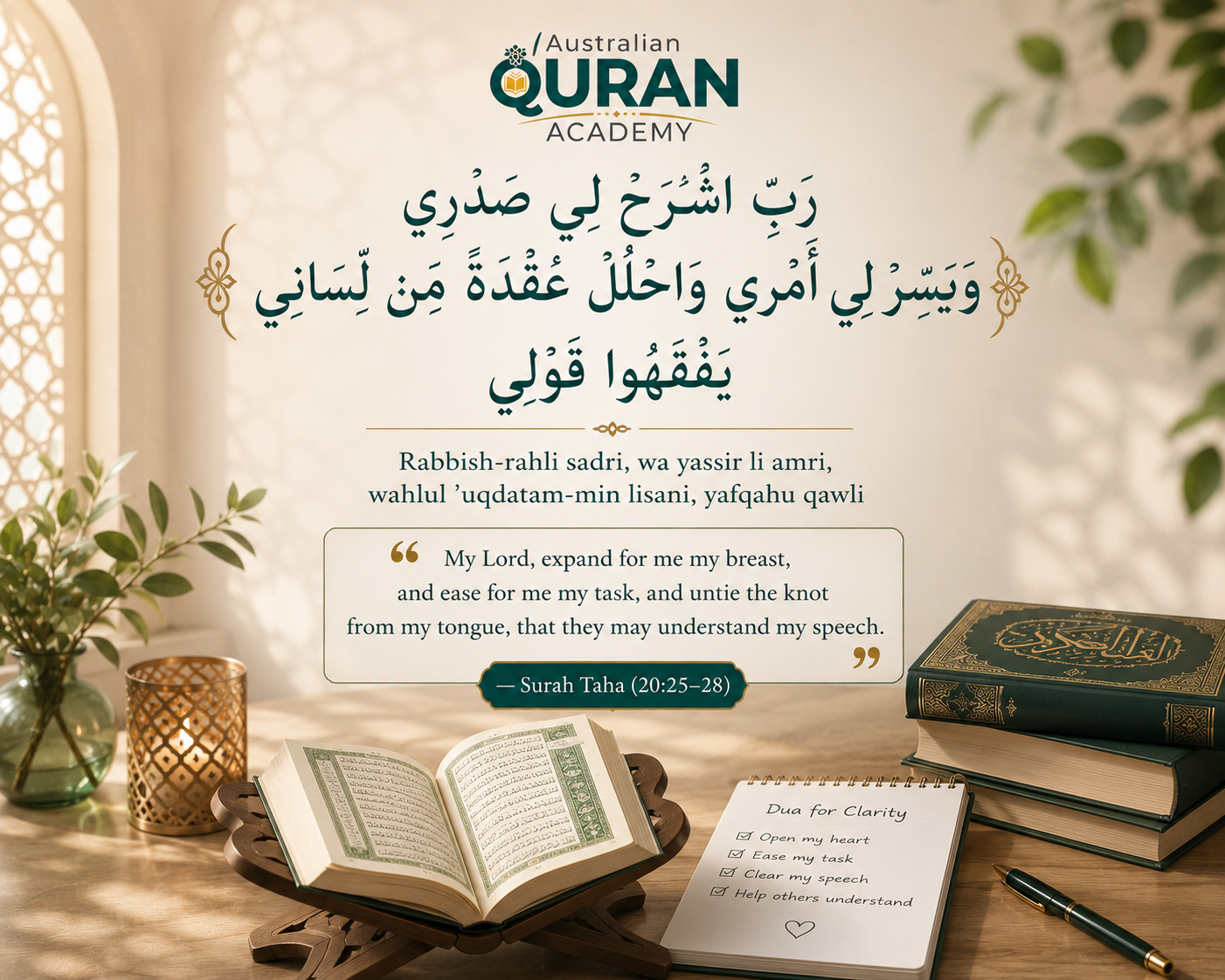
This last part is particularly powerful for students working on Tajweed — it is a direct supplication for the mouth to produce what the heart intends. Recite it before practice sessions focused on pronunciation and recitation accuracy.
See Us in Action!
Curious about what our online classrooms look like? Watch the short clips below to see how our interactive, one-on-one sessions bring learning to life with real-time feedback and engaging teaching methods.
Start Your Quranic Journey in Australia
Join our leading online academy and learn with expert tutors through a structured, personalized curriculum.
Book Your Free Trial5. Dua For the Quran to Settle in the Heart
There is a stage in every learner’s journey where the Quran has been studied but not yet felt — where it lives in the memory but not yet in the chest. This supplication is for exactly that transition: from mechanical knowledge to living connection.
اللَّهُمَّ اجْعَلِ الْقُرْآنَ رَبِيعَ قَلْبِي، وَنُورَ صَدْرِي، وَجَلَاءَ حُزْنِي، وَذَهَابَ هَمِّي وَغَمِّي
Allāhumma ij’al al-Qur’āna rabī’a qalbī, wa nūra ṣadrī, wa jalā’a ḥuznī, wa dhahāba hammī wa ghammī
“O Allah, make the Quran the spring of my heart, the light of my chest, the remover of my sadness, and the reliever of my worry and grief.”
Recorded by Imam Ahmad ibn Hanbal in his Musnad [Musnad Ahmad, No. 3712], this supplication shifts the goal of learning Quran from technical to spiritual.
The metaphor of the Quran as rabi’ — spring — is deliberate: just as spring renews the earth after winter, the Quran renews a heart that has grown distant through distraction or routine. Recite this when motivation is low or the study sessions have started to feel mechanical and joyless.
6. Dua to Learn Quran For Firm Retention and Not Forgetting
Forgetting memorised Quran is one of the most demoralising experiences a student can face. What was hard-won over weeks can seem to dissolve in days. Understanding that forgetting is a known reality — addressed directly in the Sunnah — makes it far easier to respond with supplication rather than despair.
اللَّهُمَّ ثَبِّتِ الْقُرْآنَ فِي قَلْبِي، وَلَا تَجْعَلْنِي أَنْسَاهُ مَا حَيِيتُ
Allāhumma thabbit al-Qur’āna fī qalbī, wa lā taj’alnī ansāhu mā ḥayītu
“O Allah, make the Quran firm in my heart, and do not let me forget it as long as I live.”
The Prophet ﷺ addressed forgetting directly: “Keep refreshing your knowledge of the Quran, for by the One in Whose Hand is my soul, it escapes faster than a camel from its tying ropes.” [Sahih al-Bukhari, No. 5033].
This dua pairs with that warning — asking Allah to do what consistent revision alone cannot guarantee. It is especially important for students who have memorised substantial portions and are now focused on preserving what they have built.
7. Dua For Recitation And Restoring What Was Forgotten
Recitation and memorisation are closely linked, but they are not the same thing. A student can have memorised a passage and still struggle to recall it under pressure — and a student can recite without truly engaging. This supplication covers both needs in a single, comprehensive plea.
اللَّهُمَّ ارْزُقْنِي تِلَاوَةَ الْقُرْآنِ وَذَكِّرْنِي مِنْهُ مَا نَسِيتُ وَعَلِّمْنِي مِنْهُ مَا جَهِلْتُ
Allāhumma arzuqnī tilāwata al-Qur’āni wa dhakkirnī minhu mā nasītu wa ‘allimnī minhu mā jahiltu
“O Allah, grant me the recitation of the Quran, remind me of what I have forgotten from it, and teach me from it what I am ignorant of.”
This supplication acknowledges three realities simultaneously: that recitation is a gift (rizq) from Allah, not an entitlement; that forgetting is part of the human condition, not a personal failing; and that there is always more to learn, no matter how advanced the student.
Recite it when sitting down for your daily revision session, particularly on days when what was memorised yesterday feels distant today.
If you are just beginning your recitation journey, Australian Quran Academy’s Learn Quran for Beginners in Australia programme provides the structured foundation that makes these duas land in fertile ground.

What Is The Role Of Dua For Learning Quran?
Before moving to timing and method, it helps to understand what dua actually does within the learning process — because most students either underestimate it or misuse it by treating it as a quick ritual rather than a sustained spiritual practice.
Dua (دعاء) in the context of Quran learning is the act of asking Allah (SWT) directly to grant ease of retention, clarity of understanding, and permanence of what has been memorised or recited. It is the spiritual condition that makes structured effort productive.
The Prophet Muhammad ﷺ said: “Dua is worship.” [Sunan Abu Dawud].
This means the student is rewarded simply for making the supplication — independent of how much was memorised that day. The act of asking is itself an act of worship.
Importantly, dua is not a replacement for method. Consistent revision (muraaja’ah), correct recitation with Tajweed, and learning under a qualified teacher are all required. What dua does is surround that effort with the conditions most favourable for Allah’s acceptance and barakah.
A common mistake is treating it as something to say once, quickly, before opening the Quran — the more effective approach is to build it into the entire routine, before and after, with presence of heart rather than speed.
Read Also:Can I Learn Quran Without Wudu
Best Times To Make Dua For Learning Quran
Knowing the right supplication is only half the equation. Knowing when to make it is the other half — because not all moments carry the same spiritual weight, and placing your most important duas at the right times dramatically increases the likelihood of acceptance.
These times are established in the Sunnah as periods when supplication is most likely to be accepted:
| Time | Evidence |
| Last third of the night (Tahajjud) | Allah descends to the lowest heaven and calls: “Who is supplicating so I may answer?” [Sahih al-Bukhari, No. 1145] |
| During sujood (prostration) | “The closest a servant is to his Lord is when he is in sujood, so make much supplication.” [Sahih Muslim, No. 482] |
| Between adhan and iqamah | “Dua between the adhan and iqamah is not rejected.” [Sunan Abu Dawud, No. 521] |
| After Fajr and Asr prayers | Specifically when angels gather [Sahih al-Bukhari, No. 555] |
| Friday — final hour before Maghrib | “There is an hour on Friday in which no Muslim asks Allah for good except that He gives it to him.” [Sahih al-Bukhari, No. 935] |
| Laylat al-Qadr (last 10 nights of Ramadan) | Better than a thousand months (Surah Al-Qadr 97:3) |
A practical recommendation: place your dua for learning Quran immediately after Fajr, before your study session begins.
The early morning hours combine the spiritual weight of post-Fajr supplication with the brain’s peak receptiveness to new memorisation — the two reinforce each other powerfully.
Read Also: Free Online Quran Classes for Kids in Australia
Inside Our Virtual Classrooms
We believe in full transparency and proven quality. Take a look at these actual snippets from our live classes to experience our modern learning platform, patient instructors, and interactive student participation.
Start Your Quranic Journey in Australia
Join our leading online academy and learn with expert tutors through a structured, personalized curriculum.
Book Your Free TrialStart Your Quran Learning Journey with Australian Quran Academy
Sincere dua opens the door. Structured, expert-guided learning is how you walk through it. If you have been making dua for learning Quran and are ready to pair that intention with a programme that matches your commitment, Australian Quran Academy is built exactly for that.

Australian Quran Academy offers expert-led Quran Classes in Australia for students of all ages and backgrounds — from complete beginners to those deepening their Hifz. Our instructors combine authentic Islamic knowledge with teaching methods designed for Muslim families living in the West.
Whether you are an adult beginning for the first time or a parent looking to start your child on this journey, Australian Quran Academy’s Islamic Studies Courses for Adults in Australia and full Quran curriculum are built around your life, your schedule, and your goals.
Our Islamic Studies Courses:
- Islamic Studies Courses
- Islamic Studies Courses for Kids
- Islamic Studies Courses for Adults
- Islamic Studies Courses for Female

Conclusion
The dua for learning Quran is not one supplication — it is a collection of them, each addressing a different need at a different stage of the journey. Rabbi zidni ‘ilma before you begin. The dua of Prophet Musa (AS) when a passage feels impossible. The retention dua when you fear forgetting what you’ve worked to preserve. The spring-of-my-heart supplication when the routine has gone cold.
What runs beneath all of them is the same recognition: the Quran is Allah’s Book, and only Allah can truly open it for you. Every student who has sat with it seriously knows that some days the words flow and some days they do not — and the difference is rarely just effort. It is tawfiq: divine facilitation.
Ask for it. Consistently, sincerely, at the right times, in the right condition. Then show up to your study session and do the work. That combination — dua to learn Quran paired with structured method — is what the most successful learners across history have understood. And it is what Australian Quran Academy helps students in Australia build, one lesson at a time.

Frequently Asked Questions About Dua for Learning Quran
Whether you are new to this journey or looking to deepen your practice, these answers address the most common questions students and parents ask about supplication and Quran learning. Each answer is designed to give you clarity quickly — so you can spend more time practising and less time searching.
1. Is there one specific dua for learning Quran?
There is no single obligatory dua, but several authenticated supplications are widely recommended. The most concise is Rabbi zidni ‘ilma (Surah Taha 20:114) — a direct Quranic instruction to seek more knowledge. It can be recited before every session by students of any age.
2. Can I make dua in English for learning Quran?
Yes. Allah hears supplication in every language, and presence of heart (khushu’) matters far more than the language used. A sincere dua in English carries more weight before Allah than a memorised Arabic phrase recited without attention. Scholars across all major schools of thought are unanimous on this point.
3. What is the best time to make dua for learning Quran?
The strongest times are the last third of the night (tahajjud), during sujood, between the adhan and iqamah, and after the obligatory prayers — particularly Fajr. For students with a morning study routine, making dua immediately after Fajr prayer, before opening the Quran, combines spiritual and practical benefit in one step.
4. What do I do when I keep forgetting what I’ve memorised?
Forgetting is normal — the Prophet ﷺ described the Quran as faster to escape than camels from their ropes. The practical response is structured daily revision across three tiers: new material, recent material (within 7 days), and older memorised portions. The spiritual response is the dua: Allāhumma thabbit al-Qur’āna fī qalbī wa lā taj’alnī ansāhu mā ḥayītu — “O Allah, make the Quran firm in my heart and do not let me forget it as long as I live.”
5. Can children use these duas for learning Quran?
Yes — and teaching them early is one of the best investments a parent can make. Rabbi zidni ‘ilma is short enough for children aged 4–5 to memorise and recite daily. The Musa (AS) dua is ideal for older children facing challenging passages. Building the habit of asking Allah before study instils lifelong tawakkul and spiritual awareness. Australian Quran Academy’s Quran classes for children are designed to reinforce exactly this approach.






Leave a Reply