 Quran
Quran
| Key Takeaways |
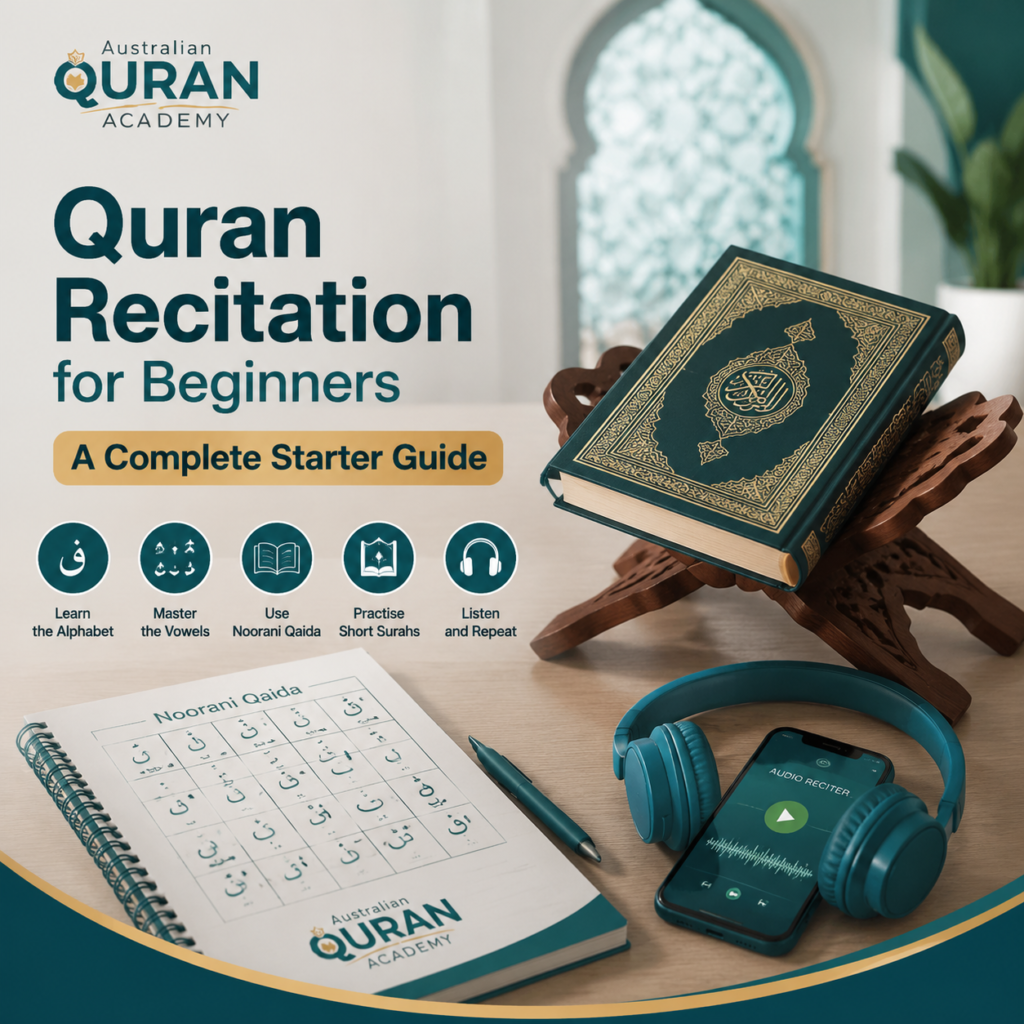
| Quran recitation for beginners starts with the Arabic alphabet and basic pronunciation (Tajweed) — not with memorising long chapters. |
| The proven path has five stages: learn the alphabet, master the vowels (Harakat), work through Noorani Qaida, practise short surahs, then listen and repeat with recognised reciters. |
| Pronunciation comes before pace: reading slowly and correctly is what builds real fluency and improves the focus (Khushu) of your daily Salah. |
| Just 15–20 minutes of daily practice produces stronger progress than one long weekly session. |
| Most beginners finish Noorani Qaida in 2–4 months and reach full reading fluency with Tajweed in about 2–3 years of consistent study. |
| One-on-one lessons with a certified teacher catch mistakes early, before bad habits form — the single biggest factor in learning to recite correctly. |
| Australian Quran Academy offers structured, one-on-one beginner recitation classes in Australia, taking learners from their first Arabic letter through to fluent Tajweed. |
Learning quran recitation for beginners doesn’t start with memorising long chapters — it starts with a single Arabic letter pronounced correctly.
If you’ve ever opened the Mushaf and felt unsure where to begin, you’re in the right place. This guide lays out exactly how a beginner learns to read the Quran properly, what to expect at each stage, and how long it realistically takes.
Reciting the Quran well matters because a slight change in the articulation of a letter can change the meaning of a word. That’s why beginners are taught pronunciation before speed, and rules before volume.
Whether you’re an adult starting from zero, a revert learning the alphabet for the first time, or a parent guiding a child, the path below applies to you.
What Quran Recitation For Beginners Really Means?
Quran recitation for beginners is the structured process of learning to read the Quran in Arabic with correct pronunciation, starting from the alphabet and building toward fluent reading with Tajweed rules.
It is not the same as memorisation. Recitation is about reading correctly from the page; memorisation comes later. A beginner’s goal is simple: recognise every Arabic letter, produce its sound from the right place in the mouth, and connect letters into words accurately.
A good beginner course builds this foundation in a fixed order — alphabet first, then vowel marks, then joining letters, then short surahs. Skipping ahead is the single most common reason beginners develop reading errors that are hard to unlearn later.
The Two Foundation Skills Every Beginner Needs
Two things carry a beginner further than anything else: the Arabic alphabet and basic Tajweed.
The alphabet is usually taught through a structured primer called Noorani Qaida (or the similar Noor Al Bayan). It teaches letter shapes, letter sounds, and the vowel marks that change how each letter is read. Most beginners finish Noorani Qaida in two to four months of consistent practice.
Tajweed is the science of correct pronunciation. At the beginner stage you don’t need every advanced rule — you need the basics: articulating each letter from its proper origin (Makharij) and reading the short vowels (Fatha, Kasra, Damma) accurately.
This is where structured programmes like Learn Quran for Beginners in Australia focus their early lessons.
Why Pronunciation Comes Before Pace?
New learners often want to read fast. Reading slowly and correctly is what actually builds fluency.
Accurate pronunciation turns recitation from a reading task into the authentic style in which the Quran was revealed. It also improves the quality and focus (Khushu) of your daily Salah, because you recite the verses of your prayer with confidence rather than hesitation.
Read Also: How to Learn Quran in Australia?
Quranic Recitation – The Step-By-Step Path
Beginners progress fastest when they follow a clear sequence rather than jumping between resources. Here is the path most certified teachers use.
The Five Stages In Order for Quranic Recitation
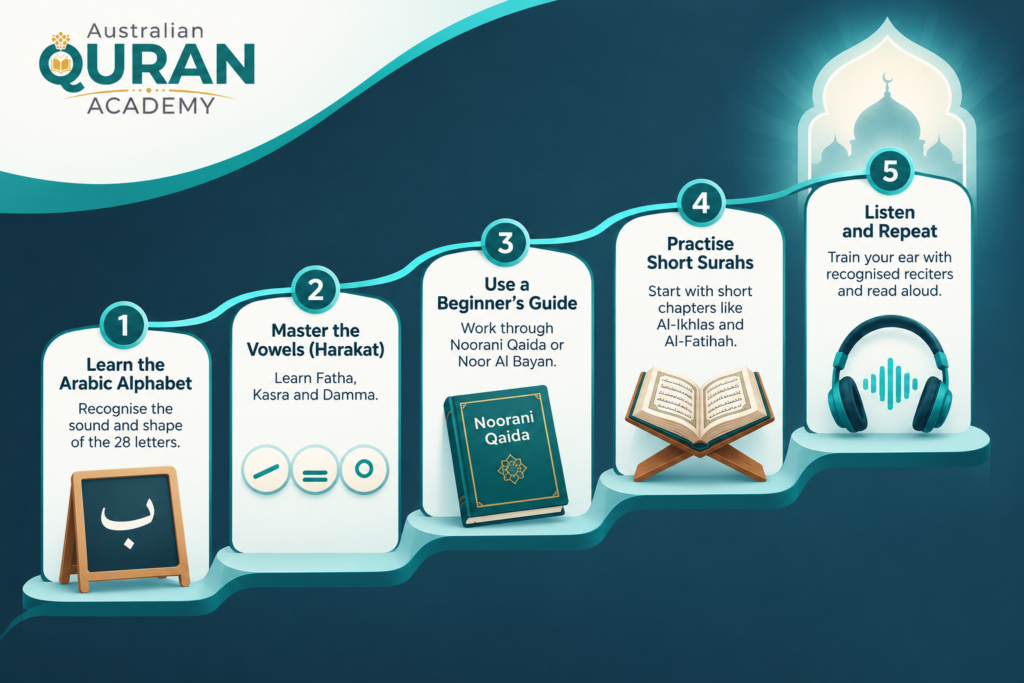
The route from complete beginner to reading short surahs breaks into five stages:
- Learn the Arabic alphabet: Recognise the sound and visual shape of each of the 28 letters. This is your foundation.
- Master the vowels (Harakat): Learn Fatha, Kasra, and Damma — the marks that change how a letter sounds.
- Use a beginner’s guide: Work through Noorani Qaida or Noor Al Bayan to learn how letters connect into words.
- Practise short surahs: Start with the short chapters at the end of the Quran, such as Surah Al-Ikhlas and Surah Al-Fatihah, read slowly and correctly.
- Listen and repeat: Train your ear with recognised reciters, reading aloud alongside the audio to fix your rhythm and pronunciation.
Inside Our Virtual Classrooms
We believe in full transparency and proven quality. Take a look at these actual snippets from our live classes to experience our modern learning platform, patient instructors, and interactive student participation.
Start Your Quranic Journey in Australia
Join our leading online academy and learn with expert tutors through a structured, personalized curriculum.
Book Your Free TrialHow Much Daily Practice of Quran recitation You Actually Need?
Consistency beats intensity. Fifteen to twenty minutes a day of reading and listening produces stronger progress than a single long session once a week.
This is why short, frequent lessons work so well for beginners — especially children, who retain more from two thirty-minute sessions a week than one hour-long class. Adults, by contrast, often concentrate better in two sixty-minute sessions per week.
If you’d like structured daily guidance from the start, the beginner track at Australian Quran Academy is built around this exact rhythm of short, regular, one-on-one lessons.
The Benefits Of Learning Quran Recitation As A Beginner
Beginners sometimes wonder whether the early, slow stages are worth it. They are — and the benefits reach beyond reading itself.
1. Spiritual and worship benefits
Reciting correctly strengthens your connection in prayer. When you can read verses fluently, your Salah becomes more focused and meaningful rather than a struggle to sound out words.
There is also immense reward in the effort itself. As the Prophet ﷺ taught, every letter recited from the Book of Allah earns a reward multiplied tenfold — and Alif, Lam, and Meem count as three separate letters, not one. Beginners who repeat difficult words again and again are rewarded for every attempt.
2. Mental and cognitive benefits
The rhythmic nature of recitation lowers stress and cultivates a sense of inner peace. Many learners describe a calming, settling effect after even a short session.
Learning also sharpens focus and memory. The discipline of daily practice — sitting, concentrating, and revising — tends to carry over into other areas of life, improving patience and consistency.
How to Choose a Beginner Recitation Course in Australia?
Not every course suits every learner. A few practical criteria separate a strong beginner programme from a weak one.
Prioritise these three things when choosing:
One-on-one lessons: Personalised feedback lets a certified tutor correct mispronunciations in real time, before bad habits form. This matters far more for beginners than for advanced students.
Certified teachers: Ask about credentials such as Ijazah or formal Tajweed certification. A confident teacher shares them willingly.
A clear progression: A good academy takes you from Noorani Qaida through Quran reading and Tajweed without forcing you to switch providers midway.
For adults building broader knowledge alongside recitation, pairing lessons with Islamic Studies Courses for Adults in Australia or Learning Arabic for Non-Arabic Speakers in Australia helps you eventually understand what you recite, not just read it.
Common beginner mistakes to avoid
A few errors slow learners down more than anything else. The most frequent: rushing to read fast before pronunciation is solid, skipping Noorani Qaida to jump straight into the Mushaf, and practising alone without a teacher to catch mistakes early. Each one creates habits that take longer to fix than to learn correctly the first time.
Read Also: How to Learn Quran for Kids in Australia
See Us in Action!
Curious about what our online classrooms look like? Watch the short clips below to see how our interactive, one-on-one sessions bring learning to life with real-time feedback and engaging teaching methods.
Start Your Quranic Journey in Australia
Join our leading online academy and learn with expert tutors through a structured, personalized curriculum.
Book Your Free TrialStart Your Quran Recitation Journey Today
You don’t need any prior Arabic to begin — just a willingness to practise fifteen minutes a day. A certified teacher will start exactly where you are, whether that’s the very first letter or polishing surahs you already know.
Australian Quran Academy offers one-on-one beginner recitation classes with certified teachers, flexible timing for busy schedules and families, and a clear path from your first Arabic letter through to fluent Tajweed. Book your first session and start reciting with confidence.

Australian Quran Academy offers a complete range of one-on-one courses, so you can progress from your first Arabic letter all the way to Hifz without ever switching providers. Explore the course that fits your goal:
Our Quran Courses:
- Quran Recitation Classes
- Quran Reading Classes
- Online Quran Classes for Kids
- Quran Classes for Adults
- Quran Classes for Female/Sisters
- Learn Quran for Beginners
- Quran Memorization (Hifz) Course
- Hifz Classes for Adults
- Quran Memorization and Hifz for Kids
- Quran Hifz for Ladies
- Noorani Qaida Course
- Noorani Qaida Course for Kids
Start Your Quranic Journey in Australia
Join our leading online academy and learn with expert tutors through a structured, personalized curriculum.
Book Your Free TrialConclusion
Quran recitation for beginners is a step-by-step process, not a leap. You start with the Arabic alphabet, learn the vowels, work through a structured guide like Noorani Qaida, then move to short surahs — always reading slowly and correctly before reading fast.
With fifteen to twenty minutes of daily practice and a certified teacher giving real-time feedback, most beginners reach comfortable reading within a few months.
The reward is both practical and spiritual: cleaner prayers, a calmer mind, and a genuine connection to the words you recite. Whatever your age or starting point, the path is open — and it begins with a single letter.
Frequently Asked Questions
Below are the questions beginners ask most often before starting their Quran recitation journey. Each answer is kept short so you can find what you need quickly.
1. How long does it take a beginner to recite the Quran?
Most beginners complete Noorani Qaida in two to four months, then take another twelve to twenty-four months to read the full Quran with Tajweed. Two to three years of consistent weekly study is a realistic timeline for full reading fluency.
2. Do I need to know Arabic before I start?
No. Most students begin with no Arabic at all. A good teacher starts from the very first letter of the alphabet and builds from there.
3. How much daily practice do I need as a beginner?
Just fifteen to twenty minutes a day of reading and listening. Short, consistent practice produces far better results than one long session per week.
4. Can adults start Quran recitation from zero?
Yes. Adults are not too late — a good teacher starts exactly where you are and moves at your pace, in a private one-on-one setting with no comparison to others.
5. What is the first thing a beginner should learn?
The Arabic alphabet — the shape and sound of each letter. This is usually taught through Noorani Qaida before moving to vowels, joining letters, and short surahs.
6. Is learning Quran recitation online effective for beginners?
Yes. One-on-one online lessons let a teacher hear and correct your pronunciation in real time, which is the single most important factor in learning to recite correctly.




Leave a Reply