 Quran
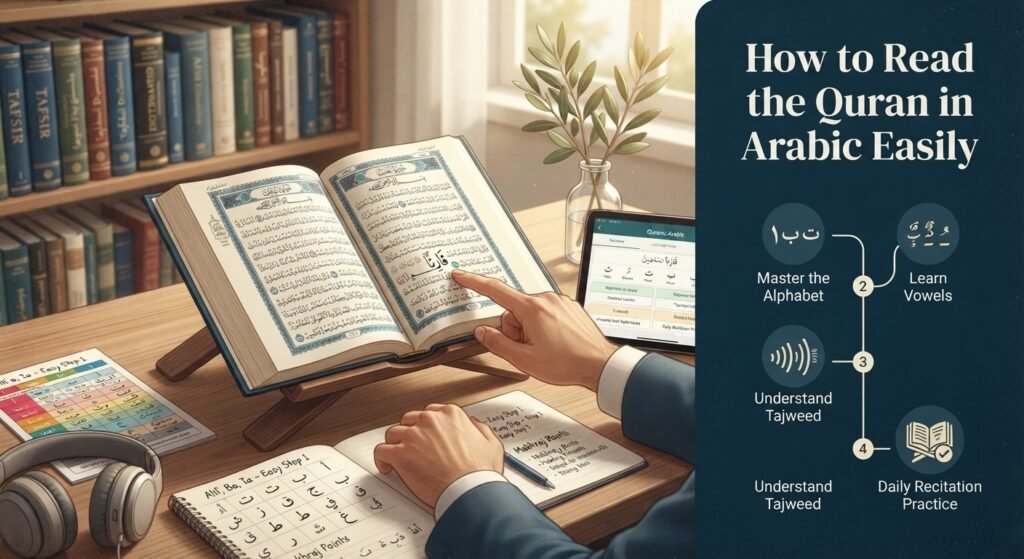
Learning how to read the Quran in Arabic may seem difficult at first, especially for beginners who are not familiar with the Arabic alphabet or Quranic pronunciation.
However, with the right learning method and regular practice, reading the Quran in Arabic can become much easier and more comfortable.
If you are wondering how to read the Quran in Arabic easily, this guide will take you through the essential steps, from learning Arabic letters and Harakat to connecting letters, understanding basic Tajweed rules, and reading short Surahs.
You will also discover practical tips to help you build confidence and improve your Quran reading skills step by step.
1. Learn the 28 Arabic Letters
Start by learning the 28 letters of the Arabic alphabet and the correct sound of each letter. Pay attention to letters that may sound similar, such as س (Seen) and ص (Sad) or ت (Ta) and ط (Ta).
Do not rush into reading complete Quranic words until you can recognize the letters easily. Practicing their shapes and sounds repeatedly will give you a strong foundation for reading the Quran in Arabic.
2. Master Short Vowels (Harakat)
After learning the Arabic letters, the next step is to understand Harakat, the short vowel marks that help you pronounce Quranic words correctly. The three basic Harakat are:
- Fatha (َ) – produces a short “a” sound.
- Kasra (ِ) – produces a short “i” sound.
- Damma (ُ) – produces a short “u” sound.
For example, adding different Harakat to the same letter changes its pronunciation. Practice reading individual letters with each vowel before moving on to complete words.
Mastering Harakat is an essential part of learning how to read Quran in Arabic for beginners, because it helps you pronounce words accurately from the beginning.
3. Practice Connecting Arabic Letters
Arabic letters can change their shape when they appear at the beginning, middle, or end of a word. After learning individual letters and Harakat, practice joining letters together to form simple words.
Start with short combinations and gradually move to Quranic words. Focus on recognizing each letter while reading the word as a whole rather than stopping after every letter.
For example, practice moving from:
ب + س + م → بِسْمِ
This step helps beginners read Quranic words more smoothly and is an important part of finding an easy way to read Quran in Arabic.
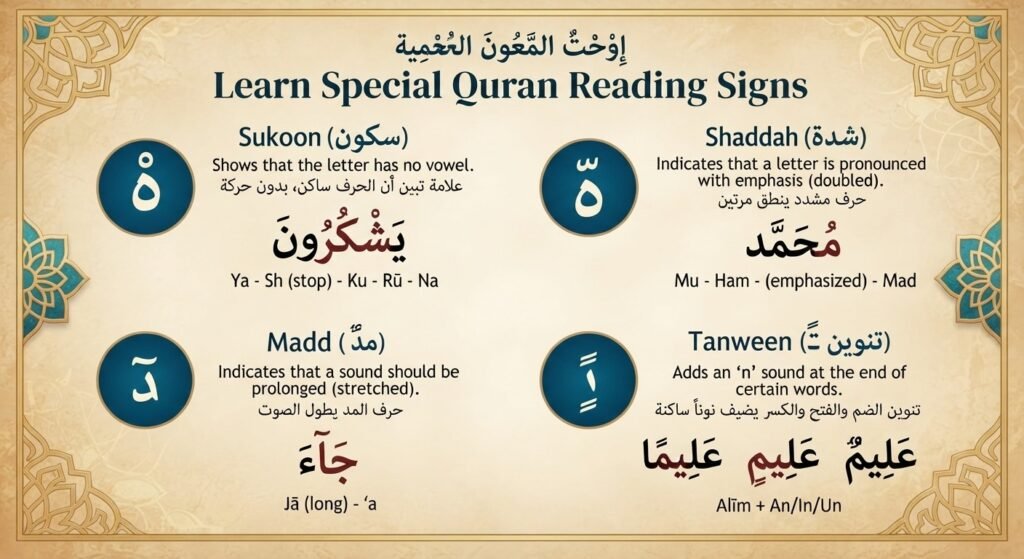
4. Learn Special Quran Reading Signs
Once you are comfortable with letters, vowels, and connected words, start learning the special signs used in the Quran. These symbols guide you on how a word or verse should be pronounced and when you should stop or continue reading.
Some important signs include:
- Sukoon (ْ) – shows that the letter has no vowel.
- Shaddah (ّ) – indicates that a letter is pronounced with emphasis.
- Madd (ٓ) – indicates that a sound should be prolonged.
- Tanween (ً ٍ ٌ) – adds an “n” sound at the end of certain words.
- Waqf signs – help you know where it is appropriate to stop or continue.
Understanding these signs makes Quranic reading more accurate and helps beginners move from simply recognizing Arabic letters to reading complete Quranic verses with greater confidence.
Read Also: How To Read The Quran In English In Australia?
5. Study Noorani Qaida
Noorani Qaida is a popular beginner-friendly method for learning how to read Arabic, especially for Quran reading. It introduces the basic skills gradually, starting with individual letters and vowels before moving to joined letters, words, and more advanced reading patterns.
Working through Noorani Qaida can help you:
- Recognize Arabic letters more quickly.
- Practice different Harakat and pronunciation patterns.
- Learn how letters are connected.
- Develop a stronger foundation for Quran reading.
- Prepare for basic Tajweed lessons.
For beginners asking how to read the quran in arabic easy, following a structured resource such as Noorani Qaida can make the learning process more organized and easier to follow.
6. Learn Basic Tajweed and Makharij
After building your basic reading skills, start learning Tajweed and Makharij to improve the accuracy of your Quranic pronunciation.
Makharij refers to the correct articulation points from which Arabic letters are pronounced. This is especially important because some Arabic letters have similar sounds but are pronounced from different parts of the mouth or throat.
Basic Tajweed also teaches you how to pronounce letters correctly, when to extend sounds, and how to apply important reading rules.
You do not need to master every Tajweed rule immediately. Start with the fundamentals and practice them gradually while reading short Quranic verses.
7. Start Reading Short Surahs
Once you can recognize letters, Harakat, connected words, and basic Quran reading signs, begin practicing with short Surahs. This allows you to apply what you have learned in real Quranic verses.
Start with familiar Surahs such as Al-Fatihah, Al-Ikhlas, Al-Falaq, and An-Nas. Read slowly and focus on correct pronunciation rather than speed.
You can also listen to a qualified reciter and repeat each verse several times. This helps you become more familiar with Quranic pronunciation and gradually build confidence in how to read Quran in Arabic for beginners.
Read Also: How to Read Quran If You Don’t Know Arabic?
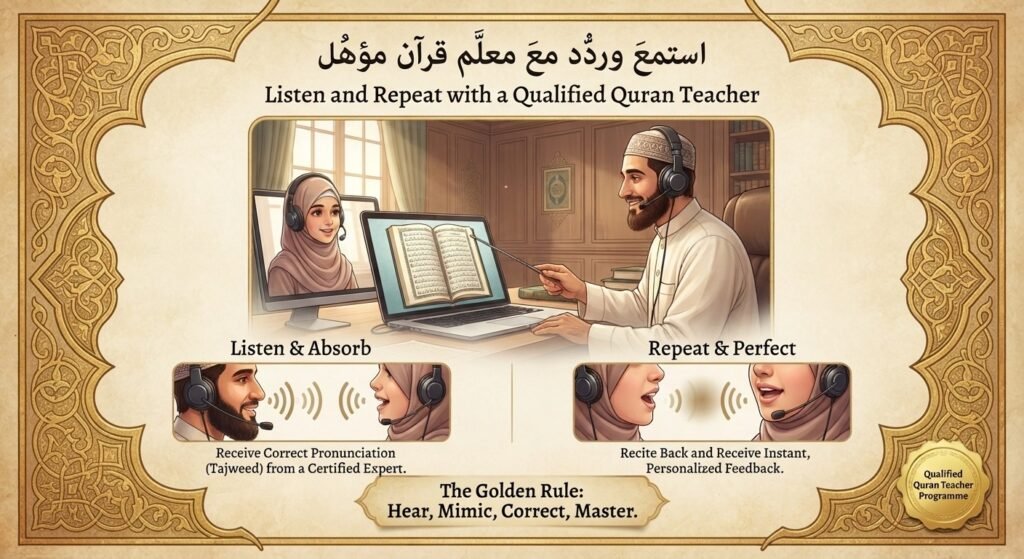
8. Listen and Repeat with a Qualified Quran Teacher
Learning to read the Quran on your own is possible, but guidance from a qualified Quran teacher can make the process easier and help you identify pronunciation mistakes early.
A teacher can listen to your recitation, correct your Makharij, explain Tajweed rules, and show you how to pronounce difficult Arabic letters correctly.
Try reading a short passage aloud and then repeating it after your teacher or a reliable reciter. This listen-and-repeat method helps improve both accuracy and confidence over time.
9. Practice Reading Every Day
Consistent practice is one of the most effective ways to improve your Quran reading skills.
You do not need to study for hours; even 10–15 minutes of focused practice each day can help you become more familiar with Arabic letters, pronunciation, and Quranic words.
Create a simple routine that includes:
- Reviewing letters and Harakat.
- Reading a few Quranic words or verses.
- Practicing difficult sounds.
- Revising the Tajweed rules you have learned.
- Listening to and repeating correct recitation.
With regular practice, reading becomes more natural, and you can gradually move from short Surahs to longer passages with greater confidence.
Read Also: Common Mistakes When Reading the Quran
How Long Does It Take to Learn to Read the Quran in Arabic?
The time needed to learn Quranic Arabic reading varies from one beginner to another. It depends on your previous knowledge, pronunciation skills, learning method, and how consistently you practice.
If you are starting from zero, focus first on recognizing the Arabic letters, Harakat, and connected words. With regular practice and guidance, you can gradually begin reading simple Quranic words and short Surahs.
Rather than focusing on a specific number of days or weeks, set small goals and track your progress. Consistent practice is more important than learning quickly.
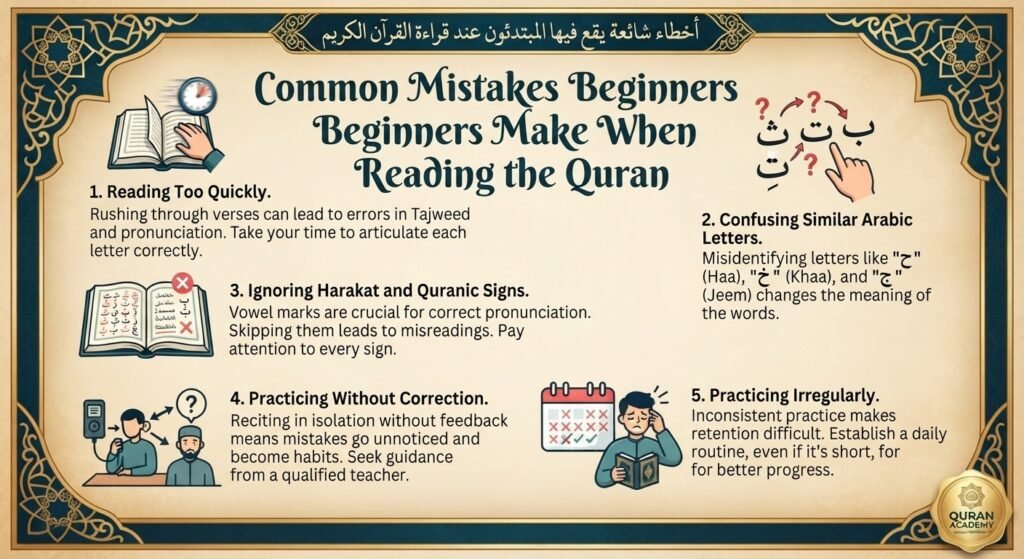
Common Mistakes Beginners Make When Reading the Quran
When learning how to read the Quran in Arabic, beginners often make a few common mistakes. Recognizing them early can make the learning process easier and improve reading accuracy.
1. Reading Too Quickly
Trying to finish verses quickly can lead to incorrect pronunciation and missed reading rules. Start slowly and focus on saying every letter clearly.
2. Confusing Similar Arabic Letters
Some Arabic letters have similar sounds or shapes, such as س and ص or ت and ط. Practice their pronunciation carefully and learn their correct Makharij.
3. Ignoring Harakat and Quranic Signs
Skipping vowel marks, Shaddah, Sukoon, or Madd can change how a word should be pronounced. Pay attention to these signs while reading.
4. Practicing Without Correction
Reading alone without receiving feedback can allow pronunciation mistakes to become habits. Whenever possible, read to a qualified Quran teacher who can correct your mistakes.
5. Practicing Irregularly
Studying for a long time once a week is often less effective than short, consistent practice. Even a few minutes every day can help you gradually improve your Quran reading skills.
A Simple Daily Routine to Improve Quran Reading
A consistent routine can make learning how to read Quran in Arabic easier and help you improve without feeling overwhelmed. You can start with a simple 15-20 minute daily routine:
- Review Arabic letters – 3 minutes
Quickly revise difficult letters and their correct pronunciation. - Practice Harakat – 3 minutes
Read examples with Fatha, Kasra, Damma, Sukoon, and Shaddah. - Read Quranic words – 4 minutes
Practice connecting letters and reading words slowly. - Read a short Surah – 5 minutes
Choose a short passage and focus on accurate pronunciation rather than speed. - Listen and repeat – 3–5 minutes
Listen to a qualified reciter or teacher and repeat the verses carefully.
The most important part is consistency. Following a manageable routine every day can gradually improve your pronunciation, fluency, and confidence.
Read Also: Can Adults Learn to Read Quran in Australia?
See Us in Action!
Curious about what our online classrooms look like? Watch the short clips below to see how our interactive, one-on-one sessions bring learning to life with real-time feedback and engaging teaching methods.
Start Your Quranic Journey in Australia
Join our leading online academy and learn with expert tutors through a structured, personalized curriculum.
Book Your Free TrialLearn to Read the Quran in Arabic with Australian Quran Academy
If you are a beginner looking for guidance on how to read Quran in Arabic, Australian Quran Academy can help you build your reading skills through structured Quran learning.
Instead of trying to learn everything at once, you can develop your skills step by step, from recognizing Arabic letters to improving pronunciation and Quran recitation.
With consistent practice and appropriate guidance, learners can work on their Arabic reading, Tajweed, Makharij, and recitation while progressing at a comfortable pace.
Whether you are completely new to Arabic or want to improve your existing Quran reading skills, learning with a qualified teacher can make the process clearer, more organized, and easier to follow.
Our Quran Courses
- Quran Online Academy
- Quran Recitation Classes
- Quran Reading Classes
- Online Quran Classes for Kids
- Quran Classes for Adults
- Quran Classes for Female/Sisters
- Learn Quran Course for Beginners
- Quran Memorization (Hifz) Course
- Hifz Classes for Adults
- Quran Memorization and Hifz Course for Kids
- Quran Hifz Course for Ladies
- Quran Ijazah Program
- Quran Qirat Learning Course
- Quran Tafsir Course
- Noorani Qaida Course
- Noorani Qaida Course for Kids
- Weekend Quran Classes
- Intensive Quran Course
- Al-Azhar Quran Course
- Online Tajweed Classes
- Tajweed Course for Kids
- Tajweed Course for Adults
- Tajweed Course for Ladies

Conclusion
Learning how to read the Quran in Arabic easily does not require you to master everything at once. By starting with Arabic letters, Harakat, connected words, and basic Quran reading rules, you can gradually build the skills you need to read with greater confidence and accuracy.
Regular practice is essential, but having the right guidance can make your learning journey much easier. A qualified Quran teacher can help you improve your pronunciation, correct your mistakes, understand basic Tajweed, and progress according to your learning level.
Ready to start reading the Quran in Arabic with confidence? Join Australian Quran Academy and take the first step toward improving your Quran reading and recitation skills. Start learning with structured guidance and make Quran reading a consistent part of your daily life.
FAQs
Can I learn to read the Quran in Arabic as a complete beginner?
Yes. You can start from the basics, including Arabic letters, Harakat, connected letters, and simple Quranic words. With regular practice, you can gradually progress to reading complete verses and short Surahs.
What is the easiest way to learn to read the Quran in Arabic?
The easiest approach is to learn step by step rather than trying to read full verses immediately. Start with the Arabic alphabet, master Harakat, practice connecting letters, learn basic Tajweed, and then begin reading short Surahs.
Do I need to speak Arabic to read the Quran?
No. You do not need to speak or understand conversational Arabic to learn how to read the Quran in Arabic. Reading and understanding Arabic are related but different skills.
How long does it take to learn Quran reading for beginners?
There is no fixed timeframe. Your progress depends on your starting level, practice frequency, pronunciation, and whether you receive guidance from a qualified teacher.
Should I learn Tajweed before reading the Quran?
You can begin learning basic Quran reading first and gradually introduce Tajweed. Learning Tajweed alongside your reading practice can help you develop accurate pronunciation and recitation habits from the beginning.






Leave a Reply