 Quran
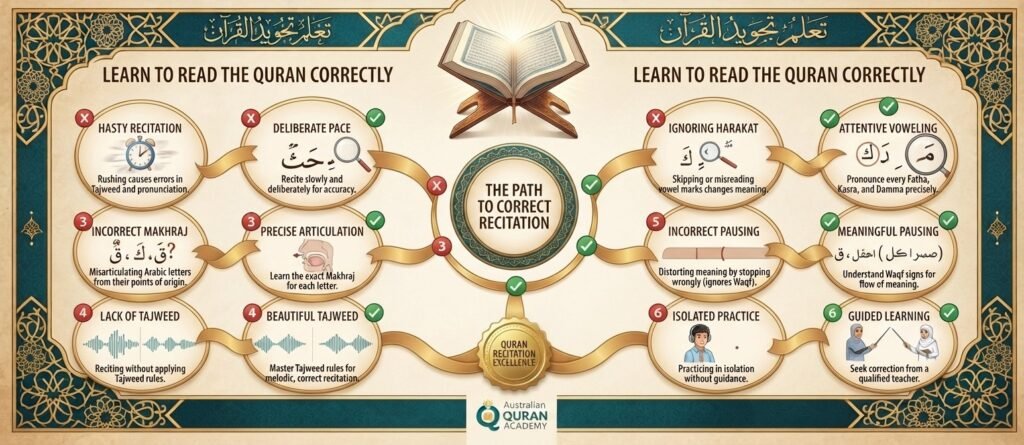
Reading the Quran correctly requires more than recognizing Arabic words. Many learners make common mistakes when reading the Quran, such as mispronouncing Arabic letters, confusing similar sounds, missing Tajweed rules, stretching Madd incorrectly, or stopping in the wrong places.
These errors are common, especially for beginners, but they can be improved with proper practice and guidance.
In this guide, we’ll explain the most common Quran reading mistakes, why they happen, and practical ways to avoid them so you can improve your pronunciation, Tajweed, and overall Quran recitation.
1. Mispronouncing Arabic Letters and Their Makharij
One of the most Common Mistakes When Reading the Quran is pronouncing Arabic letters from the wrong Makharij, or articulation points.
Each Arabic letter has a specific place and manner of pronunciation, and changing it can make the sound unclear or, in some cases, alter the word.
For example, beginners may confuse letters that sound similar, such as س (Seen) and ص (Saad), ت (Taa) and ط (Taa with heaviness), or ك (Kaaf) and ق (Qaaf). These differences may be difficult to hear at first, especially for learners who are not native Arabic speakers.
To improve your pronunciation:
- Learn the correct Makharij of each Arabic letter.
- Watch and listen to a qualified Quran teacher pronounce difficult letters.
- Practice individual letters before reading complete words.
- Repeat difficult sounds slowly until you can produce them comfortably.
- Record yourself and compare your pronunciation with a reliable recitation.
- Practice the letters in Quranic words and verses rather than learning them in isolation only.
Correct pronunciation is the foundation of accurate Quran recitation. Once you become familiar with the articulation points, reading becomes clearer and Tajweed rules become easier to apply.
2. Confusing Similar Arabic Letters
Another Common Mistakes When Reading the Quran is confusing Arabic letters that have similar sounds or articulation points.
This is especially common among beginners and non-Arabic speakers because some Arabic sounds do not have exact equivalents in English. Common examples include:
- س (Seen) and ص (Saad): The ص is pronounced with a heavier sound than س.
- ت (Taa) and ط (Taa): The ط is a heavier letter, while ت is lighter.
- ك (Kaaf) and ق (Qaaf): These letters come from different articulation points and should not be pronounced the same way.
- ذ (Dhaal) and ظ (Dhaa): Their sounds are different, even though they may seem similar to beginners.
- ه (Haa) and ح (Haa): The ح has a deeper breathy sound that requires correct articulation.
How to Avoid Confusing Arabic Letters
Start by practicing one difficult letter at a time. Listen carefully to a qualified reciter or teacher, repeat the sound slowly, and then practice it within simple Quranic words. Once you can distinguish the letters clearly, move on to complete verses.
Regular correction is also important because some pronunciation differences are difficult to notice when you are listening to your own recitation. With consistent practice, you can train your ear and improve your Quran pronunciation.
Read Also: How To Read The Quran In English In Australia?
3. Changing or Misreading Harakat
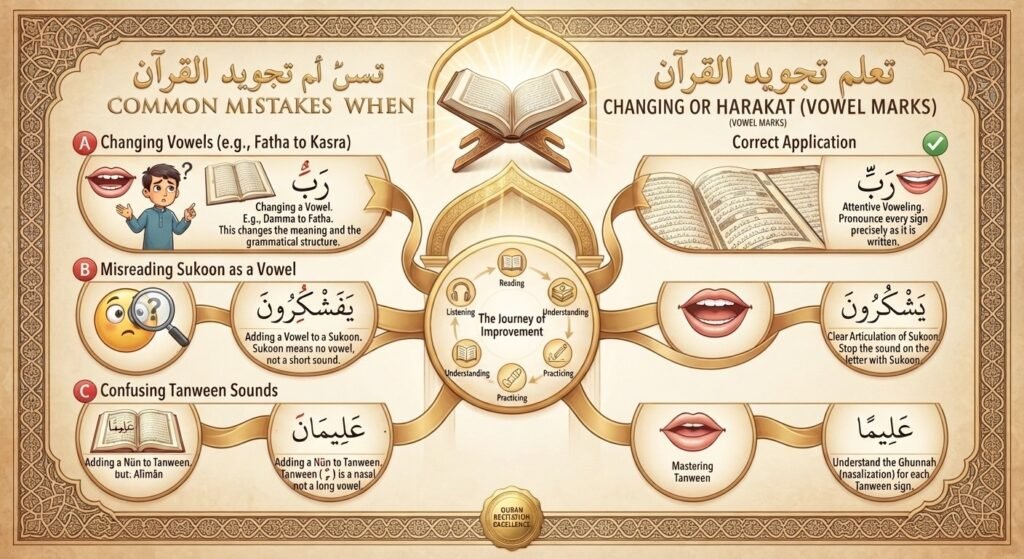
Changing or misreading Harakat is another common mistake when reading the Quran. Harakat are the short vowel marks that help determine how Arabic letters are pronounced.
The main ones are Fathah (َ), Kasrah (ِ), and Dammah (ُ), along with Sukoon (ْ) and Shaddah (ّ).
For example, changing a Fathah to a Kasrah can change the way a word is pronounced and may affect its grammatical form or meaning. Similarly, overlooking a Shaddah can cause a learner to pronounce a letter incorrectly or too weakly.
How to Avoid Harakat Mistakes
To improve accuracy, pay attention to every vowel mark instead of trying to guess the pronunciation from the shape of the word.
Beginners should read slowly, pronounce each syllable clearly, and repeat words that contain unfamiliar vowel patterns.
It is also helpful to practice with a qualified Quran teacher who can immediately correct mistakes in Harakat, pronunciation, and Shaddah. With regular practice, recognizing these marks becomes more natural and helps you read Quranic words with greater accuracy.
Read Also: How To Read The Quran In Arabic Easily?
4. Ignoring Basic Tajweed Rules
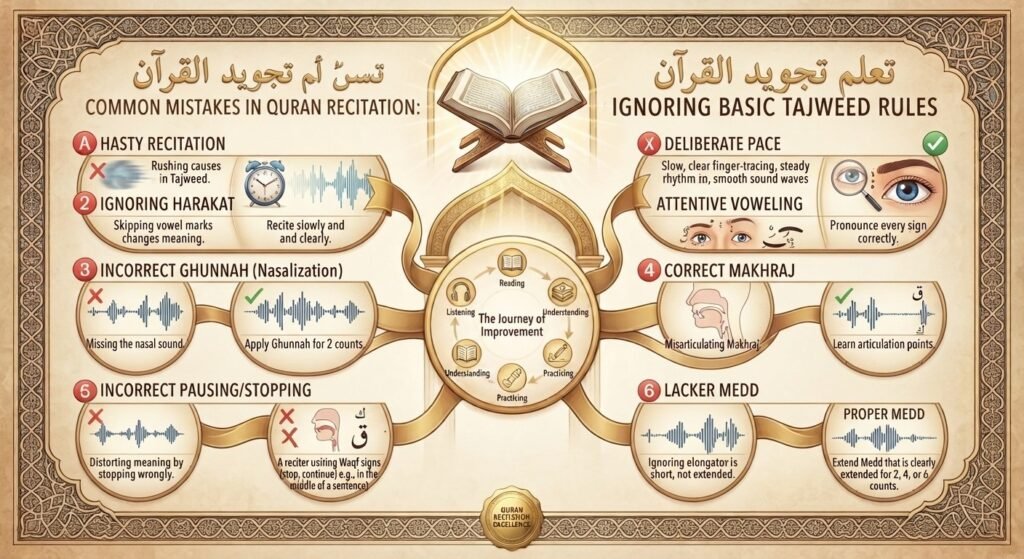
One of the most common mistakes when reading the Quran is ignoring basic Tajweed rules. Tajweed teaches you how to pronounce Quranic letters correctly and how to give each letter and sound its proper characteristics.
Beginners do not need to master every Tajweed rule at once. However, understanding the essential rules can prevent many common Quran recitation errors, including:
- Noon Sakinah and Tanween: Rules such as Izhar, Idgham, Iqlab, and Ikhfa.
- Meem Sakinah: Including its main pronunciation rules.
- Ghunnah: Maintaining the correct nasal sound where required.
- Madd: Giving elongated sounds their appropriate length.
- Qalqalah: Producing the correct echoing sound for its letters.
- Heavy and light letters: Knowing when certain letters should be pronounced with heaviness or softness.
- Waqf: Understanding where it is appropriate to stop or continue.
How to Avoid Tajweed Mistakes
Start with the Tajweed rules that appear most frequently in the passages you read. Learn one rule at a time, listen to a qualified reciter, and practice it repeatedly in Quranic words and verses.
Most importantly, do not focus only on reading more quickly. Accurate pronunciation and correct application of Tajweed should come before speed. Regular feedback from a qualified Quran teacher can also help identify mistakes that may be difficult to recognize on your own.
Read Also: How to Read Quran If You Don’t Know Arabic?
5. Stretching Madd for Too Long or Too Short
Madd means extending a vowel sound for a specific length during Quran recitation. One common Quran reading mistake is stretching a Madd sound for too long or shortening it when it should be extended.
Some learners may extend sounds based on personal reading habits, while others may rush through them and fail to give the required length. Both can affect the rhythm and accuracy of recitation.
How to Avoid Madd Mistakes
Learn the basic types of Madd and their required lengths with a qualified Quran teacher. When practicing, listen carefully to an experienced reciter and pay attention to how long each sound is held.
Avoid trying to judge the length only by what feels natural. Consistent practice, careful listening, and teacher correction can help you develop a more accurate sense of Madd and improve the overall flow of your Quran recitation.
6. Missing or Incorrect Ghunnah
Ghunnah is a nasal sound used in Quran recitation, particularly with certain forms of Noon and Meem. Missing this sound, weakening it, or holding it for an incorrect length is a common Quran recitation mistake.
Beginners may sometimes pronounce the letter without giving the required nasal quality, especially when reading quickly. Others may exaggerate the sound or hold it longer than required.o
How to Avoid Ghunnah Mistakes
Start by learning when Ghunnah is required and how it should sound. Listen to a qualified Quran reciter and focus on the nasal quality rather than simply trying to imitate the overall rhythm.
Practice short examples repeatedly, then apply the rule while reading complete Quranic verses. A Quran teacher can also listen to your recitation and correct the strength, timing, and pronunciation of Ghunnah, helping you develop greater accuracy and confidence.
See Us in Action!
Curious about what our online classrooms look like? Watch the short clips below to see how our interactive, one-on-one sessions bring learning to life with real-time feedback and engaging teaching methods.
Start Your Quranic Journey in Australia
Join our leading online academy and learn with expert tutors through a structured, personalized curriculum.
Book Your Free Trial7. Stopping at the Wrong Place
Stopping at the wrong place is another common mistake when reading the Quran. Waqf refers to stopping or pausing during recitation, and knowing where to stop helps preserve the meaning and natural flow of the verses.
A learner may stop simply because they need to take a breath, without considering whether the sentence or meaning is complete. In some cases, an inappropriate pause can make a statement sound incomplete or change how the verse is understood.
How to Avoid Waqf Mistakes
Pay attention to the Waqf signs in the Quran and learn what the most common symbols indicate. When practicing, listen to qualified reciters and notice where they pause and resume.
If you are unsure whether a stopping point is appropriate, ask a qualified Quran teacher to guide you. Learning proper Waqf alongside pronunciation and Tajweed will help make your recitation clearer, more natural, and easier to understand.
8. Reading the Quran Too Quickly
Reading the Quran too quickly is a common mistake when reading the Quran, especially when learners focus on finishing a certain number of pages or verses. Speed can make it harder to pronounce every letter clearly and apply Tajweed rules correctly.
When you rush, you may:
- Skip or swallow some letters and sounds.
- Shorten or lengthen Madd incorrectly.
- Miss Ghunnah.
- Confuse similar Arabic letters.
- Stop or pause without considering the meaning.
How to Avoid Reading Too Quickly
Focus on accuracy before speed. Read each word clearly, give letters their correct pronunciation, and pause naturally when needed. If you make a mistake, stop and repeat the word rather than continuing quickly.
A useful approach is to read a short passage slowly several times before gradually increasing your pace. With regular practice and teacher feedback, you can develop a smoother recitation without sacrificing correct pronunciation or Tajweed.
Read Also: Can Adults Learn to Read Quran in Australia?
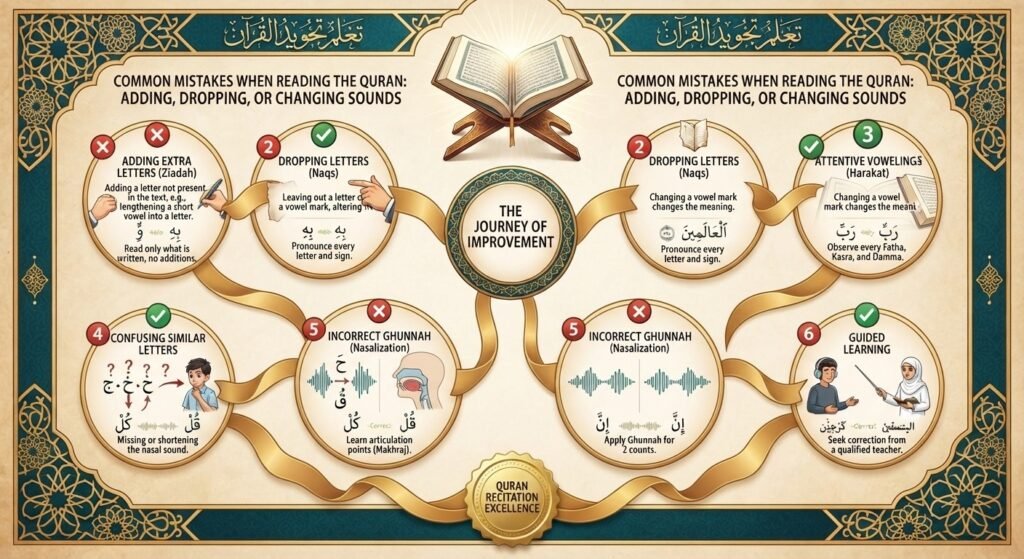
9. Adding, Dropping, or Changing Sounds
Adding, dropping, or changing sounds is another common mistake when reading the Quran. This can happen when a learner reads too quickly, struggles with unfamiliar Arabic words, or is not yet confident with Quranic pronunciation.
For example, a reader may accidentally skip a letter, add an unnecessary sound, change a vowel, or merge sounds incorrectly. Even a small pronunciation change can affect the accuracy of a Quranic word.
How to Avoid These Mistakes
Read each word carefully rather than relying on memory or guessing its pronunciation. Pay attention to the Harakat, Shaddah, Sukoon, and individual letters.
If a word is difficult, break it into smaller sounds and practice it slowly before reading it within the complete verse. Listening to a qualified reciter and receiving regular correction from a Quran teacher can also help you identify repeated errors before they become habits.
10. Practicing Without Regular Correction
Regular practice is essential for improving Quran recitation, but practicing alone without any feedback can allow pronunciation mistakes to become habits.
You may not always notice your own errors, especially when they involve subtle differences in Makharij, Tajweed, Madd, or Ghunnah.
Reading the same mistake repeatedly does not necessarily make the recitation more accurate. Instead, learners should combine independent practice with reliable correction.
How to Improve Through Regular Feedback
Try recording your recitation and comparing it with a qualified reciter. More importantly, read regularly to a Quran teacher who can identify specific mistakes and explain how to correct them.
A teacher can help you:
- Identify recurring pronunciation errors.
- Correct difficult Arabic letters and Makharij.
- Improve your Tajweed application.
- Correct Madd and Ghunnah.
- Guide you on appropriate Waqf and pauses.
- Track your progress over time.
With consistent practice and constructive feedback, you can gradually replace incorrect habits with more accurate Quran reading and recitation.
Inside Our Virtual Classrooms
We believe in full transparency and proven quality. Take a look at these actual snippets from our live classes to experience our modern learning platform, patient instructors, and interactive student participation.
Start Your Quranic Journey in Australia
Join our leading online academy and learn with expert tutors through a structured, personalized curriculum.
Book Your Free TrialLearn to Read the Quran Correctly With Australian Quran Academy
If you want to overcome common mistakes when reading the Quran, Australian Quran Academy can help you build stronger reading and recitation skills through structured online Quran learning.
Lessons can focus on the areas learners commonly struggle with, including Arabic pronunciation, Makharij, Tajweed, Madd, Ghunnah, and Waqf. Instead of simply reading through lessons, learners can receive guidance and correction to help them understand their mistakes and improve them step by step.
Whether you are a beginner, returning to Quran reading, or looking to improve your existing recitation, learning with a qualified Quran teacher can make the process clearer and more effective.
Why Learn With Australian Quran Academy?
- Personalized Quran learning based on your current reading level.
- Tajweed and pronunciation practice to improve recitation accuracy.
- Teacher feedback to identify and correct recurring mistakes.
- Online Quran lessons that allow you to learn from home in Australia.
- Step-by-step guidance for learners who need to strengthen their Quran reading skills.
You do not have to struggle with the same Quran reading mistakes on your own. With regular practice, expert guidance, and consistent feedback, you can improve your pronunciation and recite the Quran with greater confidence.
Start improving your Quran reading with Australian Quran Academy and take the next step toward more accurate and confident recitation.
Conclusion
Common mistakes when reading the Quran are normal, especially for beginners and non-Arabic speakers. Mispronunciation, incorrect Tajweed, confusing Arabic letters, improper Madd or Ghunnah, and stopping in the wrong places can all be improved with the right approach.
The key is to practice consistently, read carefully, and receive regular correction. You do not need to master everything at once. Focus on one mistake at a time and gradually build more accurate reading habits.
If you want professional guidance, Australian Quran Academy can help you improve your Quran pronunciation, Tajweed, and recitation through structured online learning. Start your journey toward reading the Quran more accurately and confidently today.
FAQs
How can I improve my Quran pronunciation?
Practice Arabic letters and their Makharij, read slowly, listen to qualified reciters, learn essential Tajweed rules, and practice regularly. Reading to a qualified Quran teacher can also help you identify pronunciation mistakes that you may not notice yourself.
What is the difference between Lahn Jali and Lahn Khafi?
Lahn Jali refers to a clear recitation error that can involve changing a letter, vowel, or pronunciation in a noticeable way. Lahn Khafi refers to a less obvious error, often involving the application of Tajweed rules. Both can be improved through learning and practice.
How can I avoid Tajweed mistakes?
Learn Tajweed gradually, practice one rule at a time, listen carefully to qualified reciters, and apply the rules while reading Quranic verses. Regular feedback from a teacher can help you recognize and correct recurring Tajweed errors.
Can I learn Quran reading online?
Yes. Online Quran classes can help learners develop Arabic pronunciation, Tajweed, and recitation skills from home. A qualified online Quran teacher can provide live correction and personalized guidance based on the learner’s level.
Do I need a teacher to improve my Quran recitation?
You can practice independently, but a teacher can make improvement easier by identifying mistakes you may not hear yourself. Regular feedback is especially valuable for correcting Makharij, Tajweed, Madd, Ghunnah, and Waqf.





Leave a Reply