 Quran
Quran
Most aspiring memorisers ask the same question before they begin: how long does it take to become a Hafiz? For most learners, a realistic timeline is around two to five years, although some full-time students finish much faster and others may take seven years or more.
The timeline depends largely on how much time you can commit each day, how fluently you can read Quranic Arabic before you begin, and how effectively your revision system keeps pace with your new memorisation.
Speed alone should never be the goal. What matters is reaching the end with strong, lasting retention — rather than rushing through the Quran only to struggle with earlier sections later.
This guide breaks down realistic hifz timelines, the factors that can shorten or extend them, and why revision plays such an important role in determining how long your journey takes.
How Long Does It Take to Memorise the Quran?
The standard Mushaf (Madani) contains 604 pages, approximately 6,236 verses across 114 surahs. If you memorise one page per day with perfect consistency, you’d finish in roughly 20 months. But that calculation leaves out the most important variable: revision.
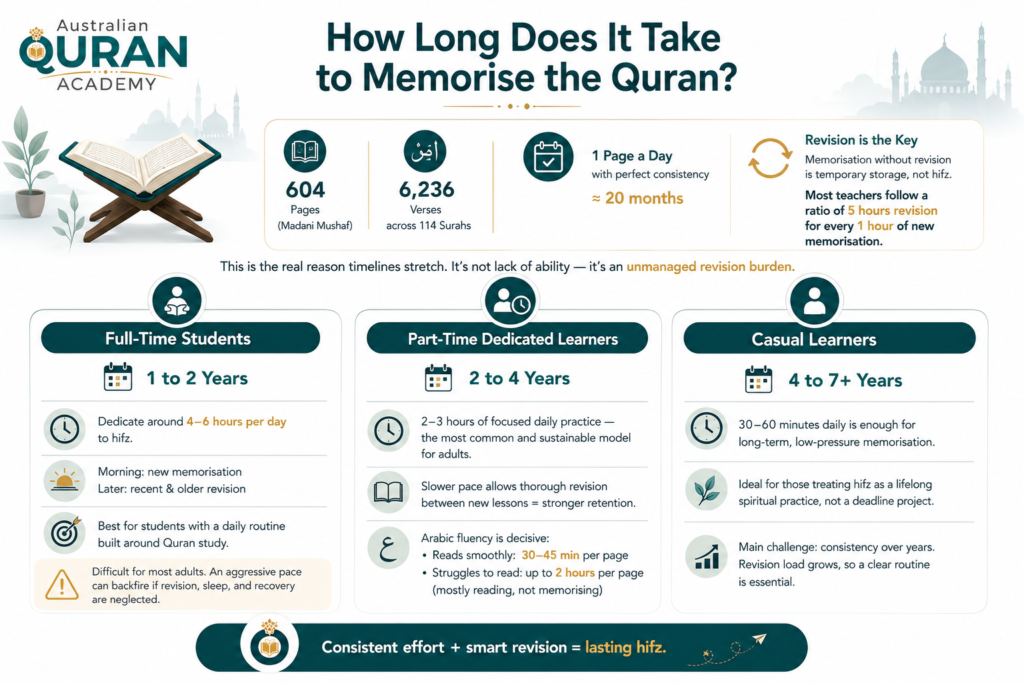
Memorisation without revision is temporary storage, not hifz. For every new page you lock in, you need to keep revisiting everything you’ve already memorised — and that revision load grows every single week. Most experienced hifz teachers follow a ratio of roughly five hours of revision for every one hour of new memorisation. By the time you’ve memorised 200 pages, you need substantial daily revision just to hold what you already have.
This is the real reason timelines stretch. It’s not lack of ability — it’s an unmanaged revision burden.
Full-Time Students: 1 to 2 Years
Students who dedicate around four to six hours per day to hifz may be able to complete their initial memorisation in one to two years.
In a traditional full-time hifz schedule, morning sessions may focus on new memorisation, while later sessions are dedicated to recent and older revision.
This intensive approach can work well for students whose daily routine is built around Quran study. However, it is difficult to sustain for most adults balancing work, family, university, or other responsibilities.
An aggressive pace can also become counterproductive if new memorisation consistently takes priority over revision, sleep, and recovery.
Part-Time Dedicated Learners: 2 to 4 Years
Two to three hours of focused daily practice is the most common and sustainable model for adults. This timeline produces strong retention precisely because the slower pace allows thorough revision between new lessons.
This is also where Arabic fluency becomes a decisive factor. A student who reads smoothly can memorise a page in 30 to 45 minutes. A student who still stumbles over letters may spend two hours on that same page — and most of that time goes to reading, not memorising.
Casual Learners: 4 to 7+ Years
Thirty to sixty minutes daily is enough for long-term, low-pressure memorisation. This approach works well for people treating hifz as a lifelong spiritual practice rather than a deadline project.
The main challenge at this pace is maintaining consistency over several years. Because new memorisation progresses slowly while the amount requiring revision continues to increase, having a clear revision routine becomes particularly important.
If your Quranic Arabic reading is still choppy, building fluency first through a structured Arabic course for non-Arabic speakers will save you hundreds of hours across the full hifz journey.

How Daily Quotas Determine How Long It Takes To Become A Hafiz?
Your daily quota gives you a useful starting point for estimating your timeline, but it should never be viewed in isolation.
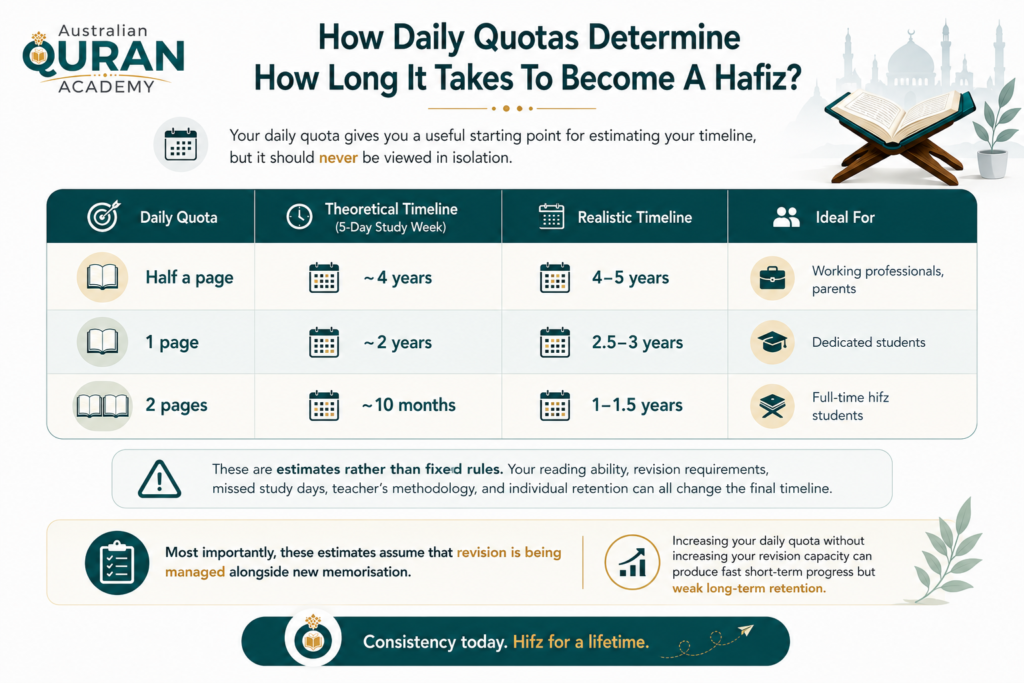
Here is a practical estimate based on the 604-page Madani Mushaf and a five-day study week:
| Daily Quota | Theoretical Timeline | Realistic Timeline | Ideal For |
| Half a page | ~4 years | 4–5 years | Working professionals, parents |
| 1 page | ~2 years | 2.5–3 years | Dedicated students |
| 2 pages | ~10 months | 1–1.5 years | Full-time hifz students |
These are estimates rather than fixed rules. Your reading ability, revision requirements, missed study days, teacher’s methodology, and individual retention can all change the final timeline.
Most importantly, these estimates assume that revision is being managed alongside new memorisation. Increasing your daily quota without increasing your revision capacity can produce fast short-term progress but weak long-term retention.
Read also: Female Hafiz of the Quran – History, Role Models, and How to Become One
Why Hifz Progress Slows Down Over Time?
One of the most important realities of hifz is that the balance between new memorisation and revision changes as you progress At the beginning, your revision workload is relatively small. If you have memorised only ten pages, reviewing your previous material may not take very long.
After 100, 200, or 300 pages, the situation is completely different As your memorisation grows, a larger share of your daily study time needs to be allocated to maintaining older material. Many students therefore find that their pace of new memorisation naturally slows during the later stages of hifz.
This does not mean you are becoming worse at memorising. It often means your responsibilities have changed: you are no longer simply learning new pages; you are maintaining hundreds of pages at the same time.
Students who fail to account for this shift may eventually find themselves forgetting older material faster than they can strengthen it The solution is not necessarily to memorise faster or slower. It is to establish a structured revision system early enough that it can grow alongside your hifz.
See Us in Action!
Curious about what our online classrooms look like? Watch the short clips below to see how our interactive, one-on-one sessions bring learning to life with real-time feedback and engaging teaching methods.
Start Your Quranic Journey in Australia
Join our leading online academy and learn with expert tutors through a structured, personalized curriculum.
Book Your Free TrialFactors That Affect How Long It Takes To Become A Hafiz
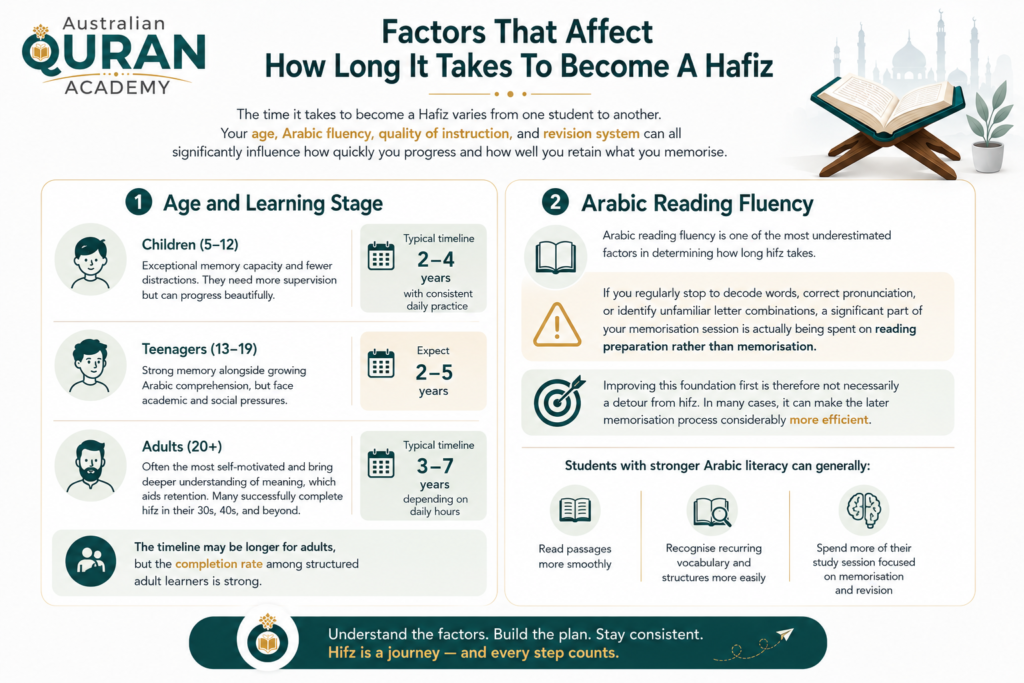
The time it takes to become a Hafiz varies from one student to another. Your age, Arabic fluency, quality of instruction, and revision system can all significantly influence how quickly you progress and how well you retain what you memorise.
Age and Learning Stage
Children between 5 and 12 have exceptional memory capacity and fewer distractions. Their typical timeline is 2 to 4 years with consistent daily practice, though they need more supervision.
Teenagers carry strong memory alongside growing Arabic comprehension, but face academic and social pressures. Expect 2 to 5 years.
Adults are often the most self-motivated and bring deeper understanding of meaning to the memorisation process — which actually aids retention. Many students successfully complete hifz in their 30s, 40s, and beyond. The timeline is longer (3 to 7 years depending on daily hours), but the completion rate among structured adult learners is strong.
Arabic Reading Fluency
Arabic reading fluency is one of the most underestimated factors in determining how long hifz takes If you regularly stop to decode words, correct pronunciation, or identify unfamiliar letter combinations, a significant part of your memorisation session is actually being spent on reading preparation rather than memorisation.
Improving this foundation first is therefore not necessarily a detour from hifz. In many cases, it can make the later memorisation process considerably more efficient.
Students with stronger Arabic literacy can generally read passages more smoothly, recognise recurring vocabulary and structures more easily, and spend more of their study session focused directly on memorisation and revision.
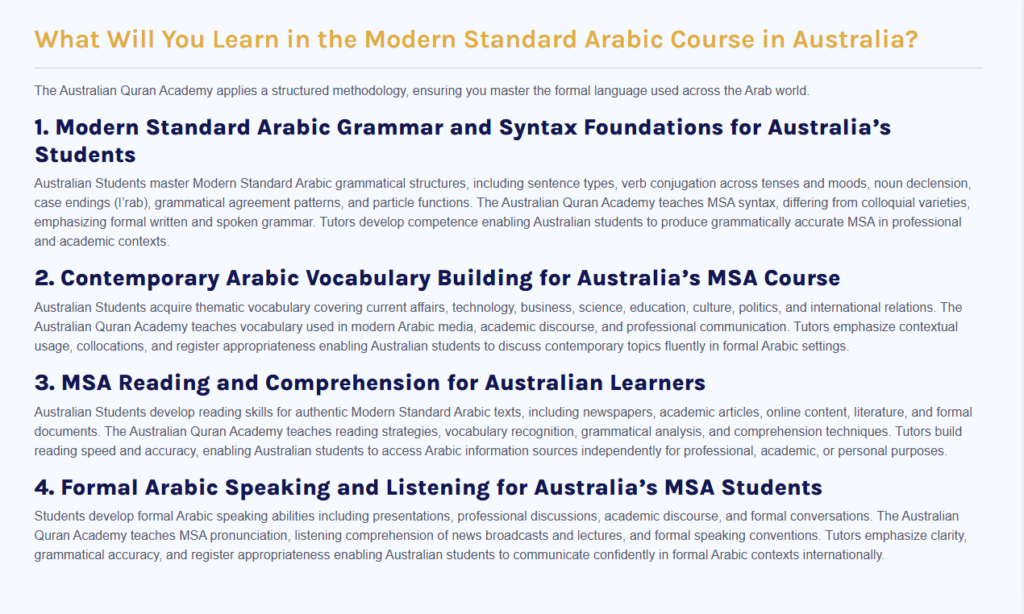
For students who need a broader foundation in Arabic, a structured Modern Standard Arabic course can support vocabulary, grammar, and overall reading confidence.
Quality of Instruction
Self-directed Quran memorisation is possible, but studying with a qualified teacher offers important advantages Without regular correction, pronunciation or tajweed mistakes can become embedded through repetition and become more difficult to correct later.
A teacher can identify these errors early, listen to your recitation, adjust your daily workload, and help determine when a passage is strong enough for you to move forward There is also an accountability benefit. Motivation naturally rises and falls during a multi-year journey, and having regular lessons creates structure when personal motivation is lower.
Good instruction therefore affects more than recitation quality. It can also make the overall memorisation process more organised and sustainable.
Your Revision System
Your revision system may ultimately matter more than how quickly you can memorise a new page Random revision — reviewing whichever pages happen to feel weak that day — can create gaps. Familiar sections may receive too much attention while less familiar passages gradually become weaker.
A systematic approach gives every section of your memorisation regular attention and allows weaker passages to receive additional review when necessary The earlier this system is established, the easier it is to scale.
Instead of waiting until you have memorised hundreds of pages and then trying to solve an overwhelming revision problem, build revision into your daily hifz routine from the beginning.
Read also: How Long Does It Take to Memorize the Quran in Australia?
How to Consolidate Your Hifz After Completion?
Reaching the final surah is a major milestone, but it does not necessarily mean every part of your memorisation is equally strong.
After completing the first full memorisation of the Quran, many students benefit from a dedicated consolidation period in which the focus shifts away from adding new material and towards strengthening the entire Quran.
This period may involve repeated full-Quran revision, identifying weak sections, correcting recurring mistakes, improving transitions between pages and surahs, and developing greater confidence in reciting without prompts.
Depending on the student’s retention and previous revision system, consolidation may take several months or longer. A period of roughly six to twelve months can be a useful planning estimate, but it should not be treated as a fixed requirement for every student.
The objective is simple: move from “I have memorised this before” to being able to recall it accurately and consistently.
Students who want additional structure during this stage may benefit from an intensive Arabic and Quran programme where regular recitation, revision planning, and teacher feedback can help strengthen weaker areas.

Inside Our Virtual Classrooms
We believe in full transparency and proven quality. Take a look at these actual snippets from our live classes to experience our modern learning platform, patient instructors, and interactive student participation.
Begin Your Hifz Journey with Expert Guidance
At Australian Quran Academy, our Quran memorisation programmes are designed to help students progress at a pace that matches their current level, daily schedule, and long-term hifz goals. With guidance from qualified and experienced teachers, students receive personalised support with memorisation, tajweed, pronunciation, and consistent revision.
Whether you’re starting by strengthening your Arabic reading or you’re ready to begin formal hifz, having a clear structure can make the journey more manageable and sustainable. Our teachers help you develop a practical memorisation and revision routine, identify weak areas early, and stay accountable as your hifz progresses.
Our Quran Courses
- Quran Online Academy
- Quran Recitation Classes
- Quran Reading Classes
- Online Quran Classes for Kids
- Quran Classes for Adults
- Quran Classes for Female/Sisters
- Learn Quran Course for Beginners
- Quran Memorization (Hifz) Course
- Hifz Classes for Adults
- Quran Memorization and Hifz Course for Kids
- Quran Hifz Course for Ladies
- Quran Ijazah Program
- Quran Qirat Learning Course
- Quran Tafsir Course
- Noorani Qaida Course
- Noorani Qaida Course for Kids
- Weekend Quran Classes
- Intensive Quran Course
- Al-Azhar Quran Course
- Online Tajweed Classes
- Tajweed Course for Kids
- Tajweed Course for Adults
- Tajweed Course for Ladies
Start Your Quranic Journey in Australia
Join our leading online academy and learn with expert tutors through a structured, personalized curriculum.
Book Your Free Trial
Conclusion
How long does it take to become a Hafiz doesn’t have a single answer — it has a range shaped by your commitment, your starting point, and the quality of your system. Part-time learners typically complete hifz in three to five years. Full-time students can finish in one to two years. But every timeline must account for the revision shift, the consolidation period, and the Arabic fluency required to memorise efficiently.
Speed is not the goal. Lasting retention is. A student who finishes in five years with a strong, reliable hifz is better prepared than someone who rushes in 18 months and spends years trying to repair the gaps.
Build your system from day one. Find a qualified teacher. And start before you feel fully ready — because the journey itself builds the capacity you think you’re waiting for.
Read also: How to Stay Motivated During Hifz?
Frequently Asked Questions
How long does it take to become a Hafiz for an average adult?
Most adults who commit one to two hours daily complete hifz in three to five years. Adults memorise slightly slower than children but tend to have stronger motivation, better comprehension of meaning, and more discipline — all of which support long-term retention.
Can you become a Hafiz in one year?
It’s possible for full-time students dedicating four to six hours daily, but it’s rare and demanding. Students who attempt a one-year timeline face a very heavy revision load. Without expert guidance and a structured revision system, many finish with weak retention that requires years of repair.
What is the easiest daily quota to maintain long-term?
Half a page per day is the most sustainable for working adults and parents. It requires 30 to 45 minutes of focused practice, produces a realistic timeline of four to five years, and is light enough to maintain through the inevitable disruptions of everyday life.
Does Arabic fluency actually affect memorisation speed?
Significantly. A fluent reader can memorise a page in 30 minutes; a struggling reader may spend two hours on the same page — mostly reading, not memorising. Building Arabic reading fluency before starting formal hifz is one of the highest-return investments you can make for your timeline.
What is a consolidation period and do I need one?
A consolidation period is the 6 to 12 months after completing your first full memorisation, during which you revise the entire Quran to reach confident, reliable recitation. It is not optional — it’s what transforms temporary memorisation into genuine hifz. Always build it into your timeline.
Is it harder to memorise as an adult than as a child?
Adults may be slightly slower at initial memorisation, but they have real advantages: deeper motivation, better understanding of meaning, and greater discipline. Many students complete hifz in their 40s and 50s. The key is a system that fits adult life — consistent daily sessions, qualified instruction, and a revision plan that scales.






Leave a Reply