 Quran
Many beginners search for how to learn Noorani Qaida online in Australia after videos, apps, or repeated page reading fail to improve their pronunciation. The usual problem is not effort. It is practising sounds without immediate correction or progressing before earlier skills are secure.
Effective online study combines a sequenced Qaida, live sound correction, short independent drills, and clear promotion tests.
This approach develops accurate decoding rather than page memorisation and prepares the learner to read unfamiliar Quranic words. Follow these practical steps in order.
1. Check Arabic Letter Recognition Before Starting Lessons
Begin by checking whether the learner can identify Arabic letters in isolated, initial, medial, and final forms. A learner who only knows the alphabet song may still confuse letters once their shapes change inside joined words.
Use a shuffled letter sheet rather than the printed Qaida order. Ask for the letter name and sound, then show the same letter in different positions. Record confusions such as ب, ت, and ث instead of correcting randomly.
The assessment should also distinguish visual errors from sound errors. Someone may recognise ص correctly but pronounce it like س. Another learner may produce ع when prompted yet fail to identify its joined form on the page.
Use this short readiness check before choosing the starting lesson:
| Skill | Test | Starting Decision |
| Isolated letters | Identify 20 shuffled letters | Begin at letter recognition if accuracy is below 90% |
| Joined forms | Find one letter in three word positions | Review changing shapes before blending |
| Letter sounds | Produce sounds without English letter names | Begin Makharij correction immediately |
| Short vowels | Read ten letter and Harakah combinations | Start vowel lessons if eight are accurate |
Do not make an older child or adult repeat pages already mastered. Equally, do not skip foundations to protect confidence. A precise starting point makes progress faster because lesson time targets genuine weaknesses.
2. Learn Noorani Qaida Online in Australia with a Tutor
A qualified tutor should hear every target sound, explain where it originates, and require another attempt after correction. Video quality and friendly conversation matter, but neither replaces technical knowledge of Quranic pronunciation and beginner teaching.
Ask prospective tutors how they correct Makharij, track errors, and decide that a lesson is complete. Strong teachers can explain their method plainly and demonstrate a correction rather than promising fluency within an identical timeframe for every student.
For learners in Australia, confirm lesson times in the correct local zone because Sydney, Perth, and Adelaide do not always share the same time. Check daylight-saving changes before committing to a timetable with an overseas tutor.
Evaluate the first lesson using observable evidence:
- The tutor tests the learner before choosing a page.
- The learner speaks for most of the reading time.
- Corrections identify the exact letter, vowel, or timing error.
- Failed items are repeated after a short interval.
- Homework states what to read, how often, and what accuracy requires.
Australian Quran Academy offers a Noorani Qaida Course that provides guided progression from Arabic letters to connected Quranic reading with live correction.

Book a free Noorani Qaida assessment
3. Secure Makharij Before Combining Arabic Letters
Train each letter from its correct articulation point before combining it with vowels or neighbouring letters. Makharij means the physical points from which Arabic sounds emerge, including the throat, tongue, lips, nasal passage, and oral cavity.
Begin with sounds that English-speaking learners commonly merge, including ح and ه, ع and أ, ص and س, and ط and ت. The goal is not louder recitation. It is consistent production from the correct place.
Use a three-part correction cycle for every difficult letter:
- Watch and hear the tutor produce the isolated sound once.
- Produce the sound slowly while observing mouth and tongue placement.
- Repeat it with each short vowel, then inside a simple joined combination.
A mirror can show lip position, but it cannot reveal every tongue or throat error. Audio recordings help comparison, yet the learner should send difficult examples to a tutor rather than deciding accuracy solely by personal hearing.
Keep an error ledger with three columns: target letter, mistaken substitute, and corrective cue. For example, record “ص becomes س” beside “raise the back of the tongue and retain heaviness”. Review only active errors before each lesson.
See Us in Action!
Curious about what our online classrooms look like? Watch the short clips below to see how our interactive, one-on-one sessions bring learning to life with real-time feedback and engaging teaching methods.
Start Your Quranic Journey in Australia
Join our leading online academy and learn with expert tutors through a structured, personalized curriculum.
Book Your Free Trial4. Read Harakaat Without Adding English Vowel Sounds
Learn Fathah, Kasrah, and Dammah as short vowel movements attached directly to a consonant. Harakaat are written marks that control the immediate vowel sound, not separate letters that permit an added English-style ending.
Beginners often turn بَ into “baa”, بِ into “bee”, and بُ into “boo”. Those forms incorrectly lengthen short vowels. The tutor should contrast clipped short vowels with later Madd forms so duration becomes audible.
Practise each vowel across shuffled letters rather than repeating one predictable row. Randomisation forces genuine decoding and prevents the learner from reciting a memorised sequence while looking only loosely at the symbols.
Use this distinction during practice:
| Mark | Short Sound | Common Error | Correction Target |
| Fathah | Brief open a | Extending into aa | Stop after one short beat |
| Kasrah | Brief i | Turning it into ee | Keep the sound short and light |
| Dammah | Brief u | Turning it into oo | Round the lips without lengthening |
| Sukoon | No following vowel | Adding an extra sound | Close the consonant cleanly |
Finish this stage only when the learner reads mixed combinations on a new sheet with at least 90% accuracy. Familiar-page fluency is insufficient because it may measure memory rather than symbol recognition.
Australian Quran Academy offers an Online Quran Reading Course that strengthens accurate decoding as students progress beyond individual letters and vowel combinations.
Build accurate Quran reading from the beginning
5. Blend Joined Letters Without Guessing Whole Words
Blend two-letter combinations before moving to longer words. Read the first sound, connect it to the next without inserting an English vowel, then repeat the complete combination smoothly while preserving both articulation points.
Joined Arabic letters change shape according to position, while six letters do not connect to the following letter. Teach these visual behaviours through repeated decoding instead of asking learners to memorise isolated word pictures.
Increase difficulty in controlled stages:
- Read two joined letters carrying the same short vowel.
- Read two joined letters carrying different short vowels.
- Add Sukoon to the final consonant.
- Read three-letter and four-letter combinations.
- Decode an unfamiliar line containing mixed patterns.
Point beneath each sound during early blending, then remove finger tracking once the eyes move accurately. If the learner guesses from the first letter, cover the remainder briefly and require sound-by-sound reconstruction.
Reading Al Quran with Noorani Qaida becomes possible when blending is automatic but still controlled. Speed should emerge from accurate recognition. Pushing pace too early usually produces swallowed vowels, substituted letters, and careless endings.
Read also: How To Learn Quran Reading With Tajweed Juz 30?
6. Add Tanween, Sukoon, and Shaddah in Sequence
Introduce advanced signs only after short vowels and simple blending are stable. Tanween, Sukoon, and Shaddah change how consonants connect, so weak earlier decoding becomes more visible when these signs appear together.
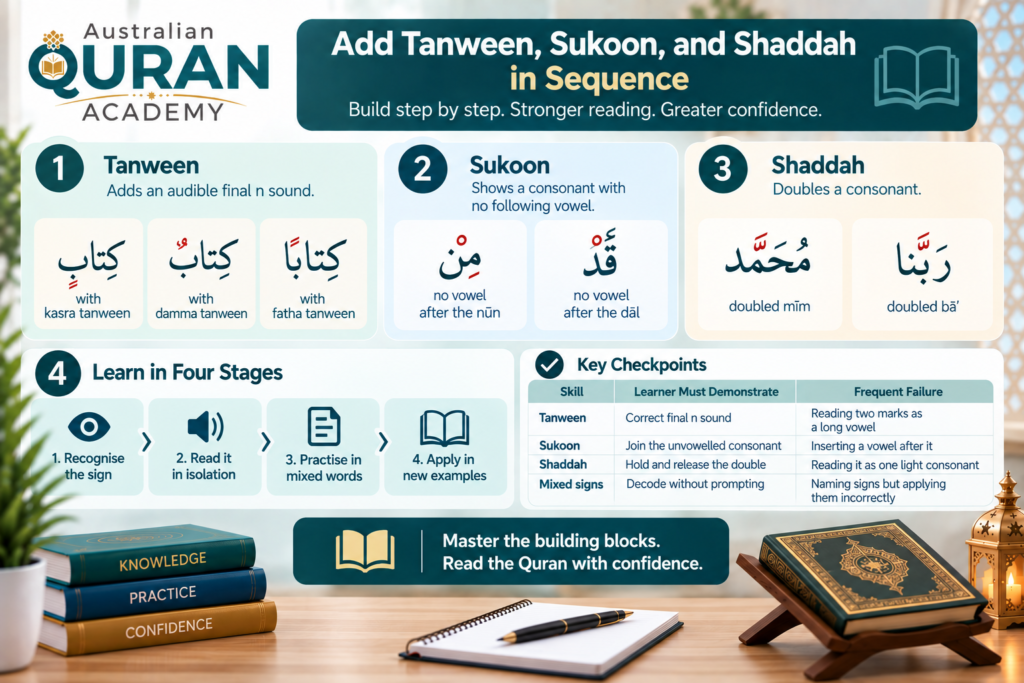
Tanween adds an audible final n sound, Sukoon shows that a consonant has no following vowel, and Shaddah doubles a consonant. Each definition should be demonstrated through contrast, not memorised as terminology alone.
Teach one symbol through four stages: recognition, isolated reading, mixed drills, and unfamiliar examples. Do not combine several new signs simply because they appear on the next printed page. Mastery should control pace, not page numbers.
The following checkpoints prevent premature progression:
| Skill | Learner Must Demonstrate | Frequent Failure |
| Tanween | Produce the correct final n sound | Reading two marks as a long vowel |
| Sukoon | Join into the unvowelled consonant | Inserting a vowel after the consonant |
| Shaddah | Hold and release the doubled consonant | Reading it as one light consonant |
| Mixed signs | Decode without prompting | Naming signs but applying them incorrectly |
Repeat failed patterns in new combinations, not only in the original line. Transfer to unfamiliar examples proves that the learner understands the sign and can apply it independently.
7. Control Madd and Ghunnah with Measured Timing
Measure extended and nasal sounds instead of copying a reciter’s melody. Madd means elongation of specified vowel sounds, while Ghunnah is nasal resonance associated particularly with Noon and Meem in defined conditions.
Use steady finger taps or quiet counts during initial drills. Counting is temporary scaffolding, not part of recitation. It helps learners distinguish a short vowel from a two-count elongation and prevents inconsistent stretching.
Teach the visual trigger before asking for duration. The learner should identify why a sound extends, pronounce it, and then verify timing. Imitation without symbol recognition may sound correct on one example but fail elsewhere.
Apply a listen, mark, read, and compare cycle:
- Listen to one model reading at a controlled speed.
- Mark only the target Madd or Ghunnah locations.
- Read the line without copying melody.
- Compare timing with the model and tutor feedback.
- Repeat the complete line after correcting individual failures.
Australian Quran Academy offers an Online Tajweed Course for learners ready to develop rule-based accuracy beyond foundational Qaida decoding.

Practise Tajweed with live correction
8. Fit Online Qaida Lessons Around Australian Family Life
Fit Qaida practice around school hours, weekend activities, prayer, and family commitments in Australia. A short routine that survives ordinary weeks is more effective than an ambitious timetable abandoned whenever homework or travel increases.
Schedule live lessons when the learner is alert, not merely when a tutor is available. Young children often perform better before evening fatigue, while working adults may prefer early mornings or a consistent post-dinner slot.
Use a five-day practice pattern with one review day and one rest or catch-up day. Keep home sessions between 15 and 20 minutes unless the learner remains accurate and attentive for longer.
| Day | Main Task | Suggested Time |
| Lesson day | Live correction and new material | 25 to 30 minutes |
| Practice days | Assigned line plus error ledger | 15 to 20 minutes |
| Review day | Mixed old and new examples | 20 minutes |
| Catch-up day | Recover one missed task only | 15 minutes |
During Australian school holidays, retain a minimum review routine instead of stopping completely. Ten minutes on four days weekly can protect letter recognition and blending until the normal lesson schedule resumes.
Parents should supervise setup and consistency without giving technical corrections they cannot verify. Mark uncertain sounds for the tutor. Conflicting pronunciation advice can confuse a child and make the next lesson mostly corrective.
Inside Our Virtual Classrooms
We believe in full transparency and proven quality. Take a look at these actual snippets from our live classes to experience our modern learning platform, patient instructors, and interactive student participation.
Start Your Quranic Journey in Australia
Join our leading online academy and learn with expert tutors through a structured, personalized curriculum.
Book Your Free Trial9. Use PDFs and Audio as Practice Tools Only
Use one clear Noorani Qaida PDF that matches the tutor’s lesson sequence. Switching between editions can alter page numbers, symbols, or exercise order, which wastes lesson time and makes homework instructions difficult to follow.
A search for a “Noorani Qaida master reading the Quran PDF” may produce attractive downloads, but a file cannot confirm pronunciation. Check that Arabic text is legible, vowel marks are distinct, and examples remain clear when enlarged.
Audio should model a specific assigned line rather than play continuously in the background. The learner listens once, predicts the symbols, reads aloud, records one attempt, and compares only after completing the line.
Follow this resource hierarchy:

- Live tutor feedback determines whether pronunciation is correct.
- The chosen Qaida provides lesson order and visual exercises.
- Tutor-approved audio supplies a repeatable sound model.
- A recording captures the learner’s independent performance.
- Flashcards support recognition of active problem symbols.
Avoid transliteration as a permanent reading aid. English letters cannot represent every Arabic articulation accurately, and dependence on them delays direct recognition. Use transliteration only for a brief explanation when the tutor considers it necessary.
10. Pass a Reading Test Before Opening the Mushaf
Complete Noorani Qaida with an unseen reading test rather than celebrating the final page alone. Completion means the learner can transfer letter, vowel, joining, timing, and basic Tajweed skills to unfamiliar material without prompts.
The test should sample the entire curriculum instead of repeating the most recent lesson. Include mixed Harakaat, Tanween, Sukoon, Shaddah, Madd, Ghunnah, difficult letter pairs, and stops appropriate to the learner’s level.
Use measurable promotion criteria:
- At least 90% accurate decoding on unfamiliar Qaida combinations.
- No repeated substitution among the learner’s tracked difficult letters.
- Correct short-vowel length without systematic stretching.
- Reliable recognition of Sukoon, Shaddah, Tanween, and Madd signs.
- Ability to self-correct several errors after one prompt.
After passing, begin with short Quranic passages at a slower pace than familiar Qaida exercises. The Mushaf introduces denser lines and connected recitation, so the first objective is accurate transfer, not completing a large daily portion.
Australian Quran Academy offers Quran Classes for Beginners that support the transition from foundational decoding to supervised Quran reading.
Move from Qaida to Quran with confidence
Track Errors and Review Progress Every Four Weeks
Review progress every four weeks using evidence from lessons, recordings, and unseen reading samples. Page completion alone can hide recurring substitutions, dependence on prompting, or accuracy that disappears outside a familiar exercise.
Keep a compact progress record containing the current lesson, active errors, corrected errors, home-practice completion, and next promotion test. Tutors and parents can then discuss specific patterns rather than relying on broad impressions.
Compare one monthly recording with the previous sample at the same difficulty. Listen for cleaner articulation, fewer hesitations, and better transfer to unfamiliar combinations. Do not compare speed unless accuracy has remained stable.
If progress stalls, change one variable at a time. Shorten the assigned line, increase correction frequency, revisit an earlier symbol, or move the lesson to a more attentive time. Changing everything together prevents useful diagnosis.
This four-week review is valuable complementary content because it converts a course into an accountable learning system. It also identifies when the learner needs additional Makharij work instead of more repetition of the same page.
Read also: How To Start Reading Quran Daily?
Start Noorani Qaida with Australian Quran Academy
Australian Quran Academy provides live online instruction, structured lesson progression, and individual correction for beginners.
Flexible scheduling supports Australian families, while tutor-led assessment keeps students working at the appropriate level rather than following a fixed pace.
What sets Australian Quran Academy apart:
- Live teachers who hear and correct each learner’s recitation.
- Individual pacing for children, adults, and complete beginners.
- A clear pathway from Noorani Qaida into Quran reading and Tajweed.
Our Quran Courses:
- Noorani Qaida Course
- Online Quran Reading Course
- Online Tajweed Course
- Quran Classes for Beginners
- Quran Classes for Kids
- Noorani Qaida Course for Kids
Conclusion
Learning Noorani Qaida online works when each stage has a defined skill, targeted correction, and a promotion test. Learners should secure letter recognition and Makharij before building vowels, joined forms, advanced signs, measured sounds, and Quranic transfer.
For anyone deciding how to learn Noorani Qaida online in Australia, the strongest plan combines a qualified tutor with brief, regular practice and one consistent resource set. Accuracy must lead, while speed follows naturally through successful repetition.
Use the monthly review and final unseen test to confirm real progress. When a learner can decode unfamiliar combinations accurately and correct prompted mistakes, beginning supervised Quran reading becomes a sound next step rather than a premature jump.
Frequently Asked Questions About Noorani Qaida Online
How Long Does Noorani Qaida Usually Take Online?
Noorani Qaida commonly takes several months, but no fixed duration suits every learner. Prior letter knowledge, lesson frequency, home practice, age, and pronunciation needs all affect progress. Promotion should depend on demonstrated accuracy rather than a promised completion date.
Can Adults Learn Noorani Qaida from the Beginning?
Yes, adults can begin Noorani Qaida without previous Arabic study. An initial assessment prevents unnecessary repetition, while structured lessons address letter recognition, Makharij, blending, and reading signs at an adult-appropriate pace without assuming childhood learning experience.
Does a Noorani Qaida PDF Replace Online Lessons?
No, a Noorani Qaida PDF cannot replace live pronunciation correction. It can organise exercises and support homework, but it cannot hear substituted letters, diagnose articulation, or confirm whether vowel and Madd timing are accurate.
How Often Should Children Attend Online Qaida Classes?
Most children benefit from two or three short live classes weekly, supported by 15 minutes of practice on other days. Younger learners may need briefer sessions, while frequency should increase only when attention and accuracy remain stable.
What Equipment Is Needed for Online Noorani Qaida?
A stable internet connection, a device with a clear microphone and camera, headphones when needed, and the tutor’s chosen Qaida are sufficient. Position the screen so the teacher can see the learner clearly without encouraging constant screen distraction.
When Can a Learner Start Reading the Quran?
A learner can begin supervised Quran reading after accurately decoding unfamiliar Qaida examples and applying core signs without regular prompting. Finishing the final page is not enough; the tutor should confirm transfer through a mixed, unseen reading assessment.







Leave a Reply