 Quran

Reading the Quran every day often starts with good intentions but becomes difficult to maintain once work, family responsibilities, changing schedules, and tired days get in the way. The solution is not to begin with a large daily target, but to build a Quran routine that is simple enough to survive ordinary life.
Learning how to start reading Quran daily means choosing a realistic minimum, attaching it to a dependable part of your day, protecting the accuracy of your recitation, and knowing exactly what to do when you miss a session.
For Muslims in Australia, that routine also needs to work around changing prayer times, work patterns, school schedules, and family commitments.
The following 10 practical steps show you how to turn Quran reading from something you intend to do into a consistent daily habit, starting with a small goal and gradually building towards accurate, meaningful, and sustainable recitation.
1. Learn How to Start Reading Quran Daily with a Small Goal
Choose a daily minimum that remains possible on your busiest normal day. Five minutes, one page, or ten carefully read verses can establish consistency without turning Quran reading into a demanding project.
Your minimum is the amount required to keep the appointment, not the maximum you may read. Continue beyond it when time and concentration allow, but never enlarge tomorrow’s obligation because today’s session felt unusually easy.
Use one measurement during the first fortnight so success remains unambiguous. Switching between minutes, pages, and verses makes progress difficult to judge and encourages quiet changes whenever the original target becomes inconvenient.
Select the starting unit that matches your present ability and schedule:
| Starting point | Daily minimum | Best suited to | Progress signal |
| Time based | 5 minutes | Readers with changing page speeds | Starting promptly every day |
| Page based | 1 page | Fluent readers seeking steady coverage | Finishing accurately without rushing |
| Verse based | 5 to 10 verses | Beginners using translation or notes | Retaining one clear meaning |
| Audio supported | 5 lines | Readers correcting pronunciation | Matching the reciter without guessing |
2. Link Quran Reading to One Salah in Australia
Attach the session to a Salah you already observe consistently because an existing act makes a stronger cue than a new clock alarm. The sequence becomes prayer, remain seated, open the Quran, then complete the minimum.
Fajr suits readers who think clearly before work, while Maghrib or Isha may suit families sharing evening responsibilities. Choose according to repeated availability, not according to an ideal routine copied from somebody else.
Australian prayer times shift substantially between seasons, especially in southern cities. Keep the selected Salah as the cue while allowing the clock time to move, so daylight changes do not dismantle the habit.
Australian Quran Academy offers an Online Quran Reading Course that helps learners build accurate reading skills through regular guided practice suited to their present level.

Start Your Free Quran Reading Lesson
3. Prepare a Quran Space That Removes Starting Friction
Make beginning physically easy by keeping your Mushaf, bookmark, reading glasses, and notebook together in one clean place. A prepared setting removes several small decisions that otherwise compete with a fragile new routine.
If you read digitally, place the chosen Quran application on the phone’s first screen and disable notifications before the session. Opening messages first turns a purposeful cue into an invitation for unrelated browsing.
Use the same Mushaf edition whenever possible because familiar page layout improves orientation and return speed. Mark the stopping point with a bookmark rather than trusting memory, particularly when reading several short sessions during one day.
Prepare the space before bedtime or before leaving for work. The next session should require only sitting down and beginning, not locating materials, charging a device, choosing a passage, or clearing a crowded surface.
See Us in Action!
Curious about what our online classrooms look like? Watch the short clips below to see how our interactive, one-on-one sessions bring learning to life with real-time feedback and engaging teaching methods.
Start Your Quranic Journey in Australia
Join our leading online academy and learn with expert tutors through a structured, personalized curriculum.
Book Your Free Trial4. Fit Quran Reading Around Daily Life in Australia
Protect a specific window that fits commuting, school runs, shift work, and household duties. A workable Australian routine may use five minutes after Fajr on weekdays and a longer review after Dhuhr on weekends.
Avoid writing “read Quran sometime today” because an undefined task must compete with every interruption. Record a cue and location instead, such as “after Maghrib at the dining table before checking messages”.
Create one backup window for predictable disruption, not several optional times. If the primary session follows Fajr, the backup might follow Isha; after that, complete only the minimum and resume normally tomorrow.
Test the chosen window for seven days before changing it. One difficult morning does not prove that a schedule fails, but repeated interruption on four or five days shows that the cue needs adjustment.
Australian Quran Academy offers an Online Quran Recitation Course that gives students scheduled live practice and direct correction, turning an intended routine into a dependable learning appointment.

5. Read Slowly Enough to Preserve Pronunciation
Read at the fastest pace that preserves every letter, vowel, Shaddah, and stopping point. Daily practice should strengthen correct patterns; repeated careless reading only makes pronunciation errors quicker and more difficult to notice.
Beginners should separate decoding from fluency. Sound out unfamiliar words without embarrassment, repeat the line until it becomes stable, then read the complete verse again rather than pushing forward through uncertain pronunciation.
Use a trusted reciter for short listen, pause, and repeat cycles. Audio provides a model for rhythm and vowel length, but it cannot confirm whether your own Makharij, the articulation points of letters, are accurate.
Read also: Quran Memorization Certificate In Australia
Apply a simple correction sequence whenever a word causes difficulty:
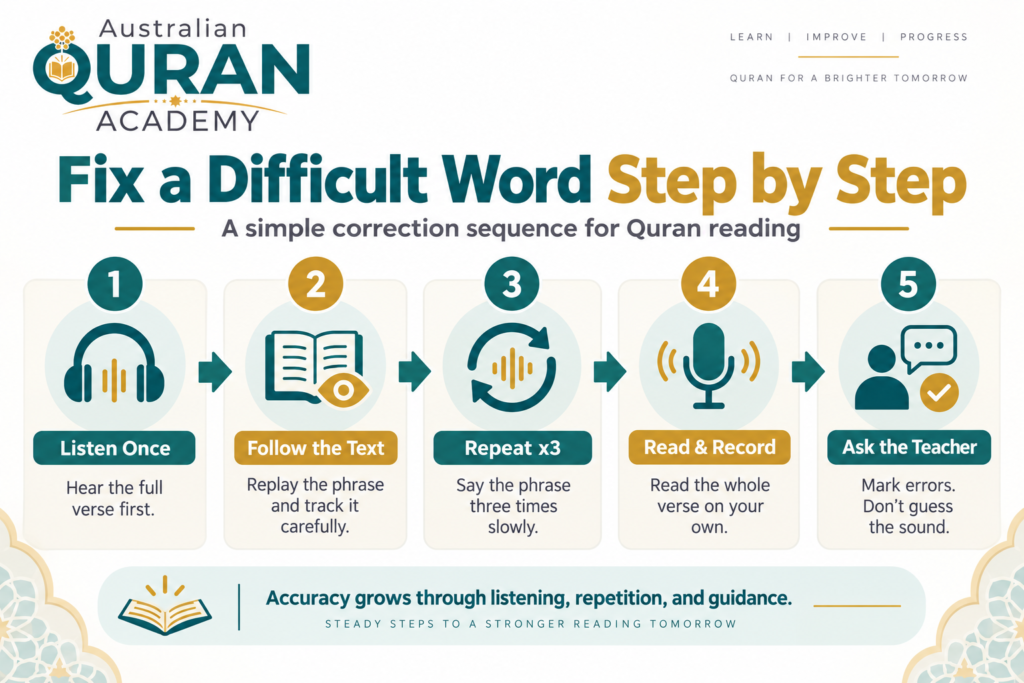
- Listen to the complete verse once without speaking.
- Replay the difficult phrase and follow the printed text carefully.
- Repeat the phrase three times at a controlled pace.
- Read the whole verse independently and record the attempt.
- Mark persistent errors for a qualified teacher rather than inventing a pronunciation.
6. Add Meaning Without Replacing Arabic Recitation
Pair Arabic reading with a reliable English translation so the daily session connects sound with guidance. Translation supports comprehension, but it serves a different purpose from reciting the revealed Arabic text accurately.
Keep reflection narrow enough to finish. Choose one verse, identify its main instruction or reminder, and write one sentence about its application rather than attempting detailed commentary on every page without suitable knowledge.
Use a trusted tafsir, meaning an explanation of Quranic context and meaning, when a verse raises questions. Personal impressions should never replace established interpretation, especially for legal rulings, theology, or passages linked to specific events. A balanced ten-minute session can divide time without becoming complicated:
| Session part | Suggested time | Purpose |
| Arabic reading | 6 minutes | Build accurate, continuous recitation |
| Translation | 2 minutes | Grasp the direct meaning |
| Reflection note | 1 minute | Record one practical lesson |
| Difficult-word review | 1 minute | Prepare a question for correction |
7. Review Quran Reading Progress Weekly in Australia
Review the routine once each week rather than judging it emotionally every day. Australian learners can use Friday before Jumu’ah or Sunday evening, depending on work patterns and family responsibilities, as a consistent checkpoint.
Record three separate measures because each answers a different question. Attendance shows whether the habit exists, accuracy shows whether reading quality is improving, and reflection shows whether the verses are receiving thoughtful attention.
Use a seven-row tracker with simple marks rather than lengthy diary entries. A tick records completion, a circle identifies a shortened backup session, and a brief note records the exact pronunciation issue requiring review.
| Measure | Weekly question | Useful evidence | Wrong conclusion to avoid |
| Attendance | Did I appear at the cue? | Days completed | More pages equal more consistency |
| Accuracy | Did errors decrease? | Corrected words | Fast reading proves fluency |
| Comprehension | Can I state one meaning? | One-sentence notes | Translation alone replaces recitation |
| Recovery | Did I return after disruption? | Next-session restart | One missed day ruins the routine |
Australian Quran Academy offers an Online Tajweed Course that provides live feedback on pronunciation, measured recitation, and recurring errors a personal tracker cannot diagnose alone.

8. Create a Minimum Plan for Tired Days
Decide the reduced version of your practice before tiredness arrives. One carefully read verse, two minutes of revision, or five familiar lines preserves the cue when illness, travel, deadlines, or family demands reduce capacity.
A minimum-day plan is not permission for permanently weak effort. It is an emergency floor that protects continuity, followed by the ordinary target when circumstances return to normal and concentration becomes available again.
Avoid compensating for a missed session with double reading the next day. Punitive catch-up makes tomorrow heavier, associates the Quran with arrears, and can turn one unavoidable absence into several deliberate postponements.
Use this recovery rule instead:
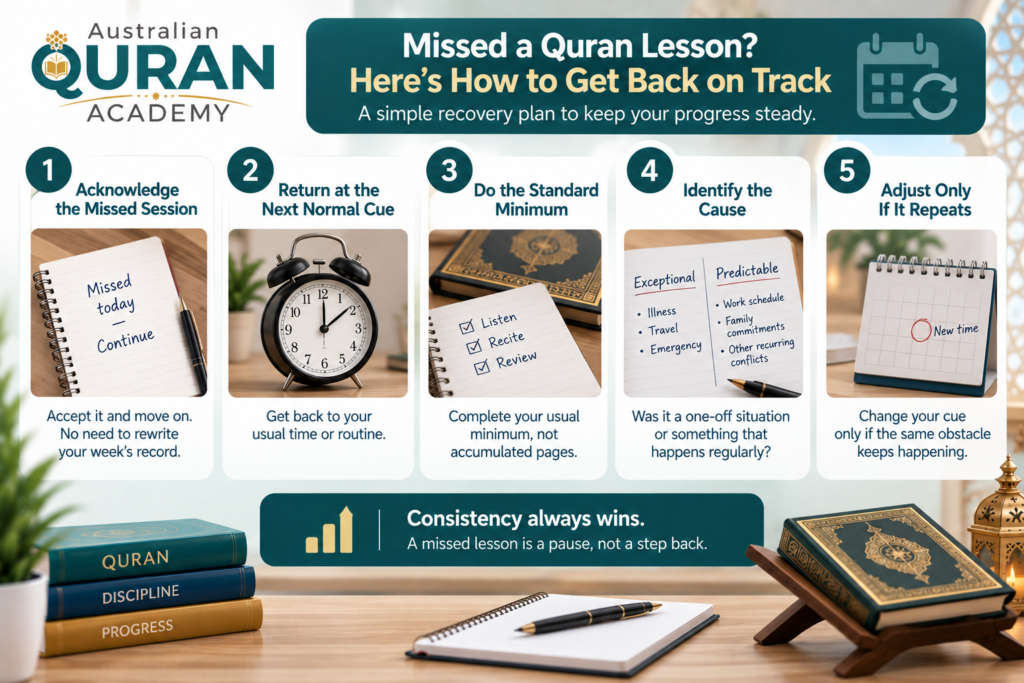
- Acknowledge the missed session without rewriting the week’s record.
- Return at the next normal cue.
- Complete the standard minimum, not accumulated pages.
- Identify whether the disruption was exceptional or predictable.
- Adjust the cue only when the same obstacle repeats.
9. Increase Quran Reading Only After Consistency
Increase the portion after completing at least twelve of fourteen planned sessions with acceptable accuracy. This threshold tests whether the current routine is stable before additional pages increase time, fatigue, and resistance.
Add the smallest useful amount, such as two minutes, half a page, or five verses. Keep the new target for another fortnight before increasing again, even when early enthusiasm suggests a much larger jump.
Fluent readers may eventually use a completion schedule, while beginners should prioritise sound control and confidence. A slow, accurate page creates a better foundation than several rushed pages filled with avoidable vowel and stopping errors.
The following progression keeps growth measurable without making volume the only achievement:
| Fortnight | Target | Quality condition | Decision |
| 1 | 5 minutes | Begin at the fixed cue | Keep or change the cue |
| 2 | 5 minutes | Read without rushing | Confirm the routine |
| 3 | 7 minutes | Preserve pronunciation | Maintain or reduce |
| 4 | 1 to 2 pages | Retain one key meaning | Continue gradual growth |
Inside Our Virtual Classrooms
We believe in full transparency and proven quality. Take a look at these actual snippets from our live classes to experience our modern learning platform, patient instructors, and interactive student participation.
Start Your Quranic Journey in Australia
Join our leading online academy and learn with expert tutors through a structured, personalized curriculum.
Book Your Free Trial10. Seek Quran Correction Within Australia
Arrange regular listening with a qualified teacher because self-review cannot reliably catch every articulation error. A teacher should identify the precise sound, demonstrate the correction, hear your repetition, and check the same skill later.
Online tuition is particularly useful across Australia, where learners may live far from a suitable local class or need lessons around different state schedules. Confirm lesson times in your own time zone before committing.
Bring marked words and one recorded sample to each lesson so correction begins with evidence. Ask the teacher to prioritise recurring mistakes rather than interrupting every line with several new rules that divide attention.
Australian Quran Academy offers Quran Classes for Adults with guided reading, individual correction, and flexible online access for adults building a serious daily practice.

Start a Free Adult Quran Lesson
Follow a Seven Day Quran Reading Starter Plan
Use the first seven days to establish the reading cue rather than increase the number of pages. Every session should remain short enough to complete accurately, even when the day becomes unexpectedly busy.
| Day | Quran Reading Task | Main Purpose |
| Day 1 | Choose one Salah and read for five minutes afterwards | Establish a clear daily cue |
| Day 2 | Repeat the same session using the same Mushaf | Reduce decisions before reading |
| Day 3 | Listen to one verse and repeat it three times | Improve pronunciation through imitation |
| Day 4 | Read the daily portion and check one English meaning | Connect recitation with comprehension |
| Day 5 | Record one minute and mark uncertain words | Identify errors requiring correction |
| Day 6 | Complete the minimum during the backup window | Test the routine against disruption |
| Day 7 | Review attendance, accuracy, and reading time | Decide what needs adjustment |
Do not increase the target during this first week, even when several sessions feel easy. The purpose is to prove that the selected cue, location, and reading amount can work across different kinds of days.
At the end of Day 7, keep the routine unchanged if you completed at least five sessions without rushing. Change only the part that repeatedly failed, such as the timing, location, portion, or digital distractions.
If one day was missed, resume with the normal minimum instead of adding unfinished pages to the next session. Successful recovery is stronger evidence of a sustainable Quran habit than maintaining a perfect first-week record.
Read also: 7 Best Quran Memorization Websites
Start Daily Quran Reading with Australian Quran Academy
Australian Quran Academy connects learners with live instruction, individual correction, and flexible online scheduling. These features help students replace uncertain solo practice with a clear reading level, appropriate material, and accountable weekly progress.
What sets Australian Quran Academy apart:
- Live teachers can hear pronunciation mistakes that applications and recordings may not identify accurately.
- Flexible lesson options support adults, children, sisters, beginners, and learners across Australian time zones.
- Structured Quran reading and Tajweed pathways connect daily practice with measurable improvement rather than page counts alone.
Our Quran Courses:
- Online Quran Reading Course
- Online Quran Recitation Course
- Online Tajweed Course
- Quran Classes for Adults
- Quran Classes for Beginners
- Quran Classes for Sisters

Conclusion
Learning how to start reading Quran daily is not about completing as many pages as possible. A stronger goal is to create a routine you can return to every day: a manageable portion, a reliable cue, careful recitation, some attention to meaning, and a clear plan for recovering when life interrupts your schedule.
Start small enough that the habit works even on busy days. Once you can maintain it consistently without rushing your pronunciation, increase your reading gradually. Over time, five focused minutes can become a stable practice that improves your fluency, understanding, and connection with the Quran.
If pronunciation or Tajweed mistakes are limiting your progress, do not simply increase the number of pages you read. Australian Quran Academy can provide live correction and structured guidance alongside your daily practice, helping you improve the quality of what you already read.
Frequently Asked Questions About Daily Quran Reading
What Is the Best Time to Read Quran Every Day?
The best time is the window you can protect consistently with reasonable concentration. Many learners choose after Fajr, Maghrib, or Isha because Salah supplies a reliable cue, but shift workers may need another repeatable daily anchor.
How Much Quran Should a Beginner Read Daily?
A beginner should start with five minutes, one page, or five carefully read verses daily. The correct amount permits accurate pronunciation and regular attendance; increase it only after the starting target feels stable for two weeks.
What Should I Do After Missing a Quran Session?
Resume at the next normal reading time and complete your usual minimum. Do not double the target or hide the missed day; record what interrupted the routine and change the cue only if that obstacle repeatedly returns.
Can I Read a Quran Translation as My Daily Reading?
Reading a reliable translation is valuable for comprehension, but it does not replace recitation of the Quran in Arabic. Combine both according to your ability, and seek instruction if Arabic decoding or pronunciation prevents meaningful progress.
How Can I Stay Consistent with Quran Reading?
Consistency comes from a small minimum, a fixed cue, prepared materials, visible tracking, and a recovery rule. Motivation may strengthen a session, but the routine must remain workable when enthusiasm, energy, or available time decreases.
When Should I Increase My Daily Quran Target?
Increase after completing at least twelve of fourteen planned sessions accurately. Add only two minutes, half a page, or several verses, then maintain the new amount for another fortnight before considering further growth.








[…] Read also: How To Start Reading Quran Daily? […]