 Quran
Quran
Imagine standing before Allah on the Day of Resurrection while the Quran itself speaks on your behalf — interceding for you, adorning you with a crown, and elevating your rank with every verse you once committed to memory. That is the reality awaiting the hafiz.
What is the reward for becoming a hafiz? It is not a single prize — it is a lifetime of honour in this world and an eternity of elevated rank in the next. From leading prayers to walking in the company of angels, the privileges Allah has prepared for those who carry His Book in their hearts are unlike any other.
A hafiz is someone who has memorized the entire Quran and holds it in their heart. The Prophet Muhammad ﷺ described the hafiz as a companion of the Quran — a title that carries weight in this life and the Hereafter alike. The rewards are not vague promises; they are specific, narrated, and classified across worldly honour and eternal elevation.
1. The Quran Intercedes for You on the Day of Resurrection
One of the greatest rewards associated with the Quran is its intercession on the Day of Resurrection.
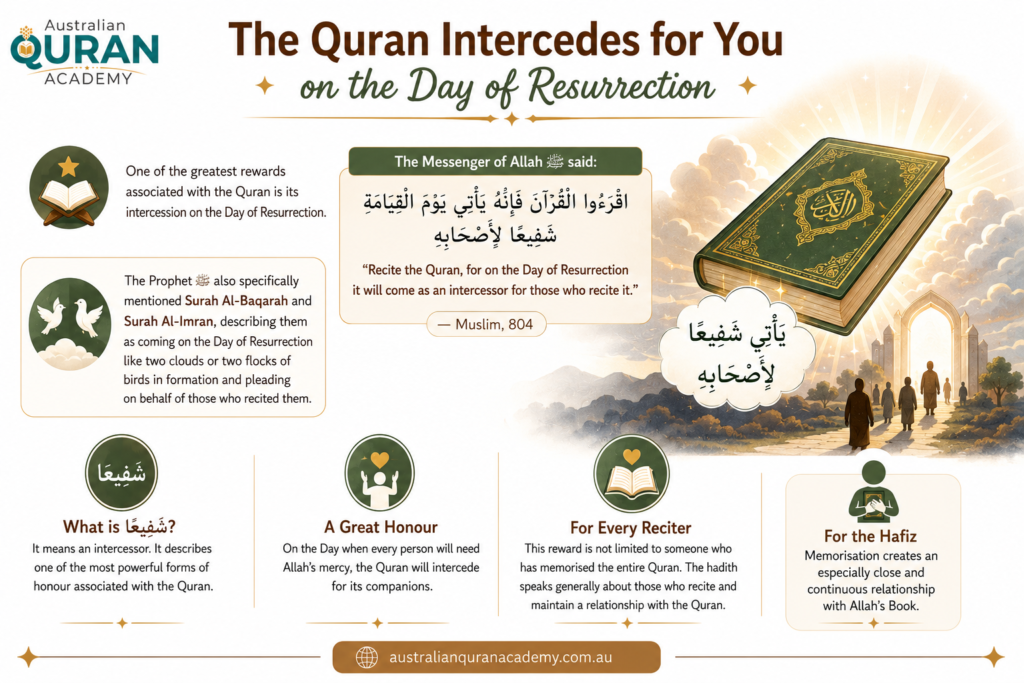
Abu Umamah al-Bahili (رضي الله عنه) reported that the Messenger of Allah ﷺ said:
«اقْرَءُوا الْقُرْآنَ فَإِنَّهُ يَأْتِي يَوْمَ الْقِيَامَةِ شَفِيعًا لِأَصْحَابِهِ»
“Recite the Quran, for on the Day of Resurrection it will come as an intercessor for those who recite it.” — Muslim, 804
The Prophet ﷺ also specifically mentioned Surah Al-Baqarah and Surah Al-Imran, describing them as coming on the Day of Resurrection like two clouds or two flocks of birds in formation and pleading on behalf of those who recited them.
The word شَفِيعًا means an intercessor. It describes one of the most powerful forms of honour associated with the Quran: on the Day when every person will need Allah’s mercy, the Quran will intercede for its companions.
This reward is not limited to someone who has memorised the entire Quran. The hadith speaks generally about those who recite and maintain a relationship with the Quran. For the hafiz, however, memorisation creates an especially close and continuous relationship with Allah’s Book.
2. Your Rank in Jannah Is Determined by the Last Verse You Recite
What is the reward for becoming a hafiz in Paradise? Your station in Jannah is directly tied to how much Quran you memorised.
Abdullah ibn Amr (رضي الله عنه) reported that the Prophet ﷺ said:
«يُقَالُ لِصَاحِبِ الْقُرْآنِ اقْرَأْ وَارْتَقِ وَرَتِّلْ كَمَا كُنْتَ تُرَتِّلُ فِي الدُّنْيَا فَإِنَّ مَنْزِلَكَ عِنْدَ آخِرِ آيَةٍ تَقْرَأُ بِهَا»
“It will be said to the companion of the Quran: ‘Read, advance in status and recite as you used to do in the world, for your status will be commensurate with the last ayah that you recite.'” — Al-Tirmidhi, 2914
This hadith describes a remarkable honour: the person’s advancement in Paradise is connected with their Quran recitation.
The hadith does not establish a mathematical formula in which every memorised verse equals one specific Paradise level. Rather, it establishes a profound connection between a person’s relationship with the Quran and their rank in the Hereafter.
For someone pursuing hifz, this gives every memorised passage a significance that extends beyond worldly achievement. The goal is not simply to finish memorisation, but to become a true companion of the Quran.
3. The Hafiz Is Honoured With a Crown and Garment
Among the most vivid descriptions of what is the reward for becoming a hafiz is the scene narrated by Abu Hurayrah (رضي الله عنه). The Prophet ﷺ said:
«يَجِيءُ الْقُرْآنُ يَوْمَ الْقِيَامَةِ فَيَقُولُ يَا رَبِّ حَلِّهِ فَيُلْبَسُ تَاجَ الْكَرَامَةِ ثُمَّ يَقُولُ يَا رَبِّ زِدْهُ فَيُلْبَسُ حُلَّةَ الْكَرَامَةِ ثُمَّ يَقُولُ يَا رَبِّ ارْضَ عَنْهُ فَيَرْضَى عَنْهُ»
“The Quran will come on the Day of Resurrection and say: ‘O Lord, adorn him.’ So he will be given a crown of honour. Then it will say: ‘O Lord, give him more.’ So he will be given a garment of honour. Then it will say: ‘O Lord, be pleased with him.’ So Allah will be pleased with him.” — Al-Tirmidhi, 2915
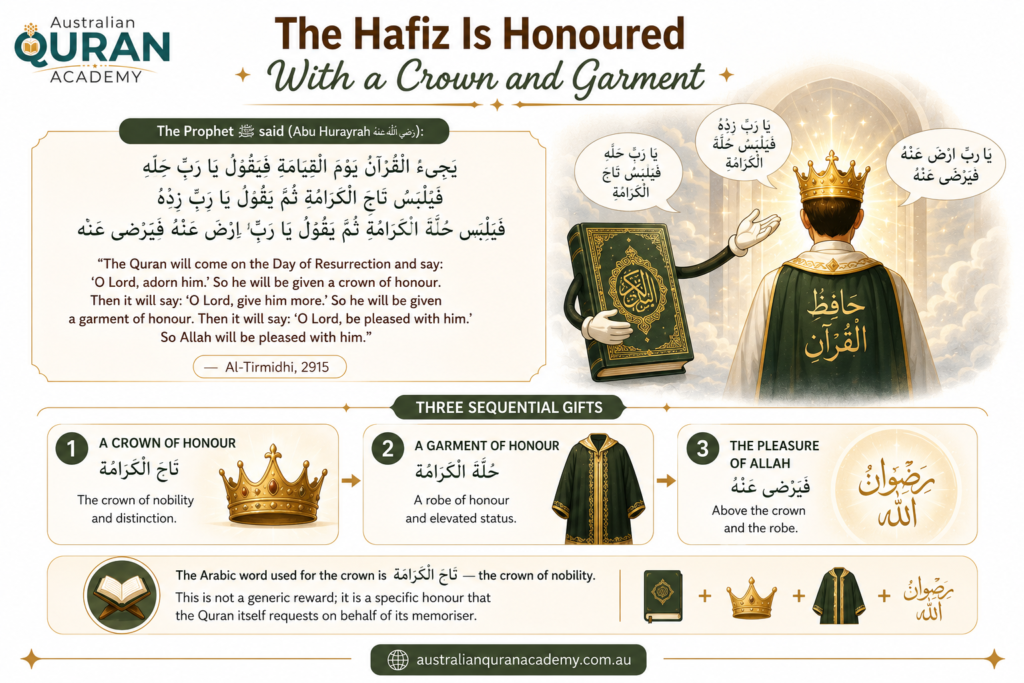
Three sequential gifts: a crown, a robe, and — above both — the pleasure of Allah. The Arabic word used for the crown is تَاجَ الْكَرَامَةِ — the crown of nobility. This is not a generic reward; it is a specific honour that the Quran itself requests on behalf of its memoriser.
4. Your Parents Are Crowned Because of You
The reward of hifz does not stop at the hafiz. If you memorise the Quran, your parents are honoured on the Day of Judgement with a crown whose light surpasses the sun.
The Prophet ﷺ said, as narrated by Buraydah (رضي الله عنه):
«مَنْ قَرَأَ الْقُرْآنَ وَتَعَلَّمَهُ وَعَمِلَ بِهِ أُلْبِسَ وَالِدَاهُ يَوْمَ الْقِيَامَةِ تَاجًا مِنْ نُورٍ ضَوْؤُهُ مِثْلُ ضَوْءِ الشَّمْسِ»
“Whoever reads the Quran, learns it, and acts in accordance with it — on the Day of Resurrection his parents will be given a crown to wear whose light will be like the light of the sun.” — [Al-Hakim, 1/756]
The wording of this narration is important. It does not mention memorisation alone; it describes someone who reads the Quran, learns it, and acts upon it.
This teaches an important principle for every hifz student: the objective is not simply to store the Quran in memory. The Quran should influence one’s worship, character, behaviour, and daily choices.
For parents, supporting a child’s Quran education can therefore become part of a much greater spiritual journey.
For families looking for structured Quran and Arabic education, explore our children’s Arabic and Quran courses.

Read also: Easy Arabic Stories for Kids – 7 Stories With Translation, Vocabulary, and Activities
5. The Proficient Quran Reciter Is in the Company of Angels
The hafiz does not walk alone. Aisha (رضي الله عنها) reported that the Prophet ﷺ said:
«الْمَاهِرُ بِالْقُرْآنِ مَعَ السَّفَرَةِ الْكِرَامِ الْبَرَرَةِ وَالَّذِي يَقْرَأُ الْقُرْآنَ وَيَتَتَعْتَعُ فِيهِ وَهُوَ عَلَيْهِ شَاقٌّ لَهُ أَجْرَانِ»
“The one who is proficient in the recitation of the Quran will be with the noble righteous scribes (angels), and the one who recites it with difficulty will have a double reward.” — Al-Bukhari, 4653 | Muslim, 798
The word الماهر refers to someone proficient in the Quran. This is an important distinction: the hadith does not say that every person who memorises the Quran automatically reaches this particular rank. Rather, it highlights the honour of proficiency and excellence in recitation.
At the same time, the hadith contains wonderful encouragement for beginners. A person who struggles with recitation but continues making the effort receives two rewards.
So whether you recite fluently or struggle through every line, sincere persistence has value with Allah.
See Us in Action!
Curious about what our online classrooms look like? Watch the short clips below to see how our interactive, one-on-one sessions bring learning to life with real-time feedback and engaging teaching methods.
Start Your Quranic Journey in Australia
Join our leading online academy and learn with expert tutors through a structured, personalized curriculum.
Book Your Free Trial6. The Quran Gives Priority in Leading Prayer
In every mosque, the person most deserving to lead the congregation is the one with the most Quran in their heart. This is a prophetic instruction, not a cultural preference.
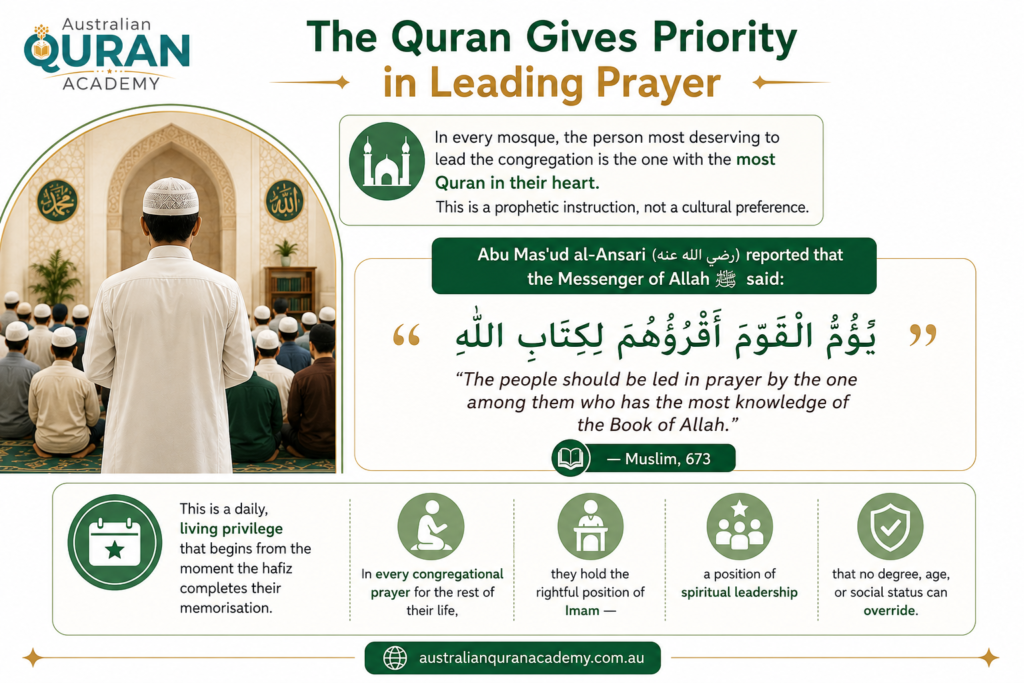
Abu Mas’ud al-Ansari (رضي الله عنه) reported that the Messenger of Allah ﷺ said:
«يَؤُمُّ الْقَوْمَ أَقْرَؤُهُمْ لِكِتَابِ اللَّهِ»
“The people should be led in prayer by the one among them who has the most knowledge of the Book of Allah.” — Muslim, 673
This is a daily, living privilege that begins from the moment the hafiz completes their memorisation. In every congregational prayer for the rest of their life, they hold the rightful position of Imam — a position of spiritual leadership that no degree, age, or social status can override.
7. Allah Elevates People Through the Quran
The Quran can also become a means of honour and elevation in this world.
At burial: Jabir ibn Abdullah (رضي الله عنه) narrated that at the Battle of Uhud, the Prophet ﷺ would ask which martyr knew more Quran before placing him closer to the qiblah in the grave. — Al-Bukhari, 1278
In leadership: Umar ibn al-Khattab (رضي الله عنه) appointed Ibn Abza — a freed slave — as governor of Makkah, citing only his mastery of the Quran. When questioned, Umar replied with the hadith:
«إِنَّ اللَّهَ يَرْفَعُ بِهَذَا الْكِتَابِ أَقْوَامًا وَيَضَعُ بِهِ آخَرِينَ»
“Indeed, by this Book, Allah would exalt some people and degrade others.” — Muslim, 817
In Islam, the Quran is the true equaliser. No lineage, wealth, or political connection outranks the one who carries Allah’s words in their chest.
Read also: How to Become a Hafiz in Australia – A 10-Step Guide
8. Memorisation Sharpens Memory and Strengthens Focus
The spiritual rewards of hifz are the primary reason to memorise the Quran, but the process also requires qualities that can benefit a person’s everyday life.
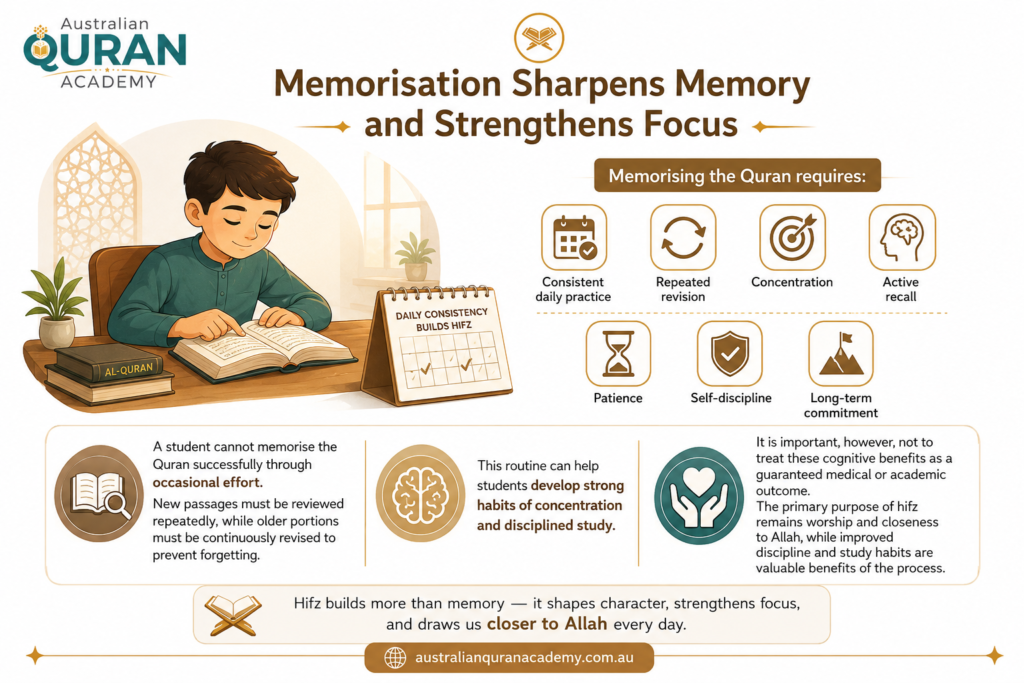
Memorising the Quran requires:
- Consistent daily practice
- Repeated revision
- Concentration
- Active recall
- Patience
- Self-discipline
- Long-term commitment
A student cannot memorise the Quran successfully through occasional effort. New passages must be reviewed repeatedly, while older portions must be continuously revised to prevent forgetting.
This routine can help students develop strong habits of concentration and disciplined study.
It is important, however, not to treat these cognitive benefits as a guaranteed medical or academic outcome. The primary purpose of hifz remains worship and closeness to Allah, while improved discipline and study habits are valuable benefits of the process.
9. The Quran Brings Tranquillity to the Heart
Allah says in Surah Ar-Ra’d, verse 28:
﴿أَلَا بِذِكْرِ اللَّهِ تَطْمَئِنُّ الْقُلُوبُ﴾
“Verily, in the remembrance of Allah do hearts find rest.” — Quran 13:28
The hafiz lives inside this verse. Daily memorisation, revision in salah, and constant return to the ayat create a relationship with the Quran that settles anxiety, softens anger, and builds an inner tranquillity that is observable — not theoretical.
Ibn Abbas (رضي الله عنه) narrated that the Prophet ﷺ said: “Indeed, the one who does not have the Quran inside him is like the ruined house.” The hafiz is the opposite of that ruined house — they are built from within by the words of Allah.
For sisters and women who want to build this connection in a supportive, female-only environment, our ladies’ Arabic and Quran courses provide the structured learning space to begin.

10. A Hafiz Carries the Quran Wherever They Go
One of the most practical and underappreciated rewards of hifz: the hafiz carries the entire Quran wherever they go. In salah, in travel, during illness, in any moment of need — the words are already present.
This means the hafiz can revise during long prayers, maintain their relationship with the Quran in any circumstance where a physical copy is unavailable, and connect with Allah’s words at any hour of the night — in any position, without a device or a book.
For women during times when they cannot access a physical mushaf, hifz means the connection to the Quran is never interrupted. The Book lives in the heart, not on a shelf.
Read also: Daily Routine in Arabic for Kids – Words, Phrases, and a Printable Vocabulary Guide
Inside Our Virtual Classrooms
We believe in full transparency and proven quality. Take a look at these actual snippets from our live classes to experience our modern learning platform, patient instructors, and interactive student participation.
Begin Your Hifz Journey with Australian Quran Academy
Understanding what the reward for becoming a hafiz is should inspire action — not just admiration. The honours described in authentic hadith are available to every Muslim who commits, with sincerity, to learning Allah’s Book.
Australian Quran Academy offers structured Quran and Arabic courses for children, adults, and ladies — taught by qualified instructors with deep grounding in tajweed and hifz methodology. Whether you are starting from scratch or continuing an interrupted journey, there is a programme designed for your level.
Explore all our Arabic and Quran programmes and take the first step toward becoming among those who carry the Book of Allah.
Our Quran Courses
- Quran Online Academy
- Quran Recitation Classes
- Quran Reading Classes
- Online Quran Classes for Kids
- Quran Classes for Adults
- Quran Classes for Female/Sisters
- Learn Quran Course for Beginners
- Quran Memorization (Hifz) Course
- Hifz Classes for Adults
- Quran Memorization and Hifz Course for Kids
- Quran Hifz Course for Ladies
- Quran Ijazah Program
- Quran Qirat Learning Course
- Quran Tafsir Course
- Noorani Qaida Course
- Noorani Qaida Course for Kids
- Weekend Quran Classes
- Intensive Quran Course
- Al-Azhar Quran Course
- Online Tajweed Classes
- Tajweed Course for Kids
- Tajweed Course for Adults
- Tajweed Course for Ladies
Start Your Quranic Journey in Australia
Join our leading online academy and learn with expert tutors through a structured, personalized curriculum.
Book Your Free Trial
Conclusion
What is the reward for becoming a hafiz? It is a crown on the Day of Judgement, a rank in Jannah tied to the last verse you memorised, the intercession of the Quran itself, the company of angels, and a crown of light for your parents — all granted by Allah for the sincere act of carrying His Book in your heart.
In this world, the hafiz leads prayers, holds leadership by prophetic instruction, carries a sharpened mind, and lives with a purified heart as the daily fruit of their memorisation. The benefits span this life and the next, and they extend to the entire family that supported the journey.
The Quran is not waiting to reward you after you finish — it rewards you with every verse, every revision session, every sincere effort along the way.
Frequently Asked Questions
What is the reward for becoming a hafiz in the Hereafter?
The hafiz receives multiple specific rewards on the Day of Resurrection: a crown of honour (تَاجَ الْكَرَامَةِ), a garment of dignity, the pleasure of Allah, a rank in Jannah determined by the last ayah memorised, and the Quran itself interceding on their behalf. These are all narrated in sahih and hasan hadith from the Prophet ﷺ.
Does the reward for becoming a hafiz extend to parents?
Yes. The Prophet ﷺ narrated that parents of a hafiz will be given crowns on the Day of Judgement whose light surpasses the sun — because they raised and supported their child in learning the Quran. Parents who actively prevent their children from learning the Quran forfeit this reward entirely.
Is hifz compulsory in Islam?
No. Memorising the entire Quran is not individually obligatory (fard ayn), but it is among the most honoured acts of worship in Islam. The community as a whole bears a collective responsibility to ensure the Quran is preserved among its members in every generation.
What is the reward for becoming a hafiz who struggled to memorise?
The Prophet ﷺ explicitly addressed this: the one who recites the Quran with difficulty and still persists receives double reward — one for the recitation, one for the effort endured. Struggle is not a disqualifier; it is a multiplier of mercy.
How does memorising the Quran benefit someone in daily life?
Beyond spiritual rewards, hifz strengthens memory, improves concentration and self-discipline, deepens understanding of Quranic meaning, brings consistent tranquillity of heart, and allows the hafiz to engage with the Quran at any time without needing a physical copy.
At what age is it best to begin memorising the Quran?
Children between 5 and 12 absorb memorisation most efficiently due to their developing memory capacity. However, adults who begin with consistent structure and a qualified teacher can also complete hifz at any age. What matters most is sincere intention and daily, disciplined revision.



Leave a Reply