 Arabic
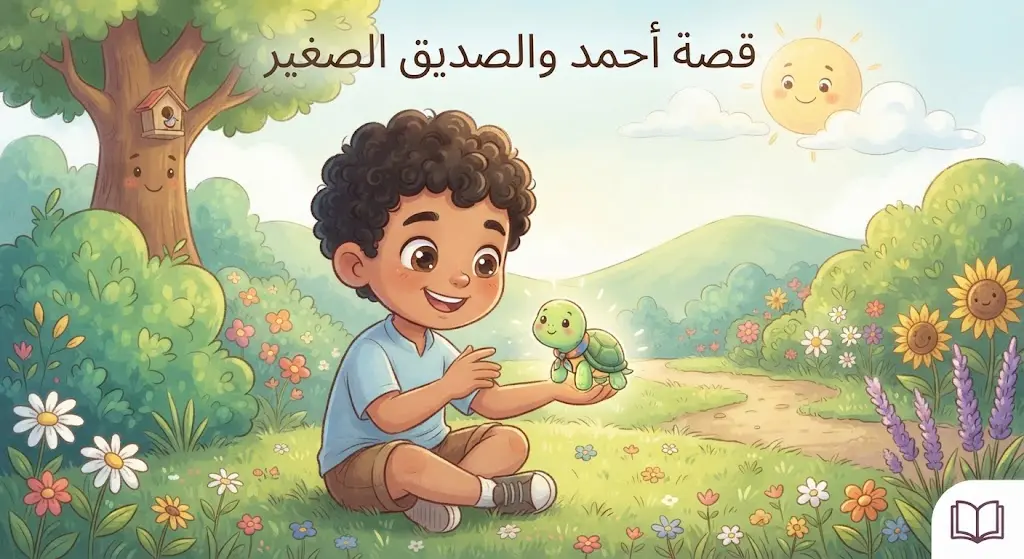
If you have ever tried to teach a child Arabic vocabulary with flashcards, you already know what happens — they remember it for ten minutes and forget it by dinner. Stories work differently. A child who hears “أَسَد” (lion) inside a jungle adventure does not need to review it the next day; the story has already done the storing.
This guide gives you 7 complete easy Arabic stories for kids, each with full Arabic text, transliteration, English translation, vocabulary, and ready-to-use exercises. The collection is built around real characters facing real emotional stakes — a lost cat, a first day at school, the frustration of a hard lesson — because that emotional layer is what converts a new word from short-term encounter into long-term memory.
Whether you are a parent, a homeschool teacher, or a private Arabic tutor, this is a practical classroom resource you can use today.
Story 1: Yusuf and the Lost Cat
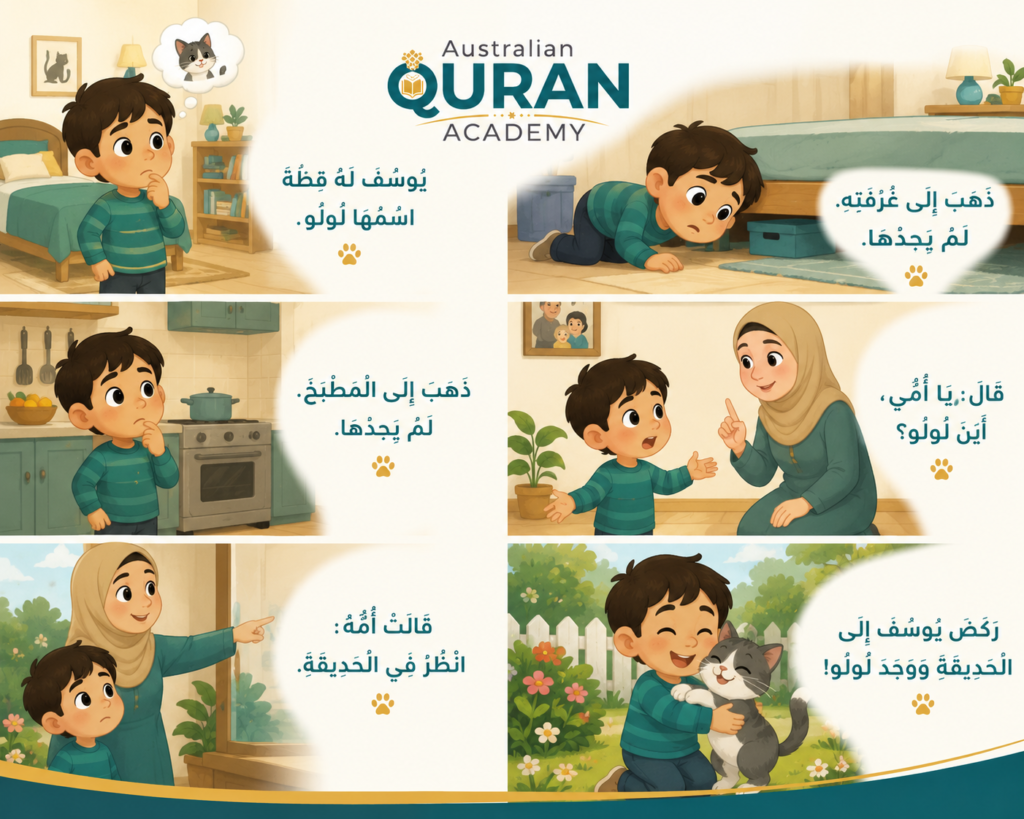
Yusuf has a cat named Lulu, but one day he cannot find her. He searches his room and the kitchen before his mother suggests looking in the garden.
The story introduces simple home and family vocabulary while repeating the useful pattern ذَهَبَ إِلَى… لَمْ يَجِدْهَا (“He went to… He did not find her”).
Arabic Story
يُوسُف لَهُ قِطَّة اسْمُهَا لُولُو.
Yusufu lahu qittatun ismuha Lulu.
Yusuf has a cat named Lulu.
فِي يَوْمٍ مِنَ الأَيَّام، بَحَثَ يُوسُف عَنْ لُولُو.
Fi yawmin min al-ayyam, bahatha Yusufu ‘an Lulu.
One day, Yusuf looked for Lulu.
ذَهَبَ إِلَى غُرْفَتِهِ.
لَمْ يَجِدْهَا.
Dhahaba ila ghurfatihi. Lam yajidha.
He went to his room. He did not find her.
ذَهَبَ إِلَى الْمَطْبَخ.
لَمْ يَجِدْهَا.
Dhahaba ila al-matbakh. Lam yajidha.
He went to the kitchen. He did not find her.
قَالَ: يَا أُمِّي، أَيْنَ لُولُو؟
Qala: ya ummi, ayna Lulu?
He said, “Mama, where is Lulu?”
قَالَتْ أُمُّهُ: انْظُرْ فِي الْحَدِيقَة.
Qalat ummuhu: unzur fi al-hadiqa.
His mother said, “Look in the garden.”
رَكَضَ يُوسُف إِلَى الْحَدِيقَة وَوَجَدَ لُولُو!
Rakada Yusufu ila al-hadiqa wa wajada Lulu!
Yusuf ran to the garden and found Lulu!
Key Vocabulary
- بَحَثَ — bahatha — searched
- لَمْ يَجِدْ — lam yajid — did not find
- أَيْنَ — ayna — where
- انْظُرْ — unzur — look
- رَكَضَ — rakada — ran
- وَجَدَ — wajada — found
Activities
Retell: Ask your child: أَيْنَ بَحَثَ يُوسُف؟ Where did Yusuf look?
Role-play: One child plays Yusuf and another plays his mother.
Change the ending: Ask what would happen if Yusuf found Lulu in the kitchen instead.
Story 2: Maryam Helps Her Mother
Maryam sees her mother cooking and offers to help. She puts the bread on the table, brings water, and arranges the plates.
This story is ideal for connecting Arabic with real-life actions.
Arabic Story
كَانَتْ أُمُّ مَرْيَم تَطْبُخ فِي الْمَطْبَخ.
Kanat ummu Maryama tatbukhu fi al-matbakh.
Maryam’s mother was cooking in the kitchen.
جَاءَتْ مَرْيَم وَقَالَتْ: أُمِّي، هَلْ تُرِيدِينَ مُسَاعَدَة؟
Ja’at Maryamu wa qalat: ummi, hal turidina musa’ada?
Maryam came and said, “Mama, do you need help?”
قَالَتْ أُمُّهَا: نَعَم، ضَعِي الْخُبْزَ عَلَى الطَّاوِلَة.
Qalat ummuha: na’am, da’i al-khubza ‘ala al-tawila.
Her mother said, “Yes, put the bread on the table.”
وَضَعَتْ مَرْيَم الْخُبْزَ وَجَلَبَتِ الْمَاء.
Wada’at Maryamu al-khubza wa jalabati al-ma’.
Maryam put the bread down and brought the water.
ثُمَّ رَتَّبَتِ الأَطْبَاق.
Thumma rattabati al-atbaq.
Then she arranged the plates.
ابْتَسَمَتْ أُمُّهَا وَقَالَتْ: شُكْراً حَبِيبَتِي.
Ibtasamat ummuha wa qalat: shukran habibati.
Her mother smiled and said, “Thank you, my dear.”
فَرِحَتْ مَرْيَم كَثِيراً.
Farihat Maryamu kathiran.
Maryam was very happy.
Key Vocabulary
- تَطْبُخ — tatbukhu — she cooks
- مُسَاعَدَة — musa’ada — help
- ضَعِي — da’i — put
- جَلَبَتْ — jalabat — she brought
- رَتَّبَتْ — rattabat — she arranged
- ابْتَسَمَتْ — ibtasamat — she smiled
- فَرِحَتْ — farihat — she was happy
Activities
Sequence the actions: Ask the child to put Maryam’s actions in order.
Use Arabic at home: While setting the table, encourage your child to say:
أَنَا أَضَعُ الْخُبْزَ. — I am putting the bread down.
أَنَا أَجْلِبُ الْمَاءَ. — I am bringing the water.
Comprehension: Ask: لِمَاذَا فَرِحَتْ مَرْيَم؟ Why was Maryam happy?
If your child is ready to move from stories into structured conversation, Australian Quran Academy’s Arabic courses for beginners build exactly this kind of oral vocabulary into every lesson.

Story 3: Khalid’s First Day at School
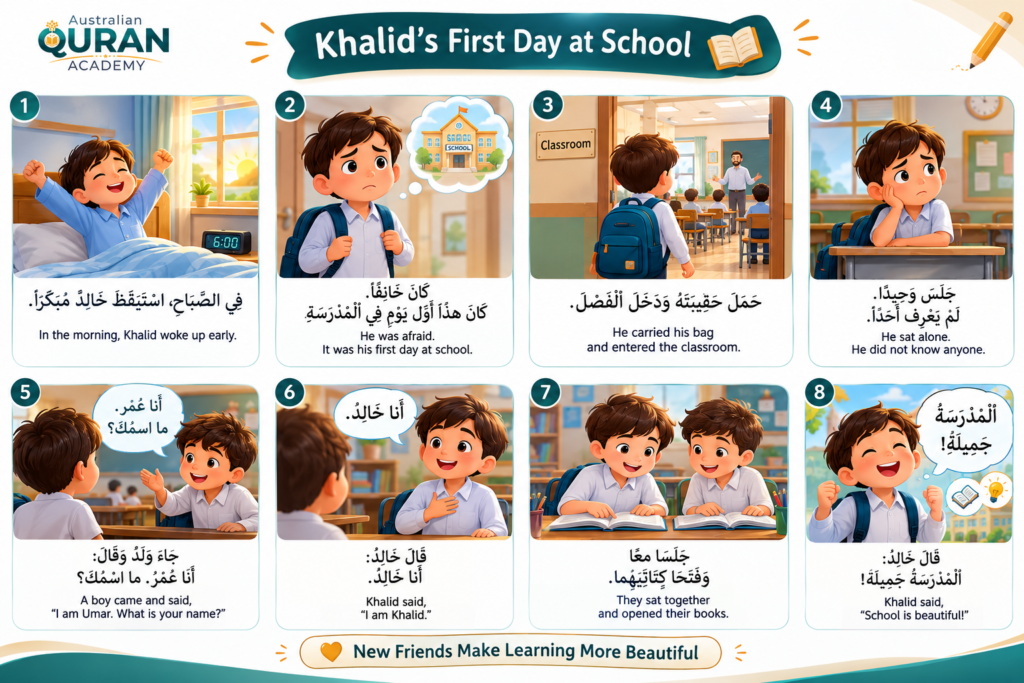
Khalid is nervous because it is his first day at school. He enters the classroom alone, but another child, Umar, introduces himself and becomes his first friend.
The story is useful for teaching school vocabulary and emotional language.
Arabic Story
فِي الصَّبَاحِ، اسْتَيْقَظَ خَالِد مُبَكِّراً.
Fi al-sabahi, istayqaza Khalid mubakkiran.
In the morning, Khalid woke up early.
كَانَ خَائِفاً.
كَانَ هَذَا أَوَّلَ يَوْمٍ فِي الْمَدْرَسَة.
Kana kha’ifan. Kana hadha awwala yawmin fi al-madrasa.
He was afraid. It was his first day at school.
حَمَلَ حَقِيبَتَهُ وَدَخَلَ الْفَصْل.
Hamala haqibatahu wa dakhala al-fasl.
He carried his bag and entered the classroom.
جَلَسَ وَحِيداً.
لَمْ يَعْرِفْ أَحَداً.
Jalasa wahidan. Lam ya’rif ahadan.
He sat alone. He did not know anyone.
جَاءَ وَلَد وَقَالَ: أَنَا عُمَر.
مَا اسْمُك؟
Ja’a waladun wa qala: ana Umar. Ma ismuk?
A boy came and said, “I am Umar. What is your name?”
قَالَ خَالِد: أَنَا خَالِد.
Qala Khalid: ana Khalid.
Khalid said, “I am Khalid.”
جَلَسَا مَعاً وَفَتَحَا كِتَابَيْهِمَا.
Jalasa ma’an wa fataha kitabahuma.
They sat together and opened their books.
قَالَ خَالِد: الْمَدْرَسَةُ جَمِيلَة!
Qala Khalid: al-madrasatu jamilah!
Khalid said, “School is beautiful!”
Key Vocabulary
- خَائِف — kha’if — afraid
- حَمَلَ — hamala — carried
- دَخَلَ — dakhala — entered
- وَحِيد — wahid — alone
- فَجْأَةً — faj’atan — suddenly
- فِي النِّهَايَة — fi al-nihaya — in the end
Activities
Emotion map: Ask how Khalid felt at the beginning and at the end.
Personal connection: Ask: هَلْ كُنْتَ خَائِفاً فِي أَوَّلِ يَوْمٍ؟
Role-play: Have two children act out Khalid and Umar’s first conversation.
Read also: Daily Routine in Arabic for Kids – Words, Phrases, and a Printable Vocabulary Guide
Story 4: The Lion and the Little Mouse
This familiar fable gives children a story they may already know, allowing them to focus more attention on Arabic vocabulary.
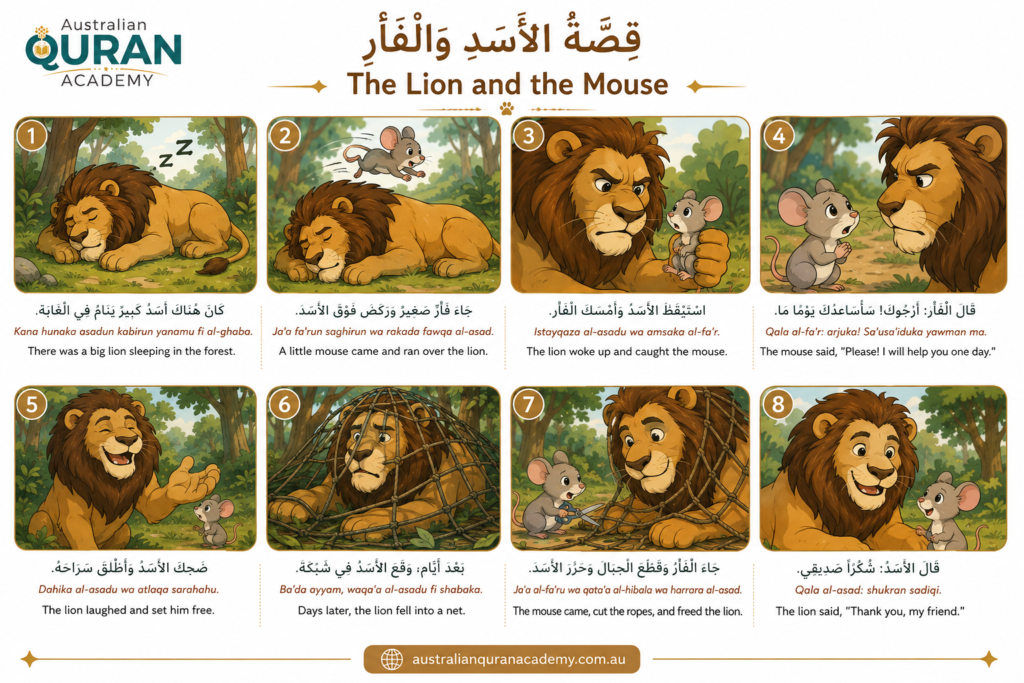
It introduces animals, actions, and the idea that even a small creature can help someone much stronger.
Arabic Story
كَانَ هُنَاكَ أَسَدٌ كَبِيرٌ يَنَامُ فِي الْغَابَة.
Kana hunaka asadun kabirun yanamu fi al-ghaba.
There was a big lion sleeping in the forest.
جَاءَ فَأْرٌ صَغِيرٌ وَرَكَضَ فَوْقَ الأَسَد.
Ja’a fa’run saghirun wa rakada fawqa al-asad.
A little mouse came and ran over the lion.
اسْتَيْقَظَ الأَسَدُ وَأَمْسَكَ الْفَأْر.
Istayqaza al-asadu wa amsaka al-fa’r.
The lion woke up and caught the mouse.
قَالَ الْفَأْر: أَرْجُوكَ! سَأُسَاعِدُكَ يَوْماً مَا.
Qala al-fa’r: arjuka! Sa’usa’iduka yawman ma.
The mouse said, “Please! I will help you one day.”
ضَحِكَ الأَسَدُ وَأَطْلَقَ سَرَاحَهُ.
Dahika al-asadu wa atlaqa sarahahu.
The lion laughed and set him free.
بَعْدَ أَيَّام، وَقَعَ الأَسَدُ فِي شَبَكَة.
Ba’da ayyam, waqa’a al-asadu fi shabaka.
Days later, the lion fell into a net.
جَاءَ الْفَأْرُ وَقَطَعَ الْحِبَالَ وَحَرَّرَ الأَسَد.
Ja’a al-fa’ru wa qata’a al-hibala wa harrara al-asad.
The mouse came, cut the ropes, and freed the lion.
قَالَ الأَسَدُ: شُكْراً صَدِيقِي.
Qala al-asad: shukran sadiqi.
The lion said, “Thank you, my friend.”
Key Vocabulary
- غَابَة — ghaba — forest
- أَمْسَكَ — amsaka — caught
- أَرْجُوكَ — arjuka — please
- أَطْلَقَ سَرَاحَهُ — atlaqa sarahahu — set him free
- شَبَكَة — shabaka — net
- قَطَعَ — qata’a — cut
- حَرَّرَ — harrara — freed
Activities
Retell with toys: Use toy animals and let the child retell the story.
Moral discussion: Ask: مَاذَا تَعَلَّمْنَا مِنَ الْقِصَّة؟
Change the ending: What would happen if the lion had not released the mouse?
See Us in Action!
Curious about what our online classrooms look like? Watch the short clips below to see how our interactive, one-on-one sessions bring learning to life with real-time feedback and engaging teaching methods.
Start Your Quranic Journey in Australia
Join our leading online academy and learn with expert tutors through a structured, personalized curriculum.
Book Your Free TrialStory 5: Sara and the Masjid
Sara visits the masjid with her father for the first time. The story introduces useful Islamic vocabulary through a familiar sequence: wudu, entering the masjid, prayer, and du’a.
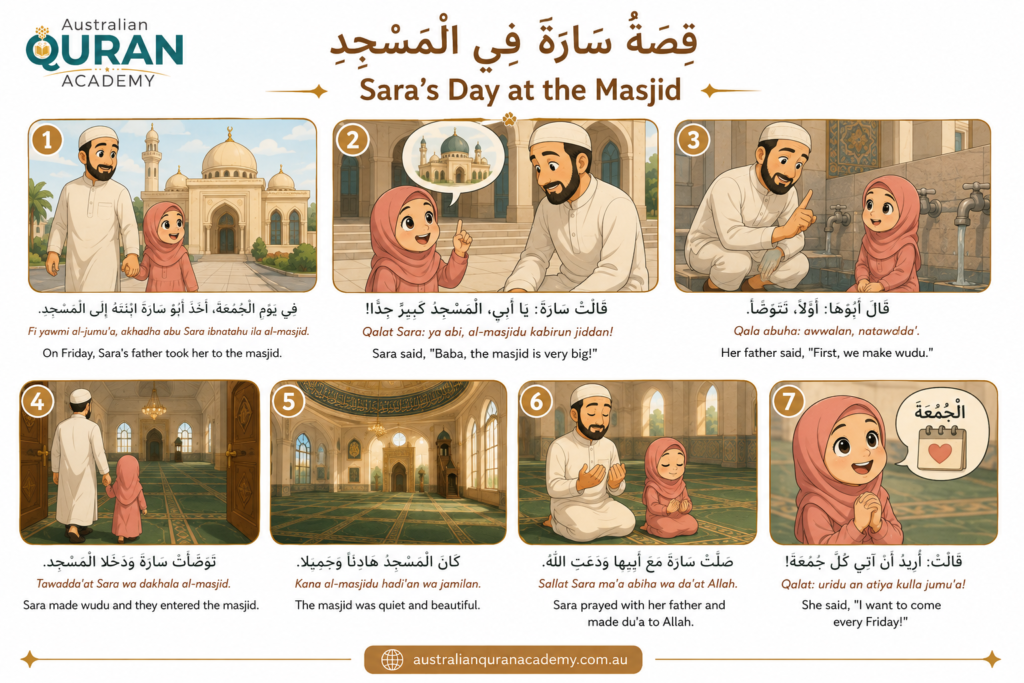
Arabic Story
فِي يَوْمِ الْجُمُعَة، أَخَذَ أَبُو سَارَة ابْنَتَهُ إِلَى الْمَسْجِد.
Fi yawmi al-jumu’a, akhadha abu Sara ibnatahu ila al-masjid.
On Friday, Sara’s father took her to the masjid.
قَالَتْ سَارَة: يَا أَبِي، الْمَسْجِدُ كَبِيرٌ جِدّاً!
Qalat Sara: ya abi, al-masjidu kabirun jiddan!
Sara said, “Baba, the masjid is very big!”
قَالَ أَبُوهَا: أَوَّلاً، نَتَوَضَّأ.
Qala abuha: awwalan, natawadda’.
Her father said, “First, we make wudu.”
تَوَضَّأَتْ سَارَة وَدَخَلَا الْمَسْجِدَ.
Tawadda’at Sara wa dakhala al-masjid.
Sara made wudu and they entered the masjid.
كَانَ الْمَسْجِدُ هَادِئاً وَجَمِيلاً.
Kana al-masjidu hadi’an wa jamilan.
The masjid was quiet and beautiful.
صَلَّتْ سَارَة مَعَ أَبِيهَا وَدَعَتِ اللَّه.
Sallat Sara ma’a abiha wa da’at Allah.
Sara prayed with her father and made du’a to Allah.
قَالَتْ: أُرِيدُ أَنْ آتِيَ كُلَّ جُمُعَة!
Qalat: uridu an atiya kulla jumu’a!
She said, “I want to come every Friday!”
Key Vocabulary
- أَخَذَ — akhadha — took
- الْمَسْجِد — al-masjid — masjid
- تَوَضَّأَ — tawadda’a — made wudu
- نَظَافَة — nazafa — cleanliness
- هَادِئ — hadi’ — quiet
- صَلَّتْ — sallat — she prayed
- دُعَاء — du’a’ — supplication
Activities
Sequence the visit: Arrive → make wudu → enter → pray → make du’a.
Islamic discussion: Ask why Muslims make wudu before prayer.
Drawing activity: Ask the child to draw Sara’s masjid and label objects in Arabic.
When your child is ready to go further, the advanced Arabic courses develop reading fluency, comprehension of classical texts, and confident spoken Arabic.

Story 6: Ibrahim Learns Arabic
Ibrahim is learning Arabic, but the lesson feels difficult. His teacher encourages him to try again. Finally, Ibrahim reads his first Arabic word: بَيْت.
The story is especially useful for children who feel frustrated when learning to read Arabic.
Arabic Story
كَانَ إِبْرَاهِيم يَتَعَلَّمُ الْعَرَبِيَّة مَعَ مُعَلِّمِهِ.
Kana Ibrahimu yata’allamu al-‘arabiyya ma’a mu’allimihi.
Ibrahim was learning Arabic with his teacher.
كَانَ الدَّرْسُ صَعْباً.
قَالَ إِبْرَاهِيم: لَا أَسْتَطِيع!
Kana al-darsu sa’ban. Qala Ibrahim: la astati’.
The lesson was difficult. Ibrahim said, “I can’t do it!”
قَالَ الْمُعَلِّم: حَاوِلْ مَرَّةً أُخْرَى.
Qala al-mu’allim: hawil marratan ukhra.
The teacher said, “Try one more time.”
نَظَرَ إِبْرَاهِيم إِلَى الْكَلِمَة: ب-ي-ت.
Nazara Ibrahimu ila al-kalima: ba-ya-ta.
Ibrahim looked at the word: b-y-t.
ثُمَّ قَالَ بِصَوْتٍ عَالٍ: بَيْت!
Thumma qala bisawtin ‘alin: bayt!
Then he said loudly, “Bayt!”
قَالَ الْمُعَلِّم: أَحْسَنْتَ يَا إِبْرَاهِيم!
Qala al-mu’allim: ahsanta ya Ibrahim!
The teacher said, “Well done, Ibrahim!”
فَرِحَ إِبْرَاهِيم كَثِيراً.
Fariha Ibrahim kathiran.
Ibrahim was very happy.
Key Vocabulary
- صَعْب — sa’b — difficult
- لَا أَسْتَطِيع — la astati’ — I cannot
- حَاوِلْ — hawil — try
- بِبُطْء — bibuṭ’ — slowly
- أَحْسَنْت — ahsanta — well done
- قَفَزَ — qafaza — jumped
- فَرَح — farah — joy
Activities
Sound it out: Have your child read ب-ي-ت and then say بَيْت.
Positive affirmation: Practice:
أَنَا أَسْتَطِيع! — I can do it!
Letter tracing: Have the child trace بَيْت and find it in the story.
Read also: How to Become a Hafiz in Australia – A 10-Step Guide
Story 7: Adam’s Perfect Day
The final story reviews vocabulary from the previous six stories. Adam moves through a complete day, from waking up and praying Fajr to school, family time, and bedtime.
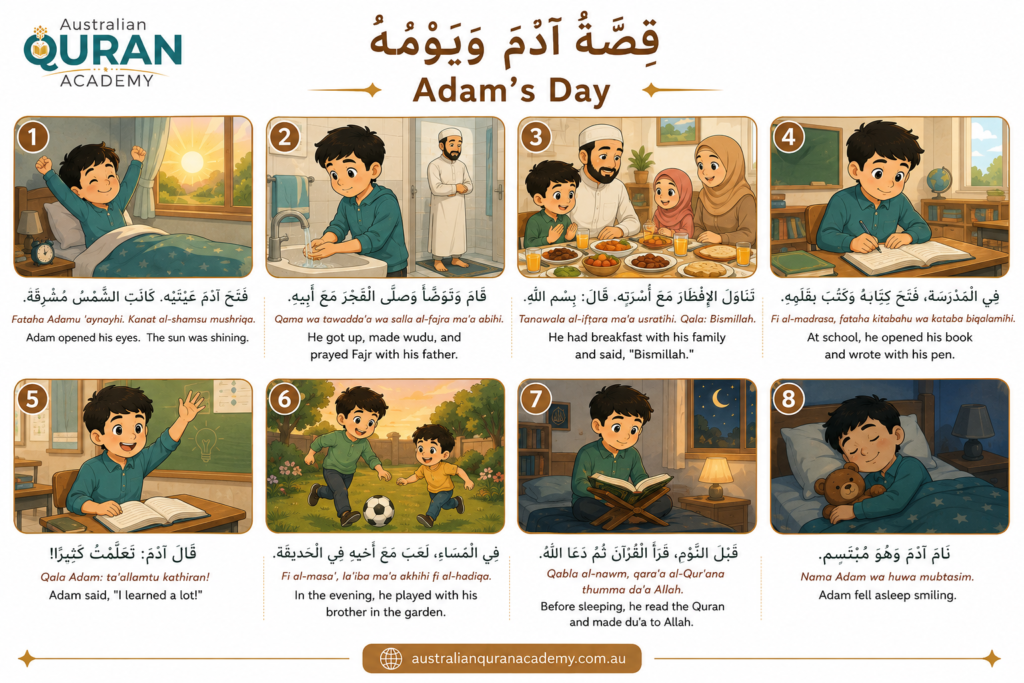
Because familiar vocabulary appears in new situations, this story works as a natural review lesson.
Arabic Story
فَتَحَ آدَم عَيْنَيْهِ.
كَانَتِ الشَّمْسُ مُشْرِقَة.
Fataha Adamu ‘aynayhi. Kanat al-shamsu mushriqa.
Adam opened his eyes. The sun was shining.
قَامَ وَتَوَضَّأَ وَصَلَّى الْفَجْرَ مَعَ أَبِيهِ.
Qama wa tawadda’a wa salla al-fajra ma’a abihi.
He got up, made wudu, and prayed Fajr with his father.
تَنَاوَلَ الْإِفْطَارَ مَعَ أُسْرَتِهِ.
قَالَ: بِسْمِ اللَّه.
Tanawala al-ifṭara ma’a usratihi. Qala: Bismillah.
He had breakfast with his family and said, “Bismillah.”
فِي الْمَدْرَسَة، فَتَحَ كِتَابَهُ وَكَتَبَ بِقَلَمِهِ.
Fi al-madrasa, fataha kitabahu wa kataba biqalamihi.
At school, he opened his book and wrote with his pen.
قَالَ آدَم: تَعَلَّمْتُ كَثِيراً!
Qala Adam: ta’allamtu kathiran!
Adam said, “I learned a lot!”
فِي الْمَسَاءِ، لَعِبَ مَعَ أَخِيهِ فِي الْحَدِيقَة.
Fi al-masa’, la’iba ma’a akhihi fi al-hadiqa.
In the evening, he played with his brother in the garden.
قَبْلَ النَّوْم، قَرَأَ الْقُرْآنَ ثُمَّ دَعَا اللَّه.
Qabla al-nawm, qara’a al-Qur’ana thumma da’a Allah.
Before sleeping, he read the Quran and made du’a to Allah.
نَامَ آدَم وَهُوَ مُبْتَسِم.
Nama Adam wa huwa mubtasim.
Adam fell asleep smiling.
Key Vocabulary
- مُشْرِقَة — mushriqa — shining
- تَنَاوَلَ — tanawala — had/eat a meal
- إِفْطَار — iftar — breakfast
- كَتَبَ — kataba — wrote
- لَعِبَ — la’iba — played
- قَبْلَ النَّوْم — qabla al-nawm — before sleep
- كَامِل — kamil — complete/perfect
Activities
Tell your own day: Use Adam’s routine as a model:
أَنَا ذَهَبْتُ…
أَنَا لَعِبْتُ…
أَنَا تَعَلَّمْتُ…
Vocabulary treasure hunt: Find words that appeared in more than one story.
Create a new ending: Ask what Adam dreamed about that night and let the child tell the dream using any Arabic vocabulary they know.
Why Easy Arabic Stories for Kids Work Better Than Vocabulary Lists?
The most effective Arabic instruction for children is not grammar-first — it is meaning-first. When a child encounters a new word inside a story, the brain encodes it with emotional, narrative, and contextual memory simultaneously. That triple encoding is why story-based vocabulary sticks when isolated word lists do not.
Research in second-language acquisition consistently shows that contextual vocabulary learning produces up to 40% better retention than rote memorization. Arabic specifically benefits from this approach because of its root-based word system: learn “كَتَبَ” (he wrote) inside a school story, and the child is already primed to recognize “كِتَاب” (book), “مَكْتَبَة” (library), and “مَكْتُوب” (written) when they appear later — without extra drilling.
Easy Arabic stories for kids also reduce cognitive load. When a child already knows the plot — The Tortoise and the Hare, The Lion and the Mouse — all of their mental energy goes toward the language rather than story comprehension. That is a structural advantage most Arabic curricula overlook.
How to Choose Age-Appropriate Easy Arabic Stories for Kids?
Not all Arabic children’s stories are equally effective at every stage. The right story for the wrong level either bores the child or overwhelms them — both outcomes kill motivation.
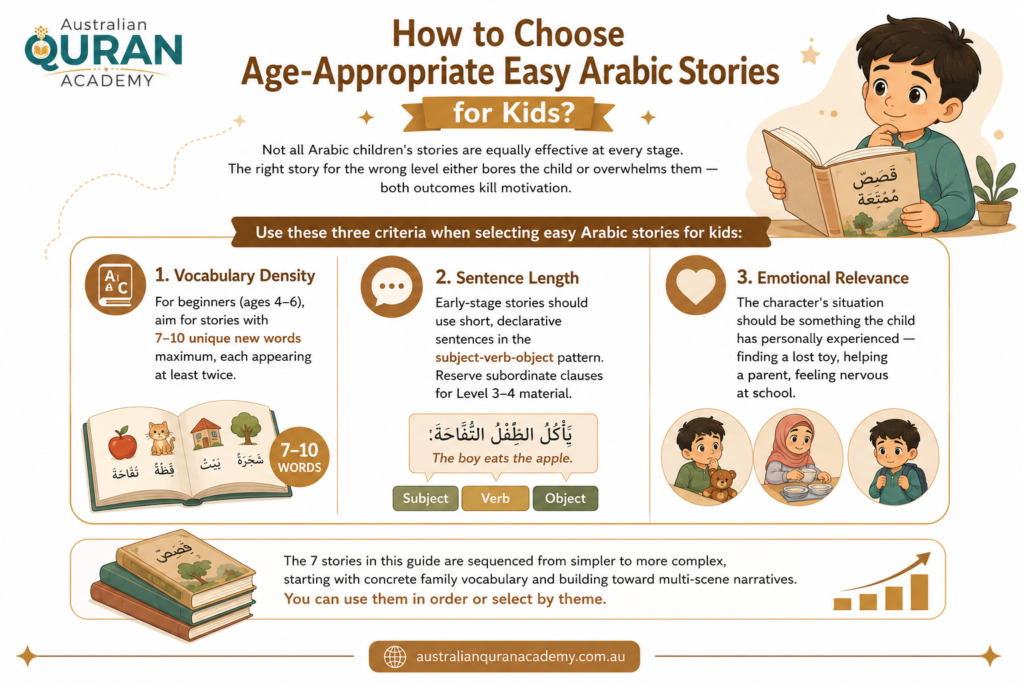
Use these three criteria when selecting easy Arabic stories for kids:
Vocabulary density:
for beginners (ages 4–6), aim for stories with 7–10 unique new words maximum, each appearing at least twice.
Sentence length:
early-stage stories should use short, declarative sentences in the subject-verb-object pattern. Reserve subordinate clauses for Level 3–4 material.
Emotional relevance:
the character’s situation should be something the child has personally experienced — finding a lost toy, helping a parent, feeling nervous at school. Emotional recognition accelerates vocabulary encoding.
The 7 stories in this guide are sequenced from simpler to more complex, starting with concrete family vocabulary and building toward multi-scene narratives. You can use them in order or select by theme.
Read also: What Are the Rewards of Becoming a Hafiz? 10 Benefits of Memorizing the Quran
How to Use Easy Arabic Stories for Kids?
The sequence in which you use a story matters as much as the story itself. The following four-step framework produces measurably better vocabulary retention than simply reading and moving on.
1. Read the Story Aloud First
Read the full story in Arabic while the child listens — do not pause to explain every word. Let the narrative flow, use your voice to signal who is speaking and what emotions are at play. This is comprehensible input before analysis, and it is where the brain begins forming emotional associations with new vocabulary.
2. Ask Comprehension Questions in Arabic
After the first read, ask simple questions using words from the story: مَنْ هُوَ؟ / أَيْنَ ذَهَبَ؟ / مَاذَا فَعَلَ؟ The child does not need to answer in full Arabic sentences — pointing at the text or a single Arabic word is enough at this stage.
3. Review Key Vocabulary in Context
Go back through the story and pause at the vocabulary words. Read the full sentence containing each word — not just the isolated word — then ask: مَا مَعْنَى رَكَضَ؟ Contextual reinforcement, not drilling, is what moves a word into memory.
4. Use the Story as a Springboard for Production
This is the step most home teachers skip — and the most important one. Ask the child to retell, role-play, draw, or change the story ending. The exercises under each story in this guide are all designed for this production step. Using vocabulary actively is what moves it from recognition into speech.
Inside Our Virtual Classrooms
We believe in full transparency and proven quality. Take a look at these actual snippets from our live classes to experience our modern learning platform, patient instructors, and interactive student participation.
Start Your Child’s Arabic Journey With Expert Instruction
These 7 easy Arabic stories for kids give your child a meaningful vocabulary foundation and a genuine connection to the language. The natural next step is structured, personalised instruction that builds on that foundation systematically.
Australian Quran Academy pair every child with specialist instructors who teach non-Arabic speakers from age 4 upward, using a context-before-abstraction method that makes these stories so effective in the first place. Children understand Arabic through meaning and real communication before any formal grammar is introduced.
Book your child’s free trial lesson today
Our Arabic Courses
- Online Arabic Academy
- Online Arabic Course
- Classical Arabic Course
- Arabic Course for Beginners
- Advanced Arabic Course
- Quranic Arabic Course
- Arabic Grammar Course
- Modern Standard Arabic Course
- Arabic Conversation / Speaking Course
- Intensive Arabic Course
- Online Arabic Classes for Kids
- Arabic Classes for Adults
- Arabic Classes for Ladies
- Fusha Arabic Course
- Business Arabic Course
- Al-Azhar Arabic Course
- Madinah Arabic Course
- Learning Arabic for Non-Arabic Speakers
- Arabic Elementary School
- Arabic Intermediate School
- Arabic Lessons for Kindergarten
Start Your Quranic Journey in Australia
Join our leading online academy and learn with expert tutors through a structured, personalized curriculum.
Book Your Free Trial
Conclusion
What makes these 7 easy Arabic stories for kids different from a vocabulary list is the same thing that makes a child ask “what happens next?” — characters, stakes, and resolution. Yusuf does not just exist near a cat; he loses her and finds her. Ibrahim does not just learn letters; he nearly gives up and then succeeds. That emotional texture is what carries Arabic words from short-term encounter into long-term memory.
Read each story aloud first, then together, then let your child lead. By the third retelling, you will notice they are no longer reading — they are remembering. That is the moment Arabic becomes theirs.
The 36 free stories from the Manhal project extend this foundation across four proficiency levels. The 4-step teaching framework gives you a reusable structure for every story you read together. And when your child is ready for guided instruction that builds on what stories have started, expert-led Arabic courses are one conversation away.
FAQs About Easy Arabic Stories for Kids
What age group are these Arabic stories designed for?
These stories are designed for children aged 4–12. Stories 1 and 2 are accessible from age 4 with parental reading support, using very short sentences and concrete home vocabulary. Stories 5–7 suit children aged 8–12 who can begin following Arabic script alongside transliteration. All seven work well as read-aloud material regardless of a child’s independent reading level.
How often should children practise with the same Arabic story?
Three to five readings across one week produces the strongest retention. The first reading focuses on meaning and story comprehension, the second on pronunciation using the transliteration, and subsequent readings on fluency and active vocabulary recall. Children who revisit the same story three times retain approximately 70–80% of its vocabulary after one week — significantly more than children who read a different story each session.
Do children need to know the Arabic alphabet before using these stories?
No. The transliteration column allows children to engage with phonetics and vocabulary immediately without knowing a single Arabic letter. That said, learning the alphabet in parallel accelerates progress significantly — a child who can sound out Arabic script independently gains access to far more material, faster.
Can a parent with no Arabic knowledge use these stories at home?
Yes. The transliteration provides complete pronunciation guidance requiring no prior Arabic knowledge. Read the transliteration aloud while your child follows the Arabic text, and use the English translation to confirm meaning. The comprehension questions and exercises are written so a non-Arabic-speaking parent can run them entirely in English while the child responds using Arabic words from the story.
Are these easy Arabic stories in Modern Standard Arabic or dialect?
All 7 stories in this guide use Modern Standard Arabic (فصحى / Fusha), which is the foundation for reading, writing, Quranic comprehension, and formal communication across the Arabic-speaking world. For dialect exposure, complement story reading with Arabic cartoons and conversational practice in your target dialect.
What is the difference between these 7 stories and the 36 Manhal stories?
The 7 stories in this guide were written specifically for non-Arabic-speaking children — each includes transliteration, a vocabulary section, and structured exercises designed for home and classroom use without specialist training. The 36 Manhal stories are authentic Arabic children’s literature levelled by proficiency, best introduced after the foundational vocabulary in these 7 stories has been established






Leave a Reply