 Arabic
Most Arabic book lists give you a title, a one-line description, and nothing else. That’s not enough when you’re trying to choose the right book for a child who’s bored, stuck, or just starting — and when the wrong choice means the book sits on a shelf within a week.
This guide covers the 12 best Arabic books for kids in full, with an honest look at what each one does well, who it’s actually built for, and what to pair it with to close any gaps it leaves open. One thing to set expectations: no book corrects a child’s pronunciation in real time, and none can catch a misunderstood rule on its own. That gap is exactly where structured instruction picks up where the book leaves off.
1. Alif Baa Taa by Asma Wahab
Best for: Children aged 4–6 who don’t yet know the Arabic alphabet
Skill gap it fills: Letter recognition from zero
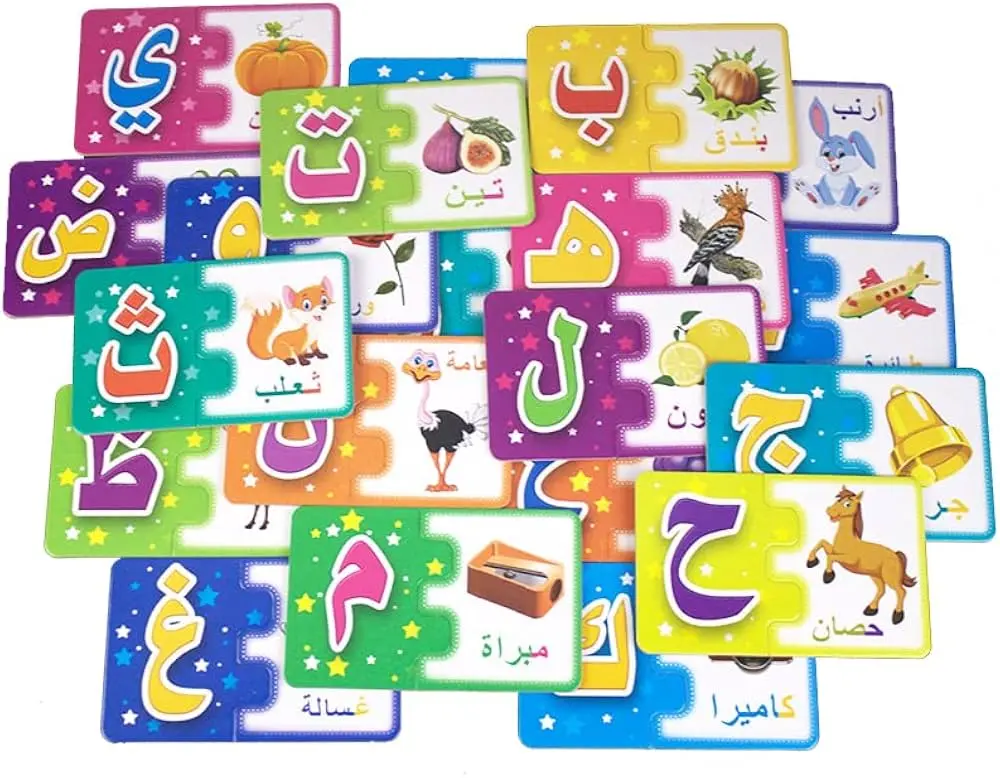
Alif Baa Taa is the strongest entry point for absolute beginners on this list. Each of the 28 Arabic letters is introduced through a memorable animal character and a short micro-story — not a dry drill. The tashkeel is complete on every page, and English transliterations let non-Arabic-speaking parents follow along and participate confidently without needing to know the letters themselves.
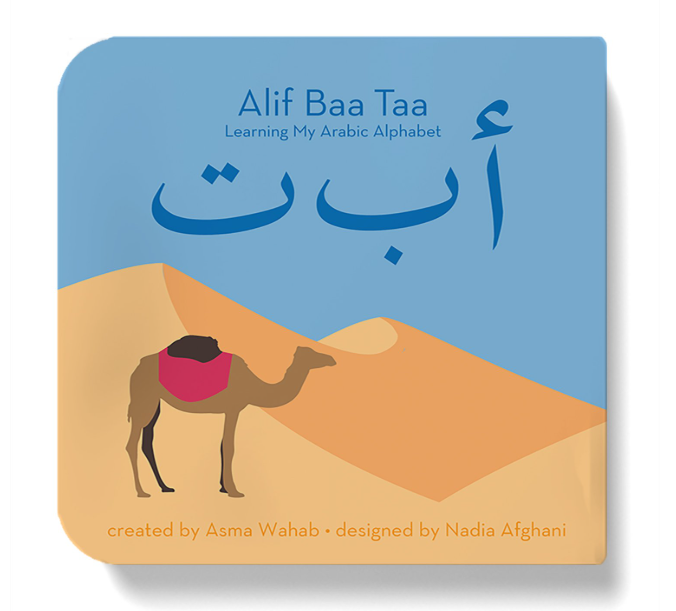
What separates this book from generic alphabet boards is its storytelling approach. Each letter feels like a character with a personality, not a symbol to memorize. Children aged 4–6 retain letter names consistently with this method because the animal association creates a memory hook that repetition alone doesn’t produce.
The practical routine that works: one or two pages read together before bedtime, five minutes daily. The format is short by design — it rewards consistency over duration.
One honest limitation: Alif Baa Taa introduces the alphabet but doesn’t teach letter positional forms or blending. Once a child finishes it, Noor Al-Bayan picks up exactly where it leaves off.
Read also: 10 Free Ways to Learn Arabic for Kids Online in Australia
2. Noor Al-Bayan — For Children Ready to Learn Vowel Sounds
Best for: Children aged 5–8 who know the letters but can’t yet blend them into words
Skill gap it fills: Phonics, harakat, and the bridge to Quranic reading
Noor Al-Bayan is where letter knowledge becomes actual reading. Its structured seven-level progression introduces harakat (vowel markings), sukoon, and tanween in a sequence designed specifically to lead non-native beginners toward Quranic recitation without gaps or jumps.
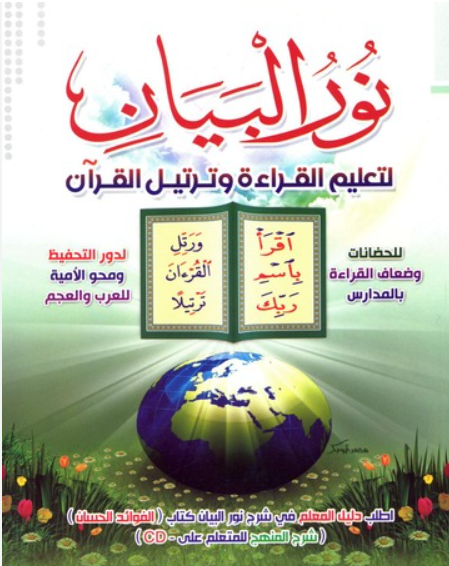
The series isolates each element — consonant, then short vowel, then long vowel, then nunation — before combining them. This slower build prevents the confusion that comes from introducing too many variables at once, which is the most common structural flaw in competing phonics primers.
The practical effect is measurable: a five-minute daily session with Level 1 produces noticeable progress within roughly four weeks — a timeframe parents can observe directly, which keeps the routine going when motivation dips.
Where it falls short: the book has minimal illustrations and no English guidance, which can slow down sessions for parents who aren’t Arabic readers. This is exactly where pairing it with a live teacher pays off — someone who can model pronunciation in real time, rather than leaving the parent to guess. The Arabic courses at Australian Quran Academy are built precisely to complement this kind of home reading with structured, teacher-led instruction.

3. My First Arabic Words by Heritage Kids Press
Best for: Children aged 2–6 at the vocabulary-building stage
Skill gap it fills: Early vocabulary, bilingual comprehension
My First Arabic Words covers over 300 words across the themes young children encounter first: colors, animals, shapes, numbers, and household objects. The bilingual Arabic-English layout means a parent who is also learning Arabic can use it alongside their child, and the format is designed for reading aloud together rather than independent study.
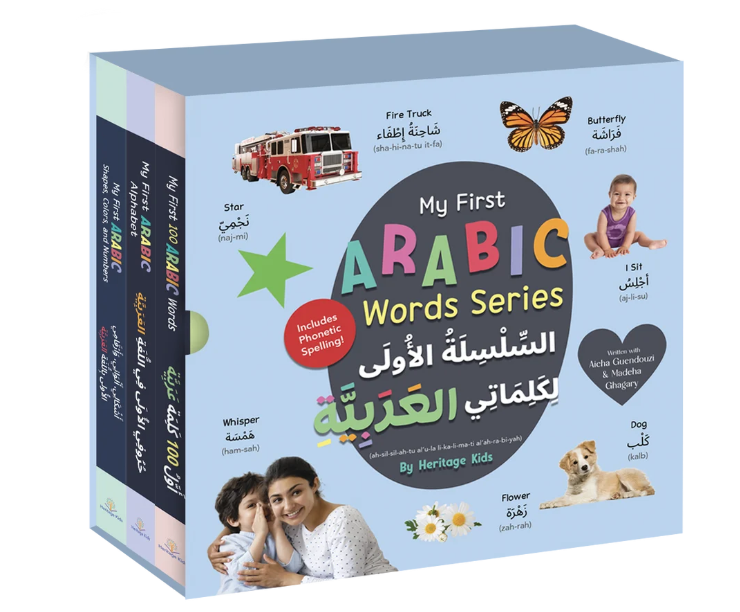
The thematic clustering is the design choice that matters most here. Rather than presenting random vocabulary in alphabetical order, words arrive in connected groups — all fruit words together, all color words together — which mirrors how children naturally acquire language and speeds up retention noticeably compared to random-order lists.
The practical habit that accelerates results: point to real objects around the house that match the book’s themes while reading. Saying كِتَاب while holding an actual book creates a word-object-meaning connection that page-only practice doesn’t fully establish.
One limitation to name clearly: the book doesn’t teach letter formation or phonics. It’s a vocabulary builder, not an alphabet primer. Use it alongside Alif Baa Taa or Noor Al-Bayan for a complete early program.
Read also: Best Arabic Learning App for Kids – The Complete Guide to the Top 10 Apps
See Us in Action!
Curious about what our online classrooms look like? Watch the short clips below to see how our interactive, one-on-one sessions bring learning to life with real-time feedback and engaging teaching methods.
Start Your Quranic Journey in Australia
Join our leading online academy and learn with expert tutors through a structured, personalized curriculum.
Book Your Free Trial4. Arabic Club Readers by Oxford University Press
Best for: Children aged 5–10 transitioning from letter recognition to reading whole sentences
Skill gap it fills: Structured reading progression, sentence fluency
The Arabic Club Readers series is the most structurally sound graded reader on this list.
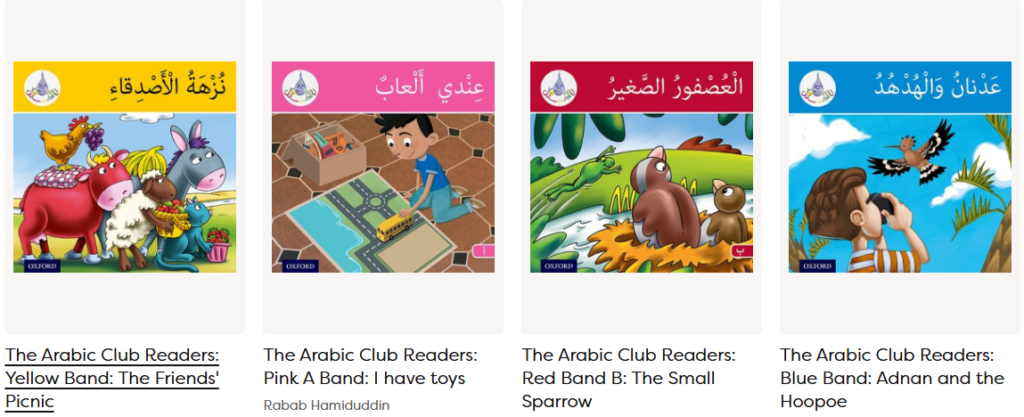
Color-banded from Pink through Red, Yellow, and Blue, it uses relatable everyday scenarios — school visits, family meals, weekend outings — that children recognize immediately, with vocabulary and sentence complexity calibrated carefully at each level.
| Color Band | Level | Age Range |
| Pink | Complete Beginner | Ages 5–6 |
| Red | Early Reader | Ages 6–7 |
| Yellow | Developing Reader | Ages 7–9 |
| Blue | Confident Reader | Ages 8–10 |
The banding system is the series’ clearest advantage: parents can track progress objectively. Moving from Red to Yellow is a visible milestone that motivates a child more effectively than a sticker chart, because the books themselves get visibly longer and more complex.
Created by experienced Arabic-speaking teachers and developed specifically for the Arabic language — not adapted from an English graded reader structure — the text patterns are built around how Arabic sentences actually work. One reader per week, read aloud together before the child reads independently, is a realistic and effective pace.
Read also: Arabic Worksheets for Kids – A Complete Guide for Parents
5. I Love Arabic (أحب العربية)
Best for: Children aged 4–18 needing a complete, long-term Arabic curriculum
Skill gap it fills: All four language skills — reading, writing, listening, speaking
I Love Arabic is the closest thing to a complete school curriculum in book form. Used by Islamic schools across North America and Europe, its twelve levels span Pre-K through secondary school, covering all four language skills with tashkeel maintained throughout. Each level contains a student textbook and a workbook; the workbook provides the exercises that deepen what the textbook introduces.
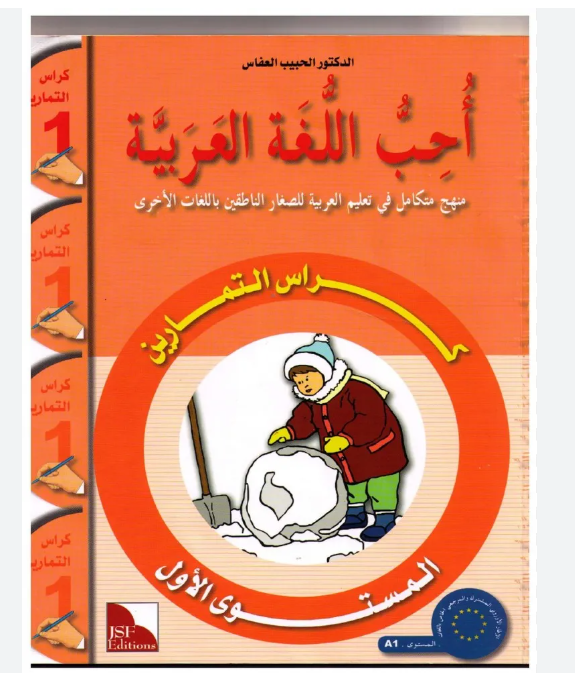
The series features 4,300 vocabulary words and roughly 500 core linguistic structures across its twelve levels — a scope that ensures a child who completes it has genuine communicative Arabic, not just reading recognition. Lessons revisit each principle across multiple sessions, which reduces the forgetting that plagues curricula that introduce a rule once and move on.
The practical decision that matters: if your child is starting at age 8 or older with no Arabic background, begin at Level 1 regardless of age. Solid foundations produce faster long-term progress than starting partway through to feel caught up.
One limitation: I Love Arabic is a structured curriculum, not a pleasure-reading series. Pairing it with graded readers or story collections keeps motivation high while the curriculum builds systematic skill underneath.
Read also: 11 Arabic Activities for Kids in Australia (Free, Printable & Online)
6. Kalimaatee Al-Oola by Asma Wahab
Best for: Children aged 5–7 who know the letters and are ready to move to full words
Skill gap it fills: The bridge from alphabet to vocabulary, letter tracing into writing
Kalimaatee Al-Oola is the natural follow-up to Alif Baa Taa by the same author. Where Alif Baa Taa introduces each letter as a character, this book moves the child from letter knowledge into actual words — introducing vocabulary through modern illustrations alongside dry-erase traceable letters on every page.
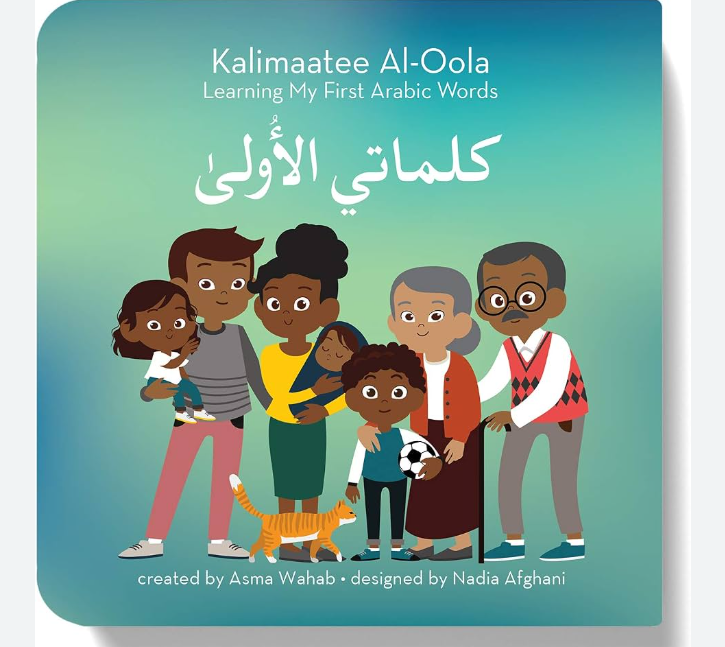
The reusable format is its practical advantage: children trace each word repeatedly using any dry-erase marker, then wipe and start again. That means one book stays useful for months rather than being filled and shelved, and the repetition builds muscle memory that reading without writing doesn’t develop on its own.
Written in classical Fus-ha Arabic with full tashkeel and English transliterations, it functions equally well whether the parent reads Arabic or not. The 6×6 board book format is easy for small hands and genuinely durable.
7. Arabic Tracing and Activity Books
Best for: Children aged 4–8 who learn better through hands-on engagement than passive reading
Skill gap it fills: Letter formation, positional forms, letter-word-meaning connection
Activity books combining letter tracing, letter-position practice (initial, medial, and final forms), and matching exercises move a child from passive recognition to active production. Tracing ب and then coloring the picture labeled بيت (house) creates a letter-word-meaning connection in a single activity — three skills reinforced at once.
The positional forms are the detail most activity books get right that single-format books miss. Arabic letters change shape depending on where they fall in a word, and a child who hasn’t practiced all four forms will stumble when they encounter new words in real reading contexts.
Children who struggle to retain letters through passive reading consistently respond better to this hands-on, multi-sensory format. The colouring and tracing slow the child down enough to actually examine each shape, rather than scanning past it.
For children who are building writing skills alongside their book work, the Arabic courses for adults at Australian Quran Academy show that the same hands-on, structured approach scales across all ages — from young children learning their first letters to adults building formal Arabic proficiency from scratch.

8. Diary of a Wimpy Kid — Arabic Edition (مذكرات طالب)
Best for: Reluctant Arabic readers aged 9–12
Skill gap it fills: Reading motivation, stamina, and comprehension scaffolding
مذكرات طالب is the tool for the child who can technically read Arabic but refuses to. A familiar, funny story in translated form gives children who already know the English version a comprehension scaffold — they can lean on the plot they already know while their Arabic reading catches up to the language.
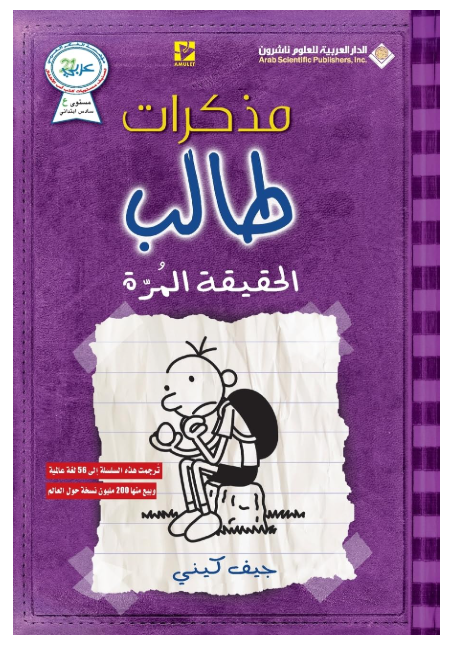
This prior-knowledge scaffolding is not a workaround; it’s a legitimate acquisition mechanism. Reading research consistently shows that comprehensible input — text where the reader understands the meaning even before fully decoding every word — produces faster reading development than texts where the reader must work out both the language and the story simultaneously.
One practical note: this is Modern Standard Arabic, not a dialect. A child who has been exposed mainly to spoken Arabic at home may find the register slightly formal at first — which is exactly what makes it a useful bridge, since it normalises the written register that Quranic Arabic requires.
Start Your Quranic Journey in Australia
Join our leading online academy and learn with expert tutors through a structured, personalized curriculum.
Book Your Free Trial9. The Little Prince — Arabic Edition (الأمير الصغير)
Best for: Children aged 9–13 who are moving beyond beginner readers
Skill gap it fills: Sustained reading, vocabulary, and narrative comprehension
The Little Prince is a useful bridge between short graded readers and longer novels. Most children already know the basic story or have encountered its characters, giving them some contextual support when reading the Arabic edition.
Its relatively compact length makes it less intimidating than a full-length classic, while the continuous narrative requires children to maintain comprehension across multiple chapters.
The book also creates opportunities for conversation. After reading a section, parents can ask simple questions in Arabic about what happened, what a character felt, or what the child thinks will happen next.
For children who are ready to move from controlled reading material toward authentic literary Arabic, this type of familiar classic can be an effective next step.
10. في بلاد العجائب — Kamil Kilani Adaptation
Best for: Children aged 9–13 who are confident readers Skill gap it fills: Fus-ha reading fluency, literary Arabic, sustained comprehension
Kamil Kilani (1897–1959) is the pioneering Egyptian author of Arabic children’s literature — the figure who spent his career adapting world classics into clear, tashkeel-supported Modern Standard Arabic without dialect. His adaptations remain some of the most widely read Arabic children’s books available today.
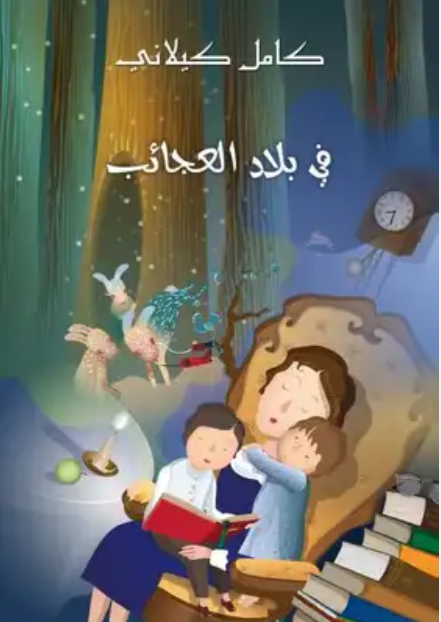
The Alice in Wonderland adaptation (في بلاد العجائب) is one of his most loved titles. A child who already knows the English story can lean on prior knowledge to fill comprehension gaps while decoding the Arabic — the same scaffolding mechanism that makes Diary of a Wimpy Kid work for reluctant readers, applied here to literary Arabic instead of contemporary humour.
Kilani’s language is clear Fus-ha: accessible without being simplified, and never archaic. Reading his adaptations consistently is one of the most practical ways to move a child from functional Arabic reading into the kind of literary Arabic confidence that advanced studies — and Quranic understanding — eventually require.
11. علاء الدين — Kamil Kilani Adaptation
Best for: Children aged 9–13 reading at an intermediate level
Skill gap it fills: Fus-ha fluency through familiar narrative scaffolding
Part of the same Kilani series, علاء الدين applies the prior-knowledge scaffolding principle in a particularly effective way: Aladdin is one of the most globally recognized stories, meaning almost every child who picks up this book already carries a full mental map of the plot. That mental map does real decoding work — when a child encounters an unfamiliar Arabic word, context from the story fills the gap automatically.
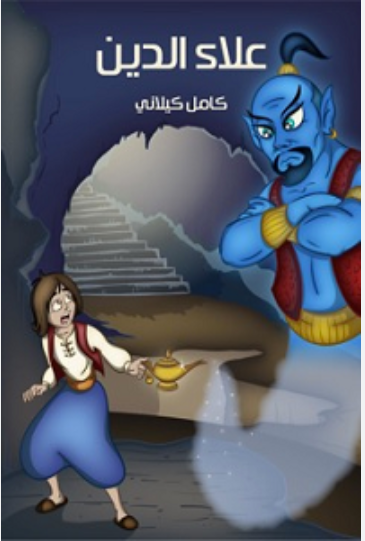
Kilani’s moral framework throughout his adaptations aligns naturally with Islamic values, giving these books a cultural double function: they build Arabic reading ability while reinforcing the ethical worldview the family is raising the child in. For children who have completed the Kilani series and are ready to take their Arabic to a structured advanced level, the advanced Arabic course at Australian Quran Academy provides the formal scaffolding — grammar, syntax, and reading analysis — that turns confident readers into genuinely proficient Arabic users.

12. Quran Stories for Children
Best for: Children aged 8+ who can already read Arabic fluently
Skill gap it fills: The bridge from general Arabic reading to Quranic and Islamic literacy
A beautifully illustrated collection of Quranic narratives — but worth naming honestly: this book is regularly bought at the aspirational level, not the actual reading level. It works best once a child can already decode Arabic fluently, as a bridge from general Arabic reading into Quranic and Islamic literacy specifically. Starting a beginner on it is one of the most common buying mistakes, because the language and content require genuine reading confidence to engage with properly.
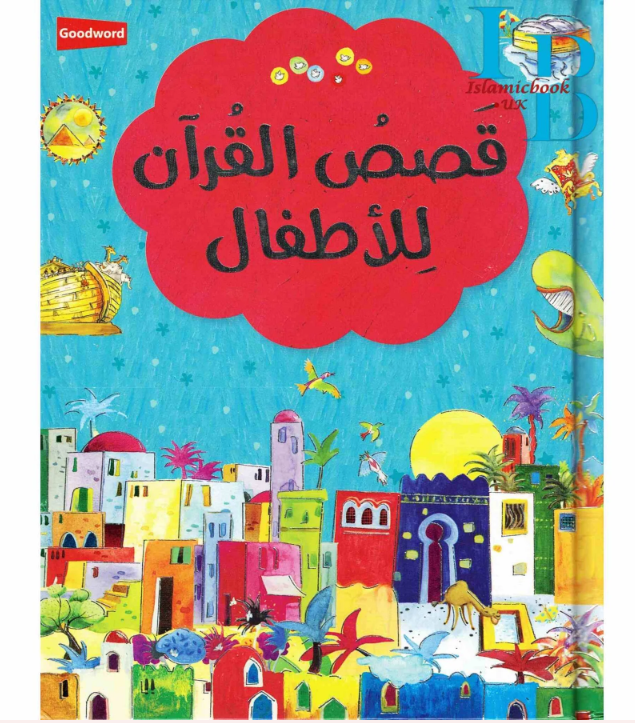
For a child who is ready, it does something no other book on this list does: it connects Arabic reading ability directly to the child’s faith life. The investment in learning to read Arabic takes on meaning beyond academic achievement — it becomes the tool for understanding the Quran, the prayers, and the stories the family considers foundational.
How to Choose the Right Arabic Book for Your Child?
The most common mistake parents make is choosing by age bracket alone. Age is a starting point, not a syllabus. Before buying, identify which of the four Arabic skills is currently the weakest in your child:
| Skill Gap | Book Type That Fills It |
| Cannot identify letters | Illustrated alphabet board books (e.g. Alif Baa Taa) |
| Knows letters but can’t blend sounds | Phonics-based graded readers (e.g. Noor Al-Bayan) |
| Can read but vocabulary is thin | Thematic vocabulary books (e.g. My First Arabic Words) |
| Reads but lacks fluency | Structured levelled readers (e.g. Arabic Club Readers) |
| Needs a full-skill foundation | Complete curriculum series (e.g. I Love Arabic) |
Most parents skip this step entirely. The result is a book that either bores the child (too easy) or overwhelms them (too advanced) — and both outcomes end the same way: the book gets abandoned.
Common Mistakes Parents Make When Buying Arabic Books for Kids
Choosing the right Arabic book starts with avoiding the common mistakes that can make even a good resource ineffective.
Using One Book Type for Everything
A curriculum series like I Love Arabic is excellent for structured progression but limited in narrative engagement. Pairing it with graded readers or story collections keeps motivation high while the curriculum builds systematic skill underneath. The two functions — structured learning and pleasurable reading — serve each other when both are present.
Removing Tashkeel Too Early
Some parents assume “real” Arabic books shouldn’t have vowel markings and move children to unvocalized text before they have a stable inner vocabulary. The result is guessing rather than reading. Children should read with full tashkeel until they can decode roughly 90% of a familiar tashkeel-free page without hesitation — typically around age 10–11 for systematic learners.
Buying at the Parent’s Aspiration Level
This is especially common among families whose children were born and schooled in English. A beautifully illustrated Quran Stories for Children in full Fus-ha is aspirational; Alif Baa Taa is where the child actually is. Starting where the child genuinely is always produces faster long-term progress than starting where the parent wishes they were.
Inside Our Virtual Classrooms
We believe in full transparency and proven quality. Take a look at these actual snippets from our live classes to experience our modern learning platform, patient instructors, and interactive student participation.
Start Your Quranic Journey in Australia
Join our leading online academy and learn with expert tutors through a structured, personalized curriculum.
Book Your Free TrialTake Your Child’s Arabic Further with Australian Quran Academy
Books build the reading foundation. A qualified teacher builds the speaking, pronunciation, and grammar that books alone cannot fully deliver.
Australian Quran Academy pairs structured Arabic and Quran instruction with qualified, certified instructors who serve students across Sydney, Melbourne, Brisbane, Perth, and beyond — all delivered online, with scheduling that fits Australian family routines. Whether your child is just starting with the alphabet, working toward Quranic reading, or ready for structured formal Arabic, every course is built around real-time feedback from a teacher who listens, corrects, and adapts to your child’s pace in the moment — not after a quiz result comes back.
Book your child’s free trial lesson today →

Start Your Quranic Journey in Australia
Join our leading online academy and learn with expert tutors through a structured, personalized curriculum.
Book Your Free TrialConclusion
There is no single best Arabic book for kids that works for every child. The right choice depends on age, current skill level, and the specific gap you want to close next. For absolute beginners, Alif Baa Taa and Noor Al-Bayan provide the clearest, most structured entry points available. For a complete long-term curriculum, I Love Arabic stands out from the rest. For older confident readers, the Kamil Kilani adaptations offer the best combination of literary Arabic quality and genuine engagement.
Used in the right sequence, and paired with consistent daily reading, the books on this list genuinely move a child’s Arabic forward. But the ceiling of what any book can do is real: none of them correct pronunciation the way a person listening in real time can, and none can hold an actual conversation that adapts to what your child just said. The best Arabic books for kids are a strong daily tool. Structured, teacher-led instruction is what turns that daily reading into lasting fluency.
Frequently Asked Questions
What are the best Arabic books for kids who are complete beginners?
Alif Baa Taa by Asma Wahab is the strongest starting point for a child who doesn’t yet know the Arabic alphabet. It pairs each letter with a memorable animal character, includes full tashkeel and English transliterations, and is built specifically for families where the parents are not Arabic speakers. Five minutes daily before bedtime is enough to see measurable progress within weeks.
At what age should children start reading Arabic books?
Children can start with picture-based Arabic board books as early as age 2–3 through simple visual exposure. Structured letter recognition works best from age 4–5. By age 6, children with consistent daily practice are ready for early graded readers like the Arabic Club Readers Pink band. Daily consistency matters far more than the exact starting age.
Do Arabic children’s books need tashkeel?
Yes — for all children up to approximately age 10–11. Without tashkeel, a child is guessing at vowel sounds rather than genuinely reading. Removing it before a child has a stable reading vocabulary of 500+ words creates guessing habits that are difficult to correct later. Keep full tashkeel until the child can decode 90% of a familiar unvocalized page without hesitation.
What is the difference between Quranic Arabic books and Modern Standard Arabic books for kids?
Quranic Arabic books like Noor Al-Bayan focus on accurate pronunciation of Quranic text, vowel markings, and the phonetic rules of recitation. Modern Standard Arabic books teach vocabulary, sentence structure, and communication for everyday and academic use. Most Muslim families need both — they serve different but complementary purposes and neither substitutes for the other.
Can a child learn Arabic from books alone, without a teacher?
Books build vocabulary and reading recognition effectively. Speaking, pronunciation correction, and grammar internalization require real interaction with a qualified teacher. Children who read extensively but never speak Arabic with an instructor understand far more than they can say — structured teaching alongside daily reading closes that gap and produces measurably faster overall progress.
How many Arabic books should a child read per week?
For ages 6–9, one graded reader per week alongside 5–10 minutes of daily phonics or activity book practice is a realistic and effective target. For ages 9–12, one chapter-length story per week plus structured reading from a curriculum series builds both fluency and genuine enjoyment without overwhelming a school schedule.



Leave a Reply