 Arabic
Finding the best Arabic learning app for kids is harder than it should be. Search any app store and you’ll find dozens of options, each promising to make Arabic “fun” and “easy” for your child. Some genuinely deliver on that promise. Many are recycled flashcard games with an Arabic skin and little real structure behind them.
This guide ranks the ten apps worth your download, organized by age, skill focus, and price, with an honest look at what each one does well and where it falls short. You’ll also get a clear framework for matching an app to your child’s actual level, rather than guessing based on star ratings or download counts.
One thing to set expectations early: no app corrects a child’s pronunciation in real time, and none can notice when a child has silently misunderstood a rule. That gap is exactly where structured instruction picks up where the app leaves off — and we’ll come back to that later in the guide.
1. AlifBee Kids App
AlifBee is the most structured app on this list, covering a full curriculum sequence: alphabet recognition, letter sounds, simple words, vocabulary expansion, and basic sentence structure, each stage building directly on the one before it. It’s endorsed by Pearson and built around the Entertainment Language Immersion Method — children absorb Arabic through context, songs, stories, and characters before facing explicit grammar rules.
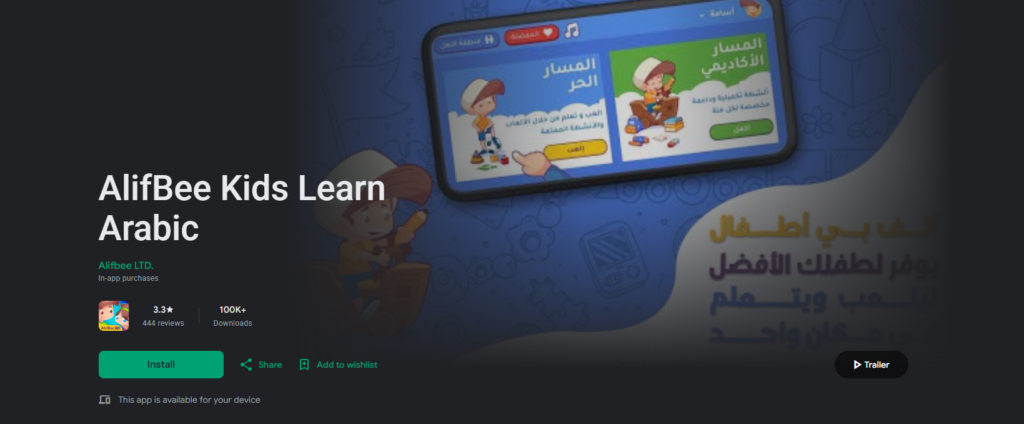
The native-speaker audio running through every activity matters most for non-Arabic-speaking parents, since it means a child hears correct pronunciation from the start even if the parent can’t model it. Progress tracking gives visibility into which stage a child has reached, which helps avoid the common trap of a child bouncing between unrelated activities with no real advancement.
One honest limitation: some in-app instructions are given in Arabic, which can confuse a child with zero prior exposure. Pairing it with a live class where a teacher bridges comprehension gaps in real time solves this quickly and keeps a child from getting stuck at the same stage for weeks.
Read also: Arabic Worksheets for Kids – A Complete Guide for Parents
2. Lamsa Kids App
Lamsa is closer to a full early-childhood platform than a single-skill app. It combines Arabic literacy, Islamic culture and values, early math, and creative activities in one bilingual (Arabic-English) environment, used by over 5 million families across the Arab world and diaspora communities.
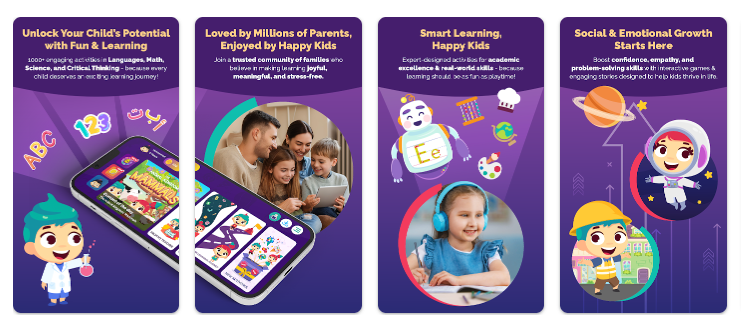
The bilingual pairing is Lamsa’s real strength for households outside the Arab world: children associate Arabic words with meaning from the first session, rather than treating Arabic as an abstract set of sounds disconnected from anything familiar. Its parental dashboard tracks which stories, games, and vocabulary sets a child has completed, and roughly how much time has gone into each.
The trade-off is depth in one specific area: Lamsa is lighter on formal alphabet instruction than a dedicated letters app. Pairing it with something like Write It! Arabic for systematic letter-writing practice covers that gap without abandoning Lamsa’s cultural strengths.
Read also: Best Online Quran Classes In Australia — The Complete Guide For Families
3. 3asafeer
3asafeer is a reading-focused Arabic app used by a large number of children, with over 1.7 million books read by learners in the past 30 days alone and more than 1.1 million reading hours completed in the same period. The app is designed for children aged 3 to 18, offering graded storybooks read aloud by professional voice actors alongside short animated lessons and games.
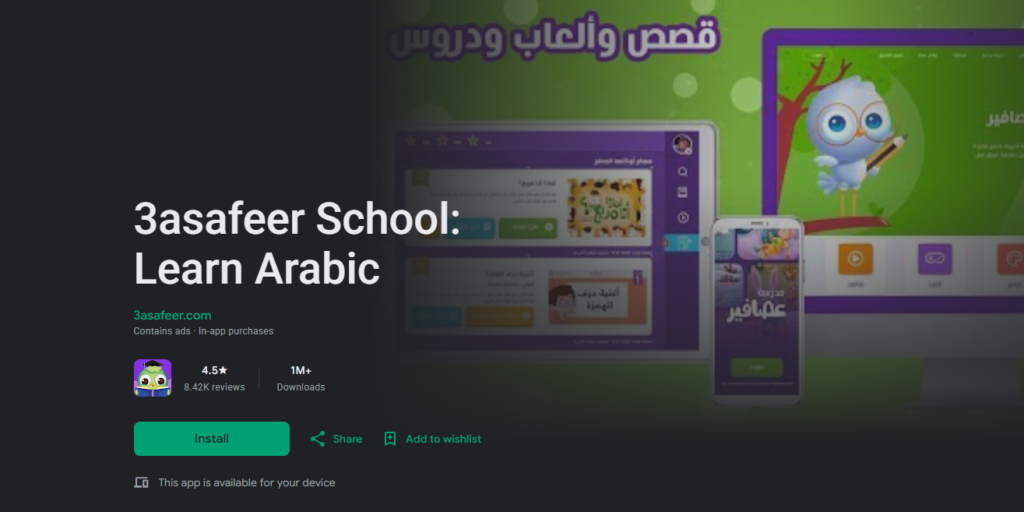
Because content spans such a wide age range, 3asafeer functions as a long-term platform rather than something a child outgrows within a few months, reducing the need to switch apps constantly as skills develop. It also covers content beyond pure language instruction — emotional intelligence, applied sciences, and core values — which gives Arabic practice a purpose beyond vocabulary drilling alone.
Read also: Arabic Alphabet for Kids
4. Alef Ba Ta (أ ب ت)
Alef Ba Ta targets children aged 4 to 10 and is fully play-based, moving learners through hundreds of interactive games, listening exercises, and levelled stories across five difficulty tiers, with no prior reading knowledge required to begin.
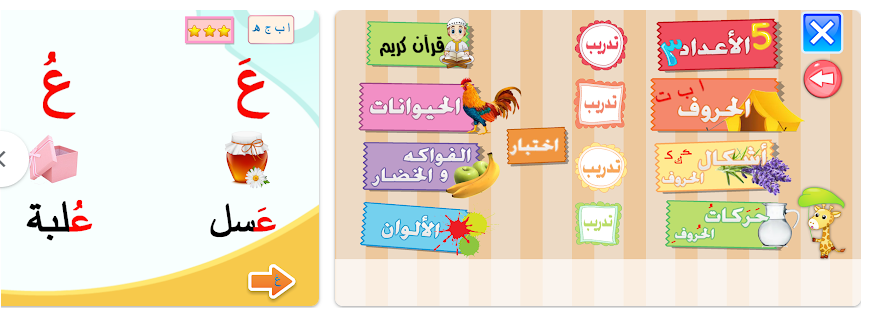
Its standout feature is a school dashboard that lets teachers assign exercises and monitor a child’s progress directly, so the same content used at home can reinforce what’s being taught in class. This matters if your child attends any kind of Arabic or Islamic weekend school, since it removes the disconnect between app practice and classroom material.
5. IReadArabic
IReadArabic offers one of the largest levelled reading libraries available in a single app, spanning pre-literacy picture books through independent chapter-level reading. Books are sorted by reading level, topic, and age group, and comprehension questions are embedded throughout each one — turning reading into an active task rather than passive page-turning.
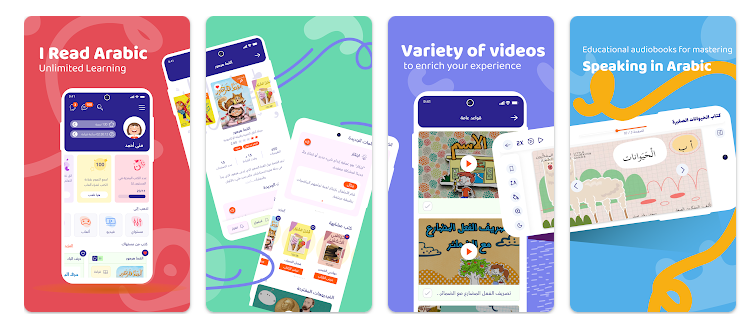
The levelling system is its clearest structural strength: as a child’s reading improves, the app supplies progressively harder texts, avoiding the content plateau that fixed-difficulty apps eventually hit. The real limitation is that IReadArabic teaches reading comprehension, not the alphabet from scratch — a child who doesn’t yet recognize Arabic letters should start with an alphabet-first app before moving here.
6. Write It! Arabic
Write It! Arabic is the most specialized handwriting app on this list, and that narrow focus is exactly its advantage. It covers all 28 Arabic letters in all four positional forms — isolated, initial, medial, and final — the forms that change a letter’s shape depending on where it falls in a word, a detail many general-purpose apps skip entirely.
An animated demonstration shows correct stroke order before the child traces, and the accuracy feedback evaluates the actual tracing path rather than just a rough shape match. This builds genuine muscle memory rather than approximate recognition, which matters because incorrect stroke habits formed early are notoriously difficult to unlearn later.
It teaches script formation only — no meaning, no pronunciation, no vocabulary — so pairing it with a vocabulary or reading app is necessary for a complete picture.
See Us in Action!
Curious about what our online classrooms look like? Watch the short clips below to see how our interactive, one-on-one sessions bring learning to life with real-time feedback and engaging teaching methods.
Start Your Quranic Journey in Australia
Join our leading online academy and learn with expert tutors through a structured, personalized curriculum.
Book Your Free Trial7. Duolingo
Duolingo’s Arabic course is the most accessible free option for children aged 8 and up who can already read English instructions. Its streak-and-points system builds a daily habit more reliably than almost any other format on this list, and individual lessons run five to ten minutes — realistic for a school-night routine without becoming a fight over screen time.
The honest caveat: Duolingo’s Arabic tree is shorter and less comprehensive than its European-language courses, and it teaches Modern Standard Arabic rather than Quranic Arabic specifically. Families whose main goal is Quran reading will need instruction built for that purpose, such as a Modern Standard Arabic program paired with dedicated Quran-focused lessons.
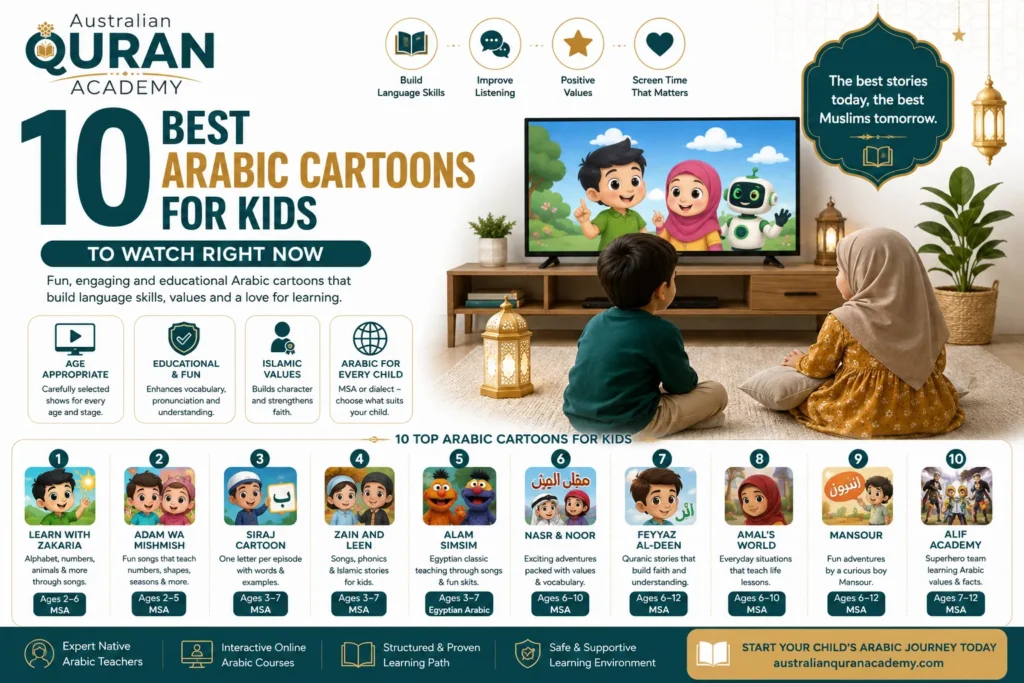
Read also: 10 Best Arabic Cartoons for Kids to Watch Right Now
8. Gus on the Go
Gus on the Go is a themed vocabulary app built around an animated owl guiding children through word sets — animals, colors, numbers, food, and family — with clear native-speaker pronunciation and a genuine speaking component: children repeat each word aloud after the model rather than only tapping to match a picture.
At roughly 90 words across all categories, it’s intentionally narrow in scope. That’s not a flaw so much as a design choice — it works best as the vocabulary layer alongside an alphabet or reading app, not as a standalone curriculum a child stays with for years.
9. Rihlet Al-Huroof (رحلة الحروف)
Developed by the Queen Rania Foundation with early-childhood and Arabic language experts, Rihlet Al-Huroof targets children aged 3 to 6 and covers letter shapes, letter sounds, and early writing. It’s free, contains no advertisements, requires no subscription, and works fully offline — a genuine advantage for travel or households managing screen access carefully.
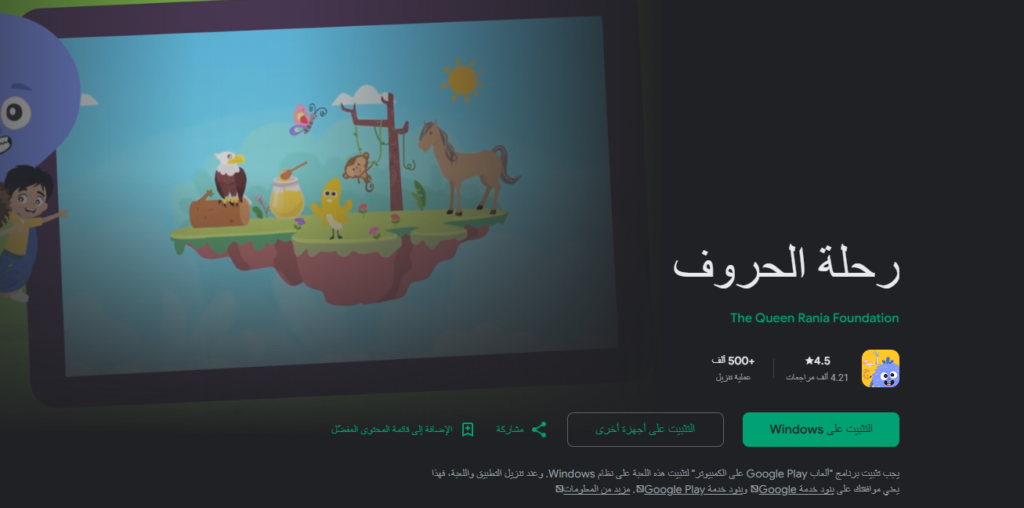
Its activities emphasize exploration over testing, which suits preschoolers who learn best through play rather than scored drills. For a first Arabic app for a very young child who isn’t ready for formal lessons yet, this is one of the most accessible and credible starting points available at any price.
10. Read Along by Google
Read Along uses real-time speech recognition to listen to children read Arabic stories aloud, with an animated companion offering gentle prompts and encouragement when a child stumbles. Unlike apps that teach letters or vocabulary in isolation, Read Along develops oral reading fluency specifically — the bridge between knowing individual letters and reading connected text smoothly and correctly.
It requires prior literacy to be useful, so a child who doesn’t yet know the letters won’t benefit from it yet. Once they do, the progress tracking shows parents exactly which words a child consistently struggles with, enabling targeted review outside the app.
How to Choose the Best Arabic Learning App for Your Child?
The best Arabic learning app for kids is one that matches three things at once: your child’s age, their current Arabic level, and the specific skill you want to build next — letters, reading, vocabulary, or speaking. No single app develops all four skills equally well, so “best” depends on what your child needs right now, not on a star rating alone.
Before comparing apps, it helps to separate two things parents often mix together: exposure — hearing and seeing Arabic regularly — and instruction — correction, feedback, and structured progression. Apps are excellent at the first. They are limited at the second, and that limitation doesn’t go away no matter how polished the app’s design is.
Choosing by Age
Children aged 2 to 5 need audio-visual apps with no reading requirement — short sessions, songs, repetition, and no pressure to perform. Children aged 5 to 8 are ready for letter tracing and early reading apps once they have the fine motor control to trace accurately and the attention span to sit through a short structured activity. Children aged 8 and up can generally handle gamified, text-heavy apps like Duolingo, since they can already read instructions written in English.
Choosing by Learning Goal
If the goal is letter recognition, start with a dedicated alphabet app before moving on to reading. If the goal is vocabulary, a themed, picture-based app builds words faster than a grammar-first curriculum. If the goal is eventually reading the Quran, look for an app that builds phonetic accuracy carefully — but understand that tajweed correction, the rules of correct recitation, is not something any current app does reliably.
A common mistake here is choosing an app based on how the goal sounds rather than what the app was actually built to do. An app labelled “comprehensive” may still teach only vocabulary; an app labelled “for beginners” may assume a child already knows the alphabet. Reading the specific age range and skill focus, not just the app store description, avoids most of the mismatch.
Structured Arabic courses for kids are built specifically to close the correction gap that apps leave open, with a real instructor listening and adjusting in the moment a mistake happens rather than after a quiz score comes back.

Common Mistakes Parents Make When Choosing an Arabic App
Choosing the right Arabic app is only part of the process. Parents should also know what an app can—and cannot—provide.
1. Using One App for Everything
One app rarely covers reading, listening, speaking, and pronunciation equally well. Pair a literacy app with one focused on vocabulary or listening for more balanced practice.
2. Overlooking Screen Time
Arabic apps work best in short, focused sessions of 10–20 minutes a day rather than long sessions that can reduce attention and retention.
3. Expecting an App to Replace a Teacher
Apps can teach vocabulary and basic skills, but they cannot provide live pronunciation correction, natural conversation, or personalised feedback like a teacher can.
Structured lessons through the Australian Quran Academy fill exactly that gap — a real instructor working with your child at their own pace, correcting pronunciation as it happens rather than after a quiz result comes back days later.

Inside Our Virtual Classrooms
We believe in full transparency and proven quality. Take a look at these actual snippets from our live classes to experience our modern learning platform, patient instructors, and interactive student participation.
Start Your Quranic Journey in Australia
Join our leading online academy and learn with expert tutors through a structured, personalized curriculum.
Book Your Free TrialLearn Arabic with Confidence at Australian Quran Academy
Arabic learning apps can help children recognise letters, build vocabulary, and practise basic words, but they cannot replace personalised instruction. Australian Quran Academy gives children the guidance of experienced tutors who can correct pronunciation, answer questions, and adapt each lesson to the child’s level and learning pace.
With Australian Quran Academy, children learn Arabic through structured, age-appropriate lessons that combine speaking, listening, alphabet recognition, vocabulary, pronunciation, reading, and basic sentence formation. The academy also uses interactive activities, stories, songs, and repetition to keep young learners engaged while building a strong foundation in Arabic.
Our Arabic courses for kids pair every child with an instructor who assesses their current level, corrects pronunciation as it happens, and builds steadily toward real Arabic fluency and Quran comprehension — not just app streaks and completed levels.
Book a free trial lesson today and give your child the kind of instruction that apps were never designed to provide.
Our Arabic Courses
- Online Arabic Academy
- Online Arabic Course
- Classical Arabic Course
- Arabic Course for Beginners
- Advanced Arabic Course
- Quranic Arabic Course
- Arabic Grammar Course
- Modern Standard Arabic Course
- Arabic Conversation / Speaking Course
- Intensive Arabic Course
- Online Arabic Classes for Kids
- Arabic Classes for Adults
- Arabic Classes for Ladies
- Fusha Arabic Course
- Business Arabic Course
- Al-Azhar Arabic Course
- Madinah Arabic Course
- Learning Arabic for Non-Arabic Speakers
- Arabic Elementary School
- Arabic Intermediate School
- Arabic Lessons for Kindergarten

Start Your Quranic Journey in Australia
Join our leading online academy and learn with expert tutors through a structured, personalized curriculum.
Book Your Free TrialConclusion
There is no single best Arabic learning app for kids that works for every child — the right choice depends on age, current level, and the specific skill you want to build next. For very young children, Rihlet Al-Huroof or Lamsa offer a gentle, screen-appropriate start with no reading required. For structured, comprehensive progress over years rather than months, AlifBee and 3asafeer stand out clearly from the rest of the field. For a specific skill gap — handwriting, reading fluency, or active vocabulary — Write It! Arabic, Read Along, and Gus on the Go each do one job precisely.
Used in pairs, and layered with consistent daily practice, the apps on this list genuinely move a child’s Arabic forward. But the ceiling of what any app can do is real: none of them correct pronunciation the way a person listening in real time can, and none can hold an actual conversation that adapts to what your child just said. The best Arabic learning app for kids is a strong daily tool. Structured, teacher-led instruction is what turns that daily exposure into lasting fluency.
Frequently Asked Questions
What is the best Arabic learning app for kids overall?
There is no single best Arabic learning app for kids for every situation — it depends on your child’s age and current skill level. For a comprehensive, structured option, AlifBee Kids and 3asafeer lead the list. For younger beginners with no prior exposure, Rihlet Al-Huroof and Lamsa are stronger starting points.
At what age should a child start using an Arabic learning app?
Children can begin using an Arabic learning app for kids from around age 2 or 3, starting with audio-visual apps like Lamsa that require no reading. Formal alphabet-tracing and reading apps become appropriate from age 5 or 6, once fine motor skills and reading readiness have developed.
Is there a free Arabic learning app for kids that actually works?
Yes. Rihlet Al-Huroof and Read Along by Google are both genuinely free with no in-app purchases, and Duolingo’s Arabic course is free for children aged 8 and up. Together, these three apps cover letter recognition, reading fluency, and vocabulary building without any cost to the family.
Can an app alone make my child fluent in Arabic?
No app alone makes a child fluent. Apps build vocabulary, letter recognition, and reading exposure effectively, but they cannot correct pronunciation in real time or hold a genuine conversation the way a teacher can. Children who pair app use with structured lessons typically progress faster and more accurately than those relying on apps alone.
How much screen time should kids spend on an Arabic app each day?
General guidance suggests no more than one hour of total screen time daily for children aged 3 to 6, and up to two hours for older children. Within that limit, the best Arabic learning app for kids works in short 10-to-20-minute sessions repeated daily, rather than long occasional sessions.
Do Arabic learning apps for kids teach Quran reading and tajweed?
Most apps build the letter recognition and phonetic groundwork that Quran reading depends on, but none reliably teach tajweed — the rules of correct recitation. That requires a qualified instructor listening and correcting in real time, which is why even the best Arabic learning app for kids works best as a supplement to, not a replacement for, structured Quran instruction.





Leave a Reply