 Arabic
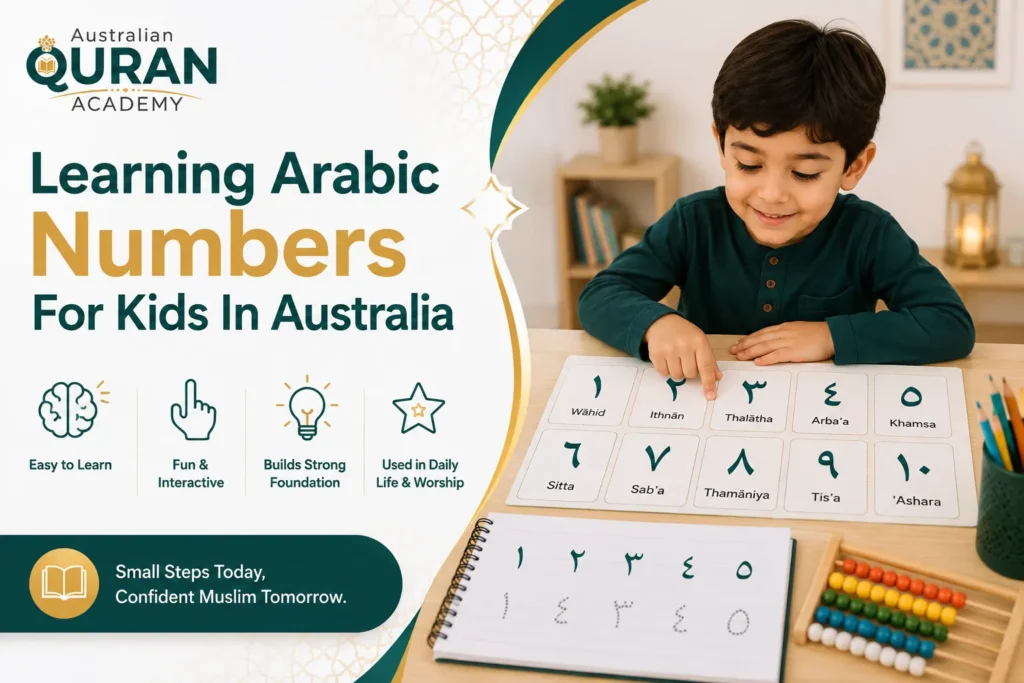
Does your child look at Arabic numerals — ١، ٢، ٣ — and see nothing but strange shapes? You’re not alone. For Muslim families across Australia, learning Arabic numbers for kids is a milestone that feels important but unclear: where do you start, how long does it take, and what actually works for a child growing up in an English-speaking environment?
Learning Arabic numbers for kids in Australia is entirely achievable at home, even without an Arabic background yourself. This guide breaks the process into eight clear steps — in order — so you know exactly what to do first, second, and next, instead of guessing where to begin.
Step 1: Decide When to Start
Research in early childhood language acquisition points to ages 3–5 as the strongest window for introducing a second numeral system. At this stage, pattern recognition is highly active, and children haven’t yet developed the resistance older learners sometimes show toward an unfamiliar system.
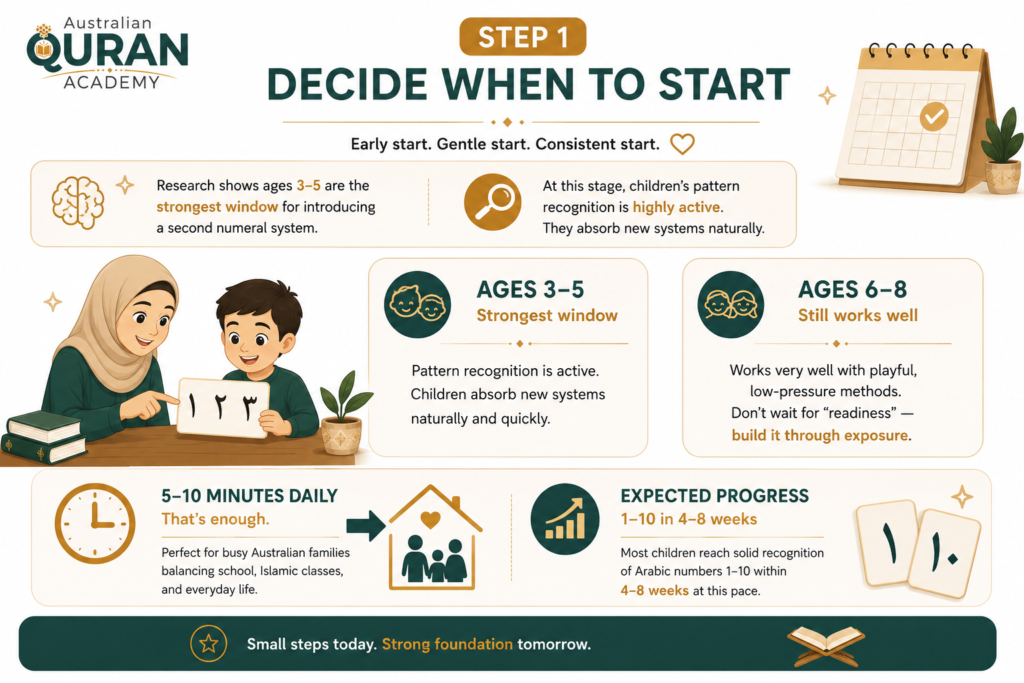
Starting at ages 6–8 still works well, especially with playful, low-pressure methods. Don’t wait for your child to “be ready” — readiness is built through gentle, consistent exposure, not age alone.
For Australian families juggling school, weekend Islamic classes, and everyday life, 5–10 minutes of daily practice is enough. Most children reach solid recognition of numbers 1–10 within 4–8 weeks at this pace.
Read also: How to Learn the Quran in English in Australia? 8 Steps
Step 2: Learn the Numeral Shapes Before Teaching Them
Arabic numerals are not a replacement for the numbers your child already knows — they are the same numbers written differently. Before any teaching session, sit with your child and go through this comparison together, so the shapes stop looking foreign.
| Western | Arabic | Pronunciation | Everyday Example |
| 1 | ١ | wāḥid | 1 sun in the sky |
| 2 | ٢ | ithnān | 2 rak’ahs in Fajr |
| 3 | ٣ | thalātha | 3 rak’ahs in Maghrib |
| 4 | ٤ | arba’a | 4 rak’ahs in Zuhr |
| 5 | ٥ | khamsa | 5 fingers on one hand |
| 6 | ٦ | sitta | 6 days of creation |
| 7 | ٧ | sab’a | 7 days in a week |
| 8 | ٨ | thamāniya | 8 birds on a branch |
| 9 | ٩ | tis’a | 9 balls in a bag |
| 10 | ١٠ | ‘ashara | 10 fingers altogether |
Print this table and put it somewhere your child sees daily — the fridge, the study desk, or beside the prayer mat. Passive exposure reinforces the active practice in the next step.
٢ and ٣ share a similar curved style, and children often notice this themselves once it’s pointed out.
٧ and ٨ are close enough in shape that beginners mix them up — spend extra time distinguishing these two specifically.
Step 3: Practice with More Than One Method at a Time
Parents who see the fastest progress combine sound, sight, and touch instead of relying on one method alone. Use these seven approaches in whatever order fits your child’s age and attention span.
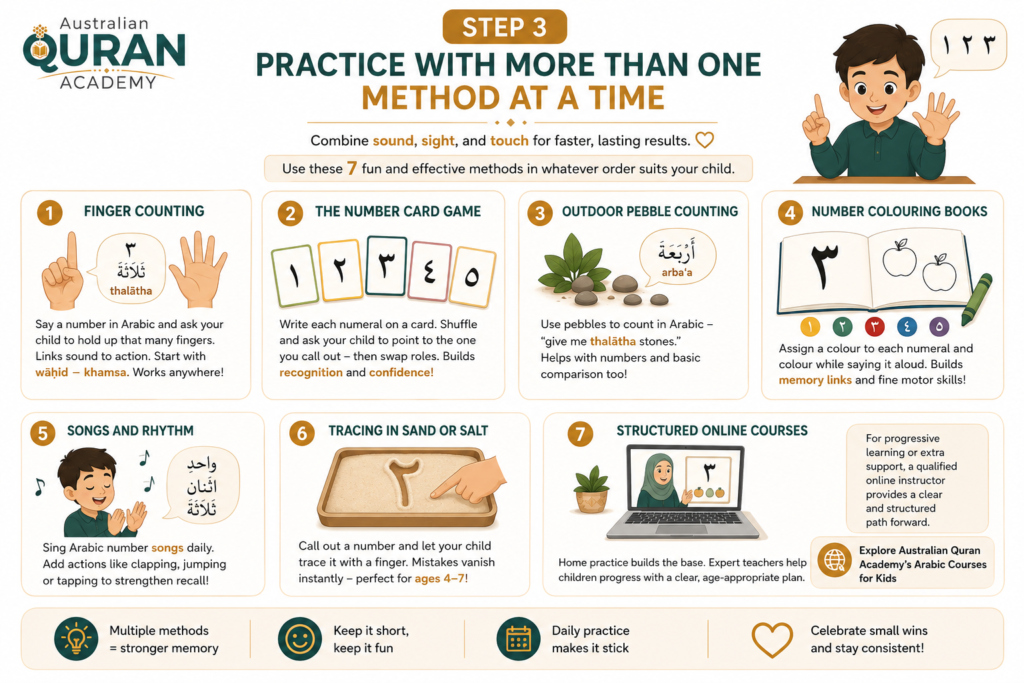
Method 1: Finger Counting
Stretch out both hands, say a number in Arabic, and ask your child to hold up that many fingers. This links the sound to a physical action before any writing is involved. Start with wāḥid through khamsa in the first session — it works anywhere, including the car ride to school.
Method 2: The Number Card Game
Write each numeral on a separate card, shuffle them, and ask your child to point to the one you call out — then swap roles. This builds recognition without writing pressure, and gives early wins that build confidence quickly.
Method 3: Outdoor Pebble Counting
Collect a small pile of pebbles at a park and ask your child to count out a number in Arabic — “give me thalātha stones.” This also opens the door to basic comparison: is arba’a more or less than thalātha? It works especially well for children who find desk-based learning difficult.
Method 4: Number Colouring Books
Assign a different colour to each numeral and have your child colour it while you say the number aloud. The colour-number pairing becomes a memory anchor, and the activity builds fine motor control before writing is required.
Method 5: Songs and Rhythm
Search “Arabic numbers song for kids” and sing along once a day. Pairing the song with a physical action — clapping, jumping, tapping — strengthens recall further, since more senses involved means deeper memory.
Method 6: Tracing in Sand or Salt
Fill a shallow tray with a thin layer of sand, call out a number, and let your child trace the numeral with a finger. Mistakes disappear instantly, with no crossed-out pages. This is particularly useful for children aged 4–7 whose pencil grip isn’t fully developed yet.
Method 7: Structured Online Arabic Courses
Home methods build early recognition and enthusiasm. For children ready for progressive, structured learning — or parents who don’t feel confident teaching Arabic themselves — a qualified online instructor can provide a clear path forward. Australian Quran Academy’s Arabic courses for kids are designed to help children build their Arabic skills through structured, age-appropriate lessons.

Step 4: Avoid the Mistake That Slows Most Children Down
The single most common mistake is teaching numbers in isolation from meaning. Writing ٥ repeatedly on a page is far less effective than saying “there are khamsa dates on your plate — ٥” while your child is actually looking at five dates.
Numbers anchored to real objects, situations, and routines are remembered. Numbers that only exist on worksheets are forgotten by the next morning — this is how children’s memory works, not a discipline issue.
The Practical Fix
For the first four weeks, commit to saying at least one number in Arabic during a real daily moment — at mealtimes, during prayer, while counting toys, or on the way to school. These small moments build a vocabulary of lived experience that no worksheet replicates.
See Us in Action!
Curious about what our online classrooms look like? Watch the short clips below to see how our interactive, one-on-one sessions bring learning to life with real-time feedback and engaging teaching methods.
Start Your Quranic Journey in Australia
Join our leading online academy and learn with expert tutors through a structured, personalized curriculum.
Book Your Free TrialStep 5: Use the Five Daily Prayers as a Built-In Practice Routine
Every salah has a fixed, repeated number of rak’ahs, and that repetition is exactly what number learning needs. When your child counts rak’ahs in Arabic, they aren’t doing homework — they’re participating in worship, and the repetition happens every single day.
| Prayer | Rak’ahs | Arabic Number |
| Fajr | 2 | ithnān (٢) |
| Zuhr | 4 | arba’a (٤) |
| Asr | 4 | arba’a (٤) |
| Maghrib | 3 | thalātha (٣) |
| Isha | 4 | arba’a (٤) |
By the end of one week of asking “how many rak’ahs is Asr?” in Arabic, most children have arba’a permanently locked in. By the end of a month of daily prayer, they’ve learned at least four Arabic numbers through lived repetition — without a single worksheet.
For families who want this connection to go further, the Fusha Arabic course at Australian Quran Academy builds the classical Arabic children hear in prayer and Quranic recitation into a skill they can read and understand.

Step 6: Check for Real Mastery Before Moving On
The most reliable test isn’t reciting 1 to 10 in sequence — that can be memorised without real recognition. The real test is calling out numbers out of order and asking your child to name or point to each one. If they hesitate or start counting from wāḥid to get there, recognition isn’t solid yet.
Space these check-ins out rather than testing daily. A quick, casual check every 4–5 days — “which one is sab’a?” while pointing at random cards — gives a more accurate read than constant drilling, and keeps the process from feeling like an exam.
What to Do If Progress Stalls?
If a child consistently mixes up the same two or three numbers after several weeks, don’t add more numbers on top. Go back to Step 3 and rotate in a different method for just those numbers — for example, switching a stuck child from cards to sand tracing for ٧ and ٨ specifically, rather than repeating the same drill that isn’t working.
Step 7: Move from Recognition to Writing
Writing should come after recognition, not alongside it. A child who can already identify ١ through ١٠ by sight has a mental template to aim for when picking up a pencil — a child who tries to learn shape and meaning at the same time usually struggles with both.
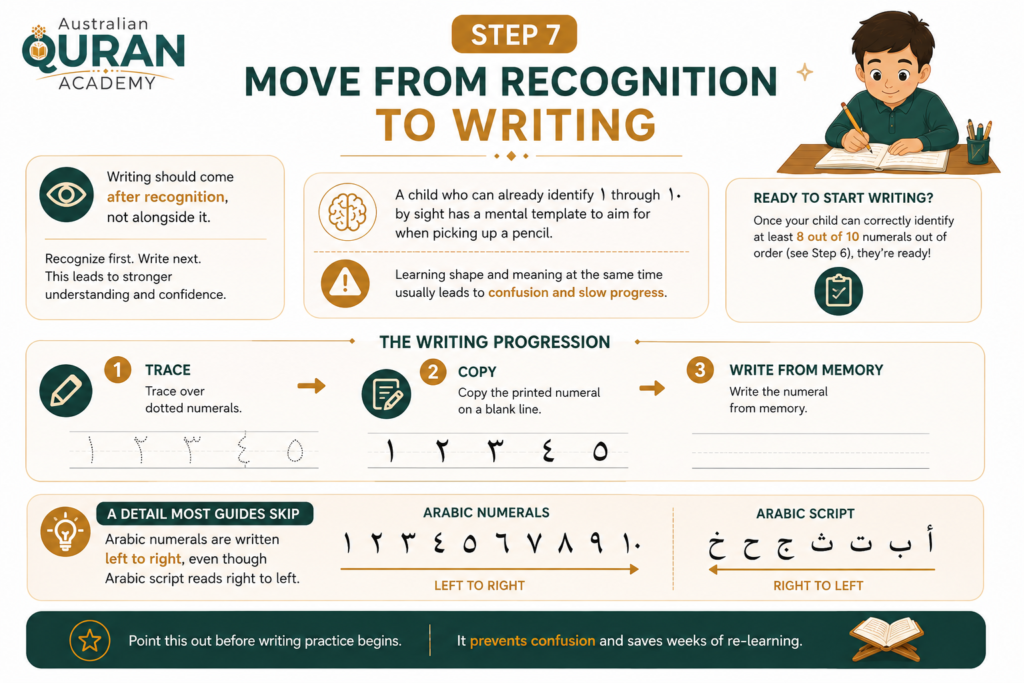
As a general guide, once a child can correctly identify at least 8 out of 10 numerals out of order (see Step 6), they’re ready to begin tracing and copying. Start with tracing over dotted numerals, move to copying a printed numeral onto a blank line, and only then ask for the number to be written from memory.
A Detail Most Guides Skip
Arabic numerals are written left to right, even though Arabic script itself reads right to left. This surprises many parents and can confuse a child who has just learned that Arabic “goes the other way.” Point this out explicitly before writing practice begins — it prevents a mix-up that otherwise takes weeks to unlearn.
Step 8: Use Numbers as a Bridge into Arabic Letters
Numbers are a low-stakes entry point precisely because they’re a closed set — there are only ten to learn, and the child already understands what they mean in English. Arabic letters are a larger, open-ended step, so the transition works best when it borrows the same techniques that worked for numbers: cards, tracing, and repetition tied to real objects rather than abstract drills.
A practical bridge is to start with the letters that appear in words your child already recognises from daily life — their own name, “Allah,” or short surah names they’ve heard in prayer. This mirrors the same principle from Step 4: meaning first, memorisation second.
As children move from recognising numbers to reading simple Arabic words, they also begin encountering basic sentence structures and grammatical patterns. At this stage, Australian Quran Academy’s Arabic grammar course can help children build a stronger understanding of how Arabic words work together.

Inside Our Virtual Classrooms
We believe in full transparency and proven quality. Take a look at these actual snippets from our live classes to experience our modern learning platform, patient instructors, and interactive student participation.
Start Your Quranic Journey in Australia
Join our leading online academy and learn with expert tutors through a structured, personalized curriculum.
Book Your Free TrialStart Your Child’s Arabic Journey with Australian Quran Academy
Learning Arabic numbers is the first step. What follows — reading Arabic, understanding the Quran, connecting to the language of prayer — is where that foundation pays off.
Australian Quran Academy offers online Arabic courses built specifically for families in Australia who want their children to grow up with a genuine Arabic skill, not just a surface familiarity. Qualified instructors, flexible scheduling, and a curriculum that connects Arabic to faith and daily life — all accessible from home.
Our Arabic Courses
- Online Arabic Academy
- Online Arabic Course
- Classical Arabic Course
- Arabic Course for Beginners
- Advanced Arabic Course
- Quranic Arabic Course
- Arabic Grammar Course
- Modern Standard Arabic Course
- Arabic Conversation / Speaking Course
- Intensive Arabic Course
- Online Arabic Classes for Kids
- Arabic Classes for Adults
- Arabic Classes for Ladies
- Fusha Arabic Course
- Business Arabic Course
- Al-Azhar Arabic Course
- Madinah Arabic Course
- Learning Arabic for Non-Arabic Speakers
- Arabic Elementary School
- Arabic Intermediate School
- Arabic Lessons for Kindergarten
Explore Arabic courses at Australian Quran Academy →

Start Your Quranic Journey in Australia
Join our leading online academy and learn with expert tutors through a structured, personalized curriculum.
Book Your Free TrialConclusion
Learning Arabic numbers for kids in Australia comes down to eight steps: pick the right age to start, learn the numeral shapes yourself first, combine more than one teaching method, avoid isolating numbers from real meaning, use daily prayer as a built-in practice routine, check for genuine mastery before moving on, shift into writing only once recognition is solid, and use numbers as the bridge into Arabic letters.
The Arabic numeral system isn’t a barrier — it’s a doorway. Once your child is comfortable with ١ through ١٠, they’ve taken the first step into a language that connects them to the Quran, to Islamic scholarship, and to a global community of over 400 million Arabic speakers. That journey is worth starting today, even with just five minutes and a handful of dates on a plate.
Frequently Asked Questions
What age is best for learning Arabic numbers for kids in Australia?
Ages 3–5 are ideal, since children in this window absorb numeral patterns quickly through play and repetition. Children aged 6–8 learn effectively too — the key factor is keeping the experience low-pressure and tied to things the child already cares about.
Are Arabic numerals the same as the numbers used in the Quran?
Yes. The numerals used in printed Arabic text and the Quran — ١، ٢، ٣ — are the same system your child will learn. Becoming familiar with them early makes Quran reading and Arabic text significantly easier to follow.
How long does it take for a child to learn Arabic numbers 1–10?
With daily practice of 5–10 minutes, most children aged 4–7 can reliably recognise and say Arabic numbers 1–10 within 4–6 weeks. Writing them correctly typically takes an additional 2–4 weeks of practice.
Do Australian Muslim kids need to learn Modern Standard Arabic or just the numbers?
Numbers are the entry point. For children who will go on to read the Quran or study Islamic texts, Modern Standard Arabic (Fusha) provides the foundation they need. Australian Quran Academy’s Modern Standard Arabic course is designed precisely for this progression.
Can I teach Arabic numbers at home if I don’t speak Arabic myself?
Yes. The methods in this guide — finger counting, number card games, songs, and sand tracing — require no Arabic fluency from the parent. A reference table of numerals 1–10 and a few minutes of daily practice are enough to get started.
Is there a difference between how Arabic numbers are spoken in classical Arabic and everyday conversation?
Yes. In Classical Arabic — the form used in the Quran and formal education — numbers are pronounced fully, such as ithnān for 2 and thalātha for 3. In spoken dialects, these are often shortened. For children learning Arabic for Quranic connection, start with the classical pronunciation, since that’s what they hear in prayer and formal Arabic education.






Leave a Reply