 Arabic
Are your kids growing up in Australia with little daily exposure to Arabic? You’re not alone. Thousands of Muslim families across Sydney, Melbourne, Brisbane, and Perth face the same challenge: keeping Arabic alive for children whose school, friends, and screen time are almost entirely in English.
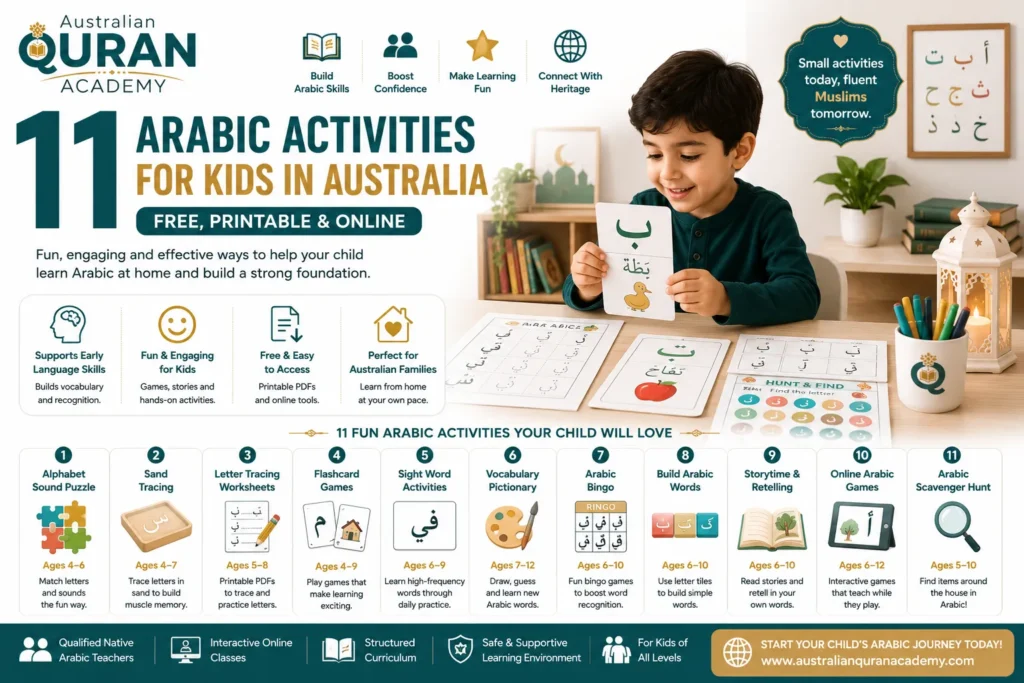
The good news is that the right Arabic activity for kids in Australia doesn’t feel like extra schoolwork. When learning is wrapped in games, stories, and hands-on play, children aged 4–10 absorb the language faster — and actually ask for more. This guide gives you 11 practical, proven activities, including free printable Arabic activities for kids, PDF resources, and online tools you can start using today.
Building letter recognition is the essential first step. Before a child can read the Quran or hold a conversation in Arabic, they need to know all 28 letters — including how each letter changes form at the start, middle, and end of a word. The activities below tackle this through movement, texture, and creative play rather than repetitive drills.
1. Arabic Alphabet Sound Puzzle (Ages 4–6)
A wooden Arabic alphabet sound puzzle is one of the most effective tools for early learners. Each piece represents a letter, and when placed correctly, the puzzle sounds out the letter name and an associated animal word. This builds two skills at once: letter recognition and basic Arabic vocabulary.
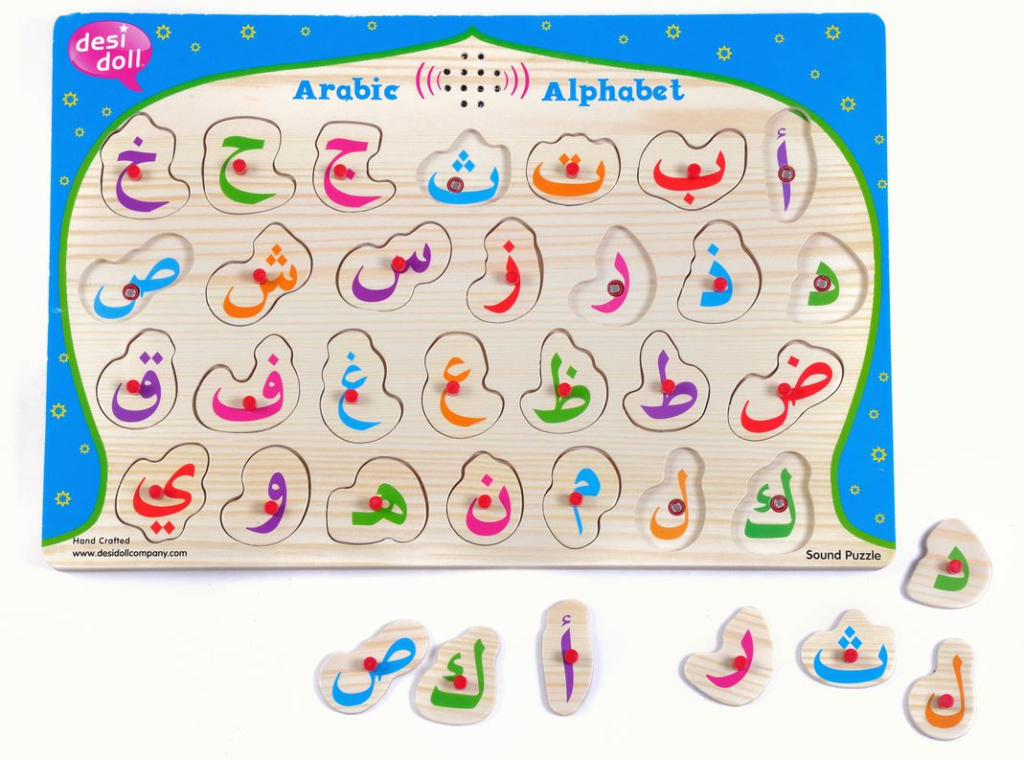
Australian parents can find Arabic alphabet puzzles through Islamic bookshops or order them online. The tactile, self-correcting format means children can play independently without needing a parent to guide every step — ideal for busy households.
2. Arabic Letter Sand Tracing (Ages 4–7)
Fill a shallow tray with fine sand or rice. Call out a letter, and your child traces it with one finger. Wrong shape? Smooth it over and try again. No paper wasted, no frustration.
This tactile approach is particularly effective for children aged 4–7 who are still developing pencil control. The sensory experience engages motor memory alongside visual memory, helping letter formation stick faster than worksheet practice alone. It also works well for children who resist sitting at a desk.
How to use it in Australia: Set the tray near the kitchen while you cook. Quick five-minute sessions three times a week produce measurable improvement in letter formation within a month.
Read also: 10 Best Arabic Cartoons for Kids to Watch Right Now
3. Arabic Letter Tracing Worksheets — Free Printable PDF (Ages 5–8)
Printable Arabic activity worksheets are the most widely used home resource for a good reason: they’re free, they’re ready in seconds, and they work. A well-designed free printable Arabic activity for kids in PDF format should include dotted letter outlines to trace, example words starting with each letter, and a blank space for free practice.
Look for worksheets that cover all three letter positions — initial (أول الكلمة), medial (وسط الكلمة), and final (آخر الكلمة) — because Australian children learning Arabic often recognise isolated letters but struggle to read letters inside words. Addressing all three positions early prevents this common gap.
Free Arabic activity for kids: The Australian Quran Academy’s kindergarten Arabic programme includes structured tracing materials designed specifically for non-native learners starting from scratch.
4. Arabic Flashcard Games (Ages 4–9)
A set of 28 Arabic-English flashcards (one per letter, with pictures) can be used in at least four different games that require zero preparation:
- Snap — Two children flip cards simultaneously; the first to say the Arabic word wins the pair.
- Memory match — Place cards face down; children flip two at a time, trying to match a letter to its picture word.
- Speed round — Parent holds up cards; child names the Arabic word as fast as possible. Time each round and celebrate improvements.
- Odd one out — Lay five cards face up, four from one letter category, one different. Child identifies which doesn’t belong.
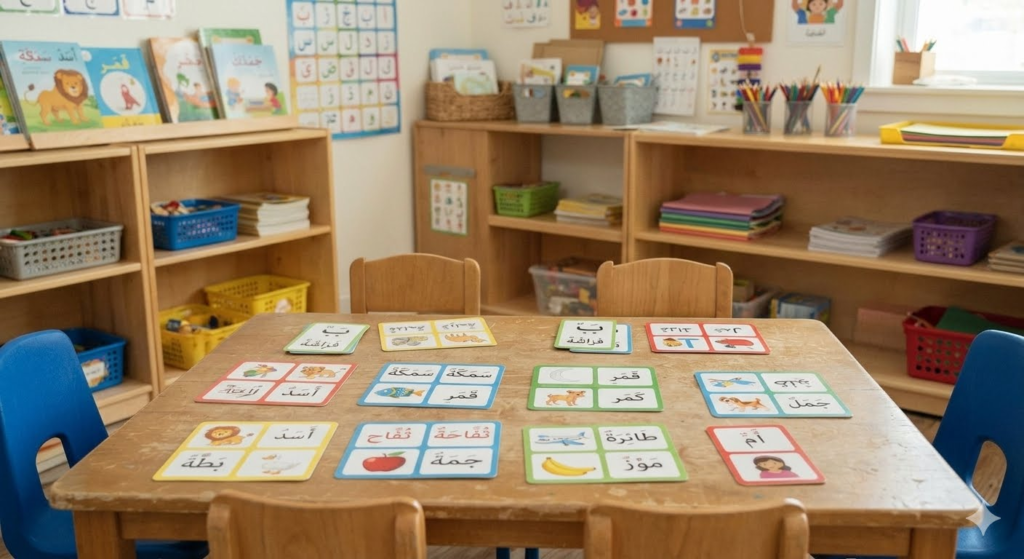
The competitive, game-based format makes this a genuinely enjoyable Arabic activity for kids that older siblings will also participate in, creating natural peer learning at home.
Read also: The Best Way To Learn Quran Online In Australia – A Complete Guide
See Us in Action!
Curious about what our online classrooms look like? Watch the short clips below to see how our interactive, one-on-one sessions bring learning to life with real-time feedback and engaging teaching methods.
Start Your Quranic Journey in Australia
Join our leading online academy and learn with expert tutors through a structured, personalized curriculum.
Book Your Free Trial5. Arabic Sight Word Activities (Ages 6–9)
Arabic sight words — the 100 most frequently used words in children’s texts — are the fastest path to reading fluency. Rather than decoding every letter, children who know these words by sight read them instantly, which makes simple sentences feel accessible and rewarding.
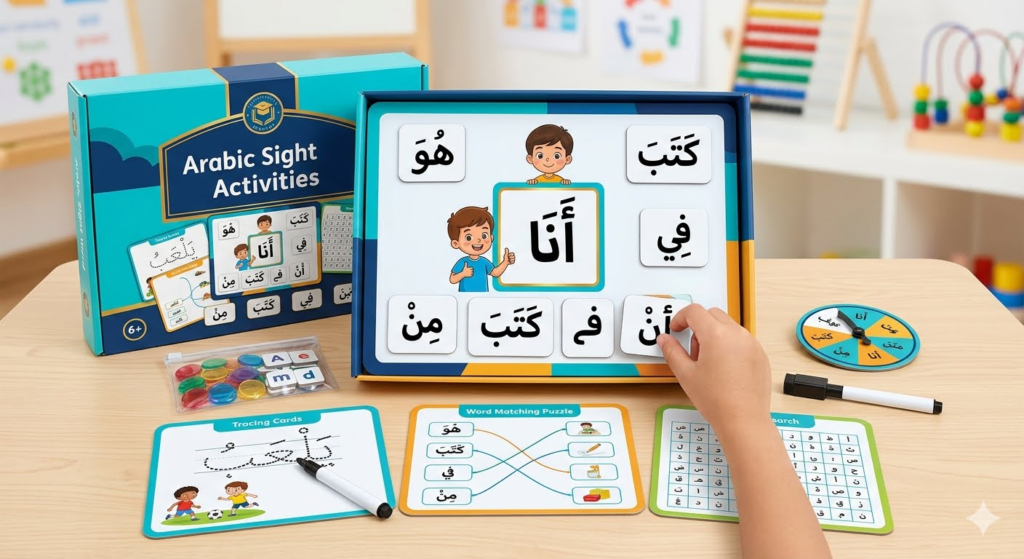
Write five sight words on index cards each week. Stick them around the house on relevant objects: كتاب on the bookshelf, باب on the door, ماء on the water bottle. Every time your child passes the object and reads the word aloud, they reinforce it without a formal lesson.
Platforms like Alefbata offer interactive online Arabic sight word activities that introduce the top 100 most-used words in children’s texts in an engaging, game-based format — a strong free Arabic activity for kids to complement home card activities.
Read also: How to Learn to Read Arabic for Kids in Australia ? – A 10-Step Guide
6. Arabic Vocabulary Pictionary (Ages 7–12)
One child draws a picture while others guess the Arabic word. No speaking — drawing only. This forces children to connect word meaning to a visual image, which is exactly how long-term vocabulary memory works.
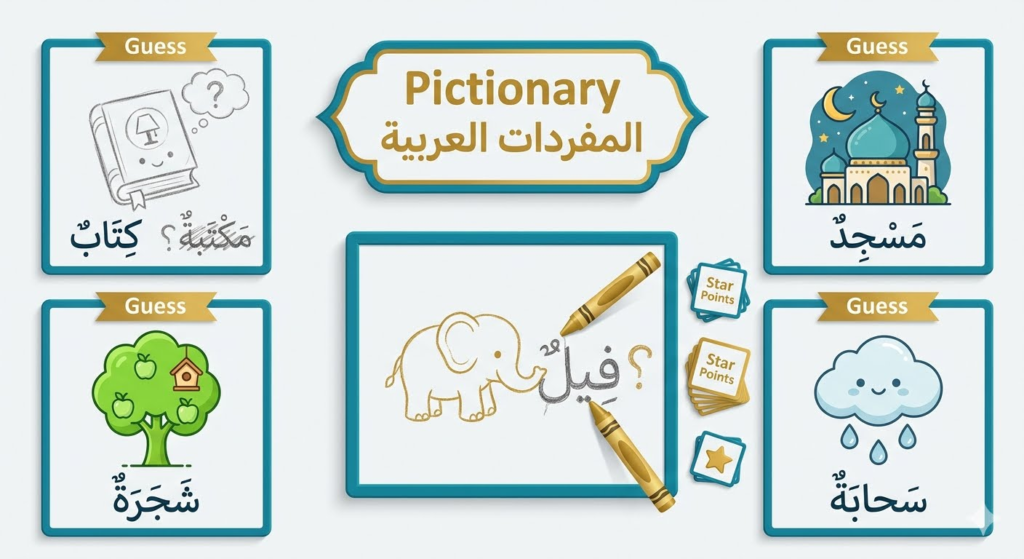
For ages 4–7, use only concrete nouns: animals (قطة، كلب)، food (تفاحة، خبز)، and household objects (كرسي، باب). For ages 8–12, introduce action words like يجري (runs) or يأكل (eats), requiring children to draw actions rather than objects.
This activity works particularly well for Australian families at weekend Islamic school catch-ups or playgroup settings — it’s competitive, loud, and completely self-running once children understand the rules.
7. Levelled Arabic Story Reading (Ages 6–10)
Arabic stories levelled by difficulty are one of the most underused resources in home Arabic learning. The principle is simple: a child who reads a story at the right level — not too easy, not too frustrating — builds confidence and vocabulary simultaneously.
Look for Arabic stories arranged by difficulty, starting with very short sentences and gradually progressing to longer texts. Choose stories that include simple comprehension activities so children can practise vocabulary and understanding alongside reading. This makes story reading a complete Arabic activity for kids online without requiring parents to create additional exercises themselves.
A practical rule for Australian families: if a child struggles with more than one word in every five, the story is too hard. Drop one level and rebuild fluency before pushing forward.
Read also: How to Learn Egyptian Arabic for Kids? – A Complete Step-by-Step Guide
8. Arabic Read-Aloud and Retelling (Ages 5–9)
Read a short Arabic story aloud to your child, pointing to each word as you say it. Then ask them to retell the story back to you — in Arabic if they can, in English if needed. The retelling step is what most parents skip, and it’s the most valuable part.
Retelling activates retrieval memory, which is significantly more durable than recognition memory. A child who can retell a story in their own words has genuinely processed the language, not just heard it.
For busy Australian parents who don’t read Arabic fluently themselves, many Arabic children’s story apps include native-speaker audio. Play the audio, follow along with your child, then pause and ask: “What happened first? What did the character do?” — in English at first, then gradually in Arabic as vocabulary grows.
Read also: Learning Arabic Numbers For Kids In Australia
9. Interactive Online Arabic Exercises (Ages 6–10)
Interactive online Arabic activities for kids provide immediate feedback that printed worksheets can’t: the child clicks, drags, or types, and the platform instantly tells them if they’re right. This self-correcting loop keeps attention focused and removes the need for a parent to mark every exercise.
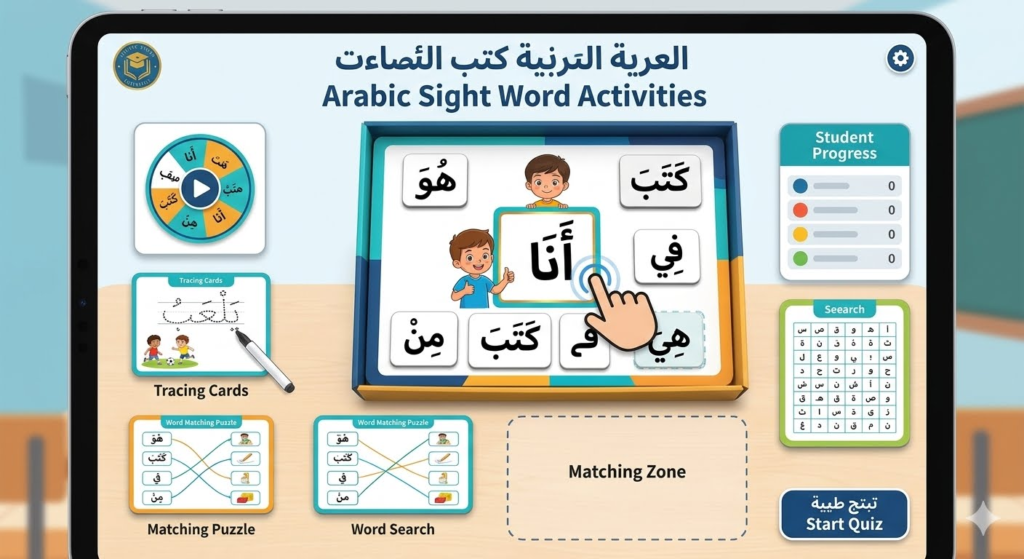
Interactive Arabic exercises can give children immediate feedback while they practise skills such as letter recognition, spelling, vocabulary, and basic grammar. Choose activities that progress gradually from beginner exercises to more challenging tasks, so children can practise at a level that matches their current ability. This makes interactive exercises a useful free Arabic activity for kids online and allows children to practise independently between lessons.
Limit sessions to 20–25 minutes. Children’s Arabic learning benefits more from short, consistent daily sessions than from occasional long ones.
10. Arabic Listening Activities (Ages 5–10)
Listening is the most underpractised skill in home Arabic learning, yet it underpins speaking, reading comprehension, and vocabulary retention. Children raised in English-speaking Australia rarely hear Arabic outside the home or mosque — which means deliberate listening practice matters more here than it does for families in Arab countries.
Practical listening activities include:
- Playing Arabic children’s songs during car trips and asking children to repeat any words they catch.
- Using short audio stories (5–7 minutes) and asking comprehension questions immediately after.
- Watching Arabic cartoons with Arabic subtitles (not English) so children link spoken and written forms simultaneously.
Interactive Arabic listening activities can give children structured practice in recognizing sounds, words, and simple spoken phrases. Choose exercises that gradually increase in difficulty and match your child’s current level. These activities can be a useful free Arabic activity for kids and can be used at home without requiring parents to speak Arabic fluently.
Read also: How to Learn the Quran in English in Australia? 8 Steps
11. Online Arabic Grammar Activities for Primary-Age Kids (Ages 8–12)
Grammar is often introduced too late in home Arabic learning, then feels overwhelming when it arrives. The solution is to introduce simple grammatical patterns early — not as rules to memorise, but as patterns children recognise from the Arabic they already know.
Start with simple grammar patterns that children can encounter naturally in everyday Arabic. Introduce the definite article (ال) first, followed by masculine and feminine nouns and simple subject–verb sentences. Use short examples and familiar vocabulary so children can understand how each pattern works in context.
Interactive grammar activities can then give children extra practice with these foundational patterns through simple exercises and worksheets. Keep the activities gradual and appropriate to the child’s reading level, introducing new grammar concepts only as they become comfortable with the basics.
For Australian families seeking a more structured curriculum, the Australian Quran Academy’s intermediate Arabic programme builds grammar systematically alongside reading and speaking in an age-appropriate online format.

Inside Our Virtual Classrooms
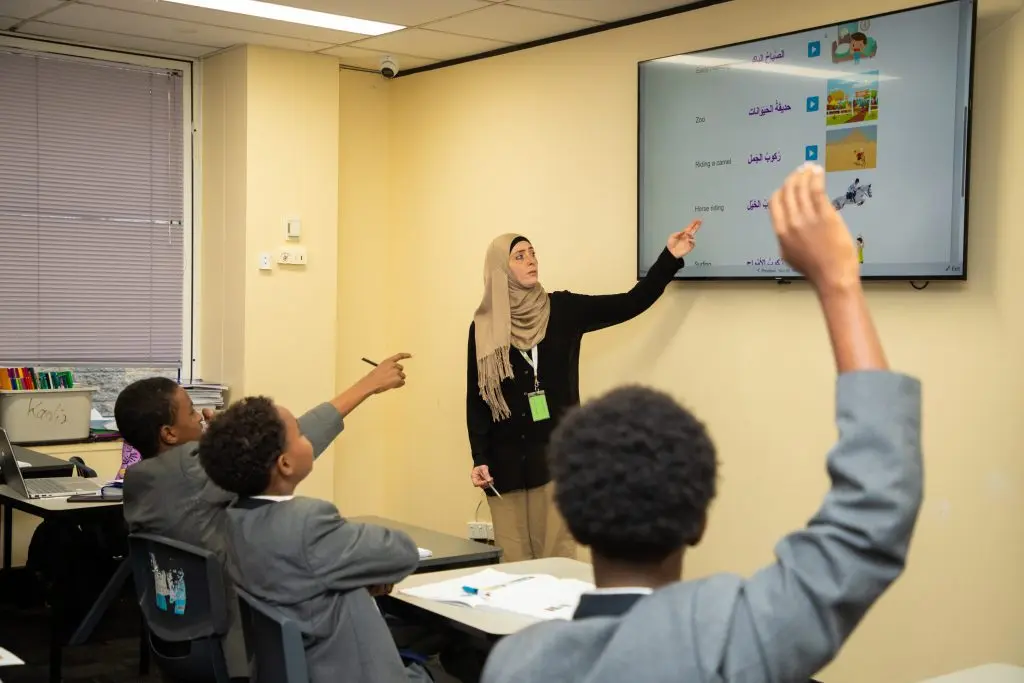
We believe in full transparency and proven quality. Take a look at these actual snippets from our live classes to experience our modern learning platform, patient instructors, and interactive student participation.
Start Your Quranic Journey in Australia
Join our leading online academy and learn with expert tutors through a structured, personalized curriculum.
Book Your Free TrialEnrol Your Child in Online Arabic Classes Designed for Australian Kids
Finding engaging Arabic activities is a great way to introduce children to the language, but consistent guidance can help turn regular practice into lasting progress. Australian Quran Academy provides online Arabic learning for children across Australia, with structured lessons designed to build skills gradually and support children at different stages of their learning journey.
Whether your child is just beginning to recognise Arabic letters or is ready to develop stronger reading, speaking, and grammar skills, lessons can be adapted to their level and learning needs. With qualified instructors and convenient online learning, families can give their children regular Arabic practice from home.
Our Arabic Courses
- Online Arabic Academy
- Online Arabic Course
- Classical Arabic Course
- Arabic Course for Beginners
- Advanced Arabic Course
- Quranic Arabic Course
- Arabic Grammar Course
- Modern Standard Arabic Course
- Arabic Conversation / Speaking Course
- Intensive Arabic Course
- Online Arabic Classes for Kids
- Arabic Classes for Adults
- Arabic Classes for Ladies
- Fusha Arabic Course
- Business Arabic Course
- Al-Azhar Arabic Course
- Madinah Arabic Course
- Learning Arabic for Non-Arabic Speakers
- Arabic Elementary School
- Arabic Intermediate School
- Arabic Lessons for Kindergarten

Start Your Quranic Journey in Australia
Join our leading online academy and learn with expert tutors through a structured, personalized curriculum.
Book Your Free TrialConclusion
The 11 Arabic activities for kids in this guide cover every core skill — letters, vocabulary, reading, speaking, listening, and grammar — using formats that children genuinely enjoy. The most important thing is consistency: 10–15 minutes of Arabic activity four or five times a week produces far stronger results than a two-hour session once a fortnight.
Australian kids face a real challenge maintaining Arabic in an all-English environment, but that challenge is absolutely manageable with the right mix of free printable Arabic activities for kids, interactive online platforms, and structured teaching from qualified instructors.
Pick two activities from this list this week. Add a third next month. By the time the school year ends, your child’s Arabic foundation will be genuinely solid — and they’ll have had fun building it.
Frequently Asked Questions
What is the best Arabic activity for kids in Australia?
For children aged 4–6, Arabic letter puzzles and sand tracing build recognition through play. For ages 6–10, interactive online platforms like Alefbata and levelled reading stories offer the most structured progression without requiring parents to teach.
Are there free printable Arabic activities for kids?
Yes. Free printable Arabic activity PDFs for kids include letter tracing worksheets, flashcard sets, and matching exercises. Australian Quran Academy’s kindergarten programme and platforms like Alefbata provide free downloadable and online materials suited to non-native learners.
How do I teach Arabic to my child at home in Australia?
Start with letter recognition (tracing, puzzles, flashcards), then introduce the 100 most common Arabic sight words, then move to simple levelled stories. Short daily sessions of 10–20 minutes outperform weekend marathon sessions. Pair home activities with a structured online course for consistent progress.
At what age should Australian kids start learning Arabic?
Most children can begin recognising Arabic letters from age 4. Formal reading and writing practice suits ages 5–6, and grammar can be introduced naturally from age 8. Starting early in a play-based format builds a strong foundation before formal schooling demands increase.
Can my child learn Arabic online if we live in Australia?
Absolutely. Online Arabic classes are the most practical option for Australian families outside major city centres. Australian Quran Academy’s online courses are structured for Australian children and delivered by qualified instructors, covering everything from kindergarten letters to intermediate school Arabic.
What is the difference between free Arabic activities and a structured course?
Free Arabic activities for kids — printable PDFs, online games, and worksheets — build exposure and reinforce specific skills. A structured course adds a qualified teacher, a progressive curriculum, consistent feedback, and accountability. The most effective approach for Australian children combines both.




Leave a Reply