 Arabic
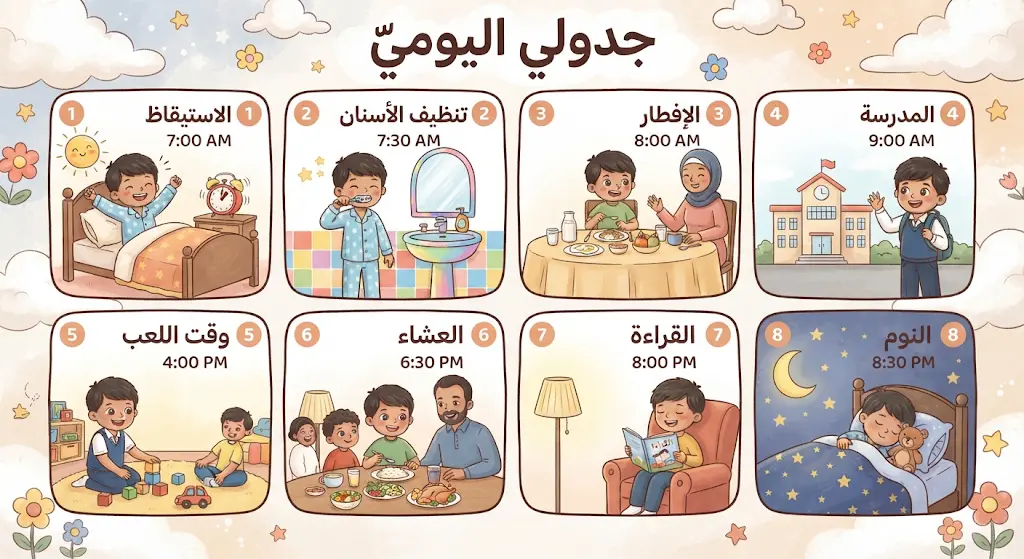
Your child wakes up, brushes their teeth, eats breakfast, goes to school — and you want every one of those moments to teach them Arabic. That instinct is exactly right. The daily routine in Arabic for kids is one of the most effective vocabulary sets a young learner can master because they live it every single day.
When a child hears أَنَا أَسْتَيْقِظُ (ana astayqidhu — “I wake up”) every morning at the exact moment they do wake up, that word sticks in a way no flashcard ever could. Context is the engine of language acquisition, and your child’s day is full of it.
This guide gives you the complete daily routine in Arabic for kids — with meaning, pronunciation, English translation, printable word lists, and a practical method for weaving it into home life without adding a single “lesson” to your schedule.
Daily Routine in Arabic for Kids: The Complete Word List
The daily routine in Arabic for kids covers the sequence of activities children do every day — morning, afternoon, and evening. Below is the core vocabulary, organized chronologically through a child’s day, with Arabic, transliteration, and English meaning.
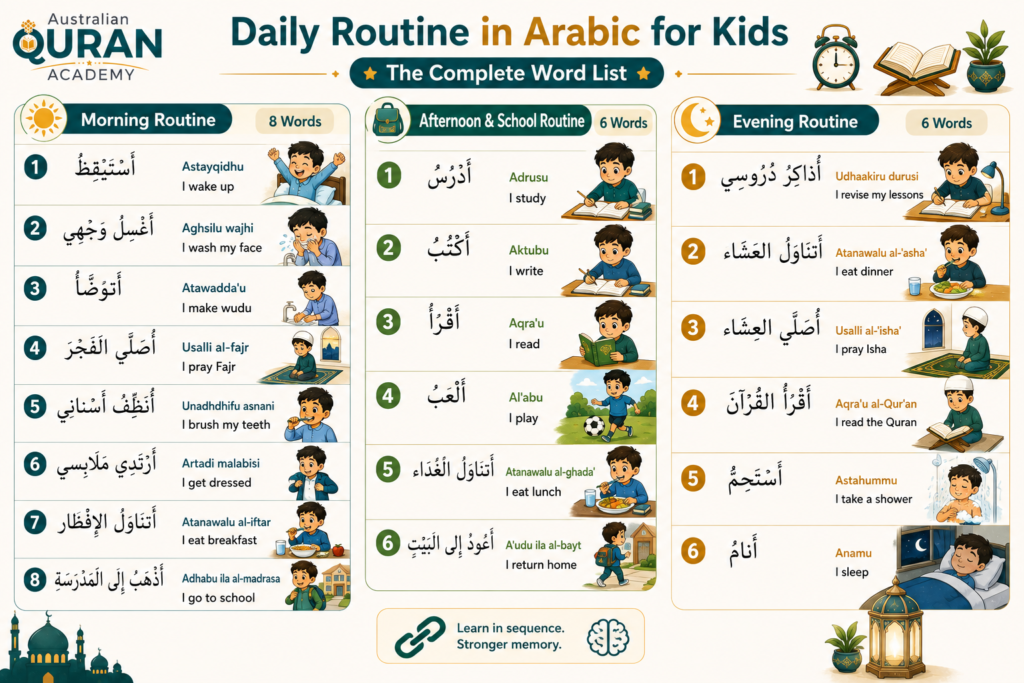
Learning vocabulary in sequence matters. When children learn “I wake up → I brush my teeth → I eat breakfast” as a chain rather than as isolated words, retention is significantly stronger because each word cues the next.
Morning Routine Words in Arabic for Kids
Start your child’s day with these eight essential morning phrases — from the moment they open their eyes to the moment they walk out the door.
| Arabic | Transliteration | English Meaning |
| أَسْتَيْقِظُ | Astayqidhu | I wake up |
| أَغْسِلُ وَجْهِي | Aghsilu wajhi | I wash my face |
| أَتَوَضَّأُ | Atawadda’u | I make wudu |
| أُصَلِّي الفَجْرَ | Usalli al-fajr | I pray Fajr |
| أُنَظِّفُ أَسْنَانِي | Unadhdhifu asnani | I brush my teeth |
| أَرْتَدِي مَلَابِسِي | Artadi malabisi | I get dressed |
| أَتَنَاوَلُ الإِفْطَارَ | Atanawalu al-iftar | I eat breakfast |
| أَذْهَبُ إِلَى المَدْرَسَةِ | Adhabu ila al-madrasa | I go to school |
Afternoon and School Routine Words in Arabic for Kids
These six words cover everything that happens between school drop-off and the journey back home — studying, playing, and the midday meal.
| Arabic | Transliteration | English Meaning |
| أَدْرُسُ | Adrusu | I study |
| أَكْتُبُ | Aktubu | I write |
| أَقْرَأُ | Aqra’u | I read |
| أَلْعَبُ | Al’abu | I play |
| أَتَنَاوَلُ الغَدَاءَ | Atanawalu al-ghada’ | I eat lunch |
| أَعُودُ إِلَى البَيْتِ | A’udu ila al-bayt | I return home |
Evening Routine Words in Arabic for Kids
The evening is when Arabic learning deepens naturally — Isha prayer, Quran reading, and bedtime all carry words children will encounter again and again throughout their Islamic education.
| Arabic | Transliteration | English Meaning |
| أُذَاكِرُ دُرُوسِي | Udhaakiru durusi | I revise my lessons |
| أَتَنَاوَلُ العَشَاءَ | Atanawalu al-‘asha’ | I eat dinner |
| أُصَلِّي العِشَاءَ | Usalli al-‘isha’ | I pray Isha |
| أَقْرَأُ القُرْآنَ | Aqra’u al-Qur’an | I read the Quran |
| أَسْتَحِمُّ | Astahummu | I take a shower |
| أَنَامُ | Anamu | I sleep |
Daily Routine in Arabic for Kids with Meaning: Key Phrases That Do Double Duty
Some daily routine phrases in Arabic for kids carry meaning far beyond vocabulary — they are also Islamic phrases children hear in prayer, in Quran, and in everyday Muslim family life. Teaching the daily routine word in Arabic alongside its deeper meaning gives children two rewards at once.
بِسْمِ اللَّهِ — Before Every Action
Bismillah means “In the name of Allah.” Children should hear and say this before eating, before drinking, before starting homework, before getting in the car. It appears throughout the Quran and is among the first Arabic phrases Muslim children learn. Teaching it as a daily routine phrase in Arabic rather than an isolated religious formula makes it feel natural and automatic within weeks.
الحَمْدُ لِلَّهِ — After Every Meal
Al-hamdu lillah means “All praise is due to Allah.” Saying it after finishing breakfast, lunch, and dinner teaches children three daily routine moments in Arabic while building gratitude. The root word حَمْد (hamd — praise) appears 38 times in the Quran, so children who learn it in daily life will recognize it instantly when they begin reading Quranic Arabic.
صَبَاحُ الخَيْرِ — The Morning Greeting
Sabah al-khayr means “Good morning.” Its response is Sabah al-nur — “Morning of light.” Using this greeting the moment your child wakes up takes five seconds and delivers daily routine vocabulary in Arabic in the most emotionally warm context possible: the start of a new day.
For families who want to build systematically beyond home phrases into reading and grammar, the Australian Quran Academy’s Modern Standard Arabic course gives children a structured path from spoken phrases like these to written Arabic comprehension — the same foundation needed for Quranic reading.

Everyday Arabic Questions and Answers for Kids
Children learning daily routine vocabulary in Arabic will ask questions. These are the most common ones, with clear answers.
How do you say “I wake up” in Arabic?
أَسْتَيْقِظُ (Astayqidhu) means “I wake up” in Arabic. The verb root is ي ق ظ (ya-qa-dha), which relates to alertness and awakening. For kids, just teach: “أَنَا أَسْتَيْقِظُ بَاكِرًا” — Ana astayqidhu bakiran — “I wake up early.”
How do you say “I go to school” in Arabic?
أَذْهَبُ إِلَى المَدْرَسَةِ (Adhabu ila al-madrasa) means “I go to school.” Note that المَدْرَسَةِ (al-madrasa — school) shares its root with دَرَسَ (darasa — to study), so the word for school literally means “the place of study.” Children find this fascinating.
How do you say “I sleep” in Arabic?
أَنَامُ (Anamu) means “I sleep.” The bedtime supplication children learn — Allahuma bismika amutu wa ahya — uses the verb أَمُوتُ (amutu — I die) and أَحْيَا (ahya — I live), making sleep a moment of Islamic reflection. Teaching the daily routine word for sleep in Arabic naturally opens the door to bedtime dhikr.
Read also: Easy Arabic Stories for Kids – 7 Stories With Translation, Vocabulary, and Activities
See Us in Action!
Curious about what our online classrooms look like? Watch the short clips below to see how our interactive, one-on-one sessions bring learning to life with real-time feedback and engaging teaching methods.
Start Your Quranic Journey in Australia
Join our leading online academy and learn with expert tutors through a structured, personalized curriculum.
Book Your Free TrialHow to Teach Daily Routine Arabic at Home?
You don’t need to speak Arabic fluently to help your child learn useful Arabic through everyday routines. The key is to introduce simple words and phrases in familiar situations and repeat them naturally until they become part of your child’s day.
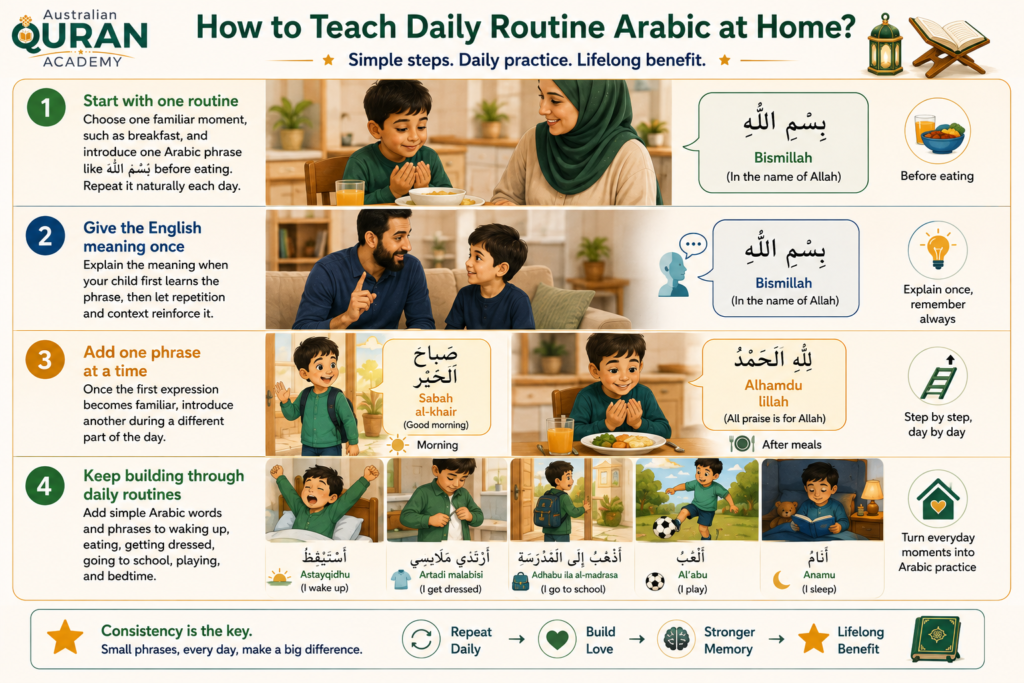
- Start with one routine: Choose one familiar moment, such as breakfast, and introduce one Arabic phrase like بِسْمِ اللَّهِ before eating. Repeat it naturally each day instead of introducing several new words at once.
- Give the English meaning once: Explain the meaning when your child first learns the phrase, then let repetition and context reinforce it. There is no need to translate it every time.
- Add one phrase at a time: Once the first expression becomes familiar, introduce another during a different part of the day. For example, add الحَمْدُ لِلَّهِ after meals, then صَبَاحُ الخَيْرِ in the morning.
- Keep building through daily routines: As your child becomes comfortable, add simple Arabic words and phrases to waking up, eating, getting dressed, going to school, playing, and bedtime. This turns ordinary moments into natural Arabic practice.
This approach works for children aged 3 through 12. For teenagers, a slightly different method works better: introducing the written Arabic word alongside the spoken phrase so they can read it, not just say it. The Australian Quran Academy’s Arabic courses offer teen-appropriate pathways that take exactly this kind of home foundation and develop it into structured reading and writing ability under qualified instructors.

Daily Routine in Arabic for Kids: Printable Guide
A printable daily routine in Arabic for kids is most effective when it matches your child’s actual day — not a generic schedule. Here is how to structure one that works.
What a Good Daily Routine Printable in Arabic Includes?
The best printable daily routine in Arabic for kids has four columns: a clock time, a simple illustration of the activity, the Arabic phrase, and the English meaning. Children can follow it as a morning checklist while building vocabulary passively through repeated reading.
A practitioner note from Arabic language educators: printables that include transliteration (the romanized pronunciation guide) are more useful for non-Arabic-speaking families in the early weeks, but should be phased out once the child can recognize the Arabic script independently. Keeping transliteration too long delays script recognition by weeks.
Here is how the four-column structure looks in practice — use this as your template when building a printable at home:
| Time | Activity | Arabic | English |
| 6:00 AM | Wake up | أَسْتَيْقِظُ | I wake up |
| 6:10 AM | Make wudu | أَتَوَضَّأُ | I make wudu |
| 6:20 AM | Pray Fajr | أُصَلِّي الفَجْرَ | I pray Fajr |
| 7:00 AM | Eat breakfast | أَتَنَاوَلُ الإِفْطَارَ | I eat breakfast |
| 7:30 AM | Go to school | أَذْهَبُ إِلَى المَدْرَسَةِ | I go to school |
| 3:30 PM | Return home | أَعُودُ إِلَى البَيْتِ | I return home |
| 6:00 PM | Eat dinner | أَتَنَاوَلُ العَشَاءَ | I eat dinner |
| 8:30 PM | Sleep | أَنَامُ | I sleep |
Read also: What Are the Rewards of Becoming a Hafiz? 10 Benefits of Memorizing the Quran
How to Use the Printable for Maximum Retention?
Post the chart at eye level in the kitchen or bedroom — somewhere your child sees it during the routine itself, not in a folder. Point to the Arabic word as the activity happens: when your child sits down to eat, point to أَتَنَاوَلُ الإِفْطَارَ and say it aloud together. When they leave for school, point to أَذْهَبُ إِلَى المَدْرَسَةِ.
This “point-and-say” method takes under 10 seconds per activity and costs zero additional study time. Over four weeks of consistent use, most children aged 5–10 recognize all ten morning routine words in Arabic without being explicitly taught.
For families who want to accelerate beyond home practice into genuine Arabic proficiency, the Australian Quran Academy’s Online Arabic Classes for Kids build on exactly this daily vocabulary foundation — turning familiar words into confident reading, writing, and Quranic understanding with qualified teachers and flexible scheduling across Australia.

Inside Our Virtual Classrooms
We believe in full transparency and proven quality. Take a look at these actual snippets from our live classes to experience our modern learning platform, patient instructors, and interactive student participation.
Start Your Child’s Arabic Journey with the Australian Quran Academy
Your child already knows a daily routine. They just need to say it in Arabic. The Australian Quran Academy’s expert-led Online Arabic Classes for Kids in Australia take children from their first Arabic words — the ones they learn at home through their daily routine — to confident reading, writing, and Quranic comprehension.
- Qualified instructors trained in child-focused Arabic pedagogy
- Lessons designed for Australian kids aged 4–15
- Flexible scheduling across all Australian time zones — Sydney, Melbourne, Brisbane, Perth, and beyond
- One-on-one live sessions with real-time feedback
- A curriculum that connects home vocabulary to Quranic Arabic naturally
- For families who want an accelerated path, the Intensive Quran Course in Australia combines structured immersion with personalized pacing for faster results
Start Your Child’s Free Trial Today →
Our Arabic Courses
- Online Arabic Academy
- Online Arabic Course
- Classical Arabic Course
- Arabic Course for Beginners
- Advanced Arabic Course
- Quranic Arabic Course
- Arabic Grammar Course
- Modern Standard Arabic Course
- Arabic Conversation / Speaking Course
- Intensive Arabic Course
- Online Arabic Classes for Kids
- Arabic Classes for Adults
- Arabic Classes for Ladies
- Fusha Arabic Course
- Business Arabic Course
- Al-Azhar Arabic Course
- Madinah Arabic Course
- Learning Arabic for Non-Arabic Speakers
- Arabic Elementary School
- Arabic Intermediate School
- Arabic Lessons for Kindergarten
Start Your Quranic Journey in Australia
Join our leading online academy and learn with expert tutors through a structured, personalized curriculum.
Book Your Free Trial
Conclusion
The daily routine in Arabic for kids is not a supplementary vocabulary list — it is the most natural entry point into the Arabic language because it meets children exactly where they already are. Every morning, every meal, every bedtime is a teaching moment that costs nothing extra and takes no additional time.
The key insight is sequence: learning أَسْتَيْقِظُ, أَتَوَضَّأُ, أُصَلِّي الفَجْرَ as a connected morning chain outperforms learning them as isolated words because the child’s brain encodes them in the same memory as the physical routine itself. That is language acquisition working the way it is designed to.
Start with one phrase this week. Bismillah before breakfast. By next month, your child’s daily routine in Arabic will be a living vocabulary lesson — and a foundation for everything that comes next in their Arabic and Quranic education.
Read also: How to Become a Hafiz in Australia – A 10-Step Guide
Frequently Asked Questions
What is the daily routine in Arabic for kids called?
The daily routine in Arabic is called الرُّوتِين اليَوْمِي (al-rutin al-yawmi). For children, this vocabulary set covers activities from waking up (astayqidhu) through sleeping (anamu), including prayers, meals, school, and study.
How do you say “daily routine” in Arabic?
الرُّوتِين اليَوْمِي (al-rutin al-yawmi) means “daily routine” in Arabic. The word يَوْمِي (yawmi) means “daily” and comes from the root يَوْم (yawm — day), the same word that appears in يَوْمَ الدِّينِ (Yawm al-din — the Day of Judgment) in Surah Al-Fatiha.
At what age should kids start learning Arabic daily routine vocabulary?
Children can begin learning daily routine vocabulary in Arabic from age 3 through spoken phrases only — no reading or writing. Ages 5–7 can start recognizing the written Arabic words on a chart. Ages 8 and above can read and write the full phrases independently with guidance.
Can a child learn the daily routine in Arabic at home without a teacher?
Yes, for basic spoken vocabulary. Parents can introduce daily routine words in Arabic through routine anchoring — saying one Arabic phrase at its matching daily moment — without any formal Arabic knowledge themselves. For reading, writing, and progression into Quranic Arabic, a qualified teacher accelerates results significantly.
What is the best way to practice daily routine Arabic words with kids?
The most effective method is context-based repetition: say each Arabic word at the exact moment the activity happens, every single day. A printable daily routine chart in Arabic posted in the kitchen or bedroom, combined with point-and-say practice, produces strong recognition in most children within three to four weeks.
How does daily routine Arabic vocabulary connect to Quranic Arabic?
Many daily routine words in Arabic share roots with Quranic vocabulary.
يَوْم (yawm — day), قَرَأَ (qara’a — to read), كَتَبَ (kataba — to write), and phrases like بِسْمِ اللَّهِ and الحَمْدُ لِلَّهِ appear throughout the Quran. Children who learn these words in daily life develop immediate recognition when they begin Quranic reading — shortening the learning curve considerably.







Leave a Reply