 Arabic
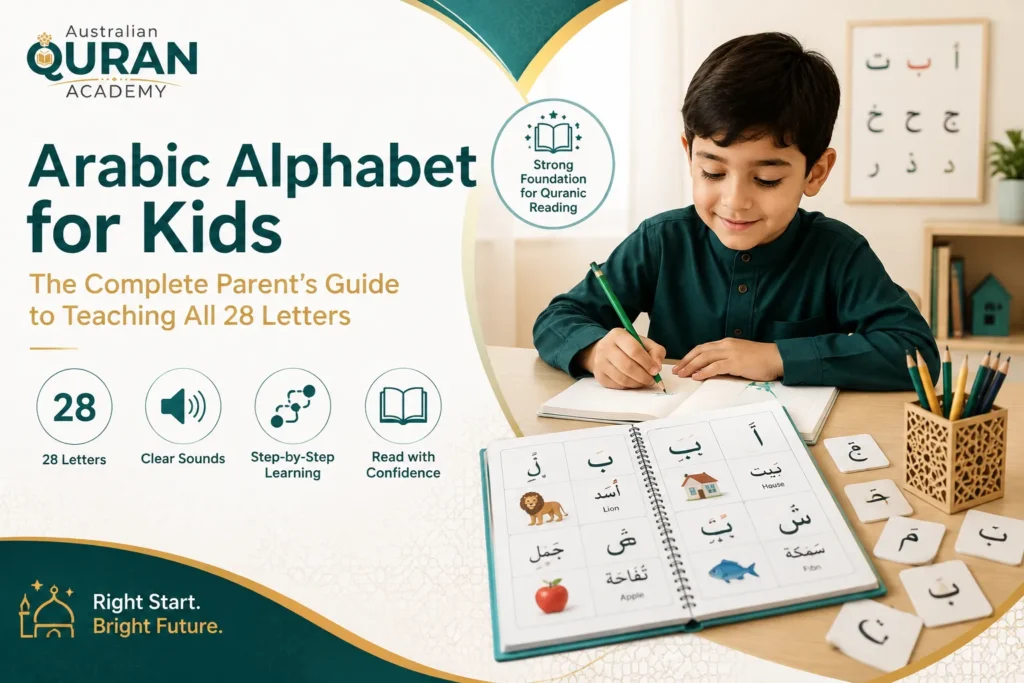
Your child already knows how to learn a language. They proved it when they picked up English — through exposure, repetition, and real-world use, not through grammar rules or memorization drills. Teaching the arabic alphabet for kids works the same way when you follow the right sequence.
The challenge parents face is not the language itself. Arabic has a remarkably consistent sound-letter system — every letter makes one sound, always. The challenge is knowing where to start, how to introduce the four positional forms without overwhelming a child, and which activities build genuine reading ability versus which ones just feel productive.
What Is the Arabic Alphabet for Kids?
The Arabic alphabet — known in Arabic as الأبجدية العربية (al-Abjadiyya al-Arabiyya) — is a consonant-based writing system of 28 letters, written from right to left. Technically it is an abjad rather than a true alphabet, meaning short vowel sounds are not represented by letters but by optional marks written above and below consonants.
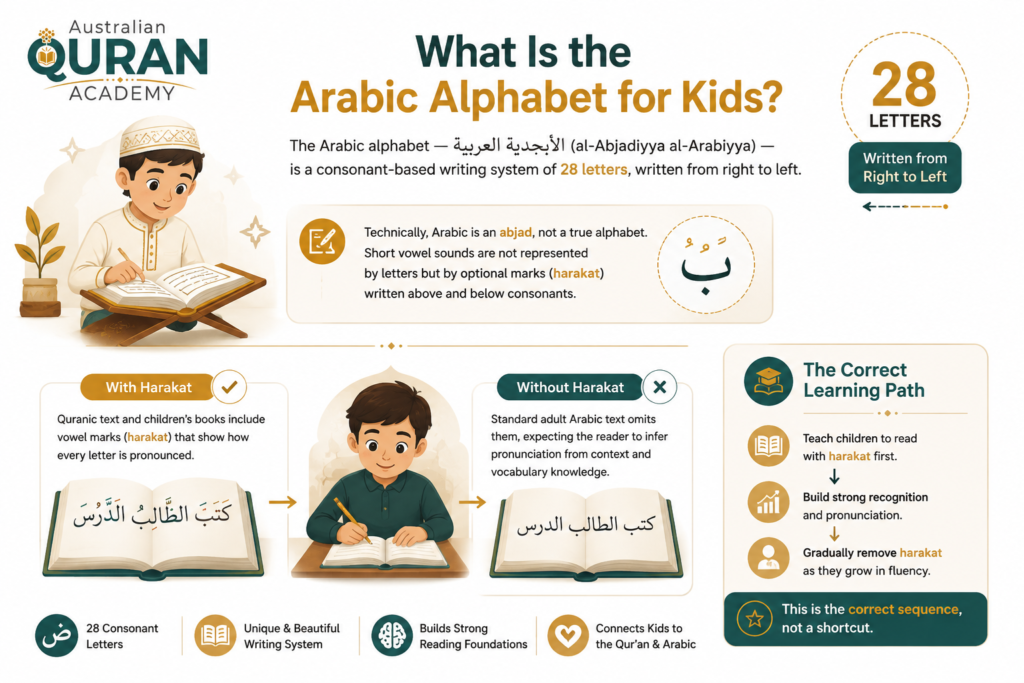
For children learning Arabic, this has a direct practical implication: the text they read in everyday life looks different from the text in their learning materials. Quranic text and children’s books include vowel marks (harakat) that show how every letter is pronounced. Standard adult Arabic text omits them entirely, expecting the reader to infer pronunciation from context and vocabulary knowledge. Teaching children to read with harakat first — and only gradually removing them — is the correct sequence, not a shortcut.
Read also: 10 Best Arabic Cartoons for Kids to Watch Right Now
How Is the Arabic Alphabet Different from English?
Understanding the core structural differences helps parents set realistic expectations and avoid common teaching errors.
| Feature | Arabic | English |
| Number of letters | 28 | 26 |
| Writing direction | Right to left | Left to right |
| Letter types | All consonants | Consonants + vowels |
| Short vowels | Written as optional marks | Written as full letters (A, E, I, O, U) |
| Letter forms per letter | Up to 4 | 2 (upper and lower case) |
| Capital letters | None | Yes |
| Script style | Naturally cursive — letters connect | Print and cursive are separate styles |
The positional forms column is the most important for parents to understand. Arabic is cursive by design — most letters connect to the letters around them, and the connection changes the shape. A child who learns only the isolated form of a letter will not recognize it inside a word until they learn the connected forms. This is not a difficulty unique to your child; it is a structural feature of the script that every learner must work through.
For children coming from an English-speaking background, a structured introduction can make these differences much easier to understand. The Arabic courses for non-Arabic speakers at Australian Quran Academy provide a gradual introduction to Arabic pronunciation, reading, and basic language skills.
The Arabic Alphabet for Kids: All 28 Letters With Sounds and Example Words
The arabic alphabet kids encounter in their first lessons looks like this, in traditional order.
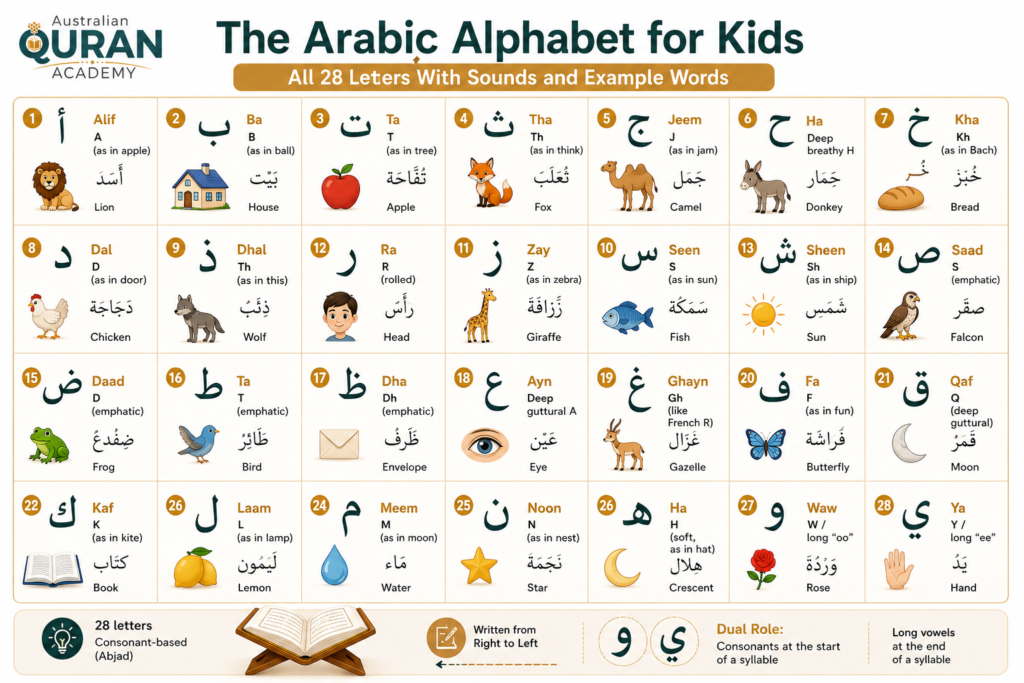
Each letter is paired with an English sound approximation and an Arabic word a child can connect to:
| Letter | Name | Sound | Example Word | Meaning |
| أ | Alif | A (as in “apple”) | أَسَد | Lion |
| ب | Ba | B (as in “ball”) | بَيت | House |
| ت | Ta | T (as in “tree”) | تُفَّاحَة | Apple |
| ث | Tha | Th (as in “think”) | ثَعلَب | Fox |
| ج | Jeem | J (as in “jam”) | جَمَل | Camel |
| ح | Ha | Deep breathy H | حِمَار | Donkey |
| خ | Kha | Kh (as in “Bach”) | خُبز | Bread |
| د | Dal | D (as in “door”) | دَجَاجَة | Chicken |
| ذ | Dhal | Th (as in “this”) | ذِئب | Wolf |
| ر | Ra | R (rolled) | رَأس | Head |
| ز | Zay | Z (as in “zebra”) | زَرَافَة | Giraffe |
| س | Seen | S (as in “sun”) | سَمَكَة | Fish |
| ش | Sheen | Sh (as in “ship”) | شَمس | Sun |
| ص | Saad | S (emphatic) | صَقر | Falcon |
| ض | Daad | D (emphatic) | ضِفدَع | Frog |
| ط | Ta | T (emphatic) | طَائِر | Bird |
| ظ | Dha | Dh (emphatic) | ظَرف | Envelope |
| ع | Ayn | Deep guttural A | عَين | Eye |
| غ | Ghayn | Gh (like French R) | غَزَال | Gazelle |
| ف | Fa | F (as in “fun”) | فَرَاشَة | Butterfly |
| ق | Qaf | Q (deep guttural) | قَمَر | Moon |
| ك | Kaf | K (as in “kite”) | كِتَاب | Book |
| ل | Laam | L (as in “lamp”) | لَيمُون | Lemon |
| م | Meem | M (as in “moon”) | مَاء | Water |
| ن | Noon | N (as in “nest”) | نَجمَة | Star |
| هـ | Ha | H (soft, as in “hat”) | هِلَال | Crescent |
| و | Waw | W / long “oo” | وَردَة | Rose |
| ي | Ya | Y / long “ee” | يَد | Hand |
One detail most guides omit: و (Waw) and ي (Ya) serve a dual role. They function as consonants when they begin a syllable and as long vowels when they follow one. A child reading Quranic Arabic will encounter both uses constantly. Introduce the consonant function first; the long vowel function follows naturally once basic reading is established.
Read also: 10 Best Arabic Cartoons for Kids to Watch Right Now
See Us in Action!
Curious about what our online classrooms look like? Watch the short clips below to see how our interactive, one-on-one sessions bring learning to life with real-time feedback and engaging teaching methods.
Start Your Quranic Journey in Australia
Join our leading online academy and learn with expert tutors through a structured, personalized curriculum.
Book Your Free TrialThe Right Teaching Sequence: What to Introduce First?
Most parents follow alphabetical order because it feels logical. Alphabetical order is actually one of the slower ways to teach the arabic alphabet for kids, for a specific reason: letters that look similar appear far apart in the sequence, so children learn ب at position 2 and don’t encounter its near-identical relatives ت and ث until positions 3 and 4 — but by then they have already memorized each in isolation without noticing the shared structure.
The faster path groups letters by what they have in common, then uses the differences within each group as the teaching point.
Stage 1 — Begin With the Non-Connecting Letters
Introduce ا، و، ر، ز first. These four letters have simple, distinct shapes and do not connect to the following letter. They appear in all positions with minimal shape change, making them the most visually stable letters in the alphabet. Early success with these four builds momentum and confidence before more complex groups are introduced.
Stage 2 — Introduce the Dot Family
Bring in ب، ت، ث together, then add ن and ي. The entire group shares one base shape. The teaching point is simple: count the dots and place them correctly. This is the moment many children realize Arabic has an internal logic — it is not a collection of arbitrary symbols but a system. That realization changes how a child approaches every subsequent letter.
Introduce ج، ح، خ immediately after, as another dot family sharing a base shape. The same dot-counting logic applies.
Stage 3 — Introduce the Remaining Letter Pairs
Work through the remaining letters as pairs or small groups where shared shapes exist: س and ش, ص and ض, ط and ظ, ع and غ, ف and ق. In each pair, the dot is the difference. By this stage the child already understands the pattern and can apply it predictably.
Stage 4 — Introduce Positional Forms in Context
Once a child recognizes all 28 letters in isolated form, begin showing each letter inside actual words — first with full harakat, then gradually in connected script. Do not wait until all 28 letters are perfectly memorized before beginning this stage. Starting to read simple words while still consolidating the later letters gives the earlier letters a real-world context that reinforces rather than competes with new learning.
Parents looking for structured instruction can also explore the Arabic courses for kids, where children can build their alphabet, reading, pronunciation, and vocabulary skills through age-appropriate lessons.
Read also: Find The Best Quran Teacher On Skype In Australia — Learn Quran Online From Home

The Four Positional Forms — A Parent’s Practical Guide
Every parent teaching arabic alphabet for kids at home needs to understand positional forms, because this is where most home-taught children stall. They know their letters but cannot read words.
The solution is simple: from the very first letter you teach, show your child all four forms together. Not as an overwhelming chart, but as four versions of the same letter placed side by side, in a word context.
Example: The Four Forms of ب (Bāʾ)
Here is how the letter ب changes depending on its position in a word:
- Isolated: ب — The letter stands alone.
- Beginning: بـ — بَيْت (house). The letter connects to the next letter.
- Middle: ـبـ — كِتَاب (book). The letter connects on both sides.
- End: ـب — كَلْب (dog). The letter connects to the letter before it.
This takes two extra minutes per letter in the early lessons. It saves weeks of confusion later.
Read also: How to Learn to Read Arabic for Kids in Australia ? – A 10-Step Guide
Three Teaching Mistakes Parents Commonly Make
Here are three common mistakes that can slow a child’s Arabic progress even when they are practicing regularly.
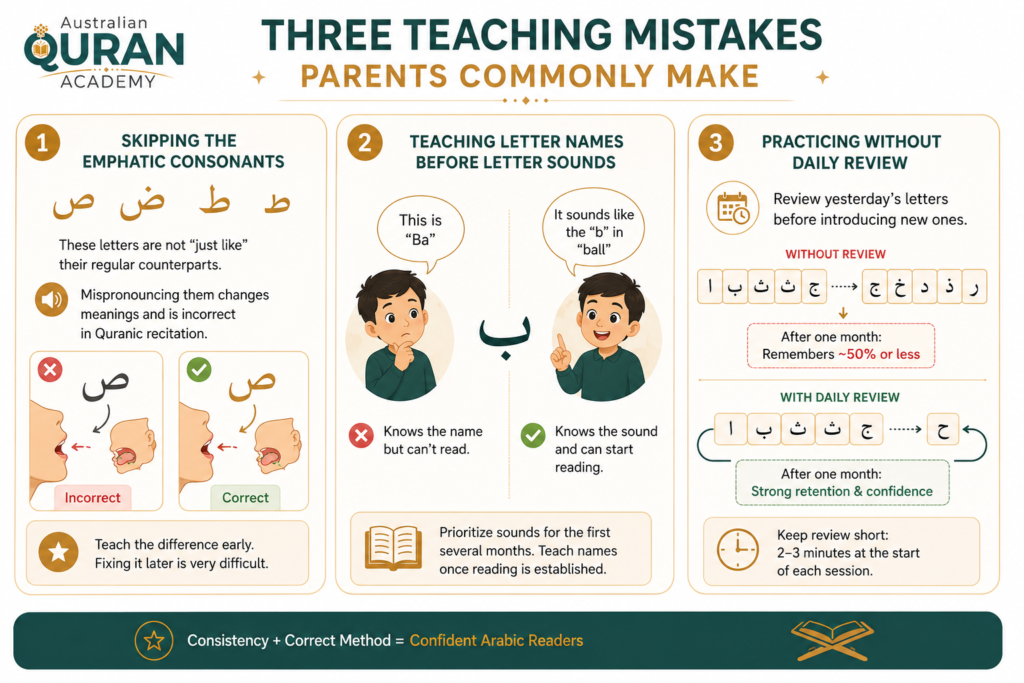
Mistake 1 — Skipping the Emphatic Consonants
The four emphatic letters ص، ض، ط، ظ are often glossed over in children’s materials as “just like” their regular counterparts. They are not. Pronouncing ص as a regular س is audibly incorrect in Quranic recitation and changes the meaning of words. Children who learn from the beginning that these letters are distinct — even with a simple physical demonstration like pressing the tongue slightly harder — build correct habits effortlessly. Correcting this error after it is embedded is genuinely difficult.
Mistake 2 — Teaching Letter Names Before Letter Sounds
A child who knows that the second letter of the Arabic alphabet is called “Ba” knows its name. A child who knows that ب makes the same sound as the first letter of “ball” can start reading. For the first several months, prioritize sounds over names. Letter names become useful once basic reading is established and the child needs to spell or reference letters by name.
Mistake 3 — Practicing Without Daily Review
The single most reliable predictor of alphabet retention in young learners is whether yesterday’s letters are reviewed before today’s new ones are introduced. A child who learns five letters one week and skips to five new letters the next week — without reviewing the first five — will remember approximately half of either group after a month. The review loop is not optional. Keep it brief: two to three minutes at the start of each session is sufficient.
Read also: How To Learn Quran Online With Tajweed Free In Australia?
Inside Our Virtual Classrooms
We believe in full transparency and proven quality. Take a look at these actual snippets from our live classes to experience our modern learning platform, patient instructors, and interactive student participation.
Start Your Quranic Journey in Australia
Join our leading online academy and learn with expert tutors through a structured, personalized curriculum.
Book Your Free TrialStart Your Child’s Arabic Alphabet Journey with Australian Quran Academy
Home practice builds the foundation. But whether a child’s ح is genuinely breathy and distinct from their هـ, or whether their ع carries the right guttural depth — these are things only a qualified teacher listening in real time can assess and correct. Pronunciation errors that go undetected for weeks become habits. Correcting them later requires significantly more time than building them correctly from the start.
The Australian Quran Academy’s Online Arabic Classes for Kids offer structured, age-appropriate instruction for Australian children from age 5 onwards. Experienced tutors begin with the Arabic alphabet and progress systematically through positional forms, vowel markers, basic vocabulary, and Quranic Arabic — using games, visual aids, and storytelling to keep children genuinely engaged throughout every lesson.
Sessions are 30 minutes for younger children and 45 minutes for older learners, scheduled after school and on weekends to fit Australian family routines. Parents receive regular progress updates. Every child begins with a free trial lesson.
Our Arabic Courses
- Online Arabic Academy
- Online Arabic Course
- Classical Arabic Course
- Arabic Course for Beginners
- Advanced Arabic Course
- Quranic Arabic Course
- Arabic Grammar Course
- Modern Standard Arabic Course
- Arabic Conversation / Speaking Course
- Intensive Arabic Course
- Online Arabic Classes for Kids
- Arabic Classes for Adults
- Arabic Classes for Ladies
- Fusha Arabic Course
- Business Arabic Course
- Al-Azhar Arabic Course
- Madinah Arabic Course
- Learning Arabic for Non-Arabic Speakers
- Arabic Elementary School
- Arabic Intermediate School
- Arabic Lessons for Kindergarten
Start Your Child’s Free Trial — Australian Quran Academy

Start Your Quranic Journey in Australia
Join our leading online academy and learn with expert tutors through a structured, personalized curriculum.
Book Your Free TrialRead also: The Best Way To Learn Quran Online In Australia – A Complete Guide
Conclusion
The arabic alphabet for kids is 28 consonant letters, written right to left, each appearing in up to four positional forms. Teaching letters in shape families — starting with the non-connectors, then the dot families, then the remaining pairs — works faster than alphabetical order because it teaches children to see the system inside the script rather than memorize 28 isolated symbols.
Sound comes before letter names. Positional forms come from the very first letter, not as an advanced topic later. The daily review loop is non-negotiable. And the four emphatic consonants deserve proper introduction from the beginning, not an apology at the end.
The arabic alphabet kids learn today determines everything that follows — how they read the Quran, how they build vocabulary, and how confident they feel every time they encounter Arabic text. Build it right, build it early, and build it with guidance that corrects what needs correcting before it becomes permanent.
Frequently Asked Questions
What is the arabic alphabet for kids and how many letters does it have?
The Arabic alphabet is a 28-letter consonant-based writing system used to write Arabic, the language of the Quran and over 400 million speakers worldwide. All 28 letters represent consonant sounds. Short vowels are shown by optional marks called harakat rather than by separate letters, which is why Arabic text can appear to have no vowels.
What order should children learn the Arabic alphabet?
Children learn the arabic alphabet for kids faster when letters are grouped by shared shapes rather than taught in alphabetical order. Start with the four simple non-connecting letters (ا، و، ر، ز), then introduce the dot families (ب، ت، ث and ج، ح، خ), then work through remaining letter pairs. This approach teaches children to recognize the system inside the script rather than memorize isolated shapes.
At what age should a child start learning the Arabic alphabet?
Informal exposure through songs, charts, and playdough shapes can begin at age 3. Structured alphabet learning — working systematically through letter recognition, sounds, and positional forms — is most effective from age 5 or 6. Children at any age can learn Arabic with appropriate methods, though the window for effortless native-like pronunciation is earlier.
How long does it take for a child to learn all 28 Arabic letters?
With daily practice of 10–20 minutes, most children aged 5–8 can recognize all 28 letters in isolated form within 6–10 weeks. Reading connected words with vowel markers typically takes 3–6 months of consistent practice. Reading Arabic text without vowel markers — as it appears in most adult Arabic — takes considerably longer and requires substantial vocabulary knowledge alongside reading skill.
Can a child learn the Arabic alphabet through online classes in Australia?
Yes. The Australian Quran Academy’s Online Arabic Classes for Kids provide structured alphabet instruction from age 5 onwards, delivered by experienced tutors via live online sessions. Classes are scheduled to fit Australian school hours and family timetables, with a free trial lesson available before enrollment.
Does learning the Arabic alphabet help with Quran recitation?
Directly and significantly. The Quran is written in Arabic script with full harakat (vowel marks), making it more readable than everyday Arabic text for beginning learners. A child with solid Arabic alphabet recognition and accurate letter pronunciation has the foundation needed to begin Quran recitation correctly. Skipping or rushing the alphabet stage creates pronunciation errors in recitation that are difficult to correct later.




Leave a Reply