 Arabic
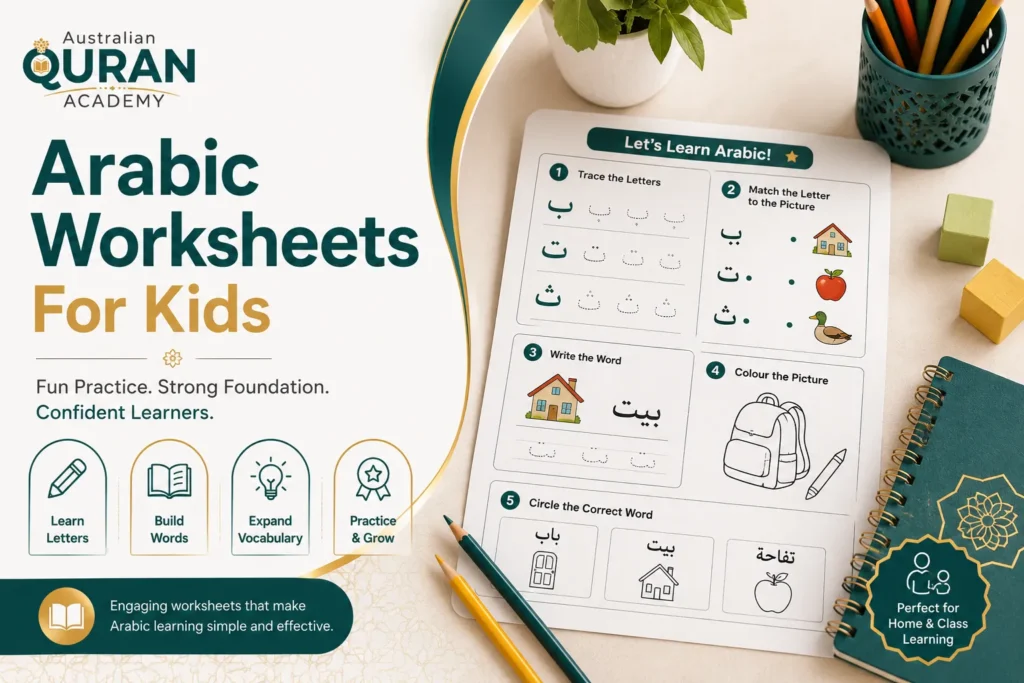
Finding good Arabic worksheets for kids shouldn’t feel like a research project. Yet most parents end up with a folder of random PDFs, no idea which ones suit their child’s age, and no clear plan for using them.
This guide fixes that. It covers exactly what Arabic worksheets for kids work best at each age, where to find genuinely free versions, and how to run a worksheet session so your child actually retains what they practice — not just fills in the page and forgets it by dinner.
What Are Arabic Worksheets for Kids?
Arabic worksheets for kids are structured practice sheets designed to build one specific skill at a time. Depending on the child’s age and level, they may focus on letter recognition, tracing, writing, word formation, reading, vocabulary, numbers, or grammar.
For younger children, worksheets can make Arabic learning more visual and interactive. Older children can use them to practise reading comprehension, vocabulary, and grammar in context.
The most effective approach is to use worksheets alongside regular Arabic lessons, allowing children to practise independently while still receiving guidance from a qualified teacher. Parents looking for a structured starting point can also explore Australian Quran Academy’s Arabic course for beginners to understand how foundational Arabic skills can be developed progressively.

Why Are Arabic Worksheets Useful for Children?
Worksheets give children an opportunity to repeat what they have learned without making every practice session feel like a formal lesson.
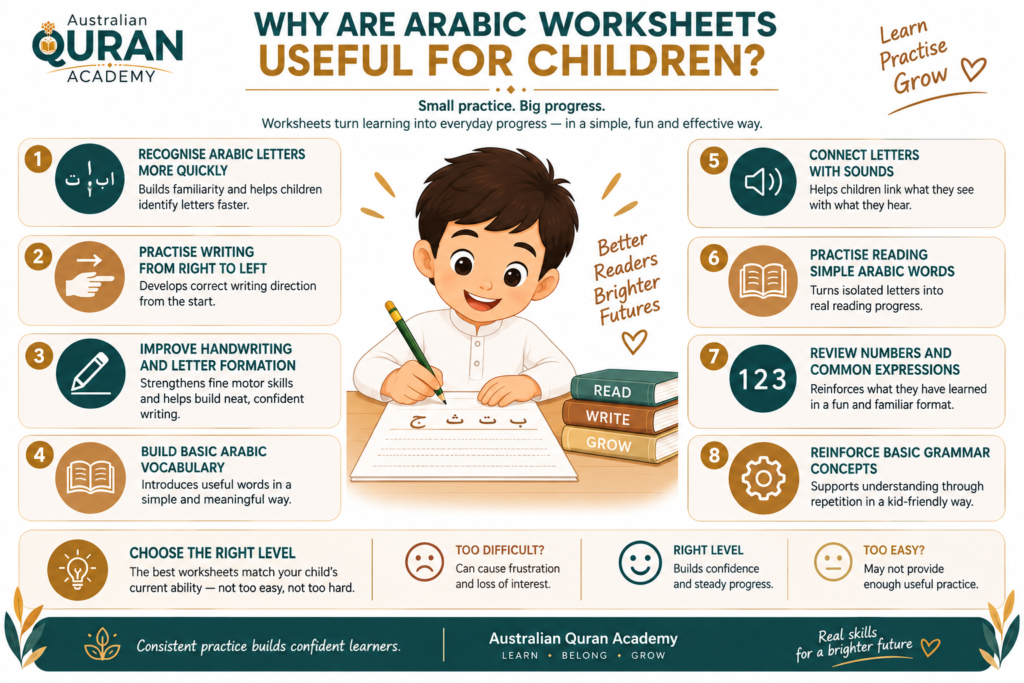
They can help children:
- Recognise Arabic letters more quickly
- Practise writing from right to left
- Improve handwriting and letter formation
- Build basic Arabic vocabulary
- Connect letters with sounds
- Practise reading simple Arabic words
- Review numbers and common expressions
- Reinforce basic grammar concepts
- Develop confidence through repeated practice
The key is choosing worksheets that match the child’s current ability. A worksheet that is too difficult can frustrate a beginner, while one that is too easy may not provide enough useful practice.
Read also: Arabic Alphabet for Kids
Types of Arabic Worksheets for Kids
Not all Arabic worksheets teach the same skill. Choosing the right type depends on what the child already knows and what they need to learn next.
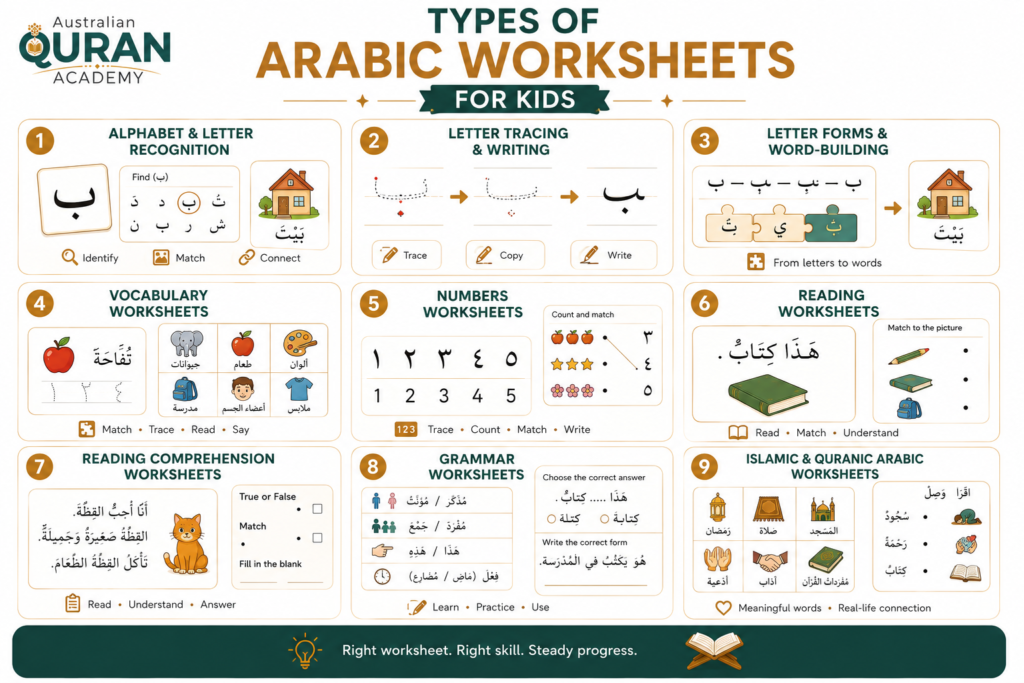
1. Arabic Alphabet and Letter Recognition Worksheets
Alphabet worksheets are usually the first step for children who are completely new to Arabic.
At this stage, children need to become familiar with the 28 Arabic letters, their names, their basic sounds, and their visual differences.
A good beginner worksheet might ask the child to identify ب among several letters, match ب with a picture, or connect the letter with a word such as بَيْت.
These activities may look simple, but visual recognition is an essential foundation for later reading.
For very young learners, alphabet worksheets can also include colouring, matching, and simple picture activities so that learning does not feel like formal handwriting practice.
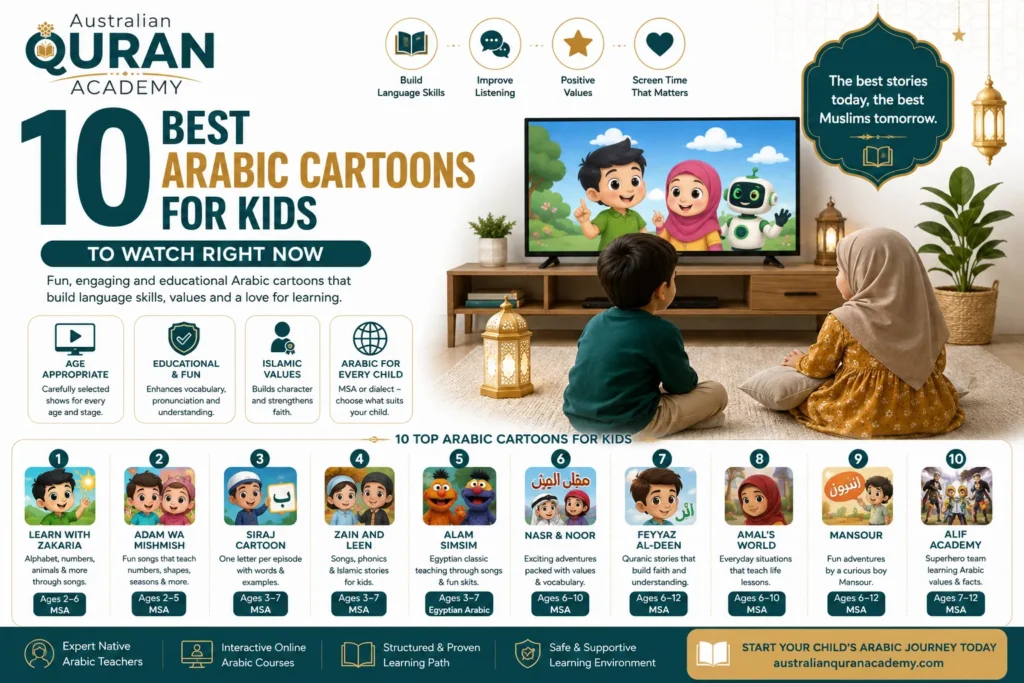
Read also: 10 Best Arabic Cartoons for Kids to Watch Right Now
2. Arabic Letter Tracing and Writing Worksheets
Once children recognise the letters, they can begin practising how to write them.
Tracing worksheets usually provide dotted outlines that children follow with a pencil, crayon, or marker. This helps them become familiar with the movement and direction required to reproduce Arabic letters.
However, tracing should gradually lead to independent writing.
A useful progression is:
Trace the letter → Copy the letter → Write the letter independently
Parents should therefore avoid using tracing worksheets indefinitely. Once a child can reproduce a letter comfortably, the worksheet should become more challenging.
3. Arabic Letter Forms and Word-Building Worksheets
One of the most important steps in Arabic reading is learning that letters can change shape depending on where they appear in a word.
For example, ب may appear as:
ب — بـ — ـبـ — ـب
Children who only learn the isolated alphabet can therefore recognise individual letters but struggle when they encounter those letters inside real Arabic words.
Letter-form worksheets should introduce these variations gradually. Once children understand them, word-building activities can help them combine letters into meaningful words.
For example:
ب + ي + ت → بَيْت
This transition from isolated letters to connected words is one of the most important stages in early Arabic literacy.
4. Arabic Vocabulary Worksheets
Vocabulary worksheets help children learn words in meaningful groups.
Instead of presenting random vocabulary, effective worksheets often organise words around familiar themes such as:
- family
- animals
- food
- colours
- school
- body parts
- clothes
- household objects
Picture matching is particularly effective for beginners because children can connect the Arabic word directly to its meaning.
For example, a worksheet might show a picture of an apple alongside:
تُفَّاحَة
The child can then trace, read, match, or complete the word.
After completing the worksheet, encourage the child to pronounce the vocabulary aloud. This turns a writing exercise into a small reading and speaking activity.
Read also: 10 Best Arabic Cartoons for Kids to Watch Right Now
5. Arabic Numbers Worksheets
Arabic number worksheets introduce children to Arabic numerals such as:
١، ٢، ٣، ٤، ٥
These are different visually from the Western numerals:
1, 2, 3, 4, 5
Beginner number worksheets can focus on tracing and recognition. Later activities can include counting objects, matching quantities with numerals, sequencing numbers, and writing numbers independently.
Numbers do not need to wait until the alphabet is completely mastered. Short number activities can be introduced alongside alphabet and vocabulary practice to add variety to a child’s learning routine.
6. Arabic Reading Worksheets
After children become comfortable with letters and simple words, reading worksheets can help them transition into connected Arabic text.
Beginner reading worksheets should use short, familiar sentences and preferably include harakat when the child is still learning to decode Arabic.
For example:
هَذَا كِتَابٌ.
A worksheet might then ask the child to match the sentence to a picture or answer a very simple question.
The goal at this stage is not speed. It is helping the child recognise words in context and understand what they are reading.
Read also: Best Online Quran Classes In Australia — The Complete Guide For Families
See Us in Action!
Curious about what our online classrooms look like? Watch the short clips below to see how our interactive, one-on-one sessions bring learning to life with real-time feedback and engaging teaching methods.
Start Your Quranic Journey in Australia
Join our leading online academy and learn with expert tutors through a structured, personalized curriculum.
Book Your Free Trial7. Arabic Reading Comprehension Worksheets
Reading comprehension comes after basic decoding skills are reasonably secure.
These worksheets combine reading, vocabulary, and understanding. A short passage might be followed by true-or-false questions, matching exercises, sentence completion, or simple comprehension questions.
For younger learners, the passage should be short and use familiar vocabulary. Fully vowelled text can also make decoding easier for beginners.
As the child’s reading improves, worksheets can gradually introduce longer passages and more open-ended questions.
8. Arabic Grammar Worksheets
Grammar worksheets are more appropriate for children who can already read simple Arabic sentences.
Early grammar activities might cover masculine and feminine forms, singular and plural nouns, pronouns, demonstratives, nouns and verbs, and basic verb conjugation.
Grammar should be introduced one concept at a time. A worksheet that combines several unrelated rules can make it difficult to know what the child actually understands.
Grammar worksheets should also move beyond mechanical exercises. After completing a grammar activity, children should have opportunities to use the same structure in actual sentences.
Read also: Best Website to Learn Quran Online in Australia
9. Islamic and Quranic Arabic Worksheets
For children learning Arabic alongside Islamic studies, thematic worksheets can provide meaningful vocabulary connected to their daily religious environment.
These may include activities related to Ramadan, salah, the masjid, Islamic manners, duas, and common Quranic vocabulary.
These worksheets can be especially useful because children are not learning vocabulary in isolation. They encounter the same words in religious lessons, stories, or Quranic texts.
However, Quranic worksheets should still match the child’s reading level. A beginner who is still learning the alphabet needs foundational literacy practice before moving into longer Quranic passages.
For families who want to connect worksheet practice with a more traditional Arabic learning pathway, an Al-Azhar Arabic course can provide additional exposure to Arabic through a structured Islamic educational context.

Arabic Worksheets by Age and Learning Level
There is no single type of Arabic worksheet that works equally well for every child. A three-year-old beginning the alphabet needs very different activities from a ten-year-old who is already reading Arabic sentences.
Arabic Worksheets for Ages 3–6
Young children are usually at the recognition and early writing stage. Their worksheets should therefore be visual, simple, and highly repetitive.
At this age, children can practise identifying individual Arabic letters, matching letters with pictures, tracing dotted letters, colouring letter shapes, and connecting a letter with its sound.
For example, a worksheet introducing م might show:
م — مَ — مِ — مُ
and then introduce simple vocabulary such as:
مَاء — māʾ — water
مَوْز — mawz — banana
مَدْرَسَة — madrasa — school
The purpose is not to make children memorise large amounts of vocabulary. The priority is helping them recognise the letter and associate it with its sound.
Tracing is also valuable at this stage because Arabic writing moves from right to left and contains letter shapes that may be unfamiliar to children who are used to Latin writing.
Arabic Worksheets for Ages 6–9
Children between approximately six and nine can begin moving from tracing toward independent writing and early reading.
Worksheets at this stage can introduce the four positional forms of Arabic letters: isolated, initial, medial, and final. Children can practise connecting letters and forming short words.
For example:
ب → بـ → ـبـ → ـب
The child can then practise words such as:
بَاب — door
كِتَاب — book
حَبْل — rope
This stage is important because recognising an isolated letter is not the same as being able to recognise it inside connected Arabic text.
Arabic Worksheets for Ages 9–12
Older children can begin working with more advanced reading, vocabulary, comprehension, and grammar activities.
A worksheet might include a short Arabic paragraph followed by questions about its meaning. Another might ask children to identify nouns and verbs or complete sentences using the correct word.
At this stage, worksheets should increasingly focus on understanding Arabic, not simply copying it. Children should be encouraged to read, interpret, write, and use vocabulary in context.
If your child is at this stage and you want a structured path rather than assembling worksheets yourself, our Modern Standard Arabic course at Australian Quran Academy walks through this exact letter-form progression with a live instructor correcting pronunciation as your child writes.
By ages 11–12, worksheets alone start to feel repetitive to most kids, and that’s a natural signal to introduce authentic material — short children’s stories, age-appropriate articles, or Quranic passages for families focused on Islamic learning. Our Online Quran Academy for Kids program is built for exactly this transition, moving a child from worksheet-based practice into guided reading of real texts with an instructor.
Age-by-Age Worksheet Progression (3–12 Years)
Children progress through Arabic at different speeds, so age should be used as a general guide rather than a strict rule. The right worksheet depends on what your child can already recognise, read, and write. The table below provides a practical age-by-age progression, showing the main skill to focus on, the worksheet activities that fit each stage, and a realistic amount of daily practice.
| Age | Skill Focus | Worksheet Types | Daily Time |
| 3–4 | Pre-writing exposure | Coloring, dot-to-dot, matching | 5–10 min |
| 5–6 | Letter mastery | Full alphabet tracing, sound association | 10–15 min |
| 7–8 | Word building | CVC words, letter forms, scrambles | 15–20 min |
| 9–10 | Reading fluency | Short passages, basic grammar | 20–25 min |
| 11–12 | Advanced reading & writing | Multi-paragraph texts, translation | 25–30 min |
The single clearest red flag across every stage: if a child shows resistance, tears, or no progress after 4–6 weeks of focused practice at the same level, that’s a signal to change the approach — not to push harder at the same worksheets.
Use Arabic Worksheets as Part of a Short Daily Routine
A simple three-step routine can turn worksheet practice into a focused Arabic learning session without overwhelming your child.
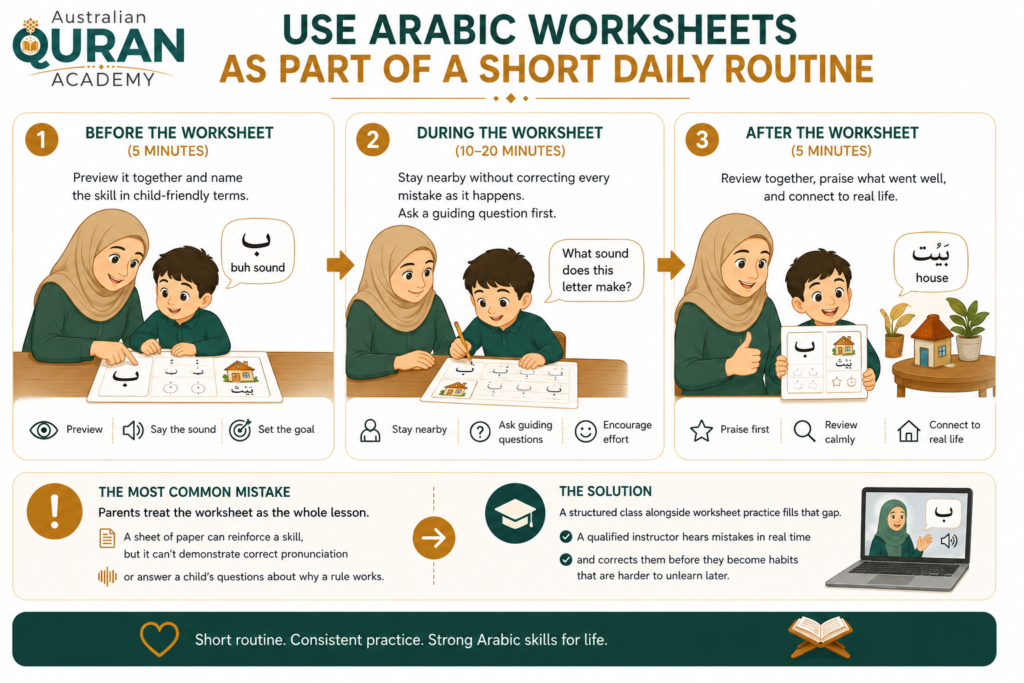
1. Before the worksheet (5 minutes):
preview it together and name the skill in child-friendly terms. Saying “today we’re practicing the letter ب, which makes the ‘buh’ sound” gives the worksheet a purpose before a single line is traced.
2. During the worksheet (10–20 minutes):
stay nearby without correcting every mistake as it happens. If your child gets stuck, ask a guiding question first (“what sound does this letter make?”) rather than supplying the answer immediately.
3. After the worksheet (5 minutes):
review the work together, note what was done well before pointing out errors, and connect the practice to real life — for example, having your child find and label an object at home using a word from that worksheet.
The most common mistake parents make isn’t choosing the wrong worksheet — it’s treating the worksheet as the whole lesson. A sheet of paper can reinforce a skill, but it can’t demonstrate correct pronunciation or answer a child’s question about why a rule works the way it does. A structured class alongside worksheet practice fills that gap; a qualified instructor can hear a mispronunciation in real time and correct it before it becomes a habit that’s harder to unlearn later.
Where to Find Free Arabic Worksheets?
Genuinely free Arabic worksheets for kids exist, but “free” comes in different forms depending on the source:
- Teachers Pay Teachers — filter by “free” in the price sidebar; quality varies significantly by creator, so check reviews before downloading.
- Twinkl’s free resources section — requires a free account and gives a limited number of downloads per month; generally higher production quality than open marketplaces.
- Islamic education platforms — many focus specifically on Quranic Arabic vocabulary and offer free alphabet and basic worksheets, which suits families prioritizing religious literacy alongside general Arabic.
- Pinterest — good for browsing variety, but expect some links to lead to paid downloads once you click through.
None of these sources will hand you a complete, correctly sequenced curriculum — you’ll need to piece together tracing, word-building, and reading worksheets from different places and order them yourself using the age-by-age guide above.
Troubleshooting Common Worksheet Challenges
A child who resists worksheets usually experiences them as “more schoolwork.” Letting them choose which worksheet to do first, or turning it into a short race against a timer, often resolves this without changing the content.
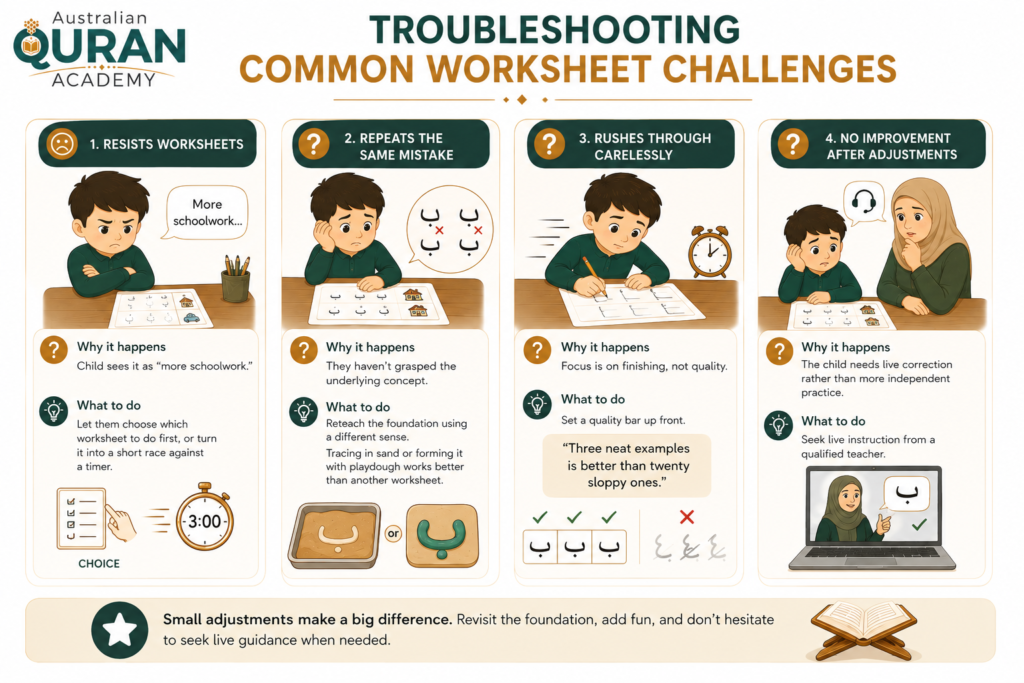
A child who repeats the same mistake typically hasn’t grasped the underlying concept — advancing to a harder worksheet won’t fix it. Reteach the foundation using a different sense: tracing the letter in sand or forming it with playdough works better here than another worksheet of the same type.
A child who rushes through carelessly benefits from a quality bar stated up front — “three neat examples is better than twenty sloppy ones” — rather than more pages to complete.
If none of these adjustments help within a few weeks, that’s usually a sign the child needs live correction rather than more independent practice.
Inside Our Virtual Classrooms
We believe in full transparency and proven quality. Take a look at these actual snippets from our live classes to experience our modern learning platform, patient instructors, and interactive student participation.
Start Your Quranic Journey in Australia
Join our leading online academy and learn with expert tutors through a structured, personalized curriculum.
Book Your Free TrialGive Your Child Structured Arabic Instruction, Not Just Worksheets
Worksheets are excellent for daily reinforcement, but they can’t correct pronunciation, adapt to your child’s pace, or explain why a grammar rule works the way it does — only a teacher can do that in real time.
At Australian Quran Academy, our instructors work one-on-one with children through structured, level-appropriate lessons — covering everything from first letters to full reading fluency — so the progress your child makes on worksheets at home is reinforced and corrected in class each week.
Book a free trial lesson today and give your child guided Arabic instruction alongside the worksheets you’re already using.
Our Arabic Courses
- Online Arabic Academy
- Online Arabic Course
- Classical Arabic Course
- Arabic Course for Beginners
- Advanced Arabic Course
- Quranic Arabic Course
- Arabic Grammar Course
- Modern Standard Arabic Course
- Arabic Conversation / Speaking Course
- Intensive Arabic Course
- Online Arabic Classes for Kids
- Arabic Classes for Adults
- Arabic Classes for Ladies
- Fusha Arabic Course
- Business Arabic Course
- Al-Azhar Arabic Course
- Madinah Arabic Course
- Learning Arabic for Non-Arabic Speakers
- Arabic Elementary School
- Arabic Intermediate School
- Arabic Lessons for Kindergarten

Start Your Quranic Journey in Australia
Join our leading online academy and learn with expert tutors through a structured, personalized curriculum.
Book Your Free TrialConclusion
Arabic worksheets for kids work best when matched precisely to a child’s age and current skill level — tracing and coloring for ages 3–6, word-building for ages 6–9, and comprehension or grammar practice for ages 9–12. Free resources exist across platforms like Teachers Pay Teachers, Twinkl, and Islamic education sites, but none of them arrive pre-sequenced, so building a coherent path is up to the parent.
The bigger takeaway: worksheets are a valuable daily habit, not a full teaching method. A child who combines 15–20 minutes of focused worksheet practice with real instruction from a teacher who can correct pronunciation and answer questions in the moment will progress faster and with fewer bad habits than one relying on printables alone.
Frequently Asked Questions About Arabic Worksheets for Kids
Where can I find genuinely free Arabic worksheets for kids?
Genuinely free Arabic worksheets for kids are available on Teachers Pay Teachers if you filter results by “free,” through Twinkl’s free resources section with a free account, and on several Islamic education sites that offer basic alphabet and vocabulary sets at no cost. Quality and completeness vary, so expect to combine sheets from more than one source.
What age should a child start using Arabic worksheets?
Children can start with simple coloring and letter-matching worksheets from around age 3. Formal tracing worksheets suit ages 4–5, once fine motor skills develop enough to hold a line. Reading and word-building worksheets are appropriate from age 6 onward, and comprehension or grammar worksheets fit best from age 9.
How long should a child practice with Arabic worksheets each day?
Ages 3–5 benefit from 10–15 minutes daily, ages 6–8 from 15–20 minutes, and ages 9–12 from 20–30 minutes. A focused 15-minute session produces better retention than a distracted 45-minute one, so consistency matters more than length.
Are free Arabic worksheets for kids enough on their own?
Free Arabic worksheets for kids are strong supplementary tools for daily reinforcement, but they can’t correct mispronunciation or adapt to a child’s specific confusion the way a teacher can. Pairing worksheets with structured lessons gives more reliable, faster progress than worksheets alone.
What order should Arabic worksheets be introduced in?
Start with letter recognition and coloring, move to full alphabet tracing, then to letter-form and word-building worksheets, followed by simple sentence construction. Introduce number worksheets alongside the alphabet rather than after it. Reading comprehension and grammar worksheets come last, once a child reads simple words with reasonable ease.
Should worksheets be Arabic-only or bilingual (Arabic-English)?
For children just starting out, bilingual worksheets help bridge understanding by connecting new Arabic letters to familiar English sounds. Once a child recognizes the alphabet reliably — typically after two to three months of regular practice — Arabic-only worksheets build stronger immersion and reduce reliance on English translation.





Leave a Reply