 Quran
Quran
| Key Takeaway |
| Master the Arabic script first, attempting to read the Quran without knowing the letters creates pronunciation errors that are hard to fix later. |
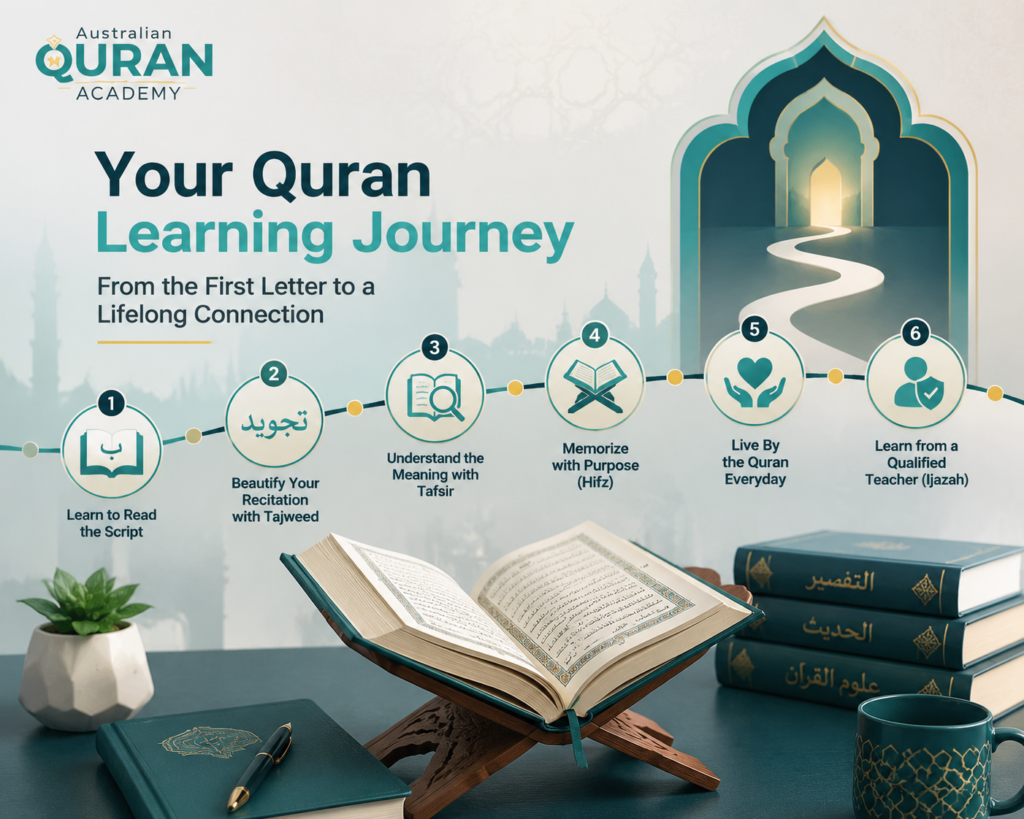
| Progress through the six stages in order: reading → Tajweed → Tafsir → Hifz → living by the Quran → teacher guidance. |
| A teacher with a verified Ijazah is not optional — authentic Quran transmission must pass through an unbroken chain of knowledge. |
| Use the three-part Hifz session daily: new lesson, recent review (last 7–10 days), and old review — skipping any one part causes memorisation loss. |
| Daily 15–30 minute practice sessions beat occasional long ones for building both recitation accuracy and memorisation retention. |
| Australian Quran Academy connects you with Ijazah-certified Quran teachers from anywhere in Australia. |
Every Muslim’s Quran learning journey starts in the same place — facing an unfamiliar script, unsure where to begin.
Whether you are an adult starting from scratch, a parent guiding your child, or someone returning to the Quran after years away, the path forward is the same: one stage at a time, in the right order, with the right support.
This guide maps out the six core stages of a meaningful Quran learning journey — from recognising your first Arabic letter to living by the Quran’s guidance every day.
At Australian Quran Academy, we have guided hundreds of students in Australia through exactly this path, and we have built this article to be the clearest, most practical roadmap you will find online.
Stage 1: Learning to Read the Quranic Arabic Script
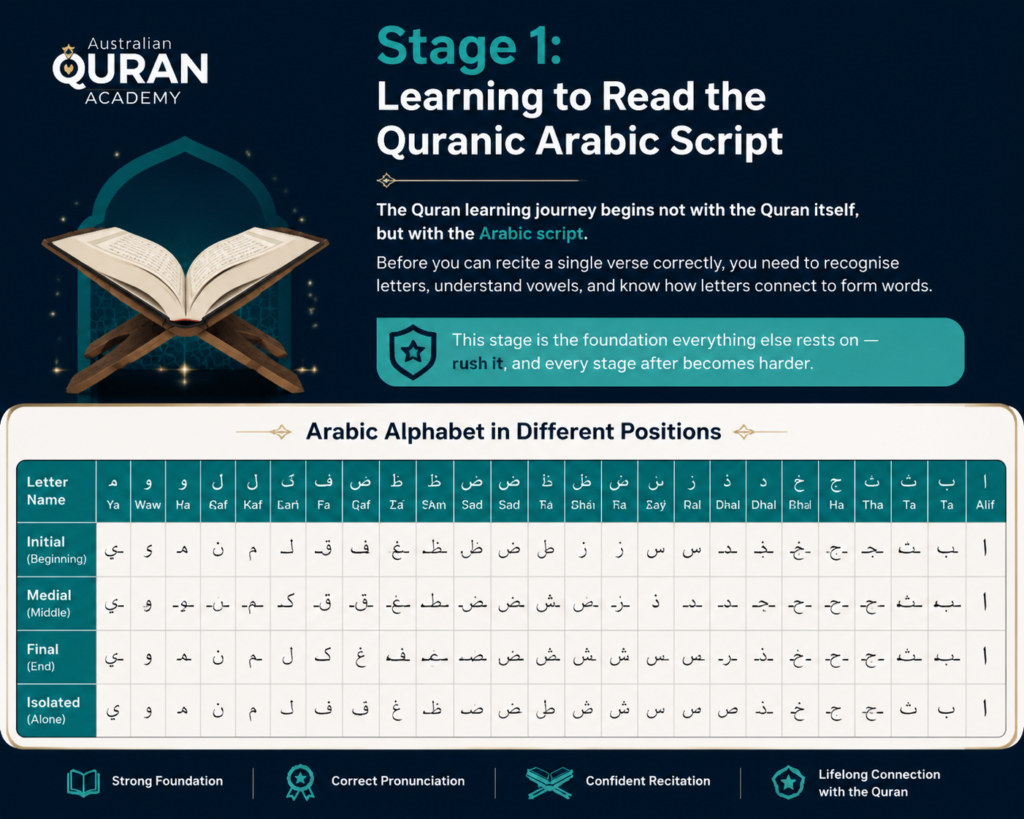
The Quran learning journey begins not with the Quran itself, but with the Arabic script. Before you can recite a single verse correctly, you need to recognise letters, understand vowels, and know how letters connect to form words.
This stage is the foundation everything else rests on — rush it, and every stage after becomes harder.
A. Start With Letter Shapes and Sounds Together
The Arabic alphabet has 28 letters. The most common mistake beginners make is learning shapes without sounds, or sounds without shapes — treating them as two separate tasks. They are one task. From day one, every letter you learn should be associated with both its written form and its precise point of articulation (makhraj).
For non-Arab learners in Australia, this is especially important for sounds that do not exist in English: the deep ع (Ayn) versus the open ا (Alif), or the breathy ح (Haa) versus the light هـ (haa). Getting these right early prevents years of mispronunciation later.
B. Use Pattern Recognition to Learn Faster
Rather than memorising 28 entirely unique letter shapes, group them by their core form.
The letters ب (Baa), ت (Taa), and ث (Thaa) all share the same “boat” shape — you learn the shape once, then distinguish between them by the number and position of dots. This approach typically cuts the time to alphabet mastery by a third.
C. Understand How Vowels Bring Letters to Life
Arabic letters are silent consonants on their own. The short vowel markings — Harakat — are what produce sound. The three primary vowels are the Fatha (ــَــ) for an ‘a’ sound, the Kasra (ــِـ) for an ‘i’ sound, and the Dammah (ــُـ) for a ‘u’ sound.
A single letter like م (Meem) becomes مَ, مِ, and مُ depending on which vowel it carries. Without a firm grasp of Harakat, reading Quranic text is impossible.
D. Read Your First Word From the Quran
The culmination of this stage is reading your first actual word from the Mushaf. Take “قُلْ” (Qul), the opening word of Surah Al-Ikhlas. It contains two letters: a ق (Qaaf) with a Dammah giving the ‘Qu’ sound, followed by a ل (Laam) with a Sukoon indicating no vowel.
You join the sounds — Qu + l = Qul — and you have just recited a direct command from Allah.
For structured, guided progression through this stage, explore Learn Quran for Beginners in Australia at Australian Quran Academy, where our teachers build your reading skills step by step from the very first session.
Read Also: learn quran by heart in Australia
Stage 2: Beautifying Your Recitation With Tajweed
Once you can read Arabic script with confidence, your Quran learning journey enters its second stage: Tajweed.
Tajweed is not an advanced subject reserved for scholars — it is the correct way to recite the Quran as it was revealed, and every Muslim is responsible for it.
A. Give Every Letter Its Right
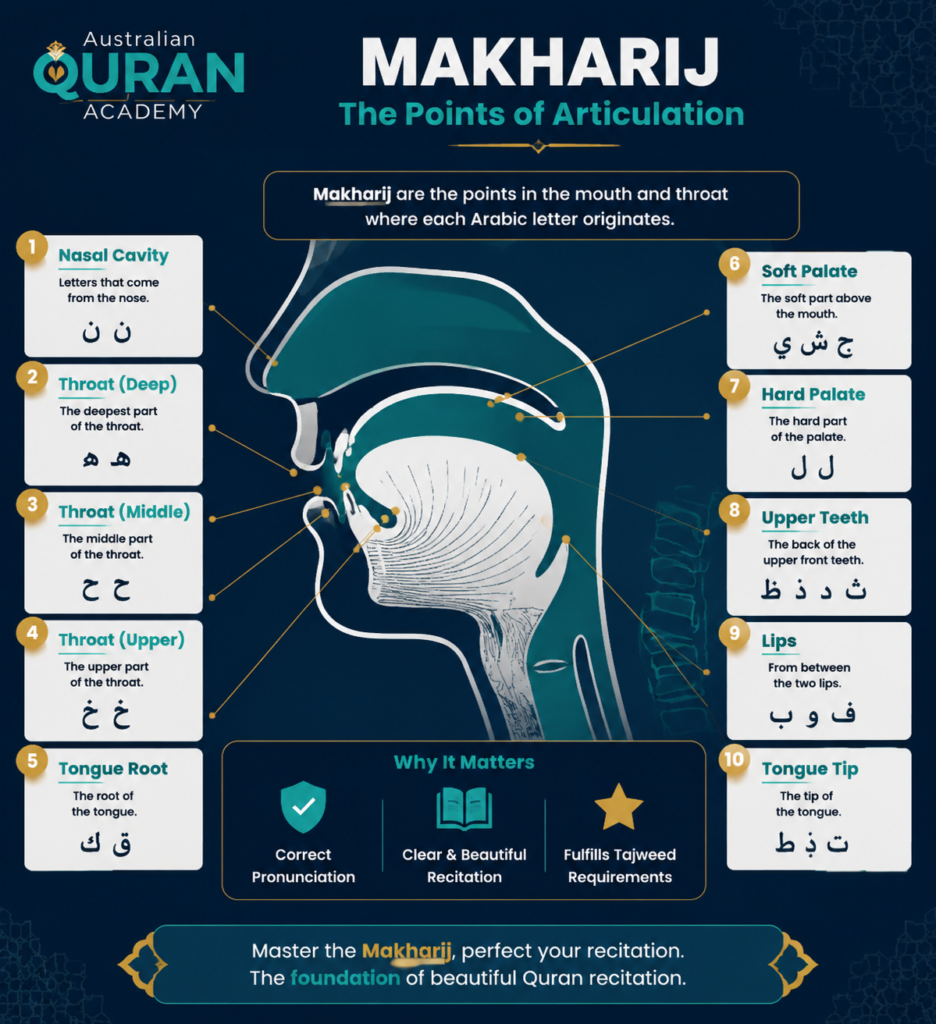
Each Arabic letter has a precise point of origin (makhraj) and a set of characteristics (Sifat). The most consequential distinction for English speakers is between “light” and “heavy” letters.
The letter ت (Taa) is produced with a flat tongue, creating a soft sound. The letter ط (Ṭaa) requires raising the back of the tongue, producing a fuller, more emphatic sound. These are not stylistic preferences — they change the meaning of words.
In Surah At-Tawbah (112), the word “At-ta’iboon” (التَّائِبُونَ, the repentant ones) uses the light ت. In Surah An-Nazi’at (34), “At-ṭaammah” (الطَّامَّةُ, the overwhelming catastrophe) uses the heavy ط. The weight of the sound reflects the weight of the word’s meaning. This is how precisely the Quran is designed.
B. Understand the Rhythm Embedded in the Text
Tajweed also reveals the Quran’s inherent rhythm — not a melody added by the reciter, but one already encoded in the text through the rules of Madd (elongation) and Ghunnah (nasal sound).
The word “قَالَ” (qāla, “he said”) stretches the ‘qaa’ sound for two counts because the Fatha is followed by an Alif. The word “خَلَقَ” (khalaqa, “he created”) has no Madd — each vowel is short. This precise timing is not ornamental; it is the structure of the recitation itself.
C. Recite With Tarteel
The purpose of Tajweed is to fulfil the divine command:
“وَرَتِّلِ الْقُرْآنَ تَرْتِيلًا”
“And recite the Quran with measured recitation” (Al-Muzzammil: 4). Tarteel means a slow, deliberate, clear recitation that allows the meaning to enter the heart.
Technical accuracy and spiritual reflection are not competing goals — Tajweed makes them one.
For a step-by-step Tajweed program taught by qualified instructors, visit Quran Classes in Australia to explore how Australian Quran Academy structures Tajweed learning for all levels.
Inside Our Virtual Classrooms
We believe in full transparency and proven quality. Take a look at these actual snippets from our live classes to experience our modern learning platform, patient instructors, and interactive student participation.
Start Your Quranic Journey in Australia
Join our leading online academy and learn with expert tutors through a structured, personalized curriculum.
Book Your Free TrialStage 3: Deepening Your Understanding Through Tafsir
Knowing how to recite the Quran and knowing what it means are two different things. This stage of the Quran learning journey moves from the tongue to the mind — seeking the profound meanings behind the words you already recite correctly.
A. Begin With a Reliable Translation
The first step is reading a trustworthy English translation of the Quran alongside your recitation practice.
This gives you access to the general meaning of every verse and begins the shift from mechanical reading to conscious engagement.
B. Engage With a Beginner-Friendly Commentary
A translation gives you the words; a Tafsir gives you the layers beneath them. Start with accessible commentaries such as the abridged English versions of Tafsir Ibn Kathir or Tafsir As-Sa’di. Both are concise, well-sourced, and written for students rather than specialists.
C. Study the Reasons for Revelation (Asbab al-Nuzul)
This is the step most self-study plans skip entirely, and it is one of the most valuable. The “reasons for revelation” provide the historical and social context in which a verse was sent down — context that transforms a general principle into a vivid, specific lesson.
For example, the opening verses of Surah ‘Abasa (“He Frowned”) were revealed when the Prophet ﷺ was speaking with a Qurayshi leader and a blind man, Abdullah ibn Umm Maktum, came seeking knowledge.
Without that context, the verses are instructive. With it, they become unforgettable. Understanding why a verse was revealed is often what moves Quranic knowledge from the head to the heart.
Read Also: Free Online Quran Classes for Kids in Australia
Stage 4: Committing the Quran to Heart Through Hifz
Memorisation (Hifz) is the stage where the Quran moves from the page into your being — becoming a constant companion you carry everywhere, accessible in every prayer, every moment of reflection, every time you need it.
A. Use the Three-Part Daily Session
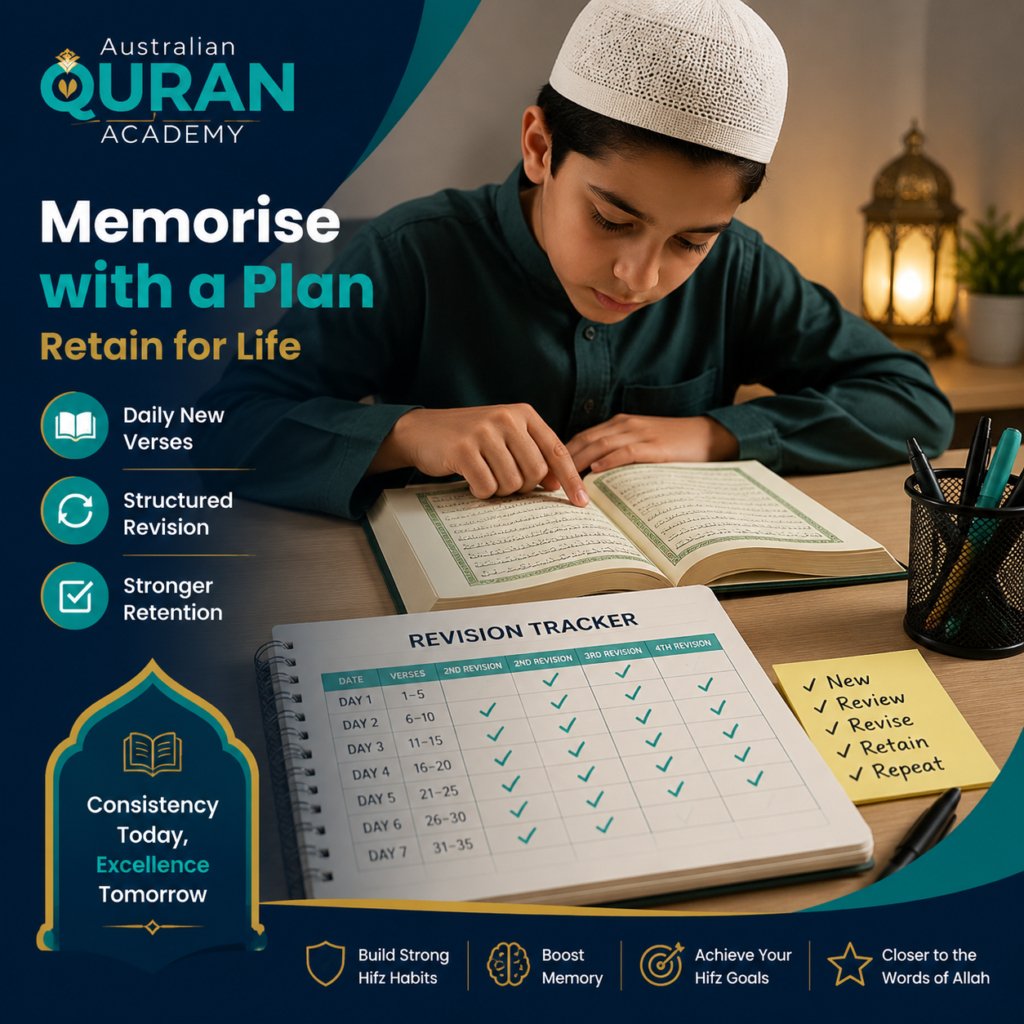
The most reliable Hifz method — proven across centuries of Islamic scholarship — divides every memorisation session into three parts. Skipping any one of them is the single most common reason students forget what they have memorised.
New lesson: A small, carefully chosen portion of new verses, memorised to perfection — even if it is only three to five verses. Quantity matters far less than the solidity of what you learn.
Recent review: A revision of everything memorised in the past 7–10 days. This daily repetition is what transfers verses from short-term to medium-term memory. Without it, new lessons are lost within a week.
Old review: A revision of a larger, older portion — typically at least one full Juz’. This is the engine of long-term retention. Every Hafiz who has lost portions of their memorisation did so because the old review was abandoned.
B. Build New Lessons Verse by Verse
The strongest memorisation technique is incremental linking. Memorise verse one until you can recite it flawlessly without looking. Memorise verse two the same way. Then immediately recite both together from memory 7–15 times before touching verse three. Only once the link is solid do you add the next.
When memorising Surah Al-Fatiha, for instance, you master “الْحَمْدُ لِلَّهِ رَبِّ الْعَالَمِينَ” completely before moving to “الرَّحْمَٰنِ الرَّحِيمِ.”
Then you practise both together repeatedly before adding “مَالِكِ يَوْمِ الدِّينِ.” This chain-linking method creates memorisation that flows automatically under pressure — in prayer, in recitation, in moments of emotion.
C. Commit to Revision as the Primary Task
A practitioner truth that every Hafiz eventually learns: the goal of Hifz is not fast memorisation — it is strong retention. Think of new verses as seeds you plant. The recent review is the daily watering.
The old review is the sunlight. Remove either, and the tree stops growing. Revision is not secondary to memorisation; it is the memorisation.
At Australian Quran Academy, our Hifz programs are structured around exactly this three-part daily system, with qualified teachers who monitor both your new lessons and your revision to ensure nothing is ever lost.
Read Also: Free Online Quran Classes for Beginners in Australia
Stage 5: Living by the Guidance of the Quran
This is where the Quran learning journey reaches its true destination. The Quran is not meant to be stored in memory alone — it is meant to shape every dimension of daily life. This stage is the most continuous of all: it does not end.
A. Understand How to Apply the Quran Through Fiqh
The Quran establishes broad principles. Fiqh (Islamic jurisprudence) translates those principles into specific rulings for daily life. Consider the verse from Surah Al-Baqarah (282):
“O you who have believed, when you contract a debt for a specified term, write it down.”
The Fiqh of financial transactions shows you how to apply the wisdom of that verse correctly — ensuring fairness and clarity in practice, not just intention.
Without some grounding in Fiqh, the gap between what the Quran instructs and what you actually do in daily life remains wide. With it, the Quran becomes a living guide to worship, family, work, and community.
B. Study the Sunnah as the Living Tafsir of the Quran
The Prophet Muhammad ﷺ is described in the Hadith as “the walking Quran” — his life was the most complete embodiment of its teachings.
Studying the Sunnah and Hadith is therefore not separate from the Quran learning journey; it is the most reliable map for applying what the Quran says.
C. Connect With Tazkiyah — Purification of the Soul
The ultimate goal of the Quran’s guidance is internal transformation. Tazkiyah (purification of the soul) focuses on cultivating ikhlas (sincerity), shukr (gratitude), and tawakkul (trust in Allah).
The external practice of living by the Quran and the internal discipline of Tazkiyah work together — one without the other remains incomplete.
For adults who want structured guidance through these Islamic sciences, Islamic Studies Courses for Adults in Australia at Australian Quran Academy provides a balanced, authentic curriculum covering Fiqh, Hadith, and Islamic character in a supportive online environment.
Read Also: learn quran alphabet in Australia
Stage 6: Learning With a Qualified Teacher
No stage of the Quran learning journey is best walked alone. A qualified teacher is not a convenience — they are a safeguard for every stage you have worked through.
Guidance Through Every Stage
A teacher shows you the correct articulation of your first letter. They correct a Tajweed error before it becomes a habit. They test your memorisation and catch the verses that feel solid but are not. They explain Tafsir with the nuance that self-study cannot always reach. Their role shifts as you progress, but their importance does not diminish.
The Unbroken Chain of Knowledge
Learning from a qualified teacher connects you to a Sanad — an unbroken chain of transmission going directly back to the Prophet ﷺ.
This is not a formality; it is the mechanism by which the Quran has been preserved without alteration for over 1,400 years. A teacher certified with an Ijazah carries this chain, and their correction of your recitation is therefore authenticated knowledge, not opinion.
For learners in Australia whose children are beginning their journey, Arabic Lessons for Kindergarten in Australia provides age-appropriate, expert-guided introduction to the Arabic script.
For adult non-Arabic speakers starting from scratch, Learning Arabic for Non-Arabic Speakers in Australia is the structured starting point we recommend before formal Quran reading begins.
Read Also: Free Online Quran Classes for Sisters in Australia
See Us in Action!
Curious about what our online classrooms look like? Watch the short clips below to see how our interactive, one-on-one sessions bring learning to life with real-time feedback and engaging teaching methods.
Start Your Quranic Journey in Australia
Join our leading online academy and learn with expert tutors through a structured, personalized curriculum.
Book Your Free TrialBegin Your Quran Learning Journey With Australian Quran Academy
Your Quran learning journey deserves more than a generic app or a self-study plan. It deserves a qualified teacher who knows exactly where you are in this process, can correct what needs correcting, and can keep you progressing with genuine confidence.
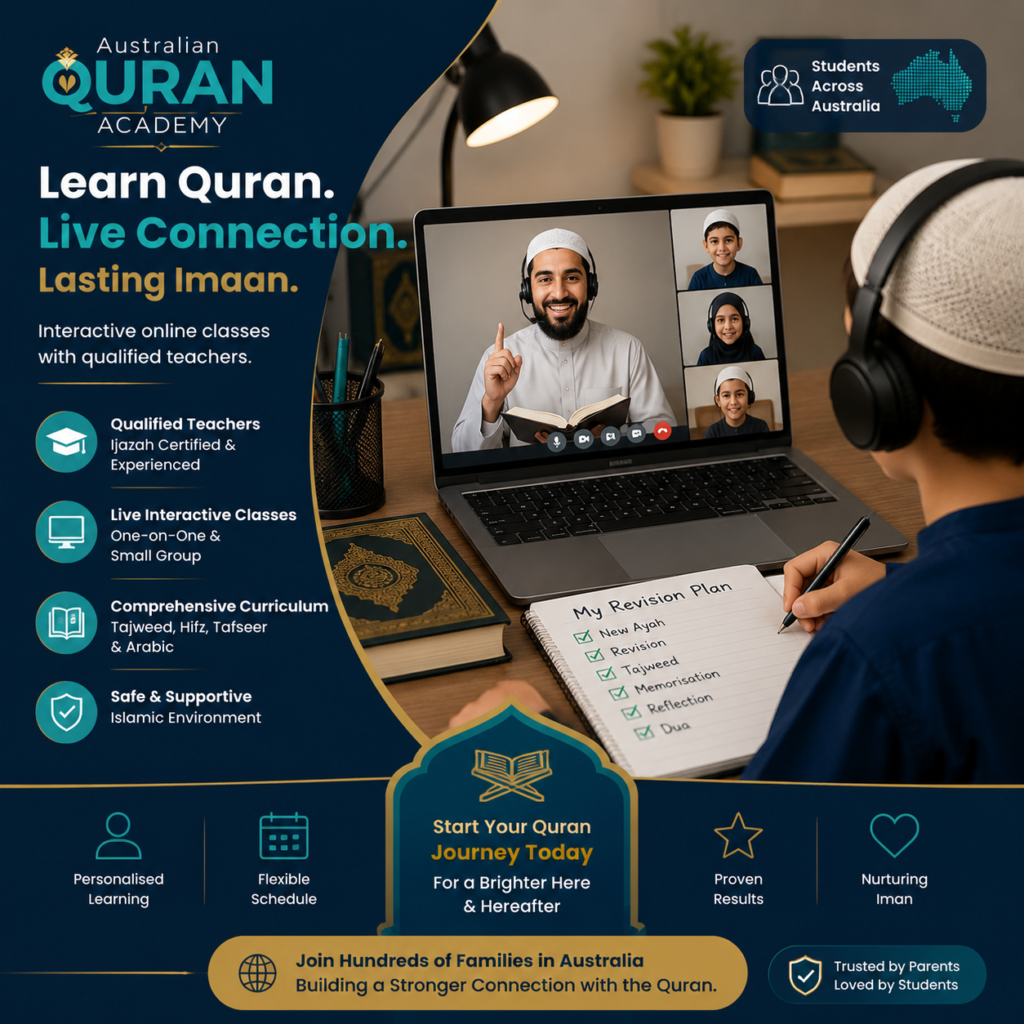
Australian Quran Academy offers live, one-on-one online classes for all six stages of the journey — Quran reading, Tajweed, Tafsir, Hifz, Arabic language, and Islamic Studies — with Ijazah-certified instructors who understand the needs of Muslim learners in Australia.
Whether you are an adult starting from the very first letter or a parent looking to give your child the strongest possible foundation, Australian Quran Academy has the course, the teacher, and the structure you need.
Our Quran Courses
- Quran Recitation Classes
- Quran Reading Classes
- Online Quran Classes for Kids
- Quran Classes for Adults
- Quran Classes for Female/Sisters
- Learn Quran Course for Beginners
- Quran Memorization (Hifz) Course
- Hifz Classes for Adults
- Quran Memorization and Hifz Course for Kids

Start Your Quranic Journey in Australia
Join our leading online academy and learn with expert tutors through a structured, personalized curriculum.
Book Your Free TrialConclusion
The Quran learning journey is not a single event — it is a lifelong progression through six interconnected stages, each one deepening and enriching the one before it.
It begins with the Arabic script: learning 28 letters, understanding vowels, and reading your first word from the Mushaf. It moves into Tajweed, where correct articulation and measured recitation bring the Quran’s embedded rhythm to life.
Tafsir then shifts the journey from tongue to mind, with translation, commentary, and the reasons for revelation opening layers of meaning that recitation alone cannot reach.
Hifz moves the Quran from the mind into the heart through a disciplined three-part daily system — new lesson, recent review, old review — built for lifelong retention. Living by the Quran translates everything memorised and understood into action, guided by Fiqh, the Sunnah, and the internal discipline of Tazkiyah.
And throughout every stage, a qualified teacher keeps the journey authentic, protected, and connected to a chain of knowledge 1,400 years long.
The journey is long. It is also one of the most rewarding commitments a person can make. Australian Quran Academy is here to walk every stage of it with you.

Frequently Asked Questions About the Quran Learning Journey
Here are answers to the questions students most commonly ask when beginning or continuing their Quran learning journey in Australia.
What is the first step in a Quran learning journey?
The first step is learning to read the Arabic script — recognising the 28 letters, understanding short vowels (Harakat), and reading connected words. Most students work through a structured beginner program or the Noorani Qaida before reading directly from the Mushaf. Attempting to read the Quran without this foundation leads to persistent pronunciation errors that are difficult to correct later.
How long does the Quran learning journey take?
The timeline varies significantly based on your starting point, available study time, and which stages you are focusing on. Most adults reach confident Quran reading with basic Tajweed in 6–18 months of regular study. Hifz of the full Quran typically takes 3–7 years for adults studying consistently. Each stage has its own timeline, and progress measured against your own starting point is the only meaningful comparison.
Can adults start a Quran learning journey from scratch?
Yes — and it is never too late. Adults bring discipline, vocabulary, and motivation that accelerate early stages significantly. The main adjustment is in learning Arabic sounds that do not exist in English, which requires deliberate practice with a qualified teacher. Many Australian Quran Academy students begin their formal Quran learning journey as adults and progress to confident recitation within a year.
Is Tajweed compulsory or optional?
Tajweed is compulsory for correct recitation. The Prophet ﷺ received the Quran with specific articulation rules, and those rules are preserved in the Tajweed tradition. Reciting without Tajweed is not invalid in the sense of prayer being rejected, but deliberately ignoring the rules when they are accessible and teachable is considered blameworthy. Learning Tajweed is one of the most important investments in your Quran learning journey.
What is the best method for memorising the Quran (Hifz)?
The most reliable method is the three-part daily session: a small new lesson, a review of the past 7–10 days, and a revision of older memorised portions. New lessons are best learned using incremental linking — verse by verse, linking each new verse to the previous ones before moving forward. Consistency matters far more than session length. Twenty minutes of structured daily practice outperforms a two-hour session twice a week.
How does a teacher improve the Quran learning journey?
A qualified teacher catches errors in real time before they become ingrained habits, provides accountability that self-study cannot replicate, and connects you to authenticated transmission of the Quran’s recitation. For Tajweed specifically, no app or recording can replace a teacher who hears your actual recitation and corrects it precisely. For Hifz, a teacher who tests your memorisation regularly is the single biggest factor in long-term retention.


Leave a Reply