 Quran
Quran
| Key Takeaways |
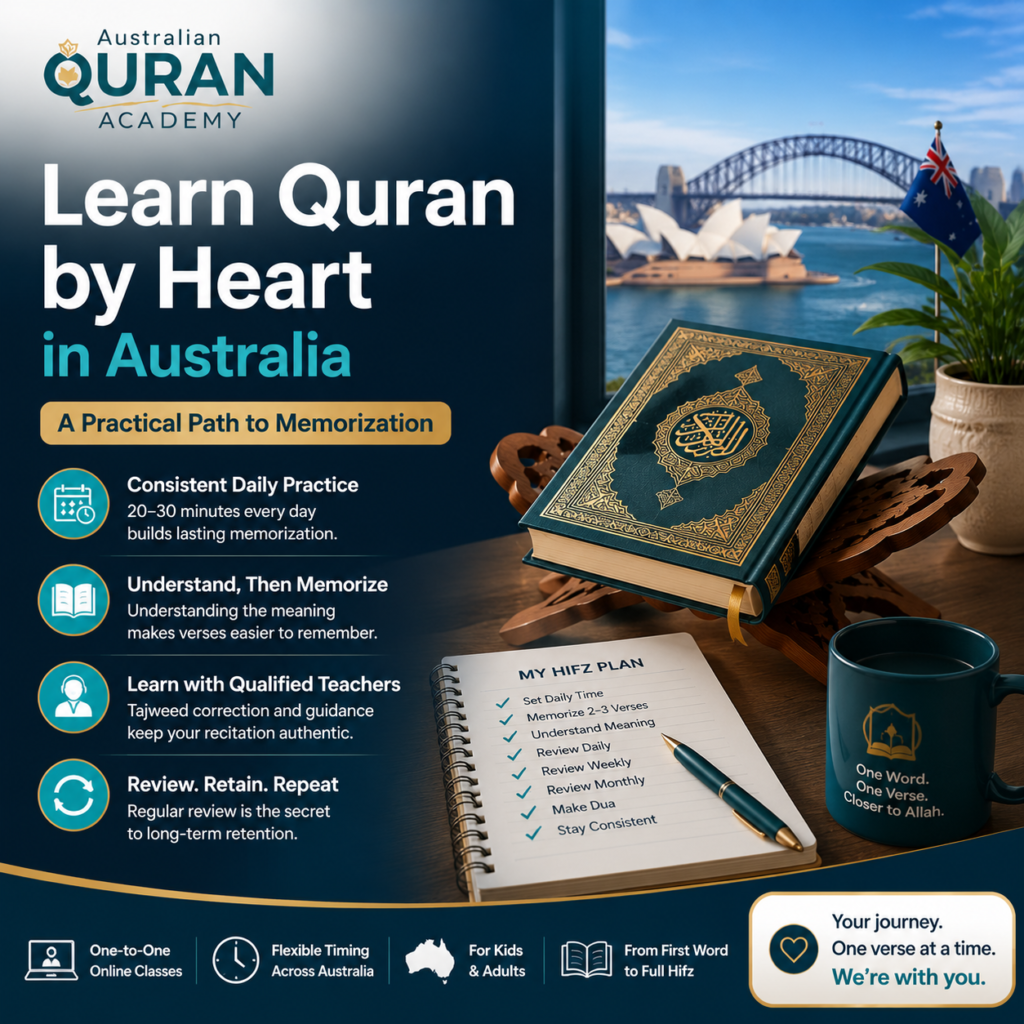
| Australian students can learn Quran by heart online through structured programs with qualified, experienced teachers. |
| Understanding the meaning of a verse before memorizing it makes retention far easier and prevents mechanical, error-prone recall. |
| Consistent daily sessions of 20–30 minutes produce faster, more stable memorization than long, irregular weekend study. |
| Tajweed must be corrected by a qualified teacher — self-study alone cannot catch mispronunciation in real time. |
| Australian Quran Academy offers flexible online Hifz classes timed to Australian schedules across NSW, VIC, QLD, and WA. |
Many Muslim families across Sydney, Melbourne, Brisbane, and beyond share the same goal: to help their children or themselves learn Quran by heart in Australia without giving up halfway.
The challenge is rarely a lack of desire — it’s finding a method that fits daily life in a Western time zone, work schedule, and school routine.
The good news is that memorizing the Quran doesn’t require moving to a Quran school overseas or dedicating every free hour to it. What it requires is a structured plan, the right teacher, and consistency.
This guide walks through exactly how students in Australia — children and adults — can learn Quran by heart in Australia in a way that sticks.
Why Quran Memorization Often Stalls in Australia?
Students who want to learn Quran by heart in Australia usually face a specific obstacle: timing.
Islamic schools and dedicated Hifz centres are limited outside a handful of major cities, so families are often left managing memorization schedules around school, work, and daylight hours that don’t match the traditional post-Fajr study window used in Muslim-majority countries.
Beyond logistics, the same universal issues apply everywhere — memorizing without reviewing, trying to cover too many verses at once, and comparing progress to other students.
In Australia, these issues are amplified by fewer local memorization circles, meaning less peer accountability unless a family actively seeks it out through an academy or online group.
The fix isn’t a shortcut. It’s a plan built around the realities of Australian time zones, paired with a teacher who checks progress regularly.
The Core Method to Learn Quran by Heart in Australia
A bridge point before the steps: none of these techniques are exclusive to Australia, but the order and pacing matter more for students juggling school terms, work shifts, and family commitments across different states.
Step 1: Fix A Daily Time Slot
Pick one consistent time — early morning before school, right after Asr, or before bed — and keep it fixed.
Australian students often do best scheduling around school terms, since routine during term time carries into consistent memorization habits, while school holidays can be used to accelerate progress.
Step 2: Memorize In Small, Connected Portions
Two to three verses a day is a realistic starting point for a beginner. Read the verse while looking at the Mushaf, repeat it from memory, then link it to the next verse before moving on. Quality of retention matters more than the number of verses covered in a session.
Step 3: Understand The Meaning First
A verse becomes far easier to retain once its meaning is clear. Use a simplified tafsir or ask a teacher to explain the verse in plain English before attempting to memorize it — this is especially useful for Australian-born students who are more comfortable in English than Arabic.
Step 4: Review On A Fixed Cycle
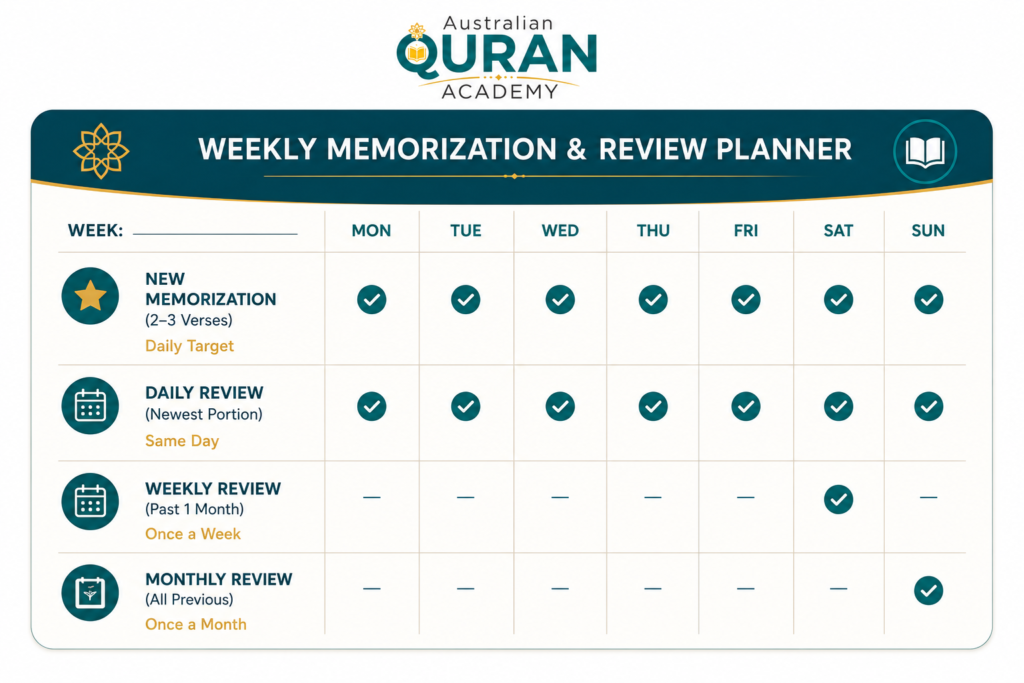
Daily review of the newest portion, weekly review of the past month, and monthly review of everything memorized earlier. Skipping this step is the single most common reason memorized portions are lost within a year.
Reviewing on a schedule like this is what separates students who reach full Hifz from those who plateau after a few Juz — a pattern our teachers see repeatedly across both younger and adult students at Australian Quran Academy.
Choosing Between Online And In-Person Memorization In Australia
Given the shortage of dedicated Hifz centres outside major Australian cities, online memorization has become the practical default for most families rather than a fallback option.
Online classes remove the need to travel, which matters in a country where the nearest qualified Hifz teacher may be hours away.
Lessons can be scheduled around Australian time zones, and a teacher can correct pronunciation and Tajweed mistakes live, exactly as they would in person.
When In-Person Classes Still Make Sense?
For younger children who need more direct supervision, or families near an established Islamic centre, in-person classes offer immediate structure without needing a device.
Many families combine both: in-person classes for younger children building foundational reading skills through resources like Arabic Lessons for Kindergarten in Australia, and online Hifz sessions as children grow older and school schedules tighten.
If you are new to Quran study altogether, starting with a structured foundation such as Learn Quran for Beginners in Australia before beginning memorization tends to produce faster, more stable Hifz progress.
See Us in Action!
Curious about what our online classrooms look like? Watch the short clips below to see how our interactive, one-on-one sessions bring learning to life with real-time feedback and engaging teaching methods.
Start Your Quranic Journey in Australia
Join our leading online academy and learn with expert tutors through a structured, personalized curriculum.
Book Your Free TrialBuilding A Realistic Memorization Plan For Australian Students
A bridge point: a plan only works if it accounts for term breaks, exam periods, and the fact that most Australian Muslim households are not immersed in an Arabic-speaking environment day to day.
1. For School-Aged Children
Start with short surahs from Juz Amma, keep daily sessions under 20–30 minutes to match attention span, and use school holidays to push slightly harder since there is no homework competing for time.
2. For Adults Balancing Work
Adults generally memorize more slowly at first but retain better once understanding is built in, since working professionals bring more life context to the meaning of the verses.
A fixed 20-minute slot before or after work, done daily, outperforms irregular hour-long sessions on weekends.
Non-Arabic speaking adults in particular benefit from pairing memorization with basic Arabic study — understanding sentence structure makes it far easier to memorize accurately rather than by rote sound alone.
A course such as Learning Arabic for Non-Arabic Speakers in Australia is often used alongside memorization for exactly this reason.
Common Mistakes Students Make While Memorizing
Even with a solid plan, small habits can quietly undo weeks of progress. Most setbacks we see among students learning Quran by heart in Australia trace back to one of a handful of avoidable patterns, rather than a lack of ability or effort.
- Trying to memorize a full Juz in a school holiday, then losing it within weeks from lack of review.
- Skipping review entirely once new verses are memorized, which is the fastest route to forgetting.
- Studying at inconsistent times depending on the day, which prevents the routine from becoming automatic.
- Memorizing alone with no teacher to correct Tajweed errors, which can cause mistakes to become fixed habits.
Avoiding these four issues resolves the majority of memorization slowdowns we see among students enrolled at Australian Quran Academy.
How Long Does It Realistically Take?
There is no fixed timeline, since pace depends on age, available time, and consistency rather than talent.
Children studying steadily after school can often complete Hifz over several years, while adults balancing work may take longer but tend to retain what they memorize more securely due to deeper understanding of meaning.
What matters more than speed is that the plan is sustainable. A student memorizing slowly but reviewing properly will retain far more, long-term, than one who rushes and forgets within months — a pattern that holds true regardless of location, but is worth stating clearly for families in Australia weighing how much time to commit weekly.
If you’re also building broader Islamic knowledge alongside memorization, pairing Hifz with a structured curriculum such as Islamic Studies Courses for Adults in Australia helps memorized verses connect to a wider understanding of the deen, which in turn supports retention.
Inside Our Virtual Classrooms
We believe in full transparency and proven quality. Take a look at these actual snippets from our live classes to experience our modern learning platform, patient instructors, and interactive student participation.
Start Your Quranic Journey in Australia
Join our leading online academy and learn with expert tutors through a structured, personalized curriculum.
Book Your Free TrialStart Your Hifz Journey with Australian Quran Academy Today
Reading about the method is one step — following it with a qualified teacher who checks your progress weekly is what actually gets students to complete their Hifz.
Australian Quran Academy builds a personalised memorization plan around your schedule, your child’s school term, or your work hours, with certified teachers correcting Tajweed and tracking review cycles from day one.

Explore our full range of programs through Quran Classes in Australia to find the right starting point for your family.
Our Quran Courses:
- Learn Quran for Beginners
- Quran Memorization (Hifz) Course
- Hifz Classes for Adults
- Quran Memorization and Hifz for Kids
- Quran Hifz for Ladies
- Quran Ijazah Program
- Quran Qirat Learning Course
- Quran Tafsir Course
- Noorani Qaida Course
- Noorani Qaida Course for Kids
- Weekend Quran Classes

Start Your Quranic Journey in Australia
Join our leading online academy and learn with expert tutors through a structured, personalized curriculum.
Book Your Free TrialConclusion
Learning to memorize the Quran doesn’t need to be overwhelming, even with the scheduling challenges that come with living in Australia.
A fixed daily time, small connected portions, understanding before memorizing, and a strict review cycle are what turn memorization from a struggle into a steady habit. Whether you are a school-aged child starting with short surahs or an adult balancing work and family, the same core method applies — it simply needs to be adapted to your routine.
If you are ready to learn Quran by heart in Australia with proper structure and consistent teacher support, a program built around your schedule will get you there far more reliably than studying alone.
Frequently Asked Questions
The questions below cover what Australian families most often ask before starting a Quran memorization program.
1. What age should a child start memorizing the Quran in Australia?
Children can start memorizing at almost any age, though many families begin once basic Arabic reading is solid, often around ages 5–7. Starting early gives more years of practice before school workload increases.
2. Is it possible to learn Quran by heart in Australia without attending classes overseas?
Yes. Most students in Australia now complete Hifz entirely through local or online programs, without needing to travel, as long as the teacher is qualified and the review schedule is consistent.
3. How many verses should a beginner memorize daily?
Two to three verses daily is a realistic starting point for beginners, with the number increasing gradually as memorization ability strengthens and daily review stays consistent.
4. Can adults with full-time jobs still complete Hifz?
Yes. Adults typically progress more slowly at first but retain memorized portions well due to a deeper grasp of meaning, especially when sessions are kept short and consistent rather than long and irregular.
5. Do online Quran memorization classes work as well as in-person ones?
Online classes can be just as effective, since a qualified teacher can still correct pronunciation and Tajweed live, track weekly review, and hold students accountable to a fixed schedule.





Leave a Reply