 Quran
Quran
| Key Takeaway |
| The right Quran learning tools for kids match how children naturally absorb information — through colour, sound, repetition, and play — not how adults prefer to study. |
| Noorani Qaida is the single most important starting tool for non-Arabic-speaking children in Australia; skipping it creates pronunciation errors that take years to correct. |
| Consistency with one tool outperforms rotating between many — a child who uses one app or flashcard set daily for six weeks will progress faster than a child with six resources and no clear routine. |
| The four learning channels — auditory, visual, kinesthetic, and environmental — should each be covered weekly: audio exposure, colour-coded Mushaf, flashcards, and a dedicated learning space. |
| Visual progress charts make effort visible to children; when kids can see memorisation accumulating, they are far more likely to maintain the daily habit without pressure. |
| Australian Quran Academy connects children across Australia with qualified Quran teachers who combine the right tools with live, structured guidance — the combination that produces real results. |
Every Muslim parent wants the same thing: a child who reads the Quran with confidence, correct pronunciation, and genuine love for the Book of Allah.
But too many families collect apps, books, and programs — and still see little progress. The problem is rarely effort. It is almost always the wrong tools used in the wrong order.
This guide cuts through the noise. It covers the most effective Quran learning tools for kids — physical, digital, and environmental — with age-specific guidance so you can choose what actually matches how your child learns, not just what looks impressive.
Whether you are just starting out in Australia or looking to sharpen an existing routine, the right combination of tools makes all the difference.
1. Noorani Qaida
Every strong Quran reader begins with a strong foundation. Before apps, before memorisation programs, before anything else — the Noorani Qaida comes first.
The Qaida teaches Arabic letters, their forms, correct sound points (Makharij), how letters join together, and basic tajweed awareness. A child who completes Noorani Qaida properly will read the Quran faster, with better pronunciation, and with far fewer bad habits to fix later.
Many families move children to Quran recitation too early. This creates long-term pronunciation problems that are genuinely difficult to correct once they become habit — what language teachers call fossilised errors.
Think of it this way: a child cannot read full English sentences before learning the alphabet. The Qaida is the alphabet stage.
A strong Qaida foundation produces three lasting benefits:
- Faster Quran reading in the months that follow
- Accurate pronunciation that does not need constant correction
- A smoother transition into full tajweed rules later
Noorani Qaida is the most widely trusted and recommended starting point, particularly for non-Arabic-speaking children. Alternatives like Ahsan-ul-Qawaid and Madani Qaida cover similar ground — the most practical approach is to use Noorani Qaida as the primary base and draw on others only to address specific gaps.
Australian Quran Academy offers structured beginner Quran courses built on this exact foundation. If your child is just starting out, explore the Learn Quran for Beginners in Australia pathway to get them started with a qualified instructor from lesson one.
2. Colour-Coded Tajweed Mushaf
For children who can already read basic Arabic, a colour-coded Tajweed Mushaf is the single most impactful physical upgrade a parent can make.
Standard black-and-white Mushafs ask children to remember every tajweed rule consciously while also decoding unfamiliar script. That is too much cognitive load for a young learner. A colour-coded Mushaf removes that bottleneck.
How the colour system works?
Each colour corresponds to a specific recitation rule. Red marks a lengthening sound (Madd). Green marks a nasal sound (Ghunnah).
The child does not need to recall the rule consciously — the colour triggers the action automatically, the way a traffic light signals stopping without requiring thought.
Children who struggled with Ikhfa (the concealment of the noon sound) for months often master it quickly once they stop trying to remember the rule and simply follow the colour. The visual cue bypasses memorisation and builds reflex.
Pairing with a Tajweed rule chart
Mount a simplified Tajweed rule chart at your child’s eye level near their practice space. When a colour appears in the Mushaf and your child forgets what it means, one glance at the chart lets them self-correct without stopping to ask. This builds genuine independence — a goal worth prioritising from early on.
3. Quran Learning Apps for Kids
Apps are among the most accessible Quran learning tools for kids today, especially for Australian families without easy access to local Islamic schools. Used correctly, they reduce learning gaps and help children revise more efficiently. Used without structure, they become screen time dressed up as education.
Ages 4–8
Look for animated apps with audio repetition and badge rewards. Short five-to-ten minute sessions with colourful visuals keep young children engaged without overwhelming them.
Ages 9–13
Colour-coded tajweed apps and memorisation trackers work well. Apps like Quran Companion use streak-based motivation — the same psychology as Duolingo — shifting the child’s focus from “this is hard” to “I don’t want to break my streak.”
Ages 14+
AI-powered apps like Tarteel provide real-time pronunciation feedback, which teenagers find motivating precisely because it feels like a challenge, not a chore.
Switching between multiple apps hoping for faster results is the most common error parents make. It slows learning down. A child who uses one app consistently for six weeks will outperform a child who rotates between four apps over the same period. Choose one, use it daily, and track progress.
Apps model correct recitation — but they cannot watch your child’s mouth and say “lift your tongue slightly.” That is the gap a qualified teacher fills.
See Us in Action!
Curious about what our online classrooms look like? Watch the short clips below to see how our interactive, one-on-one sessions bring learning to life with real-time feedback and engaging teaching methods.
Start Your Quranic Journey in Australia
Join our leading online academy and learn with expert tutors through a structured, personalized curriculum.
Book Your Free Trial4. Physical Flashcards
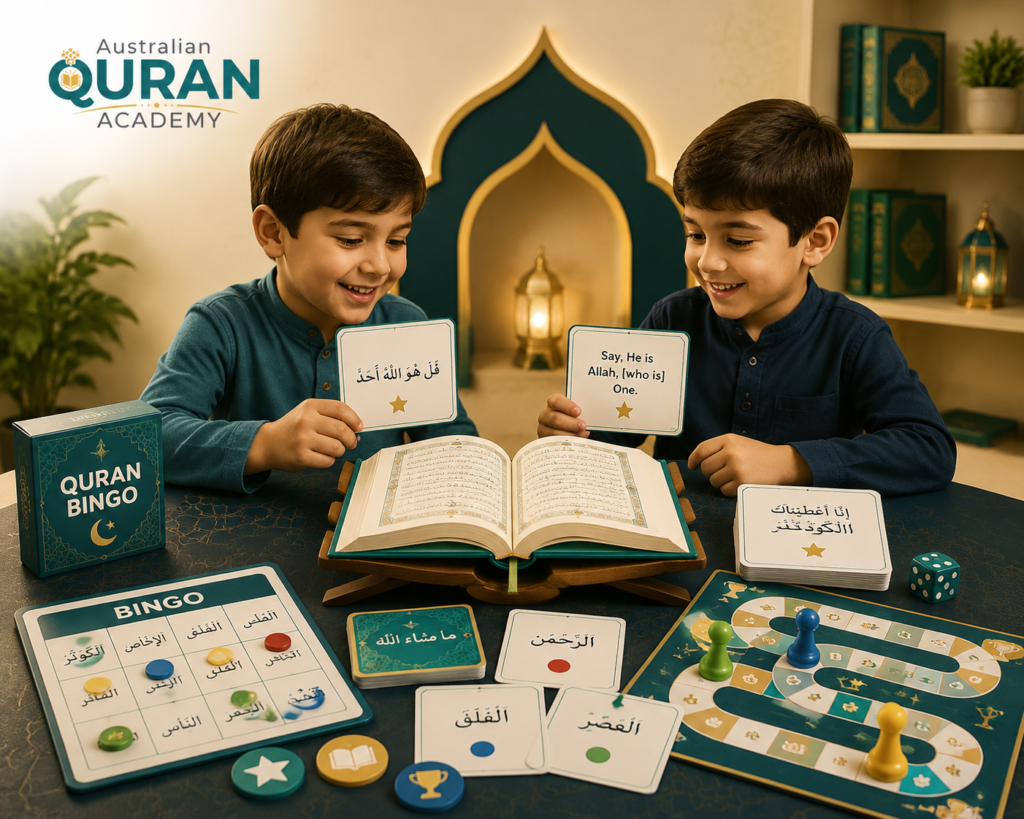
Physical flashcards are low-tech but highly effective — particularly for children aged four to ten who learn through touch, movement, and play.
A well-structured flashcard session takes ten minutes. Shuffle five to eight cards, ask your child to identify each letter sound, and celebrate every correct answer. The physical interaction (holding, sorting, flipping) creates stronger memory anchors than passive screen watching.
| Age Group | Session Length | Cards Per Session | Focus |
| Ages 4–6 | 5–8 minutes | 3–5 cards | Letter recognition only |
| Ages 7–9 | 10 minutes | 6–8 cards | Letter + basic sounds |
| Ages 10–12 | 12–15 minutes | 8–10 cards | Letters + short words |
For Surah memorisation, flashcard sets covering Juz Amma work particularly well for ages five and above. A simple three-card-per-session approach — introducing one new card and reviewing two previous ones — produces measurable results within weeks.
5. Audio Exposure
Of all the Quran learning tools for kids, consistent audio exposure is the one most families overlook. Yet it may be the most naturally effective, especially for very young children.
Children absorb language through repetitive audio before they can consciously process it — the same neurological process that lets toddlers speak full sentences before they can read a single word. Playing correct Quranic recitation during car rides, mealtimes, and quiet time creates passive learning that accumulates steadily over weeks.
Start with the surahs your child will use in Salah. Playing Surah Al-Fatiha and Surah Al-Ikhlas daily during routine activities means most children can recite them accurately within two to three weeks — before formal lessons even begin.
The key is reciter selection. For children actively memorising, Murattal-style recitation — slow, clear, and rule-precise — is most effective.
Sheikh Mahmoud Khalil Al-Husary’s recordings are the gold standard for this style. The deliberate pace lets the ear isolate individual words and sounds rather than following a continuous melodic stream.
A dedicated Bluetooth speaker in the living room, playing recitation at low volume, is the simplest setup. You are not asking your child to sit and listen — you are building familiarity in the background.
6. Visual Progress Charts
Children are powerfully motivated by seeing their own progress. A visual memorisation chart does one thing text-based checklists cannot: it makes effort tangible.
A four-stage tracking system that works
Most memorisation charts ask children to tick a box when they finish a surah — but that single checkpoint misses everything in between. This four-stage system breaks each surah into visible milestones, so a child always knows exactly where they stand and what comes next.
| Surah | First Attempt | With Help | Independent | With Tajweed |
| Al-Fatiha | ☐ | ☐ | ☐ | ☐ |
| Al-Ikhlas | ☐ | ☐ | ☐ | ☐ |
| Al-Falaq | ☐ | ☐ | ☐ | ☐ |
| An-Nas | ☐ | ☐ | ☐ | ☐ |
| Al-Kawthar | ☐ | ☐ | ☐ | ☐ |
The four-stage structure helps children understand that memorisation is a process with real milestones — which reduces frustration when progress feels slow. A child who colours in “Independent” for Al-Ikhlas understands they are not finished yet, but they also see exactly how far they have come.
Pair the chart with small, meaningful rewards: choosing the weekend activity, an extra story at bedtime, or a sticker system. Children who can see their progress learn faster than children who only study without visible feedback.
7. Illustrated Storybooks and Tafsir for Kids
When children understand what they are reciting, memorisation becomes easier and the Quran becomes more meaningful. Storybooks and age-appropriate Tafsir books build this essential connection.
Books that retell Quranic stories — the story of Prophet Ibrahim (AS), Prophet Musa (AS), Prophet Yunus (AS) — give children a narrative anchor for the Arabic text they are memorising. A child who hears the story of Prophet Ibrahim before studying the related verses approaches those verses with genuine curiosity.
Age-appropriate selection guide:
- Ages 4–7: Picture-heavy books with simple sentences and large illustrations
- Ages 8–12: Chapter-based stories with moral lessons and Quranic references
- Ages 13+: More detailed narratives connecting stories to specific Ayat with reflection prompts
Ten to fifteen minutes of shared reading before a Quran lesson creates emotional context that improves both comprehension and retention. Parents do not need to be scholars — reading alongside your child and wondering aloud creates beautiful shared learning moments.
For older children and parents looking to go deeper, Australian Quran Academy also offers Islamic Studies Courses for Adults in Australia — so that the whole family can grow together.
8. A Daily Quran Learning Routine That Actually Works
Consistency matters more than session length. A child who practices for fifteen minutes every day will outperform a child who practices for two hours once a week, every single time.
The brain consolidates Quranic text through regular, spaced engagement — not occasional intensive sessions.
A simple 3-step daily method
Learn — study a small new portion (three to five Ayat maximum for younger children) Revise — spend five minutes on the previous lesson before touching anything new Apply — recite correctly with proper guidance or audio support
The revision step is the one most parents skip. Children who revise daily consistently progress faster than children who only move forward.
Five minutes of review before each new lesson strengthens memory, reduces mistakes, and builds the confidence that makes the next lesson easier.
Sample weekly Hifz schedule for children aged 8–12
| Day | Activity | Duration |
| Saturday | New memorisation (3–5 Ayat) | 20 minutes |
| Sunday | Review previous lesson | 15 minutes |
| Monday | New memorisation (3–5 Ayat) | 20 minutes |
| Tuesday | Cumulative review (last 2 lessons) | 20 minutes |
| Wednesday | New memorisation (3–5 Ayat) | 20 minutes |
| Thursday | Full week review | 25 minutes |
| Friday | Listening day + light revision | 15 minutes |
Early morning is the best time for memorisation — the mind is fresh and distractions are minimal. Keep sessions short, keep them regular, and let consistency do the work.
9. The Learning Environment
A child who tries to memorise in front of a television or in a cluttered playroom is fighting their environment. The physical space shapes the quality of attention.
You do not need a dedicated room. You need a 4×4 foot space that signals to the child’s brain: it is time to focus. Three practical upgrades that cost very little:
A dedicated reading lamp. Warm, directed light spotlights the Mushaf and naturally dims distractions around it.
A book stand. This does two things: it treats the Quran with respect, and practically, it keeps the chest open. A child hunching over a book on their lap compresses the diaphragm, making breath control — and therefore tajweed — physically harder.
Quran visible daily. When a child sees the Mushaf in the living room, hears recitation in the background, and sees Islamic books on the shelf, the Quran becomes a natural part of daily life rather than a separate school subject.
This matters especially for Muslim families in Australia, where Islamic education is rarely part of the school day.
Inside Our Virtual Classrooms
We believe in full transparency and proven quality. Take a look at these actual snippets from our live classes to experience our modern learning platform, patient instructors, and interactive student participation.
Start Your Quranic Journey in Australia
Join our leading online academy and learn with expert tutors through a structured, personalized curriculum.
Book Your Free TrialStart Your Child’s Quran Journey with Australian Quran Academy
Finding the right tools is only half the equation. A qualified teacher who understands children — their attention spans, their frustrations, and their capacity for joy — is what turns good tools into lasting results.
Australian Quran Academy combines all of the above into a structured, age-appropriate learning path for children across Australia. Whether your child is just beginning with the Arabic alphabet or is ready for full Hifz, there is a clear next step available.
- One-to-one live Quran classes with qualified instructors
- Focus on Tajweed, pronunciation, and correct habit-building from the very first lesson
- Flexible scheduling designed for Australian family routines
- Supportive, encouraging teachers who build confidence — not pressure
Book a free trial class today and see the difference structured, child-focused guidance makes.
Our Quran Courses:
- Online Quran Classes for Kids
- Quran Classes for Adults
- Quran Classes for Female/Sisters
- Learn Quran Course for Beginners
- Quran Memorization (Hifz) Course
- Quran Memorization and Hifz Course for Kids
- Quran Hifz Course for Ladies
- Quran Ijazah Program
- Quran Qirat Learning Course
- Quran Tafsir Course
- Noorani Qaida Course
- Noorani Qaida Course for Kids
Start Your Quranic Journey in Australia
Join our leading online academy and learn with expert tutors through a structured, personalized curriculum.
Book Your Free TrialConclusion
The best Quran learning tools for kids are not the most expensive ones — they are the ones used consistently, in the right order, matched to a child’s age and learning style. Start with Noorani Qaida. Add one physical tool. Build a simple daily routine. And play Quran recitation in the background every day.
Avoid the common trap of collecting too many resources at once. A child who uses one Qaida, one flashcard set, and one audio track every day for eight weeks will outperform a child surrounded by six apps and three books but no clear system.
When parents feel stuck with pronunciation, consistency, or correction — that is the signal to bring in structured support.
Australian Quran Academy offers qualified, child-focused Quran instruction across Australia, ensuring that correct habits are built from the beginning, before mistakes become difficult to fix. Insha’Allah, the right tools combined with the right guidance are all your child needs.
Frequently Asked Questions About Quran Learning Tools for Kids
Parents often have specific questions before choosing tools or starting their child’s learning journey. The answers below address the most common concerns directly.
What age should a child start using Quran learning tools?
Children can begin with basic Arabic letter recognition tools — flashcards, illustrated Qaida books, and audio exposure — as early as age three. Formal Quran reading with a Qaida is typically most effective from age four or five, when children have sufficient attention span for short structured sessions.
Is Noorani Qaida better than going straight to the Quran?
Noorani Qaida is far more effective as a starting point for children who are not native Arabic speakers. Skipping the Qaida and going straight to the Quran produces pronunciation errors that become deeply embedded habits — and these are significantly harder to correct at age ten than at age five.
How long should a child’s Quran learning session be each day?
For children aged four to seven, ten to fifteen minutes per day is sufficient and sustainable. Children aged eight to twelve can manage twenty to twenty-five minutes. Consistency matters far more than duration — a short daily session will always outperform a long weekly one.
Can apps replace a Quran teacher for kids?
Apps are useful daily companions but cannot replace a qualified teacher. No app can watch a child’s mouth position, respond to confusion in real time, or adapt pacing to how the child feels on a given day. The most effective approach pairs one good app with regular live instruction.
What is the best Quran learning tool for a non-Arabic-speaking child in Australia?
The Noorani Qaida — ideally with an illustrated, colour-coded edition — is the single most important starting tool. Pair it with daily audio exposure to a qualified reciter and structured sessions through a program likeAustralian Quran Academy’s beginner Quran classes, and most children begin reading independently within a few months.
How do I keep my child motivated to keep learning?
Visual progress charts, small meaningful rewards, and consistent praise at every milestone are the most effective motivation tools. Children are far more likely to continue a habit they can see progressing. Pairing a chart with a streak-based app and a supportive teacher creates a reinforcing cycle of visible achievement and genuine encouragement.




Leave a Reply