 Arabic
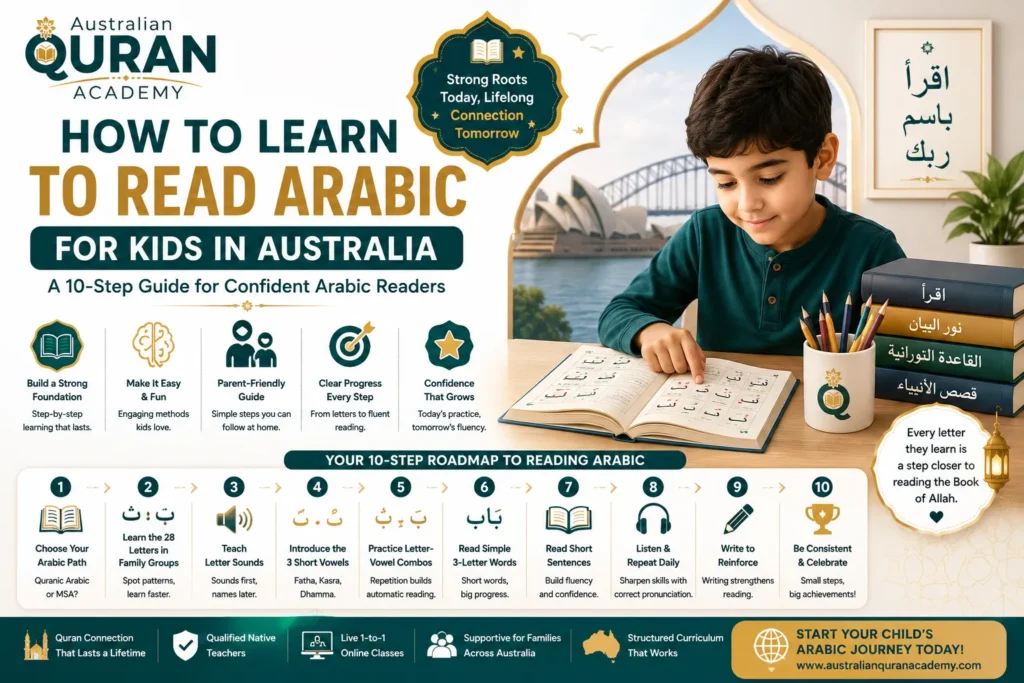
If your child is growing up in Sydney, Melbourne, Brisbane, or anywhere across Australia, teaching them to read Arabic is one of the most valuable gifts you can give them — for their faith, their heritage, and their future. But knowing where to start is the part most parents struggle with.
This guide gives you a clear, step-by-step path to help your child learn to read Arabic for kids in Australia — whether you’re starting from absolute zero or picking up from a shaky foundation. Every step is ordered deliberately: skip one, and the next one becomes harder. Follow the sequence, and your child builds a reading ability that actually sticks.
Step 1: Understand Which Arabic Your Child Will Learn to Read First
Before your child reads a single letter, you need to make one decision: are you starting with Quranic Arabic or Modern Standard Arabic (MSA)?
These are not the same reading system, and confusing them is the number-one mistake Australian parents make at the start.
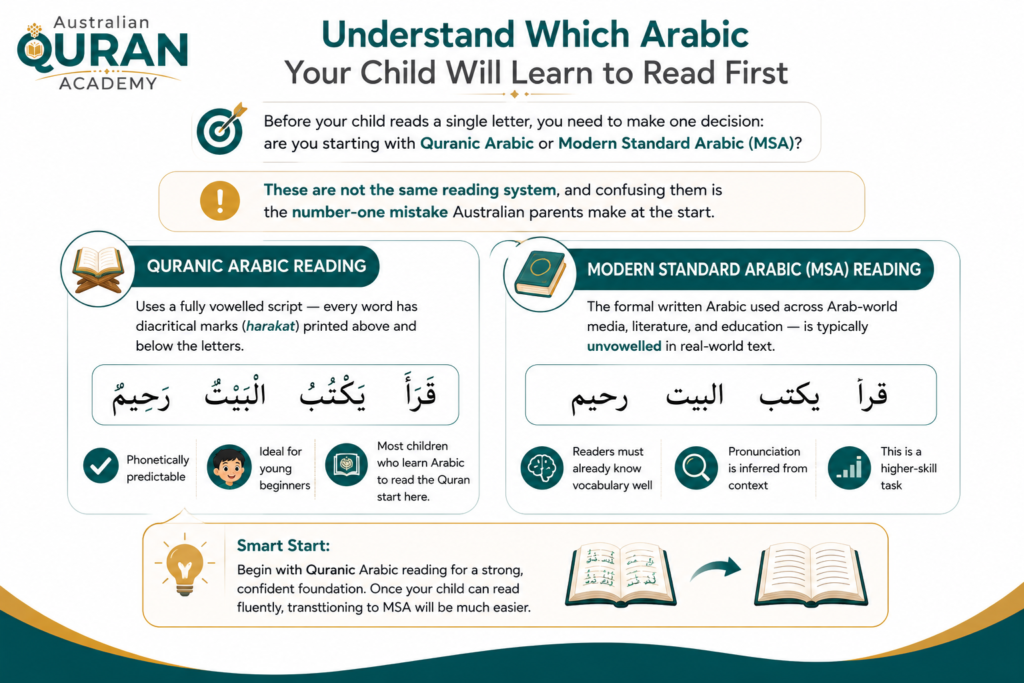
Quranic Arabic reading uses a fully vowelled script — every word has diacritical marks (harakat) printed above and below the letters. This makes it phonetically predictable and ideal for young beginners. Most children who are learning Arabic to read the Quran start here.
Modern Standard Arabic (MSA) reading — the formal written Arabic used across Arab-world media, literature, and education — is typically unvowelled in real-world text. Readers must already know vocabulary well enough to infer pronunciation from context. This is a higher-skill task.
For most Australian kids aged 5–12, starting with vowelled Quranic-style text is the faster path to early reading success. The Australian Quran Academy’s Modern Standard Arabic course is the right next step once the foundational reading skills are solid — not before.
Read also: How to Learn Egyptian Arabic for Kids? – A Complete Step-by-Step Guide
Step 2: Learn the 28 Arabic Letters in Visual Family Groups
Arabic has 28 letters. The single biggest mistake in teaching them is introducing all 28 in alphabetical order, one by one, as isolated shapes. Children’s visual memory works through pattern recognition — and Arabic letters naturally cluster into shape families.
Group letters by their base shape, then show how dots and small additions differentiate them:
- The “baa” family: ب، ت، ث (same base shape, different dot count)
- The “jeem” family: ج، ح، خ (same curved base)
- The “seen” family: س، ش (same wave shape)
Learning by visual families means a child who masters one letter immediately recognizes the shape of two or three others. For Australian kids learning to read Arabic for kids online free, this approach is well-supported by free resources from platforms like Zain Education and Arabic Playground, which organize letters exactly this way.
Read also: 12 Best Arabic Books for Kids: A Complete Parent’s Guide
Step 3: Teach Letter Sounds, Not Letter Names
This is the step most parents skip — and it costs them months of progress When a child learns that ب is called “baa,” they know the name. When they learn to produce the sound /b/ instantly on sight, they can read. These are different cognitive skills, and only one of them unlocks reading.
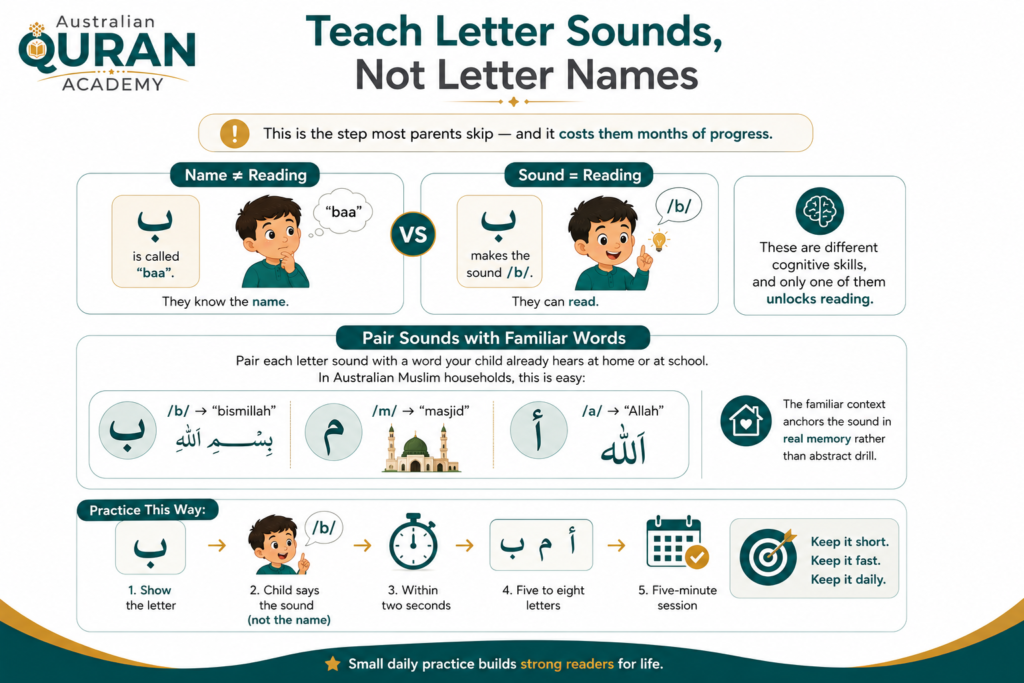
Pair each letter sound with a word your child already hears at home or at school. In Australian Muslim households, this is easy: ب /b/ connects to “bismillah,” م /m/ connects to “masjid,” أ /a/ connects to “Allah.” The familiar context anchors the sound in real memory rather than abstract drill.
Practice this way: show the letter, your child says the sound — not the name — within two seconds. Five to eight letters per five-minute session. Keep it short, keep it fast, keep it daily.
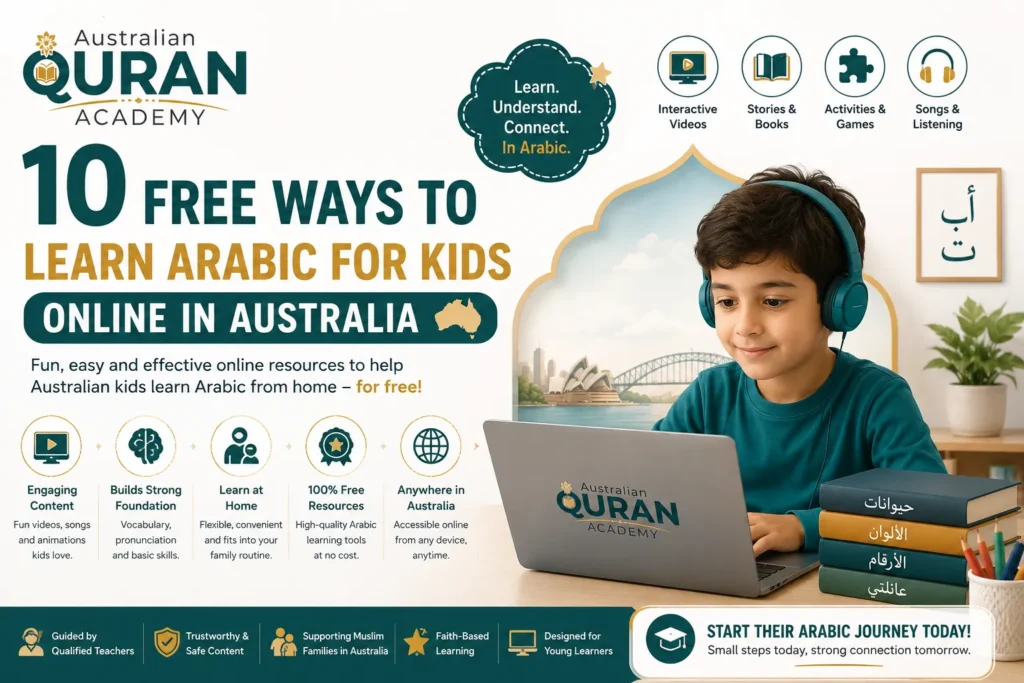
Read also: 10 Free Ways to Learn Arabic for Kids Online in Australia
Step 4: Introduce the Three Short Vowels (Harakat)
Once your child recognizes the letter shapes and their sounds, introduce the three short vowels. These are the marks that sit above and below letters and tell you how each syllable is pronounced.
| Vowel Name | Mark Position | Sound | Example |
| Fatha | Above the letter | Short “a” as in “cat” | بَ = “ba” |
| Kasra | Below the letter | Short “i” as in “bit” | بِ = “bi” |
| Dhamma | Above the letter (curled) | Short “u” as in “put” | بُ = “bu” |
The system is beautifully consistent: once your child can read بَ، بِ، بُ, they can immediately apply the exact same logic to مَ، مِ، مُ and every other letter. Spend one to two weeks on this stage and do not rush it. The entire reading system sits on top of it.
Read also: Find The Best Quran Teacher On Skype In Australia — Learn Quran Online From Home
Step 5: Practice Letter-Vowel Combinations Until Reading Becomes Automatic
Knowing that بَ = ba is different from being able to recognize and read it instantly. Children need repeated practice with letters and their short vowels until these combinations become familiar and no longer require conscious decoding.
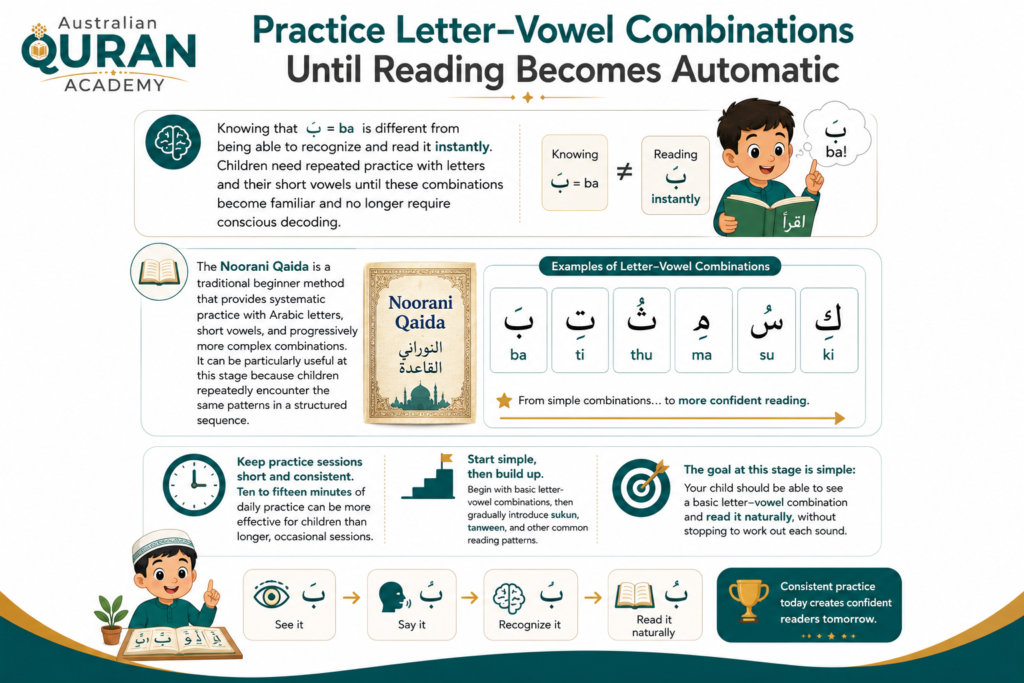
The Noorani Qaida is a traditional beginner method that provides systematic practice with Arabic letters, short vowels, and progressively more complex combinations. It can be particularly useful at this stage because children repeatedly encounter the same patterns in a structured sequence.
Keep practice sessions short and consistent. Ten to fifteen minutes of daily practice can be more effective for children than longer, occasional sessions. Start with simple letter-vowel combinations, then gradually introduce combinations with sukun, tanween, and other common reading patterns as your child becomes more confident.
The goal at this stage is simple: your child should be able to see a basic letter-vowel combination and read it naturally, without stopping to work out each sound.
Read also: How To Learn Quran Online With Tajweed Free In Australia?
See Us in Action!
Curious about what our online classrooms look like? Watch the short clips below to see how our interactive, one-on-one sessions bring learning to life with real-time feedback and engaging teaching methods.
Start Your Quranic Journey in Australia
Join our leading online academy and learn with expert tutors through a structured, personalized curriculum.
Book Your Free TrialStep 6: Introduce Sukoon, Shadda, and the Long Vowels
With short vowels mastered, three more marks complete the basic reading system:
Sukoon (ْ): a small circle above a letter indicating no vowel — the letter closes the syllable. Example: بَيْت (bayt = house). This introduces closed syllables for the first time.
Shadda (ّ): a small “w” shape indicating the letter is doubled. Example: مُحَمَّد (Muhammad). Children often mishear this as a single letter — practitioner experience shows that the best correction is to have the child physically hold the sound for a beat longer than usual.
Long vowels: the letters ا، و، ي extend the short vowels into long sounds (aa, oo, ee). These frequently appear in Quranic text and must be recognized both in vowelled and partly-vowelled script.
At this stage, many Australian kids benefit significantly from online instruction — the interactive whiteboard environment lets a tutor highlight, circle, and annotate marks in real time, which a static page cannot do. The Australian Quran Academy’s online Arabic program for non-Arabic speakers specifically covers this foundational layer for beginners.
Step 7: Move From Syllables to Full Words
This is the bridge stage — the point where isolated drills become real reading. The transition requires practice with short, fully vowelled words before any unvowelled text is attempted.
Start with two-syllable words your child already knows: كِتَاب (kitab = book), بَيْت (bayt = house), مَاء (maa’ = water). These are phonetically transparent in vowelled text — every sound is visible.
A practical exercise that works well for Australian children learning to read Arabic for kids online: “read and draw.” The child reads a short vowelled word, then draws what it means. This locks vocabulary and reading together in one session. It also gives the lesson a tactile component that keeps younger children engaged.
Progress to three-syllable words, then four. Keep all text fully vowelled at this stage. Introduce unvowelled text only in Step 9 — not before.
Read also: 11 Arabic Activities for Kids in Australia (Free, Printable & Online)
Step 8: Use Arabic Stories to Build Reading Fluency Naturally
Isolated word drills build accuracy. Stories build fluency — the ability to read at a natural pace while holding meaning.
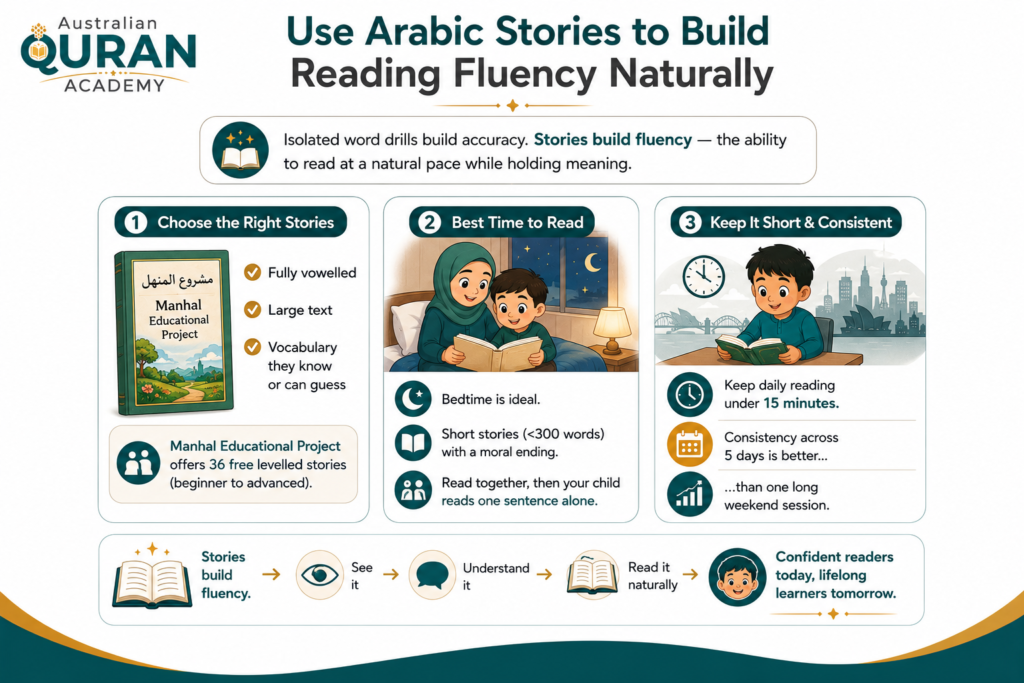
Choose stories that are fully vowelled, have large text, and use a vocabulary range your child can mostly recognize. Classic levelled Arabic story collections like the Manhal Educational Project (مشروع المنهل) offer 36 free levelled stories from beginner to advanced, all with clear vowelling. Level One stories — such as “أنا وأخي” (My Brother and I) — are ideal for children who have just completed Steps 1–7.
Bedtime is one of the most effective times to use Arabic stories with Australian children. The calm environment aids retention, and short stories under 300 words with a moral ending work particularly well. “Read one story together, then your child reads one sentence alone” is a practical routine that many families find sustainable within busy after-school and weekend schedules.
For children in Sydney and Melbourne managing school, sport, and extracurriculars, the key is keeping the daily Arabic reading session under 15 minutes at this stage. Consistency across five days beats one long weekend session.
Read also: Learning Arabic Numbers For Kids In Australia
Step 9: Begin Transitioning to Unvowelled Text
Unvowelled Arabic text — the standard in books, news, and most adult Arabic content — is a different cognitive challenge. Readers must use vocabulary knowledge and grammar intuition to infer the missing vowels.
The transition should be gradual. Start with texts that are 80% familiar vocabulary. Cover the vowels on a fully vowelled text your child knows well, and have them read it from memory-supported recognition. Then move to texts where only key words are vowelled. Eventually, introduce fully unvowelled simple sentences.
This stage is where Modern Standard Arabic reading skills begin to diverge meaningfully from Quranic reading. MSA reading requires a vocabulary base — which is why the Australian Quran Academy recommends building at least 200–300 core Arabic vocabulary words before attempting extended unvowelled MSA text.
The intensive Arabic course at the Australian Quran Academy is specifically designed for students ready to accelerate through this transition under structured expert guidance — particularly useful for Australian students in secondary school who want to build real reading independence quickly.
Step 10: Build a Consistent Daily Reading Habit Suited to Australian Schedules
The difference between children who reach reading fluency and those who plateau at the intermediate stage is almost never talent — it is consistency.
Australian school terms run approximately 10 weeks each, with four terms per year. A practical framework for Australian families is to set specific Arabic reading targets by term rather than by week, which aligns with the natural rhythm of the school year.
A realistic term-by-term reading target for beginners:
- Term 1: Letters, sounds, and basic harakat (Steps 1–4)
- Term 2: Combination drills, sukoon, shadda, long vowels (Steps 5–6)
- Term 3: Short vowelled words and beginner stories (Steps 7–8)
- Term 4: Transition toward unvowelled text (Step 9)
Daily sessions of 10–20 minutes — scheduled consistently after school or on weekend mornings — outperform irregular longer sessions. For families in AEST/AEDT time zones, the Australian Quran Academy schedules online classes to fit after-school hours in Sydney, Melbourne, Brisbane, and Perth, making live instruction genuinely accessible without the commute.
If your child is learning to read Arabic for kids online free using apps and videos, use these in the first 5–10 minutes as a warm-up, then transition to the actual reading work. Free tools are excellent supplements — they are not a substitute for structured progression.
Inside Our Virtual Classrooms
We believe in full transparency and proven quality. Take a look at these actual snippets from our live classes to experience our modern learning platform, patient instructors, and interactive student participation.
Start Your Quranic Journey in Australia
Join our leading online academy and learn with expert tutors through a structured, personalized curriculum.
Book Your Free TrialStart Your Child’s Arabic Reading Journey with the Australian Quran Academy
Learning to read Arabic becomes easier when children have a clear progression, regular practice, and support that matches their age and ability. Australian Quran Academy helps children build their Arabic reading skills step by step, with lessons designed to make learning clear, engaging, and comfortable for young learners.
Whether your child is just beginning to recognize Arabic letters or is ready to develop stronger reading fluency, the academy provides personalized guidance throughout the learning journey. With qualified instructors and flexible online lessons, families can give their children consistent Arabic practice from home while fitting learning around their everyday routines.
Our Arabic Courses
- Online Arabic Academy
- Online Arabic Course
- Classical Arabic Course
- Arabic Course for Beginners
- Advanced Arabic Course
- Quranic Arabic Course
- Arabic Grammar Course
- Modern Standard Arabic Course
- Arabic Conversation / Speaking Course
- Intensive Arabic Course
- Online Arabic Classes for Kids
- Arabic Classes for Adults
- Arabic Classes for Ladies
- Fusha Arabic Course
- Business Arabic Course
- Al-Azhar Arabic Course
- Madinah Arabic Course
- Learning Arabic for Non-Arabic Speakers
- Arabic Elementary School
- Arabic Intermediate School
- Arabic Lessons for Kindergarten
Give your child the confidence to read Arabic — start with a free trial today.
Start Your Quranic Journey in Australia
Join our leading online academy and learn with expert tutors through a structured, personalized curriculum.
Book Your Free TrialConclusion
Learning to read Arabic is not a single skill — it is a sequence of ten skills, each one building the foundation for the next. Australian kids who follow this progression — from letter recognition and sound mastery, through vowel drills and syllable automaticity, into stories and finally unvowelled text — develop reading ability that is real, lasting, and transferable to both Quranic and Modern Standard Arabic.
The path is clear. What makes the difference is starting with the right step, keeping sessions short and consistent, and getting qualified support when the material becomes more complex. For Australian families, the Australian Quran Academy provides exactly that: expert tutors, child-appropriate methods, and scheduling built around Australian school life.
Frequently Asked Questions
What age is best to start teaching a child to read Arabic in Australia?
Children as young as 4–5 years old can begin learning Arabic letter recognition and sounds. Fully structured reading instruction — covering vowels, syllables, and short words — is most effective from age 5–6 onward. Starting early creates a significant long-term advantage, particularly for children who will later read the Quran independently.
Can my child learn to read Arabic for kids online free using apps alone?
Free apps and YouTube channels are valuable practice supplements, but they rarely provide the structured progression a child needs to move from letters to actual reading. They work best as warm-up tools paired with a structured course or consistent parental guidance through the 10 steps above.
How long does it take an Australian child to learn to read basic Arabic?
A child following a structured daily program of 10–15 minutes can typically recognize all 28 letters in 4–6 weeks, read short vowelled words in 3–4 months, and read simple sentences fluently in 6–12 months. Progress depends on age, consistency, and starting level.
What is the difference between learning Quranic Arabic and Modern Standard Arabic reading for kids?
Quranic Arabic text is fully vowelled, making it phonetically transparent and ideal for beginners. Modern Standard Arabic text in books and media is typically unvowelled, requiring strong vocabulary knowledge to read correctly. Most Australian families start with Quranic reading and transition to MSA reading later — the Australian Quran Academy offers dedicated courses for both paths.
Do online Arabic reading classes work for children in Australia?
Yes — structured online Arabic classes for kids in Australia work very effectively when sessions are short (20–30 minutes), interactive, and led by tutors trained in child-appropriate methods. The Australian Quran Academy schedules classes across AEST and AEDT time zones to suit families in Sydney, Melbourne, Brisbane, and Perth, making live expert instruction genuinely accessible from home.
Is it too late to start if my child has already tried Arabic and stopped?
No. Children who stopped earlier often restart with a significant advantage — they retain more recognition than they think, and their reading comprehension capacity is higher than when they first began. The key is restarting at the correct step in the progression rather than where they left off, and keeping sessions short and positive.

Leave a Reply