 Quran
Quran
Becoming a hafiz means memorizing the entire Quran and being able to recite it accurately from memory. For students in Australia, the challenge is not only memorizing the Quran but building a Hifz routine around school, university, work, family commitments, and Australian time zones.
The good news is that you do not need to move overseas or attend a full-time madrasa to complete Hifz. Many students in Australia build their memorization through a combination of weekday lessons, Islamic weekend schools, and one-on-one online classes.
If you’re searching for how to become a hafiz in Australia, the process comes down to ten practical steps: build the right foundation, find qualified guidance, set a sustainable memorization pace, and protect everything you memorize through consistent review.
Step 1: Start With the Right Intention
Before you begin memorizing, be clear about why you want to become a hafiz The goal should be to seek Allah’s pleasure and develop a lasting relationship with the Quran, rather than memorizing simply to impress family, friends, or your community.
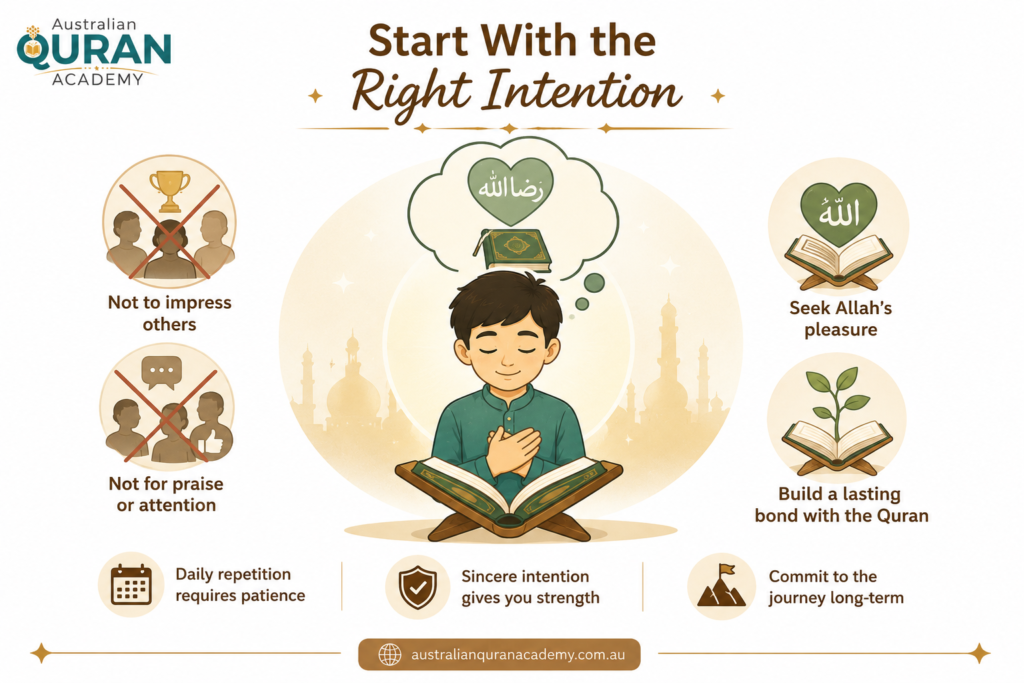
Hifz requires repeating the same verses every day, sometimes for years. A sincere intention gives you a stronger reason to continue when the process becomes difficult or repetitive.
So before setting a memorization target or choosing a teacher, make sure you’re ready to commit to the journey for the long term.
Step 2: Make Sure You Can Read the Quran Fluently
You do not need to speak Arabic fluently to become a hafiz. You do, however, need to be able to read the Quran accurately and comfortably.
For children who grow up speaking English in Australia, Quranic Arabic reading may need to be developed separately from their everyday language skills. This makes a strong Qaida and reading foundation particularly important.
Trying to memorize while still struggling to recognize letters or sound out words can slow down the entire process. Before beginning serious Hifz, make sure you can read the Quran without having to stop at every word.
For younger children who are still developing their Arabic skills, age-appropriate Arabic instruction can be a useful foundation. Parents can explore Arabic Courses for Kindergarten Students as one option for building early Arabic skills.
Step 3: Learn Tajweed Before Starting Heavy Memorization
Once your Quran reading is comfortable, the next priority should be Tajweed.
Tajweed teaches you how to pronounce the Quran correctly and apply the rules of Quranic recitation. This includes areas such as the articulation of Arabic letters, noon saakinah, meem saakinah, idghaam, madd, and other recitation rules.
It is better to correct pronunciation before memorizing large amounts of Quran.
If you memorize a verse incorrectly and repeat that pronunciation hundreds of times, the mistake can become much harder to correct later.
A qualified teacher can help you:
- Correct the pronunciation of individual letters.
- Improve your makharij.
- Identify recurring Tajweed mistakes.
- Listen to your recitation.
- Correct mistakes before they become established habits.
Step 4: Find a Qualified Hifz Teacher Who Fits Your Schedule
A teacher is one of the most important parts of a successful Hifz journey Regular one-on-one listening allows a teacher to identify pronunciation mistakes, correct hesitation, monitor your progress, and hold you accountable for your daily target.
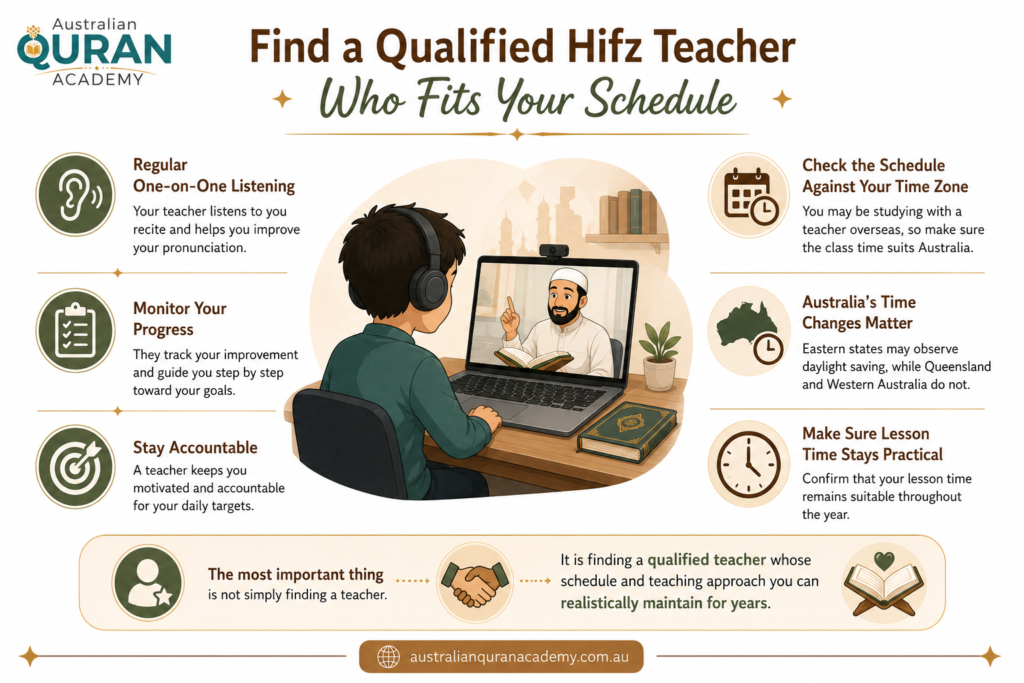
For students in Australia, online learning can make finding qualified guidance much easier. You may be studying with a teacher overseas, so check the class schedule against your Australian time zone before committing.
Remember that Australian states do not all follow the same time changes. Eastern states may observe daylight saving while Queensland and Western Australia do not, so make sure your lesson time remains practical throughout the year.
The most important thing is not simply finding a teacher. It is finding a qualified teacher whose schedule and teaching approach you can realistically maintain for years.
Read also: Daily Routine in Arabic for Kids – Words, Phrases, and a Printable Vocabulary Guide
Step 5: Set a Daily Memorization Target You Can Actually Maintain
One of the biggest mistakes students make is choosing a target based on their best day rather than their normal week.
Your Hifz schedule needs to work alongside school, exams, university, work, sports, family commitments, and other responsibilities.
As a general guide, students may work with targets such as:
- 3 lines per day: approximately 5–6 years.
- 5 lines per day: approximately 3–4 years.
- 1 page per day: approximately 2–2.5 years.
- 2 pages per day: approximately 12–15 months.
These are only rough estimates. Your actual timeline will depend on your pace, revision routine, consistency, and ability to retain what you memorize.

For students who want to develop Arabic alongside their Quran studies, Australian Quran Academy offers programs such as Fusha Arabic Courses.
Step 6: Use a Memorization Method That Helps You Retain Each Verse
Once you have a daily target, use a method that helps you actively remember the material rather than simply recognize it from the page.
One approach is auditory repetition Recite each new line repeatedly while paying close attention to pronunciation and rhythm. Listening to a recording can also help reinforce the correct recitation.
Another approach is visual chunking. Divide the page into small sections, such as two or three lines. Master one section before connecting it to the next.
Whichever method you use, finish by reciting without looking at the mushaf The goal is not to be able to recognize the verse when you see it. The goal is to be able to produce it accurately from memory.
See Us in Action!
Curious about what our online classrooms look like? Watch the short clips below to see how our interactive, one-on-one sessions bring learning to life with real-time feedback and engaging teaching methods.
Start Your Quranic Journey in Australia
Join our leading online academy and learn with expert tutors through a structured, personalized curriculum.
Book Your Free TrialStep 7: Build a Three-Layer Review System From Day One
Memorizing new verses is only one part of Hifz. Without regular revision, previously memorized portions will gradually become weaker.
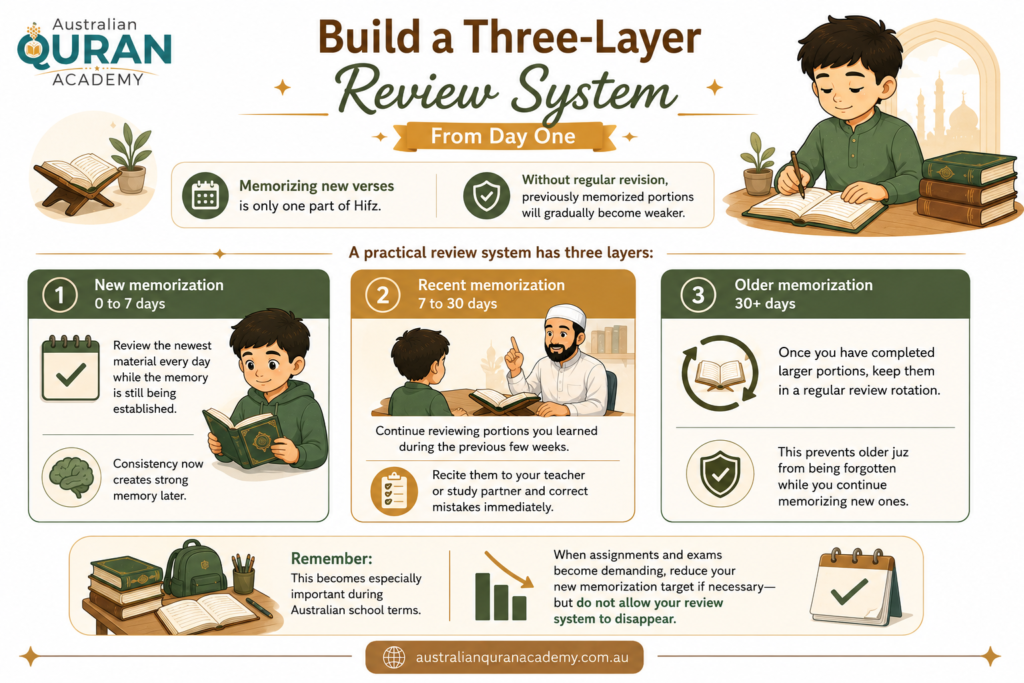
A practical review system has three layers:
New memorization — 0 to 7 days
Review the newest material every day while the memory is still being established.
Recent memorization — 7 to 30 days
Continue reviewing portions you learned during the previous few weeks. Recite them to your teacher or study partner and correct mistakes immediately.
Older memorization — 30+ days
Once you have completed larger portions, keep them in a regular review rotation. This prevents older juz from being forgotten while you continue memorizing new ones.
This becomes especially important during Australian school terms. When assignments and exams become demanding, reduce your new memorization target if necessary—but do not allow your review system to disappear.
Read also: What Are the Rewards of Becoming a Hafiz? 10 Benefits of Memorizing the Quran
Step 8: Use Your Daily Prayers to Strengthen Your Hifz
our five daily prayers provide natural opportunities to review memorized Quran.
Instead of treating every revision session as an additional task, you can incorporate portions of your Hifz into your existing prayer routine.
For example, you can:
- Use newly memorized verses in voluntary prayers.
- Recite older portions in your regular prayers.
- Alternate between different portions throughout the week.
- Use prayer to practice recalling Quran without looking at the mushaf.
- Repeat difficult passages until they become more secure.
For students balancing Hifz with school or university, using existing parts of the day can make the overall routine much easier to maintain.
Step 9: Recite Your Memorization to Your Teacher Regularly
Never rely only on your own judgment to decide whether you have memorized a passage correctly.
Recite your memorization out loud to your teacher or a reliable Quran study partner without looking at the mushaf.
Regular listening helps identify mistakes before they become established habits. At the memorization stage, weekly or twice-weekly checking is more useful than waiting for an occasional assessment.
Your teacher should be able to tell you where you hesitate, where your pronunciation needs correction, and which portions require additional revision.
Step 10: Stay Consistent and Adjust Your Life Around Hifz
Hifz will not always fit perfectly into your schedule There will be school exams, university deadlines, work commitments, family responsibilities, holidays, and unexpected events.
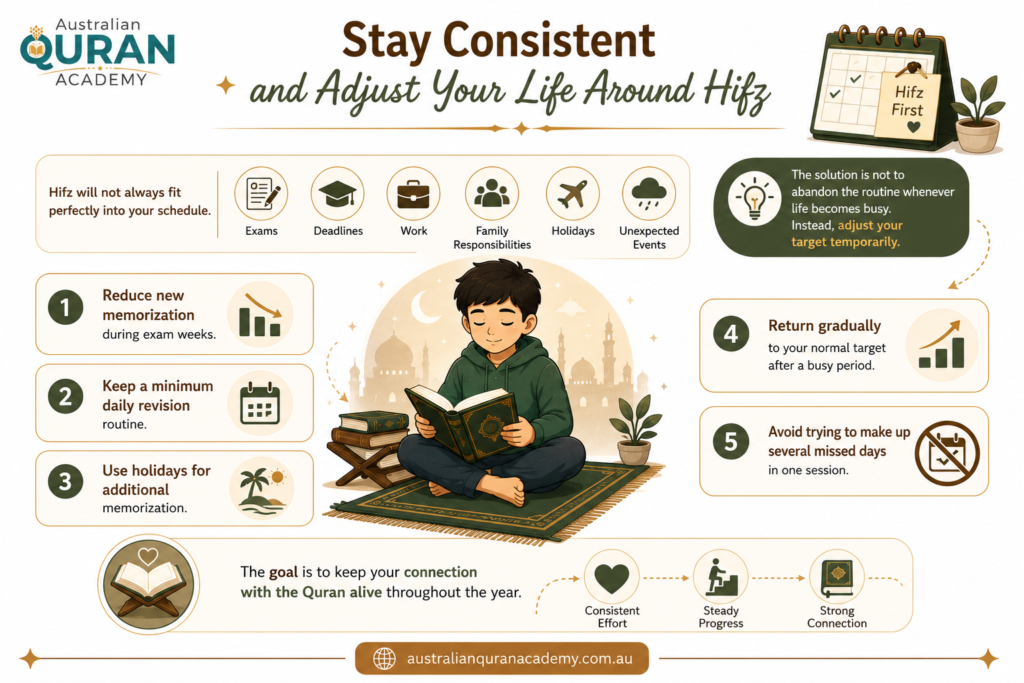
The solution is not to abandon the routine whenever life becomes busy. Instead, adjust your target temporarily.
For example:
- Reduce new memorization during exam weeks.
- Keep a minimum daily revision routine.
- Use holidays for additional memorization.
- Return gradually to your normal target after a busy period.
- Avoid trying to make up several missed days in one session.
The goal is to keep your connection with the Quran alive throughout the year.
How Long Does It Take to Become a Hafiz in Australia?
There is no single timeline for every student. The article’s practical range is around 2 to 7 years, depending on age, daily commitment, and consistency.
Children between 6 and 14 may progress faster, particularly when they have a consistent daily schedule and strong review system. Adults balancing work, university, or family responsibilities may need a longer timeline.
The important point is that your starting age is not the only factor. Your daily target and ability to maintain it throughout the year matter more.
What Slows Down Hifz Progress?
Three problems are particularly important for students in Australia:
Skipping Review During Busy School Terms
When school becomes demanding, students often stop reviewing while continuing to memorize new pages. This creates the appearance of progress while older memorization becomes weaker If your schedule becomes difficult, reduce new memorization before reducing revision.
Trying to Hifz Without Regular Teacher Support
Self-study may seem convenient when time zones are difficult, but it makes it easier for pronunciation and memorization mistakes to go unnoticed A teacher provides regular correction and accountability.
Setting an Unrealistic Daily Target
Do not copy the schedule of a full-time Hifz student overseas if you are also attending an Australian school or working full-time Your target should be based on your actual week, not somebody else’s schedule.
Read also: Easy Arabic Stories for Kids – 7 Stories With Translation, Vocabulary, and Activities
Can You Become a Hafiz in Australia Without Moving Overseas?
Yes. You can build your Hifz journey in Australia through a combination of local Islamic education and online instruction.
A student might attend Islamic weekend school, work with an online teacher during the week, and use daily home practice and prayer for additional revision.
The key is having a structured routine and qualified guidance rather than simply choosing between “Australia” and “overseas.”
For students who want to develop Arabic alongside their Quran studies, Australian Quran Academy offers programs such as Classical Arabic Courses.

Inside Our Virtual Classrooms
We believe in full transparency and proven quality. Take a look at these actual snippets from our live classes to experience our modern learning platform, patient instructors, and interactive student participation.
start Your Hifz Journey With Australian Quran Academy
Becoming a Hafiz is a long-term commitment, but you do not have to build the journey alone For students and families in Australia, having access to structured Quran and Arabic education can make it easier to establish a routine that works around school, work, and family life.
Australian Quran Academy offers online Quran and Arabic learning options for students at different stages of their learning journey.
Whether you are helping a young child develop an Arabic foundation, strengthening your Arabic skills, or looking for structured Quran education, you can explore the academy’s available programs and find an option that fits your goals.
Book your free trial lesson today
Our Quran Courses
- Quran Online Academy
- Quran Recitation Classes
- Quran Reading Classes
- Online Quran Classes for Kids
- Quran Classes for Adults
- Quran Classes for Female/Sisters
- Learn Quran Course for Beginners
- Quran Memorization (Hifz) Course
- Hifz Classes for Adults
- Quran Memorization and Hifz Course for Kids
- Quran Hifz Course for Ladies
- Quran Ijazah Program
- Quran Qirat Learning Course
- Quran Tafsir Course
- Noorani Qaida Course
- Noorani Qaida Course for Kids
- Weekend Quran Classes
- Intensive Quran Course
- Al-Azhar Quran Course
- Online Tajweed Classes
- Tajweed Course for Kids
- Tajweed Course for Adults
- Tajweed Course for Ladies
Start Your Quranic Journey in Australia
Join our leading online academy and learn with expert tutors through a structured, personalized curriculum.
Book Your Free TrialConclusion
Becoming a Hafiz in Australia is completely possible, even if you are balancing Quran memorization with school, university, work, or family responsibilities. You do not need to follow an extreme schedule or finish as quickly as possible. The key is to build a routine you can maintain for years.
Start by making sure your Quran reading and Tajweed are strong, then find a qualified teacher and choose a daily memorization target that fits your actual schedule. Most importantly, make revision a permanent part of your routine. When life gets busy, slow down your new memorization rather than giving up on Hifz altogether.
Every student’s journey will look different. Some may memorize quickly, while others may need several years. What matters is continuing to move forward while keeping the Quran you have already memorized strong.
Frequently Asked Questions
Can I become a Hafiz in Australia without attending a full-time Hifz school?
Yes. Certified online instruction can provide regular teacher supervision while allowing you to continue attending an Australian school, university, or workplace.
How can I become a Hafiz as an adult with a full-time job?
Start with a manageable target, such as five lines per day, and prioritize consistency and review. Your timeline may be longer, but a sustainable routine can allow you to progress without giving up your work commitments.
Do I need to speak Arabic to become a Hafiz?
No. You need to be able to read the Quran accurately and learn correct pronunciation and tajweed. Speaking Arabic fluently is not a prerequisite for memorizing the Quran.
Is it better to memorize with a teacher or by myself?
Regular guidance from a qualified teacher is strongly recommended because the teacher can correct pronunciation, listen to your memorization, and keep you accountable.
Do Australian school holidays help with Hifz?
They can. School holidays provide additional time for memorization and, especially, catching up on review that may have become difficult during busy school terms.







Leave a Reply