 Arabic
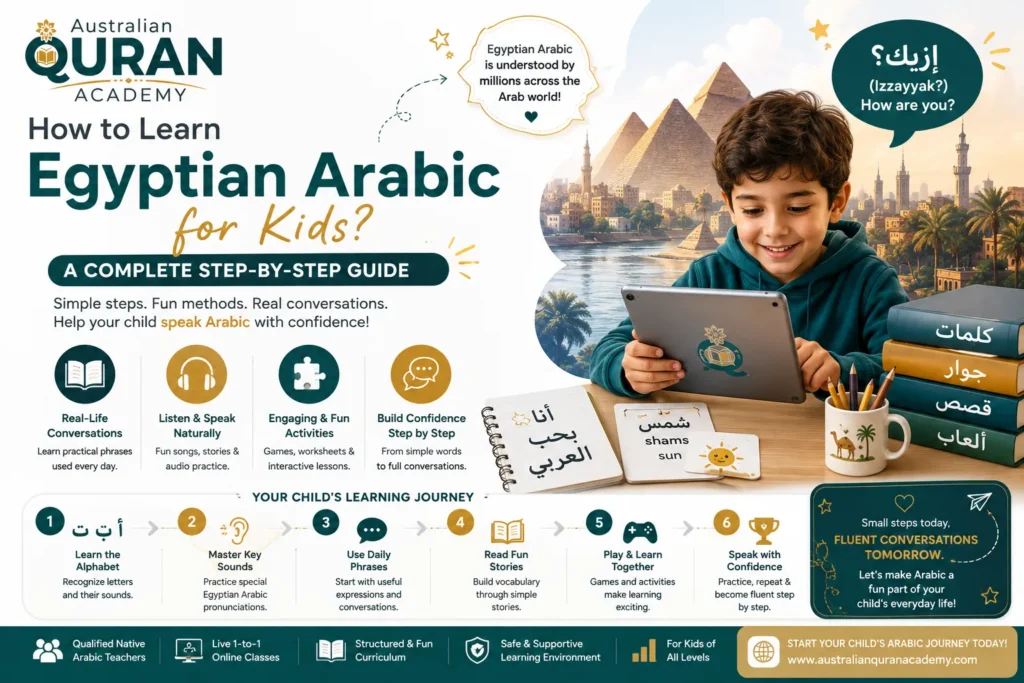
Egyptian Arabic is the most widely understood dialect in the Arab world — and one of the most rewarding languages a child can learn. Whether your child is a complete beginner or already knows a few Arabic letters, this guide gives you a clear, actionable roadmap to help them learn Egyptian Arabic in a way that sticks.
Egyptian Arabic (اللهجة المصرية) is the everyday spoken dialect of Egypt’s 100+ million people. Unlike Modern Standard Arabic (MSA), which is used in formal writing and news broadcasts, Egyptian Arabic is what you hear in homes, markets, and on every Egyptian street corner.
No one speaks MSA as a native tongue. Egyptian Arabic, on the other hand, is a living language — warm, expressive, and packed with humor. For children who want to connect with Egyptian culture, travel with family, or communicate with Egyptian relatives and friends, learning Egyptian Arabic is far more immediately useful than any formal dialect.
There is one more reason it is the smart choice for children: because of Egypt’s enormous influence on Arab cinema, television, and music, Egyptian Arabic is understood by Arabic speakers from Morocco to Iraq. A child who learns Egyptian Arabic can communicate across the Arab world — making it the highest-return dialect to learn first.
Step 1: Start with the Arabic Alphabet (Even for Egyptian Arabic)
The first practical step to learn Egyptian Arabic for kids is learning to read the Arabic script. Egyptian Arabic uses the same 28-letter Arabic alphabet as MSA, so this investment pays off for every form of Arabic your child will ever encounter.
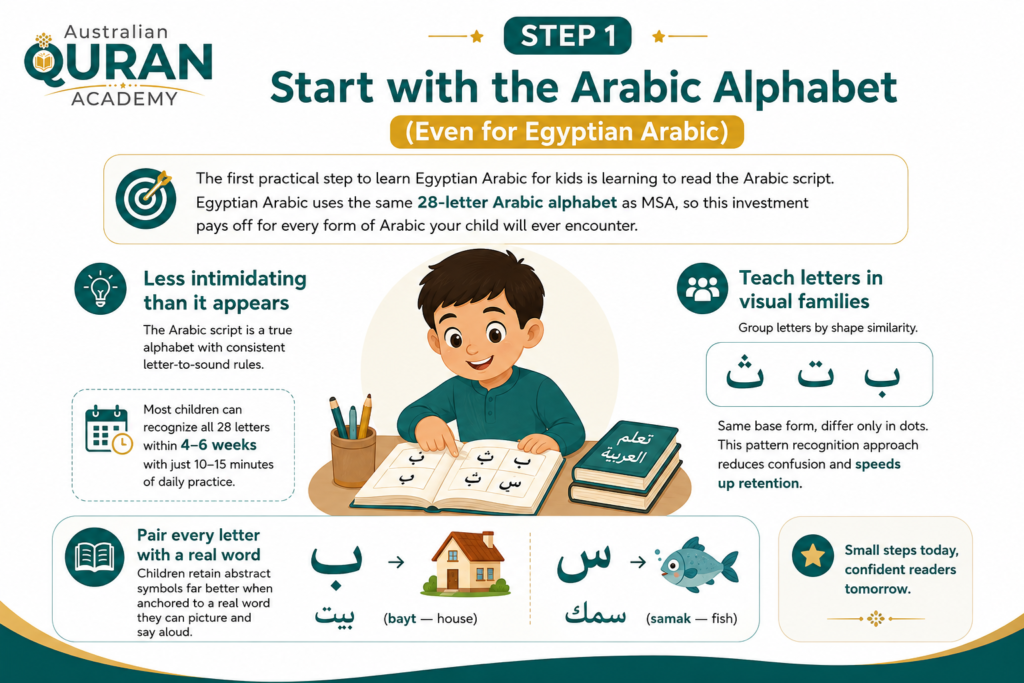
The Arabic script is far less intimidating than it appears. Unlike character-based languages, it is a true alphabet with consistent letter-to-sound rules. Most children can recognize all 28 letters within four to six weeks of consistent daily practice — roughly 10 to 15 minutes per day.
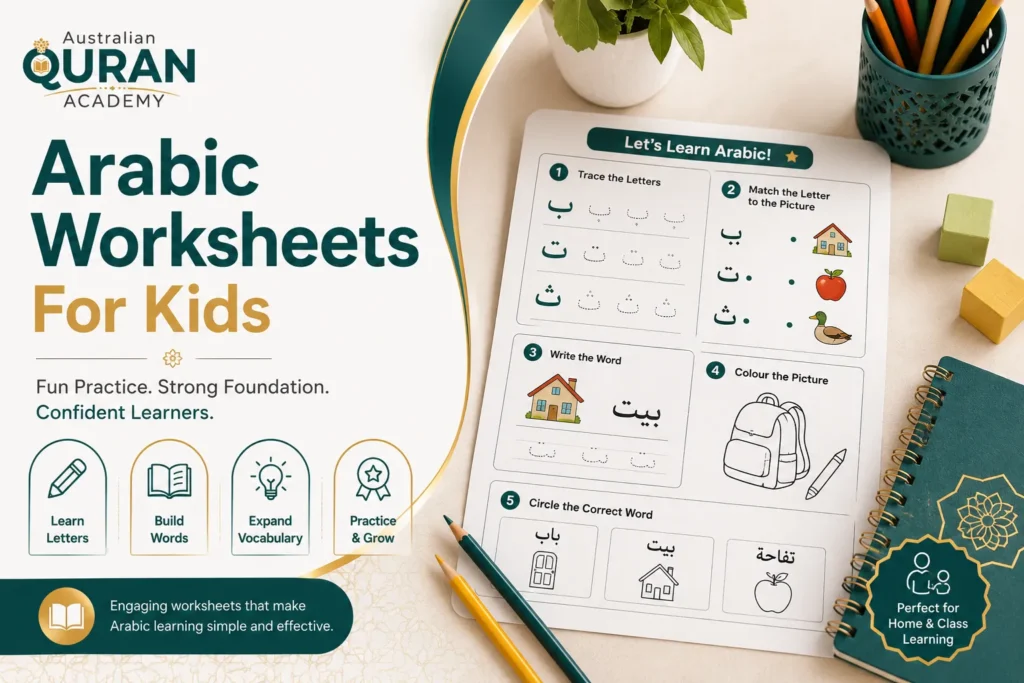
Teach letters in visual families rather than strict alphabetical order. Group letters by shape similarity: ب، ت، ث share the same base form and differ only in dots. This pattern recognition approach dramatically reduces confusion and speeds up retention.
Pair every letter with a concrete Egyptian Arabic word: ب for بيت (bayt — house), س for سمك (samak — fish). Children retain abstract symbols far better when anchored to a real word they can picture and say aloud.
Read also: 12 Best Arabic Books for Kids: A Complete Parent’s Guide
Step 2: Teach the Egyptian Arabic Sounds That Are Different
Egyptian Arabic shifts certain sounds from what the Arabic alphabet technically represents in MSA. Children who learn these sound shifts early avoid confusion and develop accurate pronunciation from the start — avoiding bad habits that are difficult to correct later.
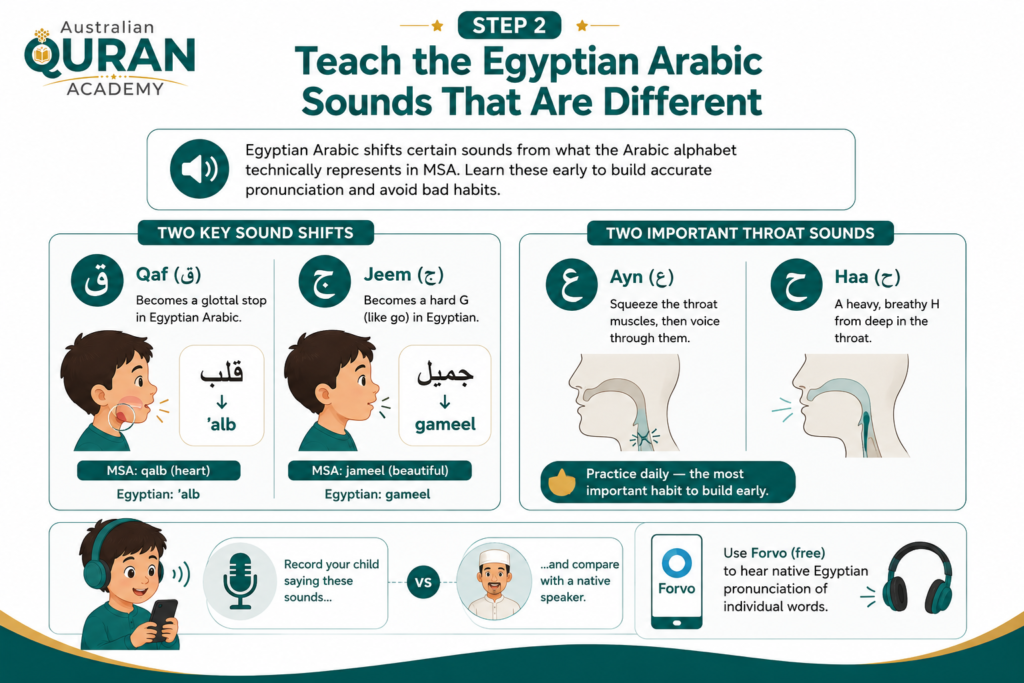
The two most important sound shifts for beginners:
Qaf (ق) is pronounced as a glottal stop in Egyptian Arabic — a tiny catch in the throat, like the pause in the English “uh-oh.” In MSA, it is a deep back-of-throat sound. So the word قلب (heart), which is qalb in MSA, becomes ‘alb in Egyptian Arabic.
Jeem (ج) is pronounced as a hard G (like go) in Egyptian Arabic, not the soft J of MSA. So جميل (beautiful), which is jameel in MSA, becomes gameel in Egyptian Arabic.
Beyond these shifts, two throat sounds need daily practice because they have no English equivalent:
- ع (Ayn): Produced by squeezing the throat muscles, then voicing through them. Practice daily — this is the single most important pronunciation habit to build early.
- ح (Haa): A heavy, breathy H, like fogging a mirror from deep in the throat.
Record your child saying these sounds and compare with a native speaker recording. Apps like Forvo (a free pronunciation dictionary) let you hear native Egyptian pronunciation of individual words, which is invaluable for getting these sounds right.
Read also: 10 Free Ways to Learn Arabic for Kids Online in Australia
Step 3: Learn Useful Egyptian Arabic Phrases Before Grammar
The most common mistake parents and teachers make when teaching Egyptian Arabic for kids is starting with grammar rules. Children learn languages through use, not through explanation. Start with phrases they can deploy immediately in real life.
Here are the most essential Egyptian Arabic phrases for children to learn first:
Greetings:
- إزيك؟ (Izzayyak? / Izzayyik?) — How are you? (male/female)
- أنا كويس (Ana kwayyis) — I’m good
- صباح الخير (Sabah el-kheir) — Good morning
- مع السلامة (Ma’a el-salama) — Goodbye
Daily life:
- أنا جعان (Ana ga’aan) — I’m hungry
- أنا عطشان (Ana ‘atshaan) — I’m thirsty
- فين الحمام؟ (Feen el-hammaam?) — Where is the bathroom?
- بكام ده؟ (Bikaam da?) — How much is this?
Social filler words (essential for sounding natural):
- تمام (Tamaam) — Perfect / okay
- خلاص (Khalas) — Enough / done
- يعني (Ya’ni) — Like / so / meaning
- ماشي (Maashi) — Okay / fine
These filler words are how Egyptian Arabic sounds natural rather than textbook-stiff. Native speakers use them constantly, and children who pick them up early sound dramatically more fluent than their actual level would suggest.
If your child later wants to explore formal Arabic for reading or Islamic studies, Fusha Modern Standard Arabic build naturally on this spoken foundation.

Step 4: Introduce Egyptian Arabic Grammar Gradually
Egyptian Arabic grammar is simpler than MSA in several key ways, making it easier for children to start speaking correctly without memorizing complex grammatical rules.
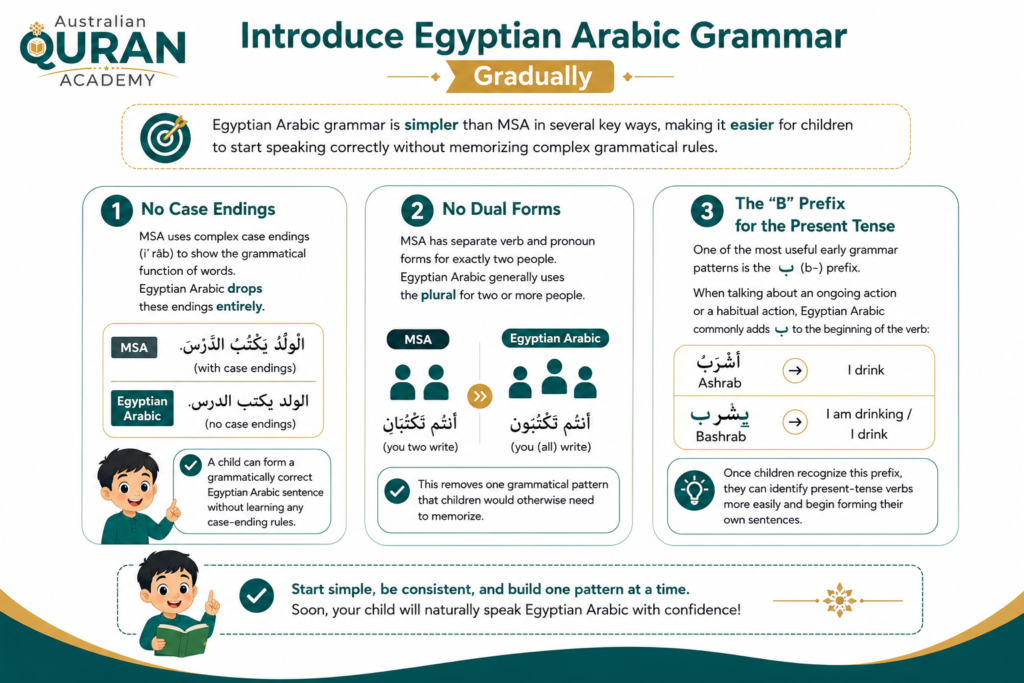
1. No Case Endings
MSA uses complex case endings (iʿrāb) to show the grammatical function of words. Egyptian Arabic drops these endings entirely.
This means a child can form a grammatically correct Egyptian Arabic sentence without having to learn a single case-ending rule.
2. No Dual Forms
MSA has separate verb and pronoun forms for exactly two people. Egyptian Arabic generally uses the plural for two or more people.
This removes one grammatical pattern that children would otherwise need to memorize.
3. The “B” Prefix for the Present Tense
One of the most useful early grammar patterns is the بـ (b-) prefix.
When talking about an ongoing action or a habitual action, Egyptian Arabic commonly adds بـ to the beginning of the verb:
- Ashrab → I drink
- Bashrab → I am drinking / I drink
Once children recognize this prefix, they can identify present-tense verbs more easily and begin forming their own sentences.
Read also: Best Arabic Learning App for Kids – The Complete Guide to the Top 10 Apps
Step 5: Use Songs, Cartoons, and Storytelling for Immersion
Children absorb language most naturally through play and story — not through drills. Egyptian media is the richest source of child-friendly immersion material in any Arabic dialect.
Egyptian children’s cartoons like بكار (Bakar) use age-appropriate vocabulary and clear pronunciation. Fifteen to twenty minutes of daily viewing builds listening comprehension passively, in the same way children absorb their first language.
Songs and rhymes are powerful vocabulary anchors. The rhythm and repetition of songs make words stick in ways that flashcards cannot replicate. Start with simple Egyptian children’s songs and have your child repeat phrases after each listen.
Storytelling in Egyptian Arabic is especially effective for building sentence structure. Tell short, familiar stories in Egyptian Arabic using simple vocabulary and repetition — fairy tales, daily routine stories, or short Islamic narratives work perfectly. After the story, ask simple questions: “الولد راح فين؟” (El-walad raah feen? — Where did the boy go?). This builds listening comprehension and conversational response simultaneously.
After watching, pause and ask your child to repeat one phrase they heard. Write it down. Three phrases per session, added to a vocabulary app like Anki, compounds into a substantial bank of naturally acquired Egyptian Arabic over several months.
See Us in Action!
Curious about what our online classrooms look like? Watch the short clips below to see how our interactive, one-on-one sessions bring learning to life with real-time feedback and engaging teaching methods.
Start Your Quranic Journey in Australia
Join our leading online academy and learn with expert tutors through a structured, personalized curriculum.
Book Your Free TrialStep 6: Practice Speaking from Day One
Speaking from the very first day is the single most effective habit that separates children who become conversational quickly from those who plateau.
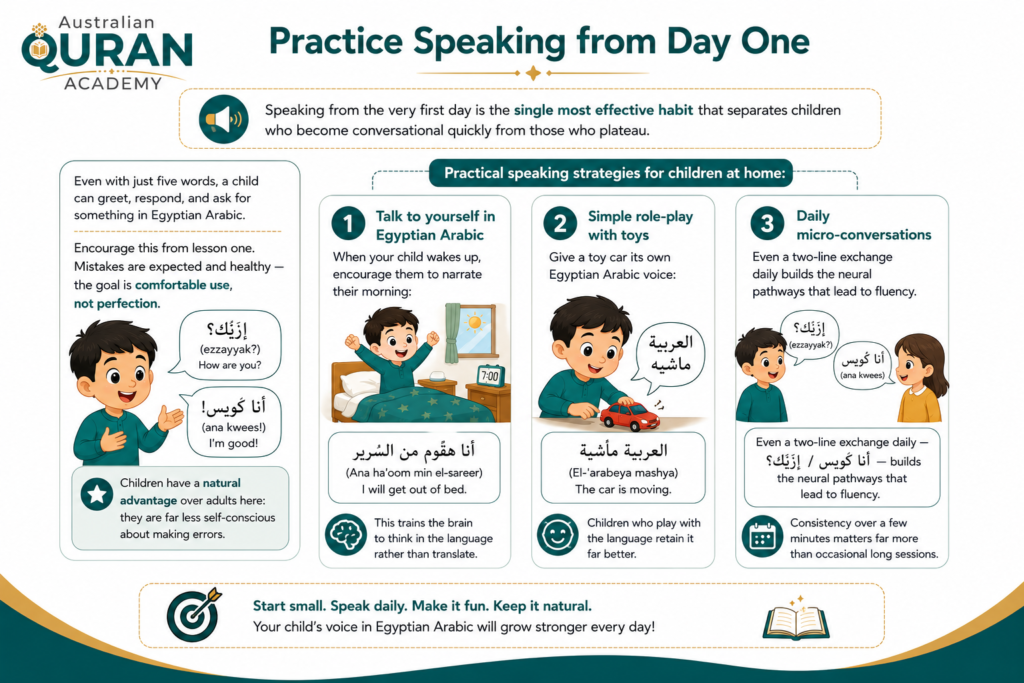
Even with just five words, a child can greet, respond, and ask for something in Egyptian Arabic. Encourage this from lesson one. Mistakes are expected and healthy — the goal is comfortable use, not perfection. Children have a natural advantage over adults here: they are far less self-conscious about making errors Practical speaking strategies for children at home:
Talk to yourself in Egyptian Arabic
When your child wakes up, encourage them to narrate their morning: أنا هقوم من السرير (Ana ha’oom min el-sareer — I will get out of bed). This trains the brain to think in the language rather than translate.
Simple role-play with toys
Give a toy car its own Egyptian Arabic voice: العربية ماشية (El-‘arabeya mashya — The car is moving). Children who play with the language retain it far better than children who only study it.
Daily micro-conversations
Even a two-line exchange daily — إزيك؟ / أنا كويس — builds the neural pathways that lead to fluency. Consistency over a few minutes matters far more than occasional long sessions.
Read also: Best Academy to Learn Quran Online from Home in Australia
Step 7: Build Vocabulary Systematically with Spaced Repetition
Random exposure to new words is less effective than regular, structured review. For children learning Egyptian Arabic, spaced repetition can help them remember useful vocabulary by bringing words back at gradually increasing intervals.
Instead of introducing large numbers of words at once, choose a small number of useful words or phrases each day and review them regularly. For example, five new words or short phrases per day can provide a manageable starting point. The key is to keep reviewing previously learned vocabulary while gradually introducing new words.
Whenever possible, combine each word with audio, a picture, or a simple example sentence This helps children connect the word with its meaning and pronunciation rather than memorizing an isolated translation.
If your child later wants to explore formal Arabic for reading or Islamic studies Classical Arabic build naturally on this spoken foundation.

How Long Does It Take a Child to Learn Egyptian Arabic?
Children learn languages faster than adults — particularly at the phonological level. Here is a realistic timeline for children with consistent daily practice of 15–30 minutes:
| Level | What the Child Can Do | Estimated Time |
| Survival | Greet, count, order food, ask for help | 1–2 months |
| Conversational | Discuss daily life, follow simple TV | 6–12 months |
| Intermediate | Participate naturally in social situations | 12–18 months |
| Advanced | Understand rapid speech, use slang comfortably | 2–3 years |
Children in bilingual or immersion environments — hearing Egyptian Arabic at home daily — can reach conversational level in four to six months. For children practicing online without daily immersion, six to twelve months is the realistic target for genuine conversational ability.
Prior Arabic knowledge matters significantly. A child who already reads Arabic script and knows MSA basics will reach Egyptian Arabic conversational level roughly forty percent faster than a complete beginner.
Read also: Best Website to Learn Quran Online in Australia
Inside Our Virtual Classrooms
We believe in full transparency and proven quality. Take a look at these actual snippets from our live classes to experience our modern learning platform, patient instructors, and interactive student participation.
Start Your Quranic Journey in Australia
Join our leading online academy and learn with expert tutors through a structured, personalized curriculum.
Book Your Free TrialReady to Help Your Child Start Speaking Arabic?
Learning Egyptian Arabic becomes much easier when children have regular opportunities to hear, practice, and use the language in meaningful situations. With the right combination of conversation practice, vocabulary building, pronunciation, and consistent exposure, children can gradually develop confidence and begin using Arabic naturally in everyday situations.
Australian Quran Academy offers Arabic courses taught by qualified native instructors, with options for different learning goals and levels. Children can build their spoken Arabic through Egyptian Arabic, while families who also want to develop Quranic understanding or formal Arabic can explore Fusha and Classical Arabic courses as their child progresses.
Our Arabic Courses
- Online Arabic Academy
- Online Arabic Course
- Classical Arabic Course
- Arabic Course for Beginners
- Advanced Arabic Course
- Quranic Arabic Course
- Arabic Grammar Course
- Modern Standard Arabic Course
- Arabic Conversation / Speaking Course
- Intensive Arabic Course
- Online Arabic Classes for Kids
- Arabic Classes for Adults
- Arabic Classes for Ladies
- Fusha Arabic Course
- Business Arabic Course
- Al-Azhar Arabic Course
- Madinah Arabic Course
- Learning Arabic for Non-Arabic Speakers
- Arabic Elementary School
- Arabic Intermediate School
- Arabic Lessons for Kindergarten
Book Your Child’s Free Trial Lesson →

Start Your Quranic Journey in Australia
Join our leading online academy and learn with expert tutors through a structured, personalized curriculum.
Book Your Free TrialConclusion
Learning Egyptian Arabic gives children the most widely understood dialect in the Arab world, direct access to a vast library of media and culture, and a spoken language foundation that makes every other form of Arabic easier to learn later. The steps are straightforward: start with the alphabet, master the key sound shifts, build vocabulary through phrases and songs, and speak from day one. Progress follows consistency — even fifteen minutes daily produces remarkable results over six to twelve months.
The single biggest accelerator is live instruction with a qualified native speaker who corrects pronunciation early, before errors become habits.
FAQs
What age should kids start to learn Egyptian Arabic?
Children can begin Egyptian Arabic as young as four years old, starting with songs, simple phrases, and letter recognition. Ages four to seven are ideal for phonological development — children at this stage acquire Egyptian Arabic sounds, including the challenging throat consonants, significantly faster and more naturally than older learners or adults.
Is Egyptian Arabic hard for kids to learn?
Egyptian Arabic is generally considered easier for children than MSA because its grammar is simplified — no case endings and no dual forms. The main challenge is a handful of throat sounds (ع and ح) that do not exist in English. Children who practice these sounds daily from the beginning rarely struggle with them by the intermediate level.
Can kids learn Egyptian Arabic without knowing MSA first?
Yes. For the purpose of speaking and understanding Egyptian Arabic, children do not need MSA first. MSA knowledge helps with reading and transitions to formal Arabic later, but conversational Egyptian Arabic can be learned independently and is often the better starting point for young children whose goal is real-world communication.
How many Egyptian Arabic words does a child need to have basic conversations?
Approximately 300 to 500 high-frequency words and phrases cover the vast majority of everyday Egyptian Arabic conversations. With consistent daily practice using spaced repetition, most children can build this core vocabulary within three to five months — reaching a level where they can greet, ask questions, describe their day, and understand basic responses from native speakers.
What is the best way for kids to practice Egyptian Arabic at home?
The most effective home practice combines daily micro-conversations (even two to three lines), Egyptian Arabic cartoons or songs for fifteen to twenty minutes, and vocabulary review through a spaced repetition app like Anki. The key is daily contact with the language rather than occasional intensive sessions. Role-play with toys, self-talk during routines, and simple questions in Egyptian Arabic at meal times all build fluency faster than formal study time alone.







Leave a Reply