 Quran
Quran
| Key Takeaway |
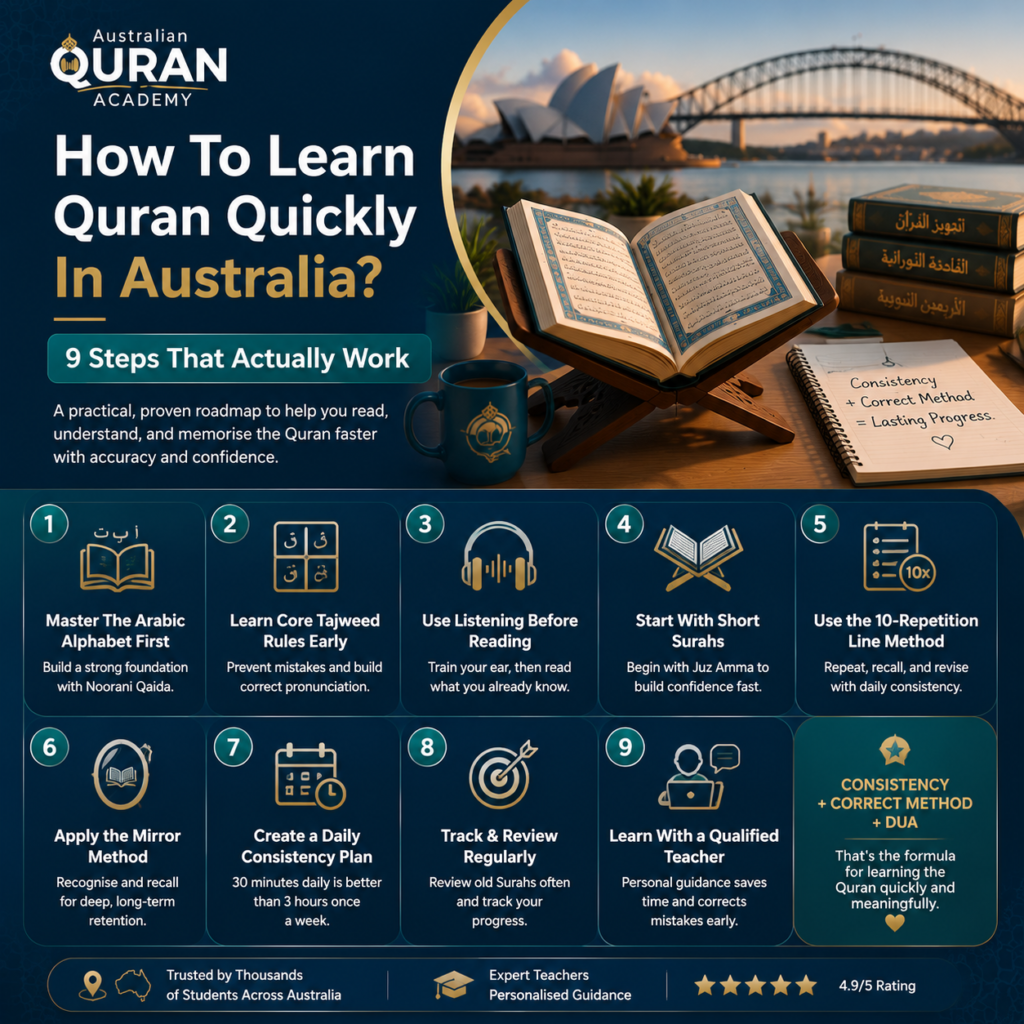
| Master the Arabic alphabet first — it’s the foundation of fast Quran learning. |
| Learn core Tajweed rules early to avoid bad habits that slow you down later. |
| Use audio-first listening before opening the Mushaf to train pronunciation faster. |
| Start with short surahs in Juz Amma to build momentum and confidence. |
| A consistent 30-minute daily routine beats occasional long sessions every time. |
| A qualified teacher from Australian Quran Academy cuts your learning time significantly. |
If you’ve been searching for how to learn Quran quickly in Australia, you already know the struggle: packed schedules, limited local teachers, and no shortage of conflicting advice online.
Whether you’re a working adult, a busy parent, or a complete beginner, learning the Quran fast is entirely possible — but only when you follow the right sequence of steps.
This guide draws on proven memorisation methods and practical strategies used by thousands of learners, structured specifically for Australian Muslims who want real, lasting progress without sacrificing accuracy.
1. Master The Arabic Alphabet Before Anything Else
Many learners want to jump straight into memorising surahs. That impulse is understandable — but skipping the foundation is the single most common reason people plateau early and never achieve the speed they’re aiming for.
The recommended starting point is Noorani Qaida (also called Qaida Nuraniyah), a structured foundation course that takes you from isolated letters to connected words. Practising 20–30 minutes per day, most beginners can read fluently at the letter and word level within 4–8 weeks.
The key focus during this stage is Makhaarij al-Huroof — the precise points of articulation for each Arabic sound, many of which don’t exist in English.
Without confident letter recognition, your brain spends its processing power decoding individual letters instead of absorbing whole words and phrases. This is the stage that looks slow but makes everything after it fast.
If you want a structured path through this stage, Australian Quran Academy’s Learn Quran for Beginners programme covers exactly this progression, from the alphabet through to confident Quran reading.
2. Learn Core Tajweed Rules Early
Tajweed is the set of rules that govern correct Quran recitation. Many beginners treat it as an advanced concern — that is a mistake. Learning the foundational rules early prevents the hardest problem in Quran learning: unlearning wrong habits.
The four core rules to prioritise first are:
- Noon Sakinah and Tanween (rules of nasal sounds)
- Meem Sakinah
- Madd rules (elongation)
- Heavy and light letters (Tafkheem and Tarqeeq)
Just 10–15 minutes of Tajweed practice per day at the beginner stage builds the pronunciation foundation that makes memorisation dramatically faster later. You’re not slowing down — you’re removing the speed bumps before you hit them.
Read Also: learn quran alphabet in Australia
Read also: The Importance Of Learning And Teaching The Quran
3. Use Listening Before Reading To Train Your Brain
One of the fastest — and most underused — methods for learning Quran quickly is audio-first learning. The brain absorbs correct pronunciation, rhythm, and natural pause points (Waqf) far faster through the ear than through the eye alone.
Choose a slow, clear reciter: Sheikh Al-Husary and Sheikh Minshawi are both ideal for beginners because they recite at a pace that allows your ear to isolate individual words. The approach is simple:
- Listen to the same ayah 3–5 times before opening the Mushaf
- Repeat it aloud after each listen
- Then open the Quran and read what your ear already knows
Learners who listen to a page the night before memorising it in the morning consistently report that the morning session takes 30–40% less time — because recognition, not acquisition, is doing most of the work.
4. Start With Short Surahs — Then Build Upward
If your goal is to learn the Quran fast and easy, the worst starting point is a long surah. Long surahs feel difficult, create early discouragement, and contain vocabulary patterns that beginners haven’t yet encountered.
Short surahs, by contrast, are rhythmically smooth, contain repeated root words, and produce genuine motivation because you finish them quickly.
The Prophet Muhammad (peace be upon him) himself began with the shorter revelations, particularly those of Juz Amma (the 30th chapter). Follow the same sequence:
Suggested starting order:
- Al-Fatiha
- Al-Ikhlas
- Al-Falaq
- An-Nas
- Al-Asr
- Al-Kawthar
Words and patterns from Juz Amma reappear throughout the Quran — which means early memorisation of short surahs creates recognition shortcuts that speed up everything that comes after.
Australian Quran Academy offers dedicated Quran Classes in Australia structured around this exact progression, helping students build momentum before moving into longer chapters.
Read also: How To Learn The Qirat Of The Quran In Australia? A Complete Guide
5. Use the 10-Repetition Line Method
This is a clean, structured approach suited to beginners and intermediate learners who want to know how to learn the Quran fast with reliable daily results.
- Recite one line a minimum of 10 times while looking
- Recite it from memory 1–10 times
- If you struggle with a word, repeat that word with the word before and after it 5 times
- Move to the next line and repeat the process
- Combine lines, reciting them 3–10 times together
- At the end of the session, repeat the full portion 20 times while tracing each line with your finger
A practical note: recite the newly memorised portion in your salah immediately after memorising it, and again randomly during the day. One day without reciting a new portion is often enough to begin losing it.
6. Apply the Mirror Method for Deep Retention
The Mirror Method balances recognition and recall using the principle of active retrieval combined with decreasing repetition loads.
It is one of the most effective answers to the question of how can I learn Quran fast without shallow, forgettable memorisation.
- Recite an ayah while looking — 7 times
- Recite it without looking — 7 times
- Recite it while looking — 5 times
- Recite it without looking — 5 times
- Recite it while looking — 3 times
- Recite it without looking — 3 times
This is 30 repetitions minimum. If the ayah is long or complex, begin at 11 and decrease through 9, 7, 5, 3, 1. Apply the same mirrored structure when combining ayahs together.
For a lighter variation, the 6446 Method works on the same principle: recite a verse looking 6 times, without looking 4 times, looking again 4 times, then without looking 6 times.
Inside Our Virtual Classrooms
We believe in full transparency and proven quality. Take a look at these actual snippets from our live classes to experience our modern learning platform, patient instructors, and interactive student participation.
Start Your Quranic Journey in Australia
Join our leading online academy and learn with expert tutors through a structured, personalized curriculum.
Book Your Free Trial7. Use the Quarter-Page Build for Full-Page Sessions
This method works well for learners targeting a full page per session and is ideal for intermediate students who have cleared the beginner stage.
- Recite one line by looking 7 times, then off memory 7 times
- Repeat for each line until you reach a quarter of the page
- Recite the quarter-page 5 times looking and 5 times off memory
- Repeat steps 1–3 for the next quarter
- Recite the first half 3 times looking and 3 times off memory
- Repeat for the second half
- Recite the entire page once looking and once off memory
- Throughout the day, recite the full page from memory repeatedly to build fluency
You can adapt this by increasing repetitions or dividing the page into three parts and repeating each 33 times, tracing the lines with your finger as you go.
8. Memorise With Meaning Using the Tafseer Method
This method is consistently underused — and consistently produces the most durable memorisation.
Ibn Taymiyyah placed Quran memorisation above most other forms of religious knowledge precisely because it combines linguistic mastery with divine meaning.
- The night before, read the translation and watch or read a short Tafseer of the target ayahs. Spend a few minutes reflecting
- The next day, recite the ayah 15–20 times aloud while looking, with the meaning actively in mind — make a mental association with each word
- Listen to the verses from a qualified reciter
- Recite from memory until you know it confidently
- If you make mistakes, break it into lines and apply the same process to each
Understanding the meaning does not slow memorisation — it creates semantic memory hooks that pure repetition cannot build.
Learners who pair meaning with repetition typically retain their memorisation significantly longer between revision sessions.
Read Also: best time to learn quran
9. Try the 3×3 Workout for Consistent Daily Progress
Developed by Qari Wisam Sharieff through his work at Quran Revolution and Memorize Mentor, the 3×3 Workout is a scalable method that suits learners of all levels — including those who want to know how to learn the Quran fast and easy within a short daily window.
- Recite the full lesson 7 times while looking
- Recite verse one — 3 times
- Recite verse two — 3 times
- Recite verses one and two together — 3 times
- Recite verse three — 3 times
- Recite verses one, two, and three together — 3 times
- Continue in this pattern for each new verse
The 3×3 structure trains both individual verse retention and cumulative page retention simultaneously — which is what makes it effective for learners with limited time.
A Daily Routine Built For Busy Australians
One of the most common blockers for Australians learning Quran quickly is time — not motivation. The good news: consistent short sessions outperform occasional long ones for both reading fluency and memorisation retention.
Here is a practical 30-minute daily plan:
| Time Block | Duration | Activity |
| Warm-up | 5 minutes | Review previous day’s portion or a memorised surah |
| Listening | 5 minutes | Listen to today’s target ayahs before opening the Mushaf |
| New memorisation | 15 minutes | Apply your chosen method (Mirror, 3×3, or Line Method) |
| Revision | 5 minutes | Recite a portion memorised earlier in the week from memory |
After Fajr is the most effective time for this routine — attention is sharper, distractions are minimal, and Islamic tradition consistently endorses this time for Quranic learning. If Fajr is not possible, early morning before work or late evening after Isha both work well.
Australian Quran Academy supports flexible scheduling for learners across all Australian time zones, so your session with a teacher can align with whenever your peak learning window actually is.
Why a Qualified Teacher Makes You Learn Quran Fast and Easy?
Self-study with the methods above will produce genuine progress. A qualified teacher multiplies that progress — sometimes dramatically.
A teacher catches pronunciation errors (including ones you don’t know you’re making), ensures your Tajweed is correct from the start, sets a personalised pace based on your actual level, and provides the accountability that keeps daily practice consistent.
The most common error in self-taught Quran learners is not a memorisation problem — it is a pronunciation habit that was never corrected and is now deeply ingrained.
Australian Quran Academy connects Australian learners with qualified, Ijazah-certified instructors for live online sessions via Zoom and Google Meet.
This means you get real-time correction and structured progression regardless of where in Australia you’re located — Sydney, Melbourne, Brisbane, Perth, or any regional area.
For non-Arabic-speaking Australians who also want to understand what they recite, Learning Arabic for Non-Arabic Speakers in Australia is the natural companion course alongside Quran classes. For families with young children, Arabic Lessons for Kindergarten in Australia provides the earliest possible foundation.
Adults who want to pair Quran learning with deeper religious understanding can explore Islamic Studies Courses for Adults in Australia.
See Us in Action!
Curious about what our online classrooms look like? Watch the short clips below to see how our interactive, one-on-one sessions bring learning to life with real-time feedback and engaging teaching methods.
Start Your Quranic Journey in Australia
Join our leading online academy and learn with expert tutors through a structured, personalized curriculum.
Book Your Free TrialStart Learning Quran Fast with Australian Quran Academy
You have the methods. You have the daily plan. The one thing that makes the difference between slow self-study and fast, confident progress is structured, expert-guided learning.
Australian Quran Academy offers live online Quran classes for beginners, children, adults, and sisters — flexible scheduling, qualified teachers, and a personalised approach built for Australian learners at every level.
Whether you want to master the basics, memorise Juz Amma, or advance toward Hifz, Australian Quran Academy has a course that fits your goals and your schedule.
Our Quran Courses:
- Quran Online Academy
- Quran Recitation Classes
- Quran Reading Classes
- Online Quran Classes for Kids
- Quran Classes for Adults
- Quran Classes for Female/Sisters
- Learn Quran for Beginners
- Quran Memorization (Hifz) Course
- Hifz Classes for Adults
- Quran Memorization and Hifz for Kids
- Quran Hifz for Ladies
- Quran Ijazah Program
Start Your Quranic Journey in Australia
Join our leading online academy and learn with expert tutors through a structured, personalized curriculum.
Book Your Free TrialConclusion
Learning how to learn Quran quickly in Australia comes down to four things: the right foundation (Arabic alphabet and Tajweed), the right method (Mirror, 3×3, or the Quarter-Page Build), a consistent daily routine of 30 minutes, and a qualified teacher to correct what self-study misses.
Speed without accuracy is not a goal worth chasing. The methods in this guide produce fast and durable results precisely because they build on each other — listening strengthens reading, reading strengthens memorisation, and understanding strengthens everything.
Choose one or two methods, apply them daily, and let Australian Quran Academy guide you from your first lesson to confident, correct recitation.
Frequently Asked Questions About How to Learn Quran Quickly in Australia
Here are the most commonly asked questions from Australian learners about fast, effective Quran learning — answered directly.
1. How long does it take to learn to read the Quran from scratch in Australia?
Most beginners who practise 20–30 minutes daily can read the Quran fluently within 3–6 months with a qualified teacher. Starting with Noorani Qaida and core Tajweed rules significantly shortens this timeline.
2. Can I learn the Quran fast without a teacher?
You can make progress independently, but a teacher will identify pronunciation errors that self-study cannot detect. Most self-taught learners develop habits that require correction later — which takes longer to fix than learning correctly from the start.
3. What is the fastest method to memorise a new surah?
The Mirror Method — alternating between looking and reciting without looking in decreasing repetition sets — produces strong, durable memorisation. Begin at 7 repetitions each and decrease through 5, 3, and 1.
4. Is it better to memorise one ayah at a time or one page at a time?
Start with one line or one short ayah at a time and combine progressively. Attempting a full page without first locking in individual ayahs creates fragile memorisation that fades quickly. The Quarter-Page Build method is the most practical middle ground.
5. How can I learn Quran fast while working or studying full time in Australia?
Divide your learning into three 10-minute blocks — morning, afternoon, and before sleep. The morning block is best for new memorisation; the afternoon and evening blocks work well for revision. Consistency across 30 minutes daily beats one long weekend session every time.
6. Does Australian Quran Academy offer online classes for all ages?
Yes. Australian Quran Academy provides online Quran classes for children, adults, and beginners across all Australian states and territories. Sessions are conducted via Zoom with Ijazah-certified teachers and flexible scheduling to suit Australian time zones.



Leave a Reply