 Quran
Quran
| Key Takeaway |
| Quran learning games are structured activities — not free play — built around a specific verse, surah, or concept, with a clear learning goal a child reaches by the end of the session. |
| Children in Australia’s minority-Muslim context benefit most from games that fill the motivational gap left by the absence of a surrounding Islamic environment — making home and online sessions the primary reinforcement channel. |
| The four learning channels — auditory, visual, kinesthetic, and social — all need to be activated across a weekly game rotation for memorization to stick long-term. |
| Match the game to the child’s dominant learning style first: visual learners → memory match and colour coding; kinesthetic learners → relay and treasure hunt; auditory learners → bingo and finish-the-ayah. |
| The “sound before rules” principle: children who hear correct Tajweed repeatedly in a game context recognize the rule instantly when a teacher names it — audio-first games outperform text-first games for pronunciation retention. |
| Australian Quran Academy connects learners of all ages and levels with live, interactive Quran teachers timed to Australian schedules — from anywhere in Australia. |
Every parent of a young Muslim child knows the moment: you sit down for Quran time, and within three minutes your child is somewhere else — mentally, physically, or both. Quran learning games exist to close that gap between a child who sits through recitation and one who genuinely engages with it.
This guide covers 12 structured, tested games grouped by learning style — memory and matching, art and creativity, physical and outdoor, and trivia — so you can match the right activity to how your child actually absorbs information. Each game includes a real verse example and practical setup notes you can use today, no special materials required.
Why Quran Learning Games Work?
Quran learning games are structured activities built around a specific verse, surah, or Islamic concept, with a clear goal a child can reach by the end of a session. They are not free play — the game mechanic is the vehicle; the Quranic content is always the destination.
When a child repeats a verse during a game, their brain connects that recitation to a positive emotional experience — a small victory, laughter, or healthy competition. That emotional tag is precisely what makes the verse stick. Passive drilling doesn’t create that tag; structured play does.
The Prophet ﷺ captured this principle directly: “Make things easy for the people, and do not make it difficult for them, and make them calm, and do not repulse them.” (Sahih al-Bukhari 6125).
Applied to a child learning Quran, this is the clearest possible argument for games over grinding repetition.
At Australian Quran Academy, this principle is built directly into the kids’ curriculum — instructors use game-based review in every live session, not as a break from learning, but as the primary review mechanism.
Inside Our Virtual Classrooms
We believe in full transparency and proven quality. Take a look at these actual snippets from our live classes to experience our modern learning platform, patient instructors, and interactive student participation.
Start Your Quranic Journey in Australia
Join our leading online academy and learn with expert tutors through a structured, personalized curriculum.
Book Your Free TrialMemory And Matching Quran Learning Games
Memory and matching games force active recall — the child must produce the answer, not just hear it repeated. Active recall is significantly more effective for long-term memorization than passive repetition, which is why these games belong at the core of any Quran learning routine.
A common parent mistake here: starting with too many cards. For children aged 5–7, cap the deck at 6–8 pairs. More than that turns the game into guessing rather than memory work, and the Quranic goal gets lost entirely.
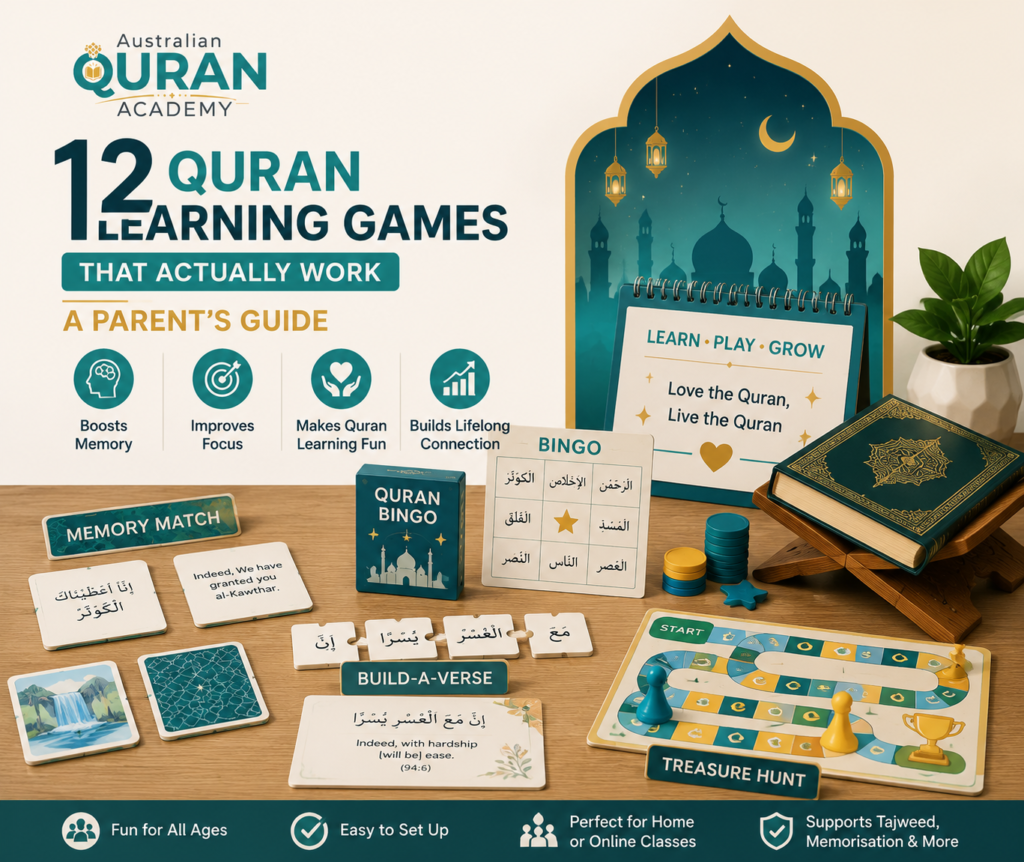
1. Quran Bingo
Quran Bingo is the ideal first game because every child already knows the format — all the learning effort goes into the verses, not the rules.
Setup: Create bingo cards with a grid of squares, each containing a surah name, key word, or verse reference. Prepare matching calling cards.
Learning style: Auditory / Visual
Gameplay: Call out a verse or show its calling card. Children mark the matching square. First to complete a row calls “Bingo.”
Try this verse:
قُلْ هُوَ اللَّهُ أَحَدٌ
“Say, He is Allah, [who is] One.” — Surah Al-Ikhlas, 112:1
This is the shortest, clearest statement of Tawhid in the Quran and the right starting point for any child, since almost everything they’ll learn about Islam builds from this single idea. Short, three-word ayat like this one work best as calling cards for children under 7 — anything longer than one line slows the game down noticeably.
Read Also: best country to learn quran
2. Memory Match (Verse and Meaning Cards)
Memory Match asks for a quieter skill than Bingo: holding a verse’s meaning in mind while searching for its pair, not just recognising the sound of it.
Setup: Create pairs — one card with an Arabic verse, one with its English meaning. Shuffle and lay face down in a grid.
Learning style: Auditory / Visual
Gameplay: Players flip two cards per turn. A match earns another turn; no match means cards flip back and play passes on. Most pairs at the end wins.
Try this verse:
إِنَّا أَعْطَيْنَاكَ الْكَوْثَرَ
“Indeed, We have granted you al-Kawthar.” — Surah Al-Kawthar, 108:1
Pair this with a meaning card reading “Allah gave the Prophet ﷺ abundant good” rather than a word-for-word translation — young children match concepts faster than vocabulary. For beginners, limit the deck to 5–6 surahs from Juz 30.
Try it online: Reinforce this game digitally with these free Wordwall activities — Find the Match,Match the Sakin Letter, and Arabic Flashcards. Perfect for a 10-minute screen session straight after the card game.
At Australian Quran Academy, our instructors observe that children aged 5–8 retain surah names noticeably faster when paired with a visual-matching activity than through repetition alone — the game mechanics trigger a small victory feeling that repetition simply cannot replicate.
3. Build-a-Verse (Word Order Puzzle)
This is the one game that tests whether a child truly knows a verse, rather than just recognises it — rebuilding it from scratch leaves nowhere to guess.
Setup: Write each word of a short surah on a separate card or building block. Mix them up.
Learning style: Kinesthetic / Visual
Gameplay: The child arranges the cards in the correct order, then recites the completed ayah aloud. For groups, run it as a timed race between teams.
Try this verse:
فَصَلِّ لِرَبِّكَ وَانْحَرْ
“So pray to your Lord and sacrifice [to Him alone].” — Surah Al-Kawthar, 108:2
Important: this game only works with a surah the child has already heard several times. If the words are unfamiliar, they’re solving a puzzle with no reference point, and the Quranic learning goal disappears entirely.
Try it online: Extend the word-ordering practice with these Wordwall group-sort activities — Game 02 Part A and Game 02 Part C. Use them as a warm-up before the physical card version.
Through drawing, colouring, and acting, children reconstruct a Quranic story in their own words or images — a stronger sign of genuine comprehension than simple recall. The critical mistake to avoid in this category: judging the artwork itself. Praise story accuracy over drawing skill, or the lesson becomes an art contest.
4. Tajweed Colour Coding
Tajweed Colour Coding gives children a visual map of recitation rules — making an abstract concept concrete and memorable.
Setup: Choose a short surah with clear Tajweed examples. Assign a colour to each rule — for example, red for Ghunnah (nasalization), blue for Idgham (merging).
Learning style: Visual
Gameplay: The child colours the Arabic text according to which Tajweed rule each letter represents, then recites the surah using the colour-coded sheet as a guide.
Example: In Surah Al-Kawthar (108:1), the “نَّ” in “إِنَّآ” shows a clear Ghunnah. The child colours this red, then reads the ayah explaining why.
This is the “sound before rules” principle in action: children who hear Ghunnah correctly in a game context recognise it instantly when a teacher names the rule formally.
The ear is calibrated first; the terminology follows. This sequencing is the key difference between Tajweed knowledge that sticks and Tajweed knowledge that only appears on a test.
Try it online: These free Wordwall games let children practise the same Tajweed rules digitally — Ikhfaa Match Up,Ghunnah True or False,Idgham Quiz, and Makhraj Spell the Word. Run one after each colour-coding session to reinforce what was just marked.
5. Quranic Story Sequencing
Story sequencing builds comprehension of the narrative arc inside Quranic stories — not just whether a child can recite, but whether they understand the events and their order.
Setup: Write key events from a Quranic story on separate cards, out of order. Choose a story the child is familiar with.
Learning style: Visual / Kinesthetic
Gameplay: The child arranges the events in the correct sequence, then retells the story in their own words.
Example events from the story of Prophet Yusuf ﷺ:
- His brothers threw him into a well
- He was sold as a slave in Egypt
- He interpreted the king’s dream
- He became a high official in Egypt
- He was reunited with his family
Add simple illustrations for younger children — the visual anchors make the sequence click faster. Encourage retelling in the child’s own words after sequencing; this is the comprehension check, not the sequencing itself.
6. Quranic Charades
Silence is the whole point of this game — without words, the child must lead with the part of the story they understood best.
Setup: Write Quranic story names or scenes on slips and place them in a container. Set a timer per round.
Learning style: Kinesthetic
Gameplay: One player acts out the story silently while the team guesses within the time limit. Points are tallied per correct guess.
Suitable stories for charades include Prophet Nuh and the Ark, Prophet Musa crossing the sea, Prophet Yunus and the whale, and Prophet Ibrahim refusing to worship idols.
7. Allah’s Beautiful Names Matching Game
This game introduces children to Asma-ul-Husna (Allah’s 99 names) through a structured matching activity that builds both Arabic vocabulary and theological understanding simultaneously.
Setup: Create flashcards with the Arabic name on one side and the English meaning on the other. Start with 5–6 names that are easy for children to grasp: Ar-Rahman (The Most Merciful), Ar-Raheem (The Most Compassionate), Al-Khaliq (The Creator), Al-Wadud (The Loving).
Learning style: Visual / Auditory
Gameplay: Lay cards face down in a grid. Players flip two at a time to find matching Arabic name and meaning pairs.
Bonus step: Once a match is found, find that name together in a Quran verse. Ar-Rahman and Ar-Raheem, for example, appear in the Basmala at the opening of Surah Al-Fatiha — and both share the same Arabic root (R-H-M), related to mercy.
This root connection, once pointed out, gives children a memory anchor that lasts far longer than rote definition.
For children in Australia building their Arabic foundations alongside Quran, Arabic Lessons for Kindergarten in Australia at Australian Quran Academy pair vocabulary work like this with structured phonics instruction — giving games like this a proper classroom backing.
8. Ayah Treasure Hunt
The search keeps children moving, but the real learning happens the moment they stop and open the card.
Setup: Hide verse cards around the play area, colour-coded by difficulty. Prepare 1–2 discussion questions per card in advance — this is the step most parents skip, and it’s the most important one.
Learning style: Kinesthetic / Visual
Gameplay: Children find cards, then gather to read and discuss the meaning and context of each verse found. Award points for finding cards and separate points for good discussion answers.
Try this verse:
إِذَا جَاءَ نَصْرُ اللَّهِ وَالْفَتْحُ
“When the victory of Allah has come, and the conquest.” — Surah An-Nasr, 110:1
A good discussion question for this card: “What does the surah say people did after this victory?” — it points the child to the next ayah instead of closing the conversation at the first one.
9. Ayah Relay Race
Recitation under mild physical pressure — mid-run, slightly out of breath — creates a different kind of memory than recitation sitting still. The verse recalled during movement is retrieved differently in the brain, and that variety strengthens retention.
Setup: Write verses on slips and place them at marked stations along a course. Split children into teams.
Learning style: Kinesthetic / Auditory
Gameplay: Each runner collects a slip at their station, recites it correctly, then continues. Score for accurate recitation, not just speed — so rushing through a verse incorrectly earns nothing.
Try this verse:
وَالْعَصْرِ إِنَّ الْإِنسَانَ لَفِي خُسْرٍ
“By time, indeed mankind is in loss.” — Surah Al-Asr, 103:1–2
Surah Al-Asr is only three ayat long and is widely cited as containing the essence of Islam’s message in miniature — making it the ideal relay verse: short enough to recite mid-run, rich enough to discuss at the finish line.
Trivia games work best as a check on understanding after stories and verses have been taught — they are a review format, not a first introduction. The mistake to avoid: writing questions about verse numbers or chapter counts instead of the story or lesson itself. That tests trivia recall, not Quranic comprehension.
10. Quranic Quiz Competition
A well-run quiz is not a test — it is a game with points, rounds, and celebration. Frame it that way, and children lean forward rather than shrink back.
Learning style: Auditory / Visual
Three-round format:
- Round 1 — Surah identification: Play a recitation clip and ask the child to name the surah
- Round 2 — Meaning round: Give the English meaning and ask for the Arabic surah name
- Round 3 — Recitation challenge: Name a surah and ask for the first three ayahs from memory
Award points for each correct answer and a small, halal reward for the highest scorer — extra story time, choosing the family’s weekend activity, or a favourite snack. For families with multiple children, this naturally becomes a weekly Quran quiz competition that everyone anticipates.
Sample question: “Which surah describes the army that came with an elephant, and what happened to them?” — the answer, Surah Al-Fil, opens with:
أَلَمْ تَرَ كَيْفَ فَعَلَ رَبُّكَ بِأَصْحَابِ الْفِيلِ
“Have you not seen how your Lord dealt with the companions of the elephant?” — (Surah Al-Fil, 105:1) This surah is remembered by children precisely because the story is vivid and short.
Try it online: Warm up before the family quiz with these Wordwall activities —Tajweed Quiz and Alif with Sukoon Quiz. Let children practise independently for five minutes, then move into the live competition round.
11. Quranic Jeopardy
The category board makes Jeopardy playable across very different knowledge levels at the same time — a younger sibling can take the easy-points category while an older one tackles harder questions. No child sits idle waiting for a turn that suits them.
Setup: Build a board (physical poster or simple table on a screen) with categories and point values by difficulty. Good categories: Surah Names, Prophets, Meanings, Tajweed Rules, Quranic Stories.
Learning style: Auditory
Gameplay: A player chooses a category and point value. They answer the question or lose the points. First to a target score wins.
Try it online: For a digital version of the gameshow format, these Wordwall activities replicate the Jeopardy feel perfectly — Madd Gameshow Quiz and Unit 18 Gameshow Quiz. Use them as a standalone screen session or as a tiebreaker round at the end of a live Jeopardy game.
For children beginning their Quran journey, Learn Quran for Beginners in Australia at Australian Quran Academy gives families the structured vocabulary bank that makes trivia games like Jeopardy genuinely achievable — rather than frustrating — for newer learners.
12. Finish the Ayah (Verse Completion Challenge)
This is the simplest game in the list and often the one with the highest immediate impact — it requires no materials, no setup, and can run at the dinner table, in the car, or anywhere.
Setup: None required.
Learning style: Auditory
Gameplay: The parent begins reciting a verse the child has been learning. They pause mid-verse and the child completes it. Increase difficulty by pausing earlier in the verse, or by giving only the first word.
Example:
You say: إِنَّا أَعْطَيْنَاكَ…
Your child completes: …الْكَوْثَرَ
The reason this game is deceptively powerful: it trains the child’s brain to expect Quranic completion — the first few words of a verse become an automatic prompt for the rest. That automatic-retrieval pattern is exactly what a child needs when reciting in Salah without looking at a page.
Read Also: How to Learn Quran for Kids in Australia
How to Choose the Right Quran Learning Game for Your Child?
Not every child learns the same way. Before picking a game, identify your child’s dominant learning style using this simple framework:
| Learning Style | Signs in Your Child | Best Game Types |
| Visual (See) | Remembers what they’ve looked at; loves colours and pictures | Memory match, puzzles, colour coding |
| Kinesthetic (Do) | Needs to move to focus; fidgets when sitting | Treasure hunts, relay races, word-order blocks |
| Auditory (Say) | Picks up rhythm quickly; hums along to recitation | Bingo, finish-the-ayah, guess-the-surah |
Most children use a mix of all three, which is why rotating across game types each week produces better results than sticking to one format. The games below are grouped by category — pick one from each group and build a simple weekly rotation.
Read Also: quran recitation for beginners
The Three Mistakes Parents Make with Quran Games
Most Quran games fail not because the game is wrong, but because of how it’s set up. These are the three most common errors:
Mistake 1: Starting with unfamiliar material.
Build-a-Verse and Memory Match only work if the child has heard the verse several times already. Running a game on an unfamiliar ayah turns it into a guessing game with no Quranic learning attached.
Mistake 2: Too many cards or questions at once.
For children under 7, cap memory-match decks at 6–8 pairs and quiz rounds at 5–6 questions. Longer sessions produce overwhelm, not learning.
Mistake 3: Skipping the discussion.
In games like Treasure Hunt and Story Sequencing, the conversation after the activity is where comprehension is built. Preparing 1–2 discussion questions per game before you start is the single highest-leverage preparation step a parent can take.
See Us in Action!
Curious about what our online classrooms look like? Watch the short clips below to see how our interactive, one-on-one sessions bring learning to life with real-time feedback and engaging teaching methods.
Start Your Quranic Journey in Australia
Join our leading online academy and learn with expert tutors through a structured, personalized curriculum.
Book Your Free TrialStart Your Child’s Quran Journey with Australian Quran Academy
The right games make a real difference — but the consistency and correction that build lasting Quran skills come from a qualified teacher who knows your child’s current level.
Australian Quran Academy offers live online Quran classes for children across Australia, taught by certified instructors who integrate game-based review directly into every lesson.
Rather than running games separately at home and structured lessons separately online, your child experiences both in a single, coherent session — with a teacher who tracks exactly which verses they’re ready to play with next.
Whether your child is starting with the Arabic alphabet, working through their first juz, or ready to begin Hifz, Australian Quran Academy has a structured pathway for every stage.
Families across Australia also access Arabic Lessons for Kindergarten,Learning Arabic for Non-Arabic Speakers, and Islamic Studies Courses for Adults — so the whole family can learn together on one platform.
Book a free trial lesson today and see how your child responds when Quran learning actually feels like play.
Our Quran Courses:
- Quran Recitation Classes
- Quran Hifz Course for Ladies
- Quran Ijazah Program
- Quran Qirat Learning Course
- Quran Tafsir Course
- Noorani Qaida Course
- Noorani Qaida Course for Kids
- Weekend Quran Classes
- Intensive Quran Course
- Al-Azhar Quran Course
- Online Tajweed Classes
- Tajweed Course for Kids
- Tajweed Course for Adults
- Tajweed Course for Ladies
Start Your Quranic Journey in Australia
Join our leading online academy and learn with expert tutors through a structured, personalized curriculum.
Book Your Free TrialConclusion
Quran learning games work because they convert the repetition that memorization requires into something a child is willing — even eager — to do again tomorrow. A child marking squares in Quran Bingo, arranging word blocks, acting out a Prophet’s story, or racing to a verse card is still rehearsing; it simply doesn’t feel like rehearsal to them.
The twelve games in this guide cover the four main ways children absorb Quranic material: memory and matching for active recall, art and creativity for story comprehension, physical activities for kinesthetic learners, and trivia formats for knowledge review.
No single game works for every child — the goal is to rotate across types until you find which two or three your child returns to willingly.
The one rule worth holding onto: match the game to the child, not the child to the game. Used consistently, Quran learning games stop being occasional activities and become the normal way your child builds their relationship with the words of Allah.
Frequently Asked Questions
Parents and teachers ask these questions most often before starting Quran learning games. Here are direct answers to help you get started with confidence.
What age should children start Quran learning games?
Children can start as early as age 3–4 with simple auditory games like Finish the Ayah and listening-based activities. Most matching and memory games work well from age 5, once a child can recognise a few short surahs by ear. Simplify the format at younger ages — fewer cards, shorter verses — rather than waiting until the child is “ready.”
Do Quran games actually help with memorization?
Yes. When children repeat verses during structured play, their brains connect that recitation with a positive emotional experience, which significantly improves long-term retention. Games support Hifz by turning repetition into active recall rather than passive listening — they work as reinforcement alongside lessons, not as a replacement for a qualified teacher.
How long should a Quran game session last?
Ten to fifteen minutes works well for children under 8, since attention drops after that regardless of the game being played. Older children can sustain 20–25 minutes, especially with trivia or board-game formats that have a clear endpoint. Short, consistent daily sessions produce better results than longer, infrequent ones.
Can Quran games replace a Quran teacher?
No. Games reinforce what a teacher has already introduced — correct pronunciation, Tajweed rules, and verse meaning still need to come from a qualified instructor. Games run without that foundation risk reinforcing mistakes a child hasn’t been corrected on yet. At Australian Quran Academy’s Quran Classes, games are built into structured live lessons, not offered instead of them.
How do I keep the Quran respected during games?
Set clear expectations before each session: handle materials carefully, say Bismillah before starting, keep the space clean and quiet, and avoid shouting or rough play during Quran time. Children accept these boundaries naturally when they’re introduced calmly and consistently — the goal is for the Quran to feel special, not forbidden.
Are these games suitable for group settings like Sunday school?
Yes. Games like Quran Bingo, the Quiz Competition, and Jeopardy work even better in group settings — they encourage healthy competition and teamwork simultaneously. For larger groups, divide into teams so every child stays involved throughout, rather than waiting for a turn.






Leave a Reply