 Quran
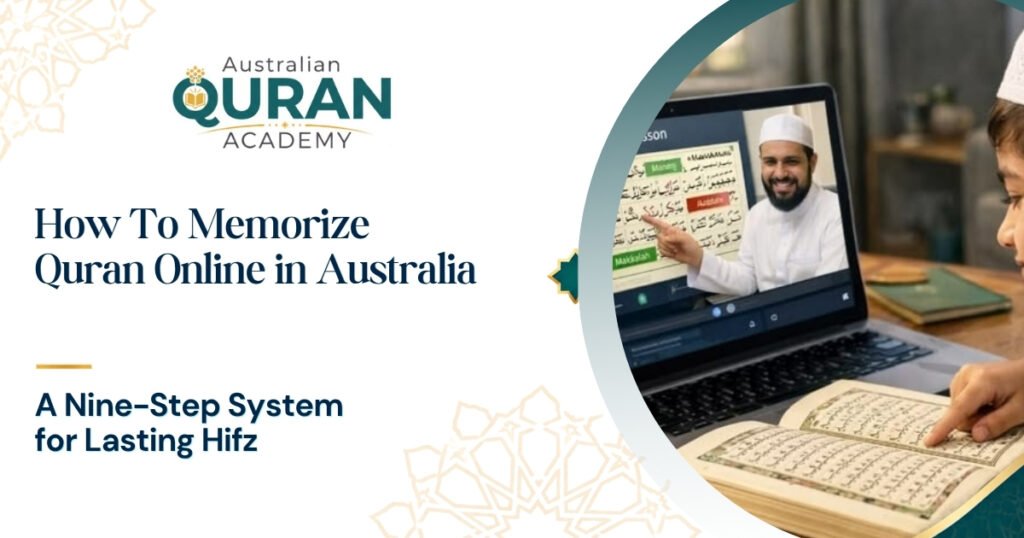
Memorizing the Quran online is realistic for adults, children, and busy families, but only when the routine protects accuracy as carefully as progress.
Many learners collect pages quickly, then discover that weak joins, guessed vowels, and missed Tajweed make those pages difficult to retain.
For anyone asking how to memorize Quran online in Australia, the starting point is not a large daily target. It is a repeatable system that combines corrected reading, small new portions, scheduled revision, and accountability across the months required for Hifz.
Online lessons can give Australian Muslims access to qualified teachers without commuting, while a personal timetable keeps the work steady between sessions. The nine steps below build that system in the order a new memorizer needs it.
1. Plan How To Memorize Quran Online In Australia
Begin by choosing a pace that fits your actual week, rather than an ambitious plan that fails after a few days. A sustainable target protects confidence and gives revision enough space to grow with every new page.
Set the first target after looking honestly at school, work, family duties, and the five daily prayers. Most beginners do better with three to five lines than with a full page because each line still needs accurate repetition and recall.
Use a simple pace guide before agreeing to a deadline. The figures are estimates, not promises, because retention and correction matter more than speed.
| Daily New Portion | Suitable Starting Point | Likely Pace |
| 3 to 5 lines | Adults and school students | Slow, steady foundation |
| Half a page | Learners with stable revision | Moderate long-term pace |
| One page | Experienced learners with daily support | Intensive commitment |
Write the target in a weekly planner and reserve one lighter day for catch-up or testing. A plan that includes recovery prevents a missed lesson from becoming a reason to abandon the whole routine.
2. Confirm Quran Reading Accuracy Before New Hifz
Correct recitation comes before new Hifz because memory preserves whatever the tongue repeats. If a learner memorizes a wrong vowel, letter sound, or stop, correction later means unlearning the familiar version before rebuilding it correctly.
Tajweed is the disciplined pronunciation of Quranic Arabic, including each letter’s articulation, qualities, lengthening, and stopping rules. Ask a qualified teacher to hear a short diagnostic recitation and identify the few errors that must be fixed first.
Allah instructs the Prophet ﷺ to recite with measured clarity, which makes careful pace part of the memorization method rather than an optional extra.
أَوْ زِدْ عَلَيْهِ وَرَتِّلِ الْقُرْآنَ تَرْتِيلًا
(Aw zid ‘alayhi wa rattilil-Qur’āna tartīlā)
(“Or add to it, and recite the Quran with measured recitation.”)
Read the intended passage aloud to the teacher before attempting to memorize it. Mark recurring errors in a notebook, then rehearse the corrected word or phrase separately until the mouth can produce it consistently.
Australian Quran Academy offers Online Tajweed Classes that let learners correct articulation live before it is carried into new Hifz.

3. Keep One Mushaf And One Reciter For Every Lesson
Use one Mushaf throughout your Hifz because consistent page layout creates visual anchors for the eyes and memory. Changing frequently between printed copies, apps, and fonts removes those anchors and makes verse order less stable.
Choose one clear, measured reciter for listening practice, then keep that voice for the current surah or Juz. A consistent recording helps the ear learn the same pauses, word connections, and rhythm each time.
Prepare the passage with this short sequence before looking away from the text.
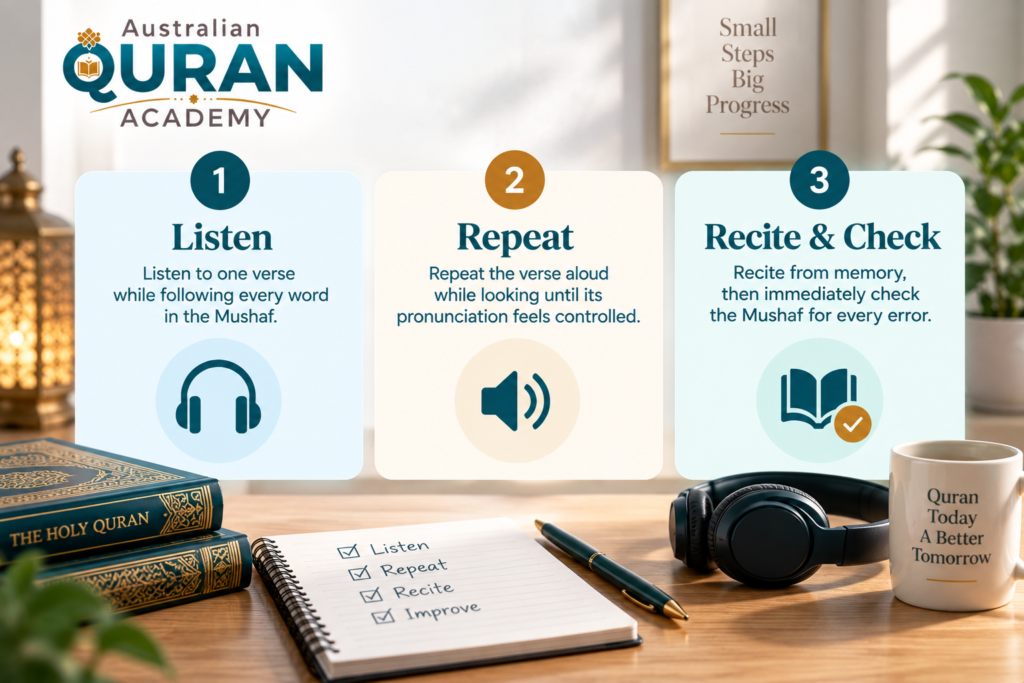
- Listen to one verse while following every word in the Mushaf.
- Repeat the verse aloud while looking until its pronunciation feels controlled.
- Recite from memory, then immediately check the Mushaf for every error.
Avoid treating an attractive melody as evidence that the verse is secure. Clear letters, correct Harakaat, and reliable recall should come first; a natural recitation style develops after the wording is stable.
See Us in Action!
Curious about what our online classrooms look like? Watch the short clips below to see how our interactive, one-on-one sessions bring learning to life with real-time feedback and engaging teaching methods.
Start Your Quranic Journey in Australia
Join our leading online academy and learn with expert tutors through a structured, personalized curriculum.
Book Your Free Trial4. Divide Each Online Hifz Session Into Three Parts
Separate every session into new memorization, recent revision, and older revision. This structure gives the brain repeated contact with material at different ages instead of allowing today’s page to replace last month’s work.
Sabaq means the new portion being memorized today, Sabaqi is the recently learned material needing frequent repetition, and Manzil is the older stock that must remain ready. Record all three after every live lesson.
Use the following 45-minute home session as a starting framework, then adjust it with your teacher when your Manzil becomes larger.
| Session Part | Task | Suggested Time |
| Manzil | Recite older secure passages | 15 minutes |
| Sabaqi | Review the most recent pages | 15 minutes |
| Sabaq | Learn and connect new lines | 15 minutes |
Do not skip Manzil to make the progress chart look faster. Older revision is the test of whether earlier effort remains available, and it becomes more important as the number of memorized pages rises.
Use the teacher’s lesson record to decide the next assignment, not only the number of pages completed. A learner who needs repair work should receive it immediately, while a secure learner can add a small new portion without weakening the routine.
Australian Quran Academy offers Online Quran Recitation Classes that help students build a teacher-checked routine before their daily Hifz load becomes larger.

5. Memorize Small Portions Through Controlled Repetition
Memorize one line or one short verse at a time until it can be recited accurately without looking. Small portions reveal mistakes quickly and make the connection between consecutive verses easier to strengthen before moving forward.
Read the first unit twenty times while looking, then recite it ten times from memory. Check the text after each unsuccessful attempt, correct only the faulty spot, and restart the count once the line is sound.
Link the first unit to the next before either one becomes isolated. Repeat the final words of the first verse with the opening words of the next until the transition comes without hesitation.
At the end of a passage, recite from its first word rather than testing only the final line. Forward recall exposes weak joins, whereas repeating the most recent phrase can create a misleading sense of security.
Read also: How To Learn Quran Reading With Tajweed Juz 30?
6. Schedule Hifz Around Australian Prayer And Work Times
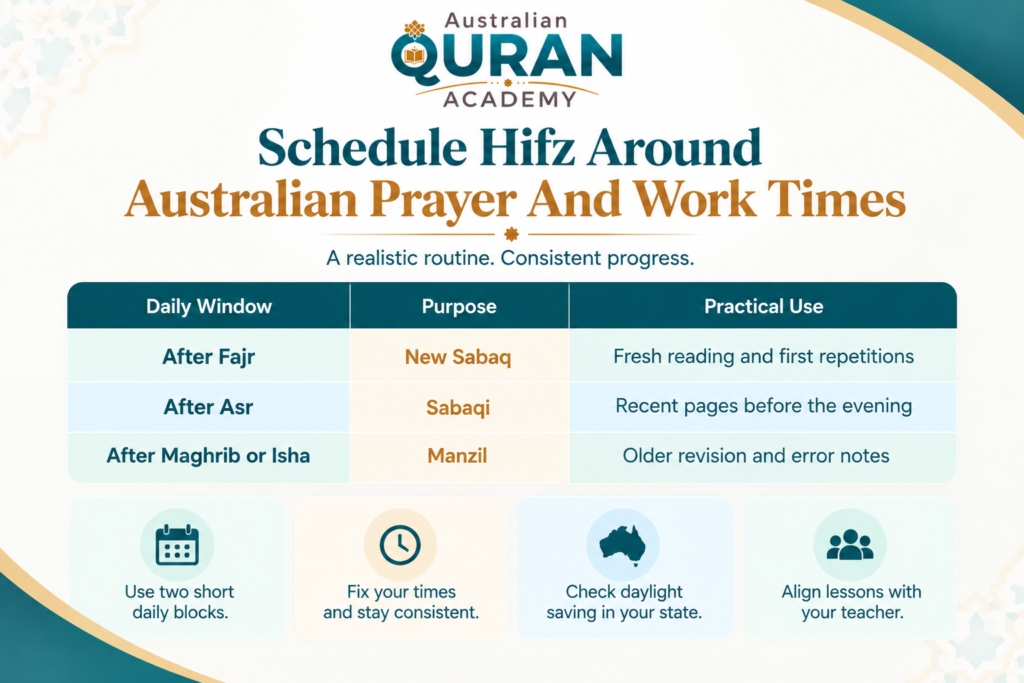
Choose a fixed memorization window that remains realistic in your Australian state. Early morning after Fajr often suits new work, while a short evening review can protect Sabaqi when school, employment, and family commitments fill the day.
Learners in Sydney, Melbourne, Canberra, Hobart, and Adelaide should review lesson times when daylight saving begins or ends. Queensland, Western Australia, and the Northern Territory do not follow the same clock changes, so an online lesson needs an explicitly confirmed local time.
Build a timetable around two short daily blocks instead of waiting for one uninterrupted hour. Ten minutes for Manzil in the morning and twenty minutes for new work later are easier to defend than a long session left until exhaustion.
| Daily Window | Purpose | Practical Use |
| After Fajr | New Sabaq | Fresh reading and first repetitions |
| After Asr | Sabaqi | Recent pages before the evening |
| After Maghrib or Isha | Manzil | Older revision and error notes |
Treat lesson attendance as a fixed appointment, then place independent revision immediately before or after it. The consistent pairing reduces forgotten homework and gives the teacher a clearer picture of what is genuinely retained.
Australian Quran Academy provides an Online Hifz Course that supports learners with structured targets and regular listening checks at an agreed weekly time.

7. Test Recall Without The Mushaf Before Calling It Secure
Test a new passage from memory at several points before marking it complete. Looking at the page while reciting can support learning, but it cannot prove that the wording, order, and transitions are available independently.
Use three checks for each passage: recite it immediately after learning, recite it again later that day, and recite it the next morning before opening the Mushaf. Any repeated hesitation belongs on the next revision list.
Keep a simple progress record so weak passages are visible instead of forgotten among completed pages. Use a status that describes recall honestly, not one that rewards speed.
| Status | Meaning | Next Action |
| Strong | Accurate without prompts | Add to scheduled Manzil |
| Shaky | Hesitation or one recurring error | Review twice today |
| Forgotten | Cannot continue independently | Relearn in smaller units |
Record yourself once a week and compare the recording with the Mushaf and teacher feedback. Audio playback often catches rushed Madd, inconsistent stops, and words that felt correct during a silent practice session.
Inside Our Virtual Classrooms
We believe in full transparency and proven quality. Take a look at these actual snippets from our live classes to experience our modern learning platform, patient instructors, and interactive student participation.
Start Your Quranic Journey in Australia
Join our leading online academy and learn with expert tutors through a structured, personalized curriculum.
Book Your Free Trial8. Use Live Feedback For Online Quran Memorization In Australia
Live feedback is what makes online Quran memorization in Australia more than independent repetition with a video call. A teacher can stop an error at the exact word, ask for the line again, and decide whether the portion is ready to progress.
Prepare for every lesson by listing one new passage, one recent passage, and one older passage. That preparation keeps the session balanced and prevents all the time being spent on whatever feels easiest to recite.
Ask the teacher to give a precise correction log rather than a general instruction to practice more. Notes such as “repeat the join between verses three and four” or “lengthen this Madd” become tasks you can complete before the next lesson.
Australian Quran Academy offers Hifz Classes for Adults with live sessions that can fit around professional and family responsibilities in Australia.

9. Protect Long Term Retention With Weekly And Monthly Review
Protect long-term retention by reviewing on a weekly and monthly cycle, not only when a teacher asks for a page. Spaced recall brings older passages back before they fade, making Hifz dependable in Salah and outside lesson time.
Assign one weekly session to recite everything learned in the previous seven days without new Sabaq. At the end of each month, test a larger selection chosen from different weeks rather than only the newest material.
Use memorized passages in voluntary Salah when you can recite them accurately. Prayer tests recall under a different kind of concentration and makes weak transitions easier to notice without looking at the Mushaf. When a passage deteriorates, pause new material for a short repair period instead of pushing ahead. Three days spent restoring ten weak lines usually saves far more time than carrying those lines into another month of uncertain review.
Review similar verses together when they begin to blur in your memory. Write the first distinctive word, the ending word, and the topic of each verse in a notebook, then ask the teacher to test the pair in changing order.
Use travel days and busy exam weeks for maintenance rather than new memorization. A ten-minute Manzil recitation, repeated twice during the day, keeps the connection active until your normal lesson schedule can resume. At the end of every month, decide whether the daily target should stay the same, increase slightly, or reduce. Let accurate recall across old and recent material make that decision, never pressure from a deadline alone.
Read also: How To Learn Noorani Qaida Online In Australia
Start Online Hifz With Australian Quran Academy Instructors
Australian Quran Academy gives Hifz learners live teacher correction, a structured balance of Sabaq, Sabaqi, and Manzil, and lesson times that can be agreed around Australian routines. A trial lesson lets you test the teaching style with your current level.
What Sets Australian Quran Academy Apart
- Live online listening and correction for every assigned portion.
- Hifz pathways for adults, children, and female learners.
- Flexible scheduling around school, work, and Australian time zones.
Our Quran Courses
- Quran Reading Classes
- Online Quran Classes for Kids
- Quran Classes for Adults
- Online Hifz Course
- Online Quran Recitation Classes
- Online Tajweed Classes
Conclusion
Learning how to Hifz Quran online requires an orderly system, not exceptional memory. Start with accurate reading, a modest new target, one consistent Mushaf, and a revision plan that makes older work visible every day.
Online instruction becomes effective when the teacher hears new Sabaq, recent Sabaqi, and older Manzil rather than only the newest lines. That repeated listening gives every error a correction point before it becomes a habit.
For Australian learners, the best timetable is the one that continues through work weeks, school terms, travel, and daylight saving changes. Build a pace you can retain, test it honestly, and increase only after the current portion is secure.
Frequently Asked Questions About Online Quran Memorization
Can I Memorize Quran Online?
Yes, you can memorize Quran online when independent practice is paired with regular live correction and a written revision plan. The essential requirement is not a physical classroom, but accurate recitation, accountable testing, and consistent review between lessons.
How To Become Hafiz E Quran Online?
To become Hafiz e Quran online, follow a paced Hifz plan that includes daily Sabaq, Sabaqi, and Manzil. Work with a qualified teacher, avoid advancing with unresolved errors, and build monthly tests into the plan from the beginning.
How Long Does Online Hifz Take?
Online Hifz commonly takes several years because the correct pace depends on reading level, daily availability, and revision capacity. A slower plan that preserves earlier pages is more valuable than a fast plan that leaves the first Juz uncertain.
How Long Does Online Hifz Take?
Online Hifz commonly takes several years because the correct pace depends on reading level, daily availability, and revision capacity. A slower plan that preserves earlier pages is more valuable than a fast plan that leaves the first Juz uncertain.
What Should I Do After Missing A Hifz Session?
After missing a Hifz session, review the last secure passage first and reduce the new portion if needed. Do not try to compensate by doubling today’s target, because rushed repetition usually creates more errors than it recovers.
Should Children And Adults Use The Same Hifz Pace?
No, children and adults should use a pace based on attention span, reading accuracy, support at home, and competing commitments. Both groups benefit from small targets, but adults often need flexible blocks while children need supervised repetition.








Leave a Reply