 Quran
| Key Takeaways |
| Memorize a small fixed portion only after its pronunciation is accurate, then give old material more time than new material. |
| Use one Mushaf, one reciter, a written error log, and closed-book tests so familiarity never masquerades as secure memorization. |
| Independent Hifz still requires periodic correction because recordings can reveal hesitation, but they cannot reliably diagnose every Tajweed or articulation error. |
| Fit sessions around Australian prayer times, work, study, and daylight-saving changes instead of depending on one rigid clock time all year. |
Learning how to memorize Quran by yourself in Australia can make Hifz accessible when local classes, transport, work hours, or family duties limit attendance.
However, studying alone places planning, testing, pronunciation control, and revision entirely in your hands.
A successful independent method must do more than help you repeat today’s lines. It must prevent unnoticed recitation errors, measure genuine recall, and keep earlier pages stable while your memorized portion steadily becomes larger.
The process below turns self-study into a controlled system suited to Australian routines, including changing prayer times, school terms, demanding shifts, and time-zone differences. Follow these steps in order rather than collecting disconnected memorization tips.
1. Check Your Recitation Before Starting Hifz
Begin by reading one familiar page aloud and recording it without preparation. Compare the recording with a reliable reciter while checking each vowel, letter ending, doubled consonant, nasal sound, elongation, and stopping point.

Mark every uncertain word directly on a printed copy or in a separate notebook. If the same letter or rule causes several errors, correct that underlying weakness before memorizing new verses containing it.
Self-assessment is useful only when the standard is strict. Smooth speed does not prove accuracy, and recognizing a verse while looking at the page does not prove that you can reproduce it correctly.
Use this starting test to decide whether you are ready for direct Hifz or need a short reading foundation first. Choose the next action from demonstrated performance rather than enthusiasm alone.
| Starting Result | Correct Next Action | Readiness Standard |
| Frequent decoding mistakes | Rebuild letter joining and vowel reading | Read unfamiliar words without guessing |
| Repeated articulation errors | Drill the affected letters separately | Produce clear contrasts in recorded pairs |
| Unstable Tajweed application | Study only the rules appearing in your passage | Apply each rule without prompting |
| Accurate but hesitant reading | Begin a small memorization portion | Read the passage correctly three times |
Do not treat correction as a delay. Every inaccurate line memorized today creates additional work later because the tongue becomes accustomed to the error through hundreds of repetitions.
2. Set a Measurable Hifz Target
Choose a target that states the passage, daily amount, completion date, and required revision. “Memorize more Quran” cannot guide a session, while “memorize Surah Al-Mulk in eight weeks” can be divided and measured.
Calculate your weekly capacity before choosing a finish date. A person who can protect five focused sessions should not build a plan that silently assumes seven perfect days every week.
Start below your maximum for the first fortnight. If you can memorize ten lines during an unusually quiet morning, that does not prove you can retain ten lines through normal work, study, and family pressure.
Set three connected targets so daily activity supports long-term completion. Write them on the first page of your tracker, review them each Sunday, and reduce the daily amount whenever revision falls behind:
- Daily target: A fixed number of lines or verses to memorize accurately.
- Weekly target: Five or six new portions plus one consolidation day.
- Retention target: At least 90 per cent accurate recall before advancing.
For learners who want a structured target with live monitoring, Australian Quran Academy offers a Quran Memorization Course in Australia that connects new memorization with correction and scheduled revision.

3. Build a Schedule Around Australian Prayer Times
Attach memorization to repeatable events rather than relying on spare time. Fajr is often effective for new material, while a shorter session after Asr or Maghrib can test the same passage without reopening the Mushaf.
Australian daylight hours change considerably across seasons and locations. Sydney and Melbourne observe daylight saving, while Brisbane and Perth do not, so a fixed 5:00 am plan may become impractical during part of the year.
Keep the routine anchored to prayer or an established household event, then adjust the clock time when seasons change. Shift workers can use “after waking” and “before leaving home” as stronger anchors than conventional morning labels.
The following model separates learning, recall, and maintenance without requiring one long session. Move the sessions to match your circumstances, but preserve the delay between initial study and later recall:
| Session | Task | Suggested Duration |
| After Fajr or waking | Memorize the new portion | 20 to 30 minutes |
| Lunch break or midday pause | Recall without looking | 5 to 10 minutes |
| After Asr or work | Correct weak words and joins | 10 to 15 minutes |
| After Maghrib or Isha | Review older memorization | 20 to 30 minutes |
Review the schedule at the start and end of daylight saving and whenever school, university, or rostered work changes. Preserve the sequence of tasks even when their precise times must move.
See Us in Action!
Curious about what our online classrooms look like? Watch the short clips below to see how our interactive, one-on-one sessions bring learning to life with real-time feedback and engaging teaching methods.
Start Your Quranic Journey in Australia
Join our leading online academy and learn with expert tutors through a structured, personalized curriculum.
Book Your Free Trial4. Use One Mushaf and One Reference Reciter
Select one clearly printed Mushaf and keep it for the entire memorization project. Repeated exposure builds a visual map of each page, including verse positions, line endings, and where a passage continues after turning.
Choose one accurate reciter whose pace lets you distinguish letters and Tajweed. Switching constantly between voices, speeds, and melodic choices adds variation before the wording and pronunciation are stable.
Listen to the full passage once while following the text. During memorization, loop only the small segment being learned, then return to the complete passage so separate pieces reconnect in their correct order.
Use audio as a pronunciation model, not as background sound. Passive listening can improve familiarity, but Hifz requires active recall in which you reproduce the verse before the recording supplies it.
Keep the audio source, Mushaf edition, and verse division unchanged for at least one complete surah. Consistency reduces avoidable cognitive load and makes every repetition reinforce the same visual and auditory cues.
Read also: How To Learn Quran Recitation In Australia?
5. Memorize Each Passage in Small Linked Units
Divide today’s portion into units short enough to recite correctly in one breath or complete phrase. A long verse may need several meaningful units, while very short verses can sometimes be learned as a pair.
Read the first unit while looking until every letter and vowel is certain. Recite it from memory several times, check immediately, and restart the count whenever an error changes the wording or pronunciation.
Add the next unit only after the first is stable. Recite the second unit alone, then join both without a pause that does not belong in the verse. Continue until the complete daily portion flows.
Use this five-pass sequence for every unit. Complete each pass deliberately and correct mistakes immediately, because repeatedly producing a wrong form strengthens the very error you are trying to eliminate:
- Read the unit slowly while checking the text.
- Listen once and notice pronunciation or stopping differences.
- Recite from memory without prompting.
- Check the Mushaf and correct the exact error.
- Link the unit to everything memorized immediately before it.
If basic pronunciation still interrupts this process, Australian Quran Academy provides Online Tajweed Classes in Australia for guided work on articulation, rules, and accurate application during recitation.

6. Connect Meaning With the Exact Arabic Wording
Read a reliable translation before memorizing, then identify the passage’s movement: who is speaking, what changes, where a command begins, and how one verse leads into the next. Meaning supplies retrieval cues.
Understanding does not replace exact verbal repetition. Two verses may express related ideas using different words, particles, or endings, so your memory must bind the meaning to the precise Arabic sequence on the page.
Create a brief cue for each verse rather than writing a full commentary. The cue might name the subject, contrast, event, or final phrase that distinguishes that verse from nearby material.
For similar verses, make a comparison table before errors become habitual. Record only the distinguishing details, then cover the answers and retrieve each difference from memory during later reviews:
| Comparison Point | What to Record |
| Opening words | The first phrase unique to each location |
| Changed particle | The exact conjunction or preposition used |
| Word order | Which noun or verb appears first |
| Ending | The final phrase and preceding cue |
| Surah location | Page, verse number, and nearby subject |
Test the cue in both directions. Seeing the meaning should prompt the Arabic, while hearing the Arabic should recall the correct context without causing you to substitute wording from another passage.
7. Prove Recall With Closed-Book Testing
Close the Mushaf before deciding that a passage is memorized. Recite it from the beginning, start from a randomly selected verse, continue after someone provides the final word, and record one uninterrupted attempt.
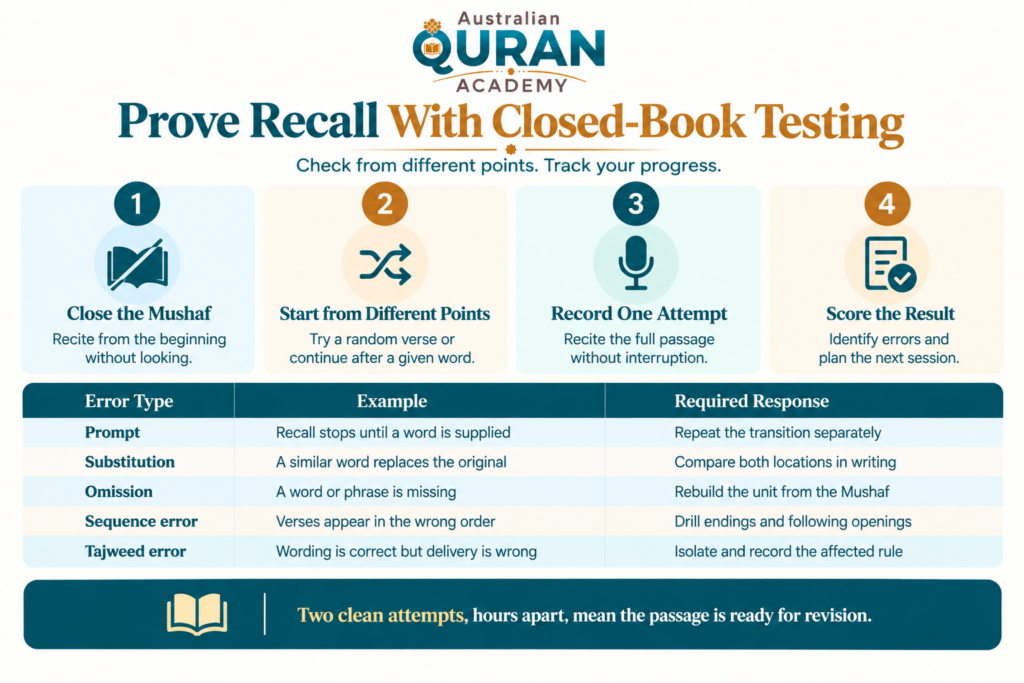
These tests expose different weaknesses. Beginning-only recall can hide dependence on a fixed sequence, while random starts reveal whether each verse has its own secure entry point in memory.
Score the attempt instead of judging it as generally “good.” Use consistent categories so improvement becomes visible and weak patterns can be corrected during the next session.
| Error Type | Example | Required Response |
| Prompt | Recall stops until a word is supplied | Repeat the transition separately |
| Substitution | A similar word replaces the original | Compare both locations in writing |
| Omission | A word or phrase disappears | Rebuild the unit from the Mushaf |
| Sequence error | Verses appear in the wrong order | Drill endings and following openings |
| Tajweed error | Wording is correct but delivery is wrong | Isolate and record the affected rule |
A passage is ready to join the revision cycle after two clean attempts separated by several hours. Immediate repetition measures short-term familiarity; delayed recall measures whether the passage has begun to settle.
8. Protect Old Hifz With Layered Revision
Give revision more time as your memorized portion grows. New memorization produces an obvious sense of progress, but revision preserves the work already completed and prevents a growing backlog from overwhelming later months.
Use three layers: yesterday’s portion, the current week’s material, and older memorization. Each layer needs a different frequency, so one general instruction to “revise daily” is not precise enough.
Apply a minimum 2:1 review ratio when retention begins weakening. For every ten minutes spent on new material, give twenty minutes to old material until accuracy returns above your chosen threshold.
This revision cycle is practical for independent Hifz. Place every memorized passage into a named layer, record the assigned review day, and complete overdue revision before adding another new portion:
- Review yesterday’s portion before learning anything new.
- Recite the current week’s portions together every second day.
- Rotate older surahs or pages across seven scheduled days.
- Test one older passage without advance warning each week.
- Stop new memorization when repeated errors remain uncorrected.
Learners needing systematic listening and correction can use Australian Quran Academy Quran Recitation Classes in Australia to identify recurring errors that ordinary self-repetition may preserve rather than remove.

9. Keep a Written Hifz Error Log
Record errors immediately after each test, not while repeatedly interrupting the recitation. The log should show the date, passage, incorrect form, correct form, likely cause, and result of the later retest.
Separate slips from patterns. One momentary hesitation may need another repetition, whereas the same omitted particle on three different days requires comparison, isolation, spaced testing, and a later unprompted retest.
Use simple symbols in your Mushaf copy or notebook: P for prompt, S for substitution, T for Tajweed, and O for omission. Avoid covering the page with notes that compete with the Quranic text.
At the end of each week, count errors by type rather than only by page. If transition errors dominate, practise verse endings with following openings; if substitutions dominate, build a mutashabihat comparison page.
Retest logged mistakes after one day, three days, seven days, and one month. Remove an item only after correct recall at a delayed test, because same-session correction does not demonstrate durable repair.
Read also: How To Learn To Read Quran Online For Kids In Australia?
10. Recite Memorized Verses in Daily Salah
Use recently memorized verses in voluntary prayers after they can be recited accurately outside Salah. The prayer context strengthens recall and exposes hesitation because you cannot depend on the visual position of the text.
Do not introduce an unstable passage into Salah merely to test it. First complete a closed-book check, review the correct stopping places, and know how to recover without inventing words if recall fails.
Assign older passages across the week so Salah supports revision rather than repeatedly returning to the same short surahs. Keep the choice manageable enough to preserve concentration and correct recitation.
A simple rotation can include the four uses below. Select passages before the prayer begins, keep the rotation written beside your revision plan, and change selections only after completing the assigned recitation:
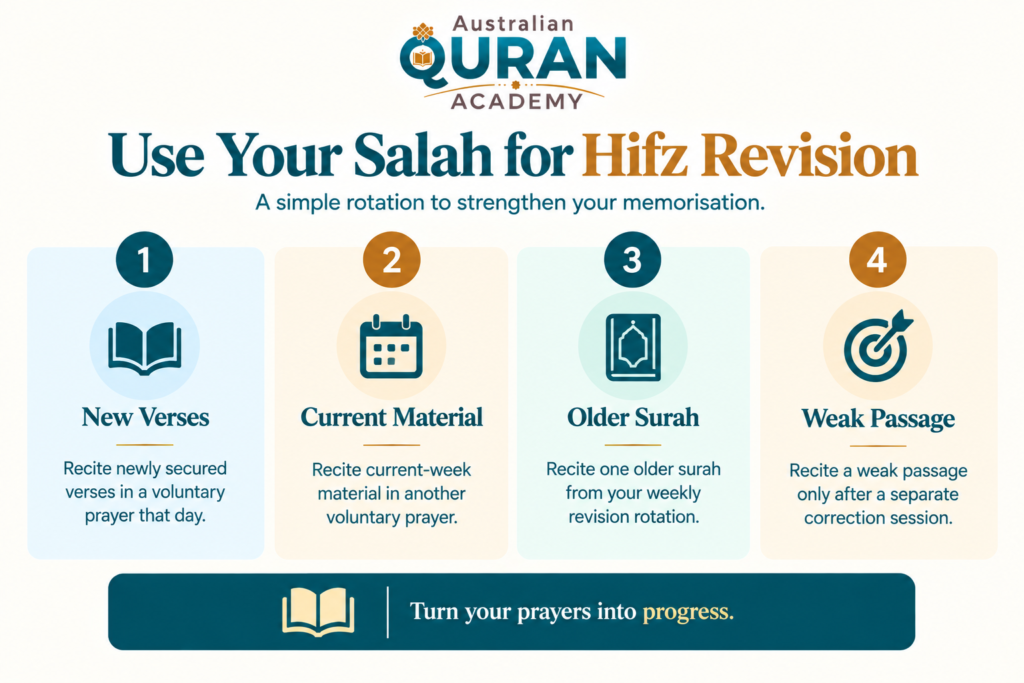
- Newly secured verses in a voluntary prayer that day.
- Current-week material in another voluntary prayer.
- One older surah selected from the weekly revision rotation.
- A weak passage only after a separate correction session.
Treat recitation in Salah as reinforcement, not your only review method. It rarely provides enough volume to maintain everything once your Hifz expands across many surahs or several ajza.
Inside Our Virtual Classrooms
We believe in full transparency and proven quality. Take a look at these actual snippets from our live classes to experience our modern learning platform, patient instructors, and interactive student participation.
Start Your Quranic Journey in Australia
Join our leading online academy and learn with expert tutors through a structured, personalized curriculum.
Book Your Free Trial11. Arrange Regular Checks With a Qualified Teacher
You can manage scheduling, repetition, testing, and much revision independently, but you cannot reliably hear every error in your own voice. Familiar mistakes often sound correct because your ear expects what you intended.
Submit a live or recorded recitation to a qualified teacher at regular intervals. Weekly correction is ideal during new memorization; experienced learners with stable pronunciation may use less frequent checks while maintaining strict self-tests.
Ask the teacher to identify the precise error and its cause, not merely supply the missing word. Useful feedback distinguishes memory failure, articulation weakness, Tajweed misapplication, unsuitable stopping, and confusion between similar verses.
Pause new Hifz and seek correction when any of these warning signs appears. Continuing under these conditions usually multiplies repair work, whereas early feedback identifies whether the problem is memory or recitation:
- The same pronunciation error survives repeated self-correction.
- Several verses require prompts during every delayed test.
- Similar passages are merging despite written comparisons.
- Old memorization is deteriorating faster than revision repairs it.
- You cannot determine whether a stopping point preserves the meaning.
For adults balancing Hifz with employment and family commitments, Australian Quran Academy offers Hifz Classes for Adults in Australia with live instruction suited to individual pace and availability.

Start Guided Hifz With Australian Quran Academy
Australian Quran Academy supports independent learners through live online instruction, individualized correction, structured memorization targets, and revision accountability.
Flexible scheduling also helps students across Australian states manage work, study, family duties, and time differences.
What Sets Australian Quran Academy Apart:
- Qualified teachers who listen to recitation and correct errors as they occur.
- One-to-one online sessions shaped around the learner’s level and Hifz target.
- Structured attention to new memorization, Tajweed accuracy, and retained revision.
- Flexible lesson options for adults, children, and female learners across Australia.
Our Quran Courses
- Quran Reading Classes
- Online Quran Classes for Kids
- Quran Classes for Adults
- Hifz Classes for Adults in Australia
- Quran Recitation Classes in Australia
- Online Tajweed Classes in Australia
- Quran Memorization Course in Australia

Conclusion
Learning how to memorize Quran by yourself in Australia is achievable when independence means managing a rigorous system, not working without standards. Accurate reading, realistic targets, linked repetition, delayed testing, and layered revision must operate together.
Begin with a small portion and require evidence before moving forward. Two accurate delayed recitations are more valuable than several pages that remain dependent on visual prompts, uncertain pronunciation, or short-term familiarity.
Keep the routine adaptable to Australian prayer times and seasonal schedules, but keep its quality rules fixed.
When an error exceeds your ability to diagnose it, qualified correction protects both your new Hifz and everything built upon it.
Frequently Asked Questions About Independent Quran Hifz
Can I Memorize Quran by Myself?
Yes, you can memorize Quran by yourself by managing repetition, testing, and revision independently. However, periodic recitation to a qualified teacher remains necessary to detect pronunciation, Tajweed, and stopping errors that self-assessment may miss.
How Much Quran Should I Memorize Each Day?
Start with three to five lines daily, then adjust only after two weeks of successful retention. Your correct amount is the portion you can memorize accurately while still completing all scheduled revision without creating a backlog.
What Is the Best Time for Quran Memorization?
The best time is a quiet, repeatable period when your mind is alert, often after Fajr or waking. In Australia, anchor the session to prayer or routine because seasonal daylight and daylight-saving changes alter fixed clock times.
How Can I Tell Whether My Hifz Is Secure?
Your Hifz is secure when you can recite it accurately after a delay, begin from random verses, connect verse endings to the next openings, and complete a recorded attempt without visual prompts or repeated hesitation.
Should I Stop New Memorization When Revision Is Weak?
Yes, pause new memorization when old passages repeatedly fall below your accuracy standard. Repair the weakest material first, increase revision time, and resume new Hifz only after delayed tests show stable recall.
How Often Should a Teacher Check Independent Hifz?
Weekly checks are safest while establishing pronunciation and adding new material. Learners with consistently accurate recitation may space checks further apart, but recurring Tajweed mistakes, prompts, or similar-verse confusion require earlier professional correction








[…] Read also: How To Memorize Quran By Yourself In Australia […]