 Quran
| Key Takeaways |
| Memorizing the full Quran in Australia is achievable, with most committed students completing Hifz within two to five years of daily supervised study. |
| Fifteen to thirty minutes of new memorization plus thirty minutes of revision produces stronger retention than long, irregular weekend sessions. |
| Self-study can build partial Hifz, yet a certified teacher is required to correct Makharij errors that a student cannot hear alone. |
| Daily revision of previously memorized portions matters more than new memorization once a student passes the fifth Juz. |
Muslim families in Sydney, Melbourne, Perth and Brisbane regularly ask whether it is realistic to memorize the Quran in Australia while managing school terms, shift work and a shortage of local Hifz teachers.
Australia hosts more than eight hundred thousand Muslims spread across a continent larger than Europe. Distance separates many households from a masjid that runs a structured Hifz circle for children or for adults.
What follows examines the scriptural evidence, the daily workload, the obstacles specific to Australian life and the teaching structure that turns a long memorization goal into measurable weekly progress.
Is It Easy to Memorize the Quran as an Australian Muslim?
Hifz is not easy, yet it is fully achievable for ordinary Australian Muslims. Difficulty comes from consistency rather than talent, and students who recite daily under correction progress steadily at almost any age.
Most beginners underestimate repetition and overestimate memory. A single page usually needs twenty to forty repetitions before it settles, then weeks of repeated review before the brain treats it as permanent.
Two factors decide whether a student finishes or stops after a few Juz, and both of them sit entirely within the control of the household.
Daily Time Commitment Behind a Realistic Hifz Plan
Serious memorization needs protected daily time rather than long weekend sessions. Australian students who succeed usually divide their work into three fixed blocks that total between sixty and ninety minutes.
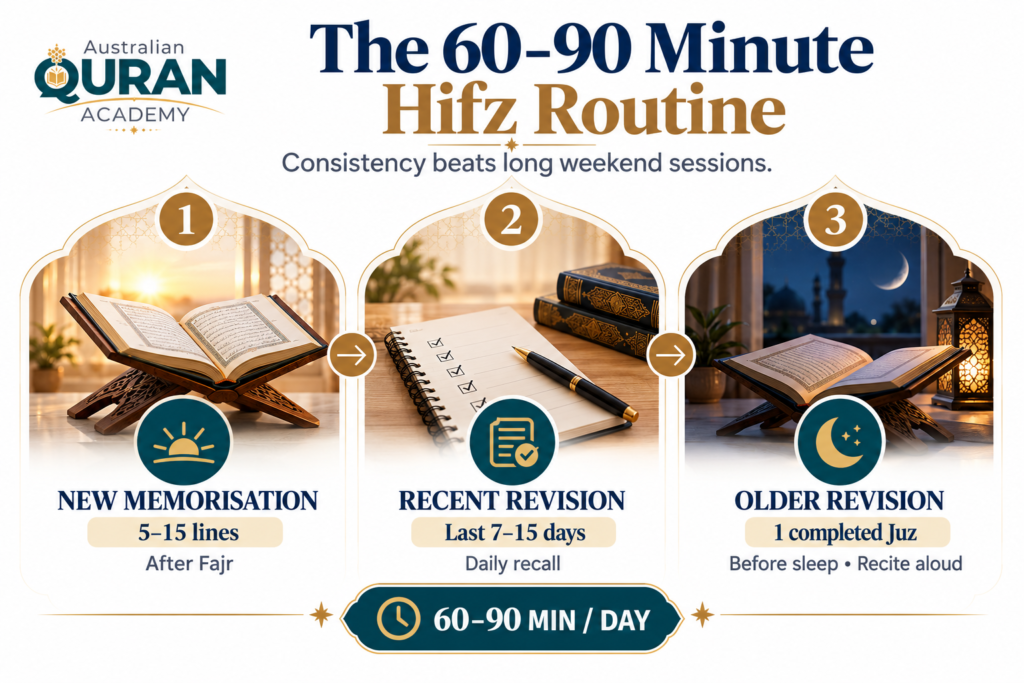
- New memorization of five to fifteen lines, done after Fajr when the mind is clearest.
- Recent revision covering the last seven to fifteen days of memorized text.
- Older revision of one completed Juz, recited aloud before sleeping.
Missing the new lesson for one day costs very little. Missing revision for one week can erase several months of accumulated work, which is why revision blocks are never treated as optional.
Surah Al-Qamar 54:17 on Ease in Quran Memorization
Allah describes the Quran itself as made easy to retain, and this promise is repeated four times in Surah Al-Qamar for emphasis. Students carrying genuine intention are addressed directly by it.
وَلَقَدْ يَسَّرْنَا الْقُرْآنَ لِلذِّكْرِ فَهَلْ مِن مُّدَّكِرٍ
(Wa laqad yassarna al-Qur’ana lidh-dhikri fahal min muddakir)
(“And We have certainly made the Quran easy for remembrance, so is there any who will remember?”)
Ease here does not mean effortlessness. It means that sincere effort meets divine assistance, which explains why children with no Arabic background still complete Hifz across Australia every single year.
Has Anyone Ever Memorized the Entire Quran?
Yes, millions of Muslims have memorized the entire Quran from the first generation until today, and tens of thousands complete it every year across Africa, Asia, Europe and Australia.
No other book in human history carries this scale of verbatim preservation in human memory. Verse order, Juz divisions and individual letters are checked against teachers who themselves recited before certified Huffaz.
Scale alone makes the achievement remarkable, yet the reason behind it is theological rather than statistical, and the historical record supports what the Quran says about its own preservation.
Read also: Quran Memorization Certificate In Australia
Unbroken Chain of Huffaz Across Fourteen Centuries
Every certified Hafiz today recites through a Sanad, a named chain of teachers reaching the Prophet Muhammad, peace be upon him. Ijazah certification exists precisely to document and verify that chain.
Australian students enrolled in Ijazah pathways join the same transmission line. Their recitation is examined letter by letter, never approved through self-assessment or through recordings reviewed casually at a distance.
Surah Al-Hijr 15:9 on Divine Preservation of the Quran
Preservation of the Quran is presented in the text as a divine guarantee rather than a human achievement, and memorization is the mechanism through which that guarantee has operated in every generation.
إِنَّا نَحْنُ نَزَّلْنَا الذِّكْرَ وَإِنَّا لَهُ لَحَافِظُونَ
(Inna nahnu nazzalna adh-dhikra wa inna lahu lahafizun)
(“Indeed, it is We who sent down the Reminder, and indeed, We will be its guardian.”)
Each new Hafiz becomes part of that guarantee. A student in Adelaide memorizing Surah Al-Mulk is doing exactly what Muslims in Madinah were doing fourteen centuries ago.
Hifz Completions Among Australian Muslim Students
Australian Islamic schools, weekend madrasah programs and online academies now produce complete Huffaz every year, including children under twelve and adults who began memorizing after the age of forty.
Completion rates rise sharply when a student has a fixed teacher, a fixed daily slot and a parent or spouse listening to revision at home several times each week.
Australian Quran Academy offers a Quran Memorization Course in Australia that pairs every student with a certified Hafiz for daily Sabaq, Sabaqi and Manzil sessions with immediate correction.
Start Hifz With a Certified Teacher
Hifz Obstacles Muslim Students Meet Across Australia
Obstacles in Australia are logistical rather than religious. Students who plan around them keep progressing, while students who ignore them usually stall somewhere between Juz Amma and the fifth Juz.
Four obstacles appear repeatedly in Australian households, and each one has a practical response that costs nothing beyond planning and a small change to the weekly timetable.
| Obstacle | Effect on Memorization | Practical Response |
| Few local Huffaz teachers | Irregular correction of Makharij errors | Enroll in daily online sessions with certified instructors |
| Long commutes in large cities | Lost evening study time | Move the new lesson to the morning after Fajr |
| School and work peak periods | Memorization pauses for several weeks | Reduce new lessons, never pause revision |
| Limited Arabic exposure at home | Slow reading and weak retention | Study Noorani Qaida and Tajweed alongside Hifz |
Two of these obstacles deserve closer attention, since they affect students in every Australian state rather than families living in one city or one suburb alone.
Distance From Qualified Huffaz in Australian Cities
Qualified Huffaz are concentrated in a small number of suburbs in Sydney and Melbourne. Families in regional areas often drive more than an hour for a single thirty-minute session.
Online instruction removed that barrier. Students who memorize the Quran in Australia can now recite daily to a certified teacher without leaving home, which protects both consistency and family time.
Time Zone Gaps Between Australia and Overseas Teachers
Australian time zones sit several hours ahead of Egypt, Pakistan and the Gulf, where many Quran teachers are based. Poorly scheduled lessons land at midnight or during school hours.
Academies that schedule around Australian Eastern, Central and Western time keep attendance high. Fixed weekly slots matter far more than lesson length for long-term retention of memorized portions.
Is It Possible to Memorize Quran on Your Own?
Partial memorization is possible on your own, yet complete and accurate Hifz is not, because no student can hear the pronunciation errors that their own ear has already accepted as correct.
Self-study works well for repetition, scheduling and revision tracking. It fails at correction, and uncorrected errors become permanent once a portion has been memorized and recited several hundred times.
Two specific risks explain why classical scholars never permitted Hifz without a listening teacher, and both appear constantly among self-taught students across Australia today.
Errors Self-Taught Students Cannot Hear Without a Teacher
Makharij errors are the most common of all. A student who pronounces ض as د, or ح as ه, repeats that same error in every verse containing those letters.
Ghunnah length, Madd counts and Qalqalah strength are equally invisible to an untrained ear. Recordings help with melody, never with the physical articulation points inside the mouth and throat.
Sahih Muslim 798a on Reward for Difficult Recitation
Struggling students sometimes assume their slow progress carries less reward. Aisha, may Allah be pleased with her, narrated a statement of the Prophet Muhammad, peace be upon him, that settles this directly.
الْمَاهِرُ بِالْقُرْآنِ مَعَ السَّفَرَةِ الْكِرَامِ الْبَرَرَةِ وَالَّذِي يَقْرَأُ الْقُرْآنَ وَيَتَتَعْتَعُ فِيهِ وَهُوَ عَلَيْهِ شَاقٌّ لَهُ أَجْرَانِ
(Al-mahiru bil-Qur’ani ma’a as-safarati al-kirami al-bararah, walladhi yaqra’u al-Qur’ana wa yatata’ta’u fihi wa huwa ‘alayhi shaqqun lahu ajran)
(“Whoever is proficient in the Quran is with the noble and obedient scribes, and whoever recites the Quran haltingly, finding it difficult, has two rewards.”)
Difficulty is rewarded rather than penalized, though the narration places proficiency at the higher station. Both groups are honored, and both reach that honor through a teacher who corrects them.
Australian Quran Academy offers Online Tajweed Classes in Australia that correct Makharij and Madd errors before those errors are memorized permanently into a student’s recitation.

Fix Your Pronunciation With Expert Instructors
Daily Hifz Routine That Works With Australian Schedules
A working routine fits the day as it already exists. Students who try to memorize the Quran in Australia around a theoretical schedule usually abandon that schedule within three weeks.
Three short, fixed sessions outperform one long session. Classical Hifz institutions have used this structure for centuries because the brain consolidates text through spacing rather than through sheer volume.
Three named stages organize every traditional memorization day, and each one answers a different memory problem that students face at a different point in the week.
Sabaq, Sabaqi and Manzil Explained for New Students
Each stage carries a specific job inside the daily routine, and skipping any one of them produces a predictable failure within a few weeks of memorization work.
| Stage | Arabic Term | Daily Task | Time Needed |
| New lesson | Sabaq | Memorize five to fifteen new lines | 20 to 30 minutes |
| Recent revision | Sabaqi | Recite the last seven to fifteen days | 15 to 20 minutes |
| Old revision | Manzil | Recite one completed Juz aloud | 20 to 30 minutes |
Students who complete Hifz almost always protect Manzil first. New memorization is the easiest block to delay and by far the least damaging block to postpone for one day.
Sahih al-Bukhari 5031 on Guarding Memorized Verses
Ibn Umar, may Allah be pleased with him, narrated an image the Prophet Muhammad, peace be upon him, used to describe how quickly memorized text escapes a neglectful student.
إِنَّمَا مَثَلُ صَاحِبِ الْقُرْآنِ كَمَثَلِ صَاحِبِ الإِبِلِ الْمُعَقَّلَةِ إِنْ عَاهَدَ عَلَيْهَا أَمْسَكَهَا وَإِنْ أَطْلَقَهَا ذَهَبَتْ
(Innama mathalu sahibi al-Qur’ani kamathali sahibi al-ibili al-mu’aqqalah, in ‘ahada ‘alayha amsakaha wa in atlaqaha dhahabat)
(“The example of the companion of the Quran is like the owner of hobbled camels. If he keeps watch over them he retains them, and if he lets them loose they go away.”)
Hobbled camels stay only while the rope is checked. Memorized Juz behave in exactly the same way, which is why revision is treated as daily maintenance rather than occasional repair.
See Us in Action!
Curious about what our online classrooms look like? Watch the short clips below to see how our interactive, one-on-one sessions bring learning to life with real-time feedback and engaging teaching methods.
Start Your Quranic Journey in Australia
Join our leading online academy and learn with expert tutors through a structured, personalized curriculum.
Book Your Free TrialHifz Timeline to Memorize the Quran in Australia
Timelines depend on daily output, not on intelligence. A student memorizing one page each day with full revision completes the Quran in roughly two years, allowing for illness and holidays.
Four realistic paces cover almost every Australian student, from a busy professional with limited evening study time to a full-time Hifz child in a fully supported home.
| Daily New Memorization | Weekly Output | Estimated Completion |
| 3 to 5 lines | Half a page | 5 to 7 years |
| Half a page | 3 pages | 3 to 4 years |
| One full page | 6 pages | About 2 years |
| Two full pages | 12 pages | 12 to 14 months |
Two groups ask about timelines more often than anyone else, and their expectations differ sharply because of the daily hours that each group can genuinely protect.
Realistic Hifz Pace for Working Adults in Australia
Adults with full-time jobs usually manage three to five new lines daily plus thirty minutes of revision. That pace completes the Quran in five to seven years without burnout.
Starting late is not a disadvantage. Adults absorb Arabic grammar faster, hold intention more firmly and rarely need the external motivation that younger students require week after week.
Memorization Speed Among Australian School Children
Children between seven and fourteen memorize faster and forget faster. A child completing one page daily can finish within two years, provided revision is supervised by a parent or teacher.
Australian school terms create natural pressure points. Reducing new lessons during exam weeks while keeping revision intact protects years of earlier work at very little cost to progress.
Australian Quran Academy offers Hifz Classes for Adults in Australia that build a realistic daily plan around full-time work, with revision targets adjusted every single month.

Book an Adult Hifz Trial Session
Revision Discipline That Prevents Forgetting After Hifz
Completing the Quran is not the end of Hifz. A Hafiz who stops revising loses fluency within months, and the loss always begins with the portions memorized earliest.
Scholars historically recited the entire Quran from memory every seven days. Modern students rarely match that, yet a full cycle every thirty to forty days keeps the text stable.
Prophetic guidance on this point is unusually direct, and the weekly revision load that follows from it is lighter than most new students expect it to be.
Sahih al-Bukhari 5033 on Constant Quran Revision
Abu Musa al-Ashari, may Allah be pleased with him, narrated a warning about neglect that every Hafiz is taught early in the journey, long before completing the first Juz.
تَعَاهَدُوا الْقُرْآنَ فَوَالَّذِي نَفْسِي بِيَدِهِ لَهُوَ أَشَدُّ تَفَصِّيًا مِنَ الإِبِلِ فِي عُقُلِهَا
(Ta’ahadu al-Qur’ana fawalladhi nafsi biyadihi lahuwa ashaddu tafassiyan min al-ibili fi ‘uqulihaa)
(“Keep refreshing your knowledge of the Quran, for by Him in whose Hand is my soul, it escapes faster than a camel from its tether.”)
Escape is faster than acquisition. One silent week after completing twenty Juz can cost more repair time than the original memorization of those same several pages.
Weekly Revision Load Every Hafiz Must Carry
Revision load scales with memorized volume, not with available enthusiasm. A simple rule keeps the daily workload predictable across every stage of a long memorization journey.
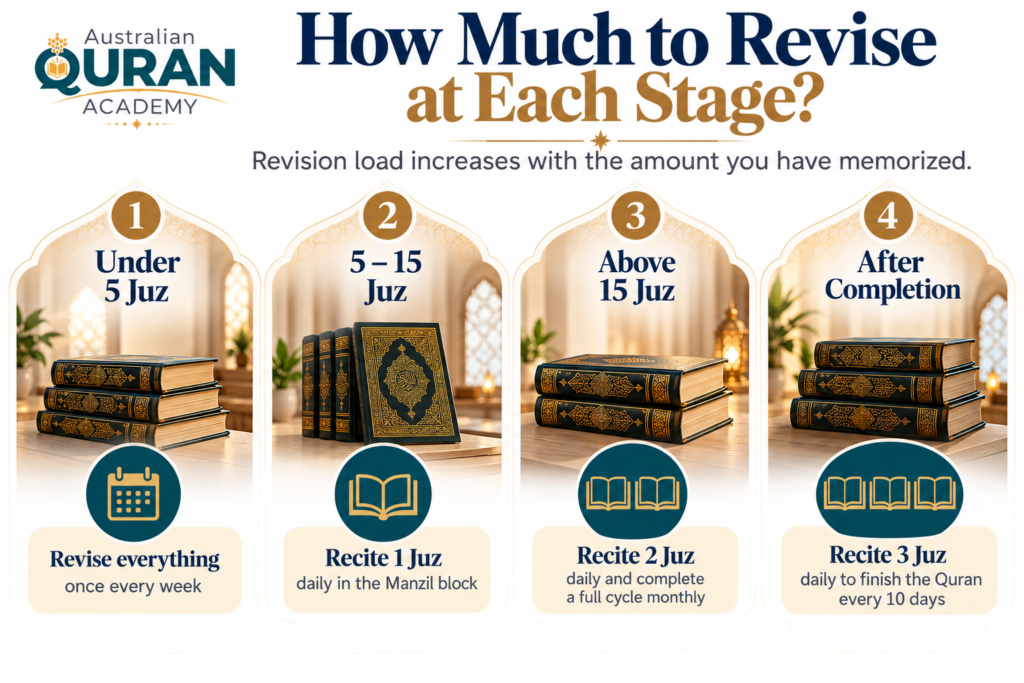
- Under 5 Juz, revise everything memorized once every week.
- Between 5 and 15 Juz, recite one Juz daily inside the Manzil block.
- Above 15 Juz, recite two Juz daily and complete a full cycle monthly.
- After completion, recite three Juz daily to finish the Quran every ten days.
Written tracking matters enormously. Students who log Manzil pages in a notebook or app sustain revision far longer than those relying on memory to track their own memory.
Family and Community Support for Hifz in Australia
Hifz rarely survives in isolation. Australian students who complete the Quran almost always have a household that treats the daily session as fixed rather than negotiable.
Support does not require Arabic fluency. A parent listening while following a transliteration still catches skipped lines and hesitation, which is most of what daily revision actually needs.
Two sources of support matter most for Australian families, and both remain available regardless of which state, city or regional town the household happens to live in.
Role of Parents in Daily Memorization Sessions
Parents hold the schedule, not the curriculum. Fixing the session time, removing devices during recitation and attending occasional lessons produces more progress than any memorization technique on its own.
Praise should target attendance rather than speed. Children rewarded for showing up daily keep going during slow weeks, when pages take much longer than usual to settle properly.
Weekend Quran Programs Across Australian Masjids
Weekend madrasah programs in Sydney, Melbourne, Brisbane and Perth give children peer motivation and group recitation. Both raise commitment in ways that individual study at home cannot reproduce.
Weekend attendance alone is insufficient for Hifz. Group sessions work best alongside daily one-on-one correction, since a teacher cannot examine fifteen children individually inside ninety minutes.
Australian Quran Academy offers Quran Memorization for Kids in Australia that keeps young students on a short daily lesson with parent progress reports after every single session.
Enroll Your Child in a Free Trial Lesson
Reward Awaiting Every Hafiz on the Day of Judgment
Reward is what sustains Hifz through the difficult years. Prophetic narrations describe outcomes that no worldly achievement matches, and students who revisit them regularly abandon memorization far less often.
Two narrations in particular are quoted in almost every Hifz circle around the world, and both describe lasting status rather than any form of material compensation.
Read also: 7 Best Quran Memorization Websites
Sunan Abu Dawud 1464 on Rank in Jannah
Abdullah ibn Amr, may Allah be pleased with him, narrated a description of what awaits the companion of the Quran, linking final rank directly to the volume a person retained.
يُقَالُ لِصَاحِبِ الْقُرْآنِ اقْرَأْ وَارْتَقِ وَرَتِّلْ كَمَا كُنْتَ تُرَتِّلُ فِي الدُّنْيَا فَإِنَّ مَنْزِلَكَ عِنْدَ آخِرِ آيَةٍ تَقْرَؤُهَا
(Yuqalu li-sahibi al-Qur’ani iqra’ wartaqi wa rattil kama kunta turattilu fid-dunya fa’inna manzilaka ‘inda akhiri ayatin taqra’uha)
(“It will be said to the companion of the Quran, recite and ascend, and recite with measured tone as you used to recite in the world, for your rank will be at the last verse you recite.”)
Rank rises with every verse a person retains. This single narration explains why Hifz students measure progress in Juz completed rather than in months spent attending lessons.
Sahih al-Bukhari 5027 on Learning and Teaching Quran
Uthman ibn Affan, may Allah be pleased with him, narrated a statement that places Quran learners and Quran teachers above every other category of excellence within the Muslim community.
خَيْرُكُمْ مَنْ تَعَلَّمَ الْقُرْآنَ وَعَلَّمَهُ
(Khayrukum man ta’allama al-Qur’ana wa ‘allamahu)
(“The best of you are those who learn the Quran and teach it.”)
Teaching completes the cycle. Many Australian Huffaz begin teaching children at their local masjid within a year of completion, which also protects their own daily revision.
Inside Our Virtual Classrooms
We believe in full transparency and proven quality. Take a look at these actual snippets from our live classes to experience our modern learning platform, patient instructors, and interactive student participation.
Start Your Quranic Journey in Australia
Join our leading online academy and learn with expert tutors through a structured, personalized curriculum.
Book Your Free TrialStart Your Hifz Journey With Australian Quran Academy
Australian Quran Academy runs one-on-one Hifz sessions with certified Huffaz holding Ijazah, scheduled around Australian Eastern, Central and Western time zones for children, adults and sisters.
Progress reports after every session track Sabaq, Sabaqi and Manzil separately, so parents see exactly where revision is slipping before the weakness costs a completed Juz.
Our Quran Courses
- Quran Memorization Course in Australia
- Hifz Classes for Adults in Australia
- Quran Memorization for Kids in Australia
- Quran Hifz for Ladies in Australia
- Online Tajweed Classes in Australia
- Online Quran Ijazah Program in Australia
Start Your Quranic Journey in Australia
Join our leading online academy and learn with expert tutors through a structured, personalized curriculum.
Book Your Free TrialConclusion
Memorizing the Quran in Australia is possible for any Muslim willing to protect a fixed daily slot and recite to a qualified teacher who corrects errors on the spot.
Obstacles are real enough. Distance, time zones and crowded school terms slow students down, yet none of them prevent completion once revision becomes a non-negotiable part of the day.
Start with a modest daily target and a teacher who listens every day. Pace matters far less than the number of days a student never missed across the year.
FAQs
Here are the most common Hifz questions Australian students ask before starting.
Is It Possible to Memorize the Quran in 1 Year?
Yes, but only with full-time study. Completing the Quran within one year requires around two pages of new memorization daily plus two hours of revision, which suits full-time Hifz students rather than working adults.
How Many Pages Should a Beginner Memorize Each Day?
Beginners should start with three to five lines daily, not a full page. Small portions memorized perfectly build revision habits, while oversized targets create a backlog that collapses within the first two months.
Can Adults Start Hifz After the Age of Forty?
Yes, adults over forty complete Hifz regularly. Retention is slower than in childhood, yet stronger discipline, better Arabic comprehension and firmer intention usually compensate, especially with daily one-on-one correction from a certified teacher.
Do I Need to Learn Arabic Before Starting Hifz?
No, Arabic fluency is not required, but accurate Quran reading is essential. Students should complete Noorani Qaida and basic Tajweed first, since memorizing text you cannot read correctly embeds errors permanently.
How Long Does Daily Hifz Revision Actually Take?
Revision takes thirty to sixty minutes for most students, scaling with memorized volume. A student holding ten Juz needs roughly forty minutes daily, while a complete Hafiz usually recites three Juz in about an hour.







Leave a Reply