 Quran

Many Muslims searching for how to concentrate while reading Quran begin with sincere intentions but finish a page unable to recall its central message. Their eyes followed the verses, yet their attention repeatedly moved elsewhere.
Weak concentration is rarely caused by weak faith. Mental fatigue, phone notifications, hurried recitation, unfamiliar vocabulary, and the absence of a clear reading purpose can divide attention before a meaningful connection with the passage develops.
Focused Quran reading becomes easier when the mind, environment, pace, and method work together. The following eight steps create a repeatable reading process that limits distraction, strengthens active engagement, and reconnects every session with meaning.
1. Plan How to Concentrate While Reading Quran
Begin each session with one purpose and a passage small enough to read attentively. A target of five focused verses is more useful than several hurried pages that leave no meaning, correction, or reflection in memory.
Renew your niyyah, meaning intention, by identifying why this session matters. You may intend worship, closer attention in Salah, better recitation, reflection on a theme, or revision of verses already studied.
Choose only one primary goal per sitting. Trying to correct Tajweed, memorise every line, study detailed Tafsir, and finish a large quota simultaneously overloads working attention and turns the session into several competing tasks.
Write the target in a short, measurable form before opening the Mushaf. Read verses 1 to 5 slowly and explain their main message gives the mind a defined finish point and a reason to stay present.
Use this simple target formula:
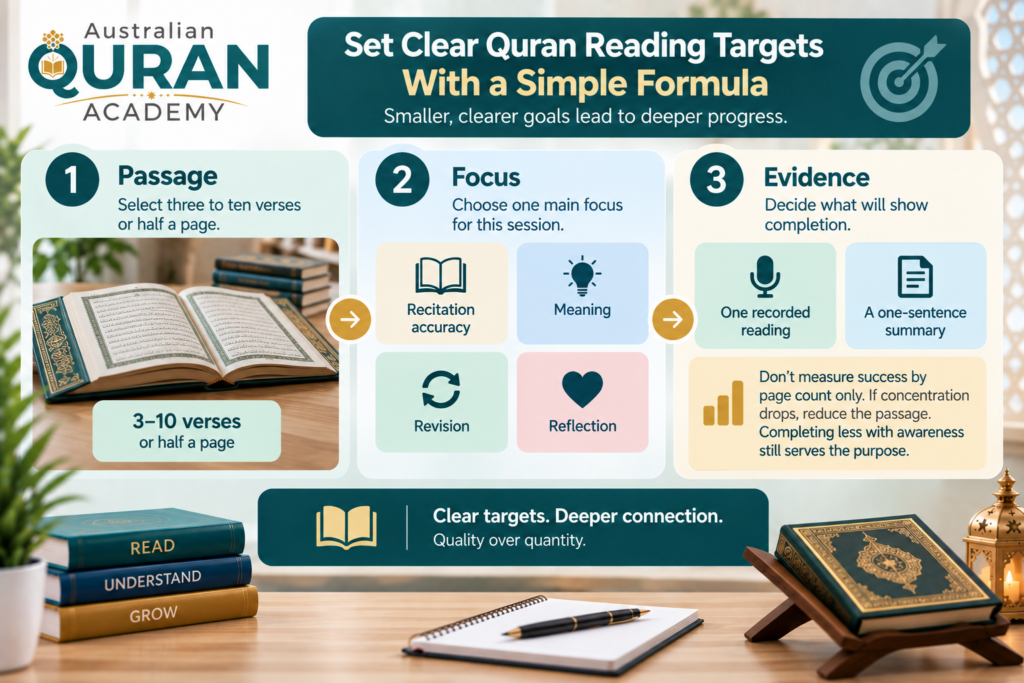
- Passage: Select three to ten verses or half a page.
- Focus: Choose recitation accuracy, meaning, revision, or reflection.
- Evidence: Decide what will show completion, such as one recorded reading or a one-sentence summary.
Avoid making page completion the only measure of success. If concentration drops repeatedly, reduce the passage instead of increasing effort; completing less with awareness directly serves the purpose of Quran reading.
2. Choose a Reliable Quran Time in Australia
Choose a reading window when your mind is awake and interruptions are predictable. For many Muslims in Australia, a brief period after Fajr works well, while others concentrate better after school drop-off or after Isha.
Prayer times shift considerably between summer and winter, particularly in southern cities such as Melbourne and Hobart. Build the habit around a stable event, not a fixed clock time that becomes impractical when daylight hours change.
An event-based cue might be after Fajr before checking messages or after the children sleep. This approach survives seasonal prayer changes, daylight saving adjustments, changing work rosters, and the different routines of weekdays and weekends.
Compare possible times for seven days before choosing one:
| Reading window | Main advantage | Likely obstacle | Best adjustment |
| After Fajr | Quiet mind and fewer messages | Sleepiness after a late night | Sleep earlier and begin with ten minutes |
| Mid-morning | Strong alertness for home workers | Meetings or household duties | Block the time in the calendar |
| After Maghrib | Natural link with Salah | Dinner and family activity | Read before entering the kitchen |
| After Isha | Fewer external demands | Mental fatigue | Use a short familiar passage |
Australian Quran Academy offers Quran Reading Classes in Australia that can give readers a consistent appointment, suitable material, and direct correction when an unstructured routine keeps breaking down.

3. Build a Quiet Quran Space in Australian Homes
Prepare one low-distraction place that signals Quran reading as soon as you sit down. It does not need to be a separate room; one chair, a prayer rug, a stand, and suitable light can establish the cue.
Many homes contain open-plan living areas, shared bedrooms, or active family spaces. Choose the quietest repeatable corner and tell household members when your short session begins, rather than waiting for perfect silence that rarely arrives.
Keep everything required within reach before starting. The Mushaf, translation, pencil, bookmark, water, and reading glasses should be ready so that searching for an item does not open a path towards another task.
Physical comfort supports attention, but excessive comfort can produce drowsiness. Sit upright with the Mushaf high enough to avoid bending your neck, use clear lighting, and avoid reading in bed when sleep commonly overtakes the session.
Remove visual clutter from the immediate field of view. Unfinished paperwork, an open laptop, laundry, and television movement repeatedly remind the brain of other obligations, even when nobody speaks or interrupts you.
Use a quick environmental check before every session:
- Required reading materials are ready.
- Television and unrelated audio are off.
- Household members know the session will last 10 to 20 minutes.
- Seating supports alertness without discomfort.
- Temperature and lighting will not require adjustment midway.
Returning to the same place strengthens the association between that setting and attentive recitation. After repeated sessions, sitting there becomes a behavioural cue that reduces the time needed to settle.
See Us in Action!
Curious about what our online classrooms look like? Watch the short clips below to see how our interactive, one-on-one sessions bring learning to life with real-time feedback and engaging teaching methods.
Start Your Quranic Journey in Australia
Join our leading online academy and learn with expert tutors through a structured, personalized curriculum.
Book Your Free Trial4. Remove Digital Interruptions Before Recitation
Make the phone unavailable before the first verse, not merely silent beside the Mushaf. A visible device can divide attention because the possibility of a message remains mentally active even when no notification appears.
Place the phone in another room, activate airplane mode, or use a timed focus setting that blocks calls and social applications. Tell essential contacts when you will be available again if urgent communication is a genuine concern.
When reading from a Quran application, remove every avoidable interruption before opening it. Disable banners, close other tabs, download the recitation in advance, and use full-screen mode so that the same device serves only one purpose.
Do not use the phone to check every unfamiliar point as it arises. Mark the verse on paper, continue to the session boundary, and research the question afterwards; repeated switching weakens comprehension and makes returning progressively harder.
Distinguish external and internal distractions because each needs a different response:
| Distraction | Example | Immediate response |
| External sound | Television, conversation, traffic | Move, use a quieter time, or close the door |
| Digital prompt | Message, email, application badge | Block notifications and place the device away |
| Practical reminder | Remembering a bill or household task | Write one word on a capture note, then resume |
| Emotional concern | Replaying an argument or worry | Name the concern, postpone it, and return to the verse |
Australian Quran Academy provides Online Tajweed Classes in Australia for guided practice where the lesson itself creates protected recitation time and a teacher keeps attention on sound, pace, and correction.

Try a focused Tajweed lesson for FREE
5. Read Slowly Aloud and Track Every Word
Read at a controlled audible pace while following each word with your eyes or finger. Hearing, speaking, and tracking the text recruit several channels of attention, making automatic page scanning easier to detect and stop.
Measured recitation is Tarteel, meaning clear, deliberate reading in which letters and words receive their proper form. Slow reading is not theatrical stretching; it protects pronunciation, allows natural pauses, and leaves room for meaning.
Allah commands measured recitation in a concise Quranic instruction:
وَرَتِّلِ الْقُرْآنَ تَرْتِيلًا
(Wa rattili al-Qur’ana tartila)
(“And recite the Quran with measured recitation.”)
Use a pencil, bookmark edge, or clean finger to guide the line without racing ahead. The movement gives wandering eyes a physical reference and reveals exactly where attention stopped following the recitation.
Pause at suitable stopping points rather than whenever breath ends. Waqf means stopping during recitation; observing recognised stop signs protects the sentence’s meaning and prevents a rushed breath from separating connected words carelessly.
Apply a four-part reading cycle to each short passage:
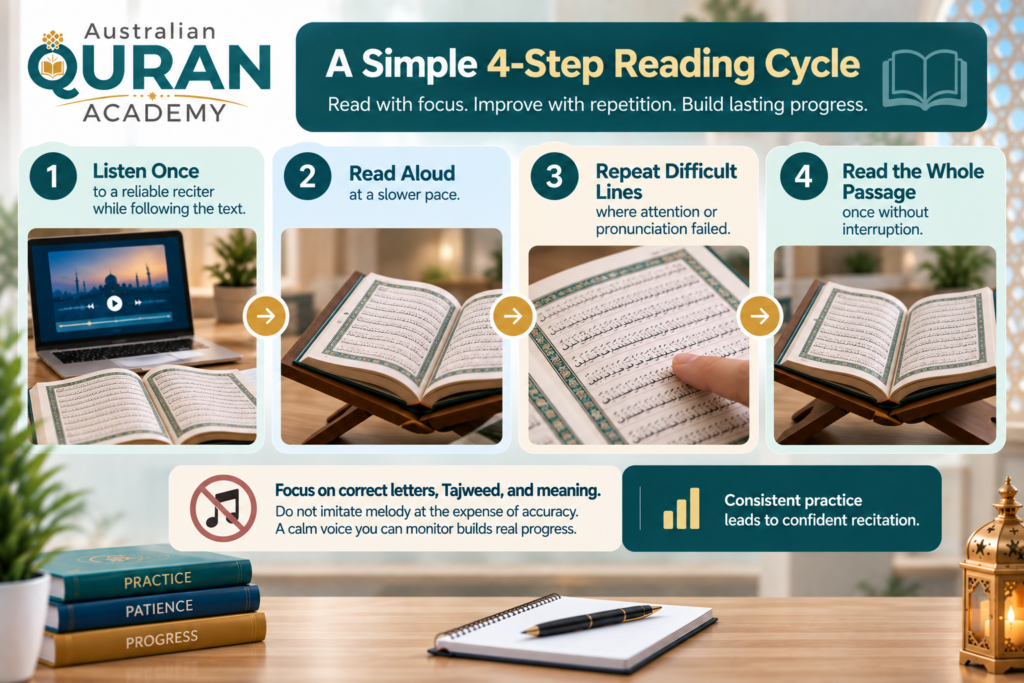
- Listen once to a reliable reciter while following the text.
- Read the passage aloud at a slower pace.
- Repeat only the lines where attention or pronunciation failed.
- Read the complete passage once without interruption.
Do not imitate melody at the expense of letters, Tajweed, or meaning. A calm voice that you can monitor is more useful for concentration than a performance-focused voice that makes you chase tone and lose the text.
Read also: How To Start Memorizing Quran In Australia In 10 Steps
6. Connect Each Passage with Its Meaning
Read an accessible translation and brief Tafsir before repeating the passage. Attention holds more easily when the words form a message, argument, command, story, or supplication instead of remaining an unfamiliar sequence of sounds.
Tafsir is the disciplined explanation of Quranic meanings using language, context, Prophetic teaching, and recognised scholarship. For a focus session, use a concise trusted explanation rather than opening several detailed commentaries and losing the reading objective.
Preview the meaning in one minute, then return to the Arabic text. During recitation, pause at the end of an idea and recall its meaning in a few words without attempting a full translation from memory.
Ask one specific reflection question after the passage. Suitable questions include What quality of Allah appears here?, What action is required?, What warning should affect my choices?, or What promise should strengthen hope?
Record the answer in one sentence. Writing a short response requires retrieval, shows whether you followed the passage, and creates a useful record without turning a 15-minute recitation session into an extended study project.
Keep recitation, translation, and reflection in a clear order:
| Stage | Action | Time limit | Purpose |
| Meaning preview | Read a translation and brief Tafsir | 2 minutes | Establish the passage’s subject |
| Measured reading | Recite the selected verses aloud | 7 minutes | Attend to words and pronunciation |
| Focused return | Repeat difficult or missed lines | 3 minutes | Repair attention and accuracy |
| Reflection note | Write one practical sentence | 2 minutes | Retain the central message |
Australian Quran Academy offers a Quran Tafsir Course that connects recitation with reliable explanation, helping students replace vague impressions with a clearer grasp of context, vocabulary, and application.
Book a FREE introductory lesson
7. Reset Wandering Attention Without Restarting
Return to the last understood phrase as soon as you notice wandering attention. Do not restart the page, criticise yourself, or abandon the session; noticing distraction is the moment concentration can be restored.
Use a three-second reset: stop your voice, take one natural breath, locate the last word you consciously followed, and resume from the beginning of that phrase. This keeps recovery short and connected to the text.
Keep a small capture note beside the Mushaf for legitimate reminders. If you remember an appointment or task, write only a cue such as invoice or call school, then return without planning the task.
Recurring thoughts require a later appointment, not a longer struggle during recitation. Set a specific time after the session to address the concern; the mind is more willing to release it when postponement is credible.
Mark each successful return with a small dot on a tracking sheet. The aim is not to produce zero dots immediately, but to shorten the time between drifting and noticing, then resume without emotional escalation.
Use the correct response for each concentration failure:
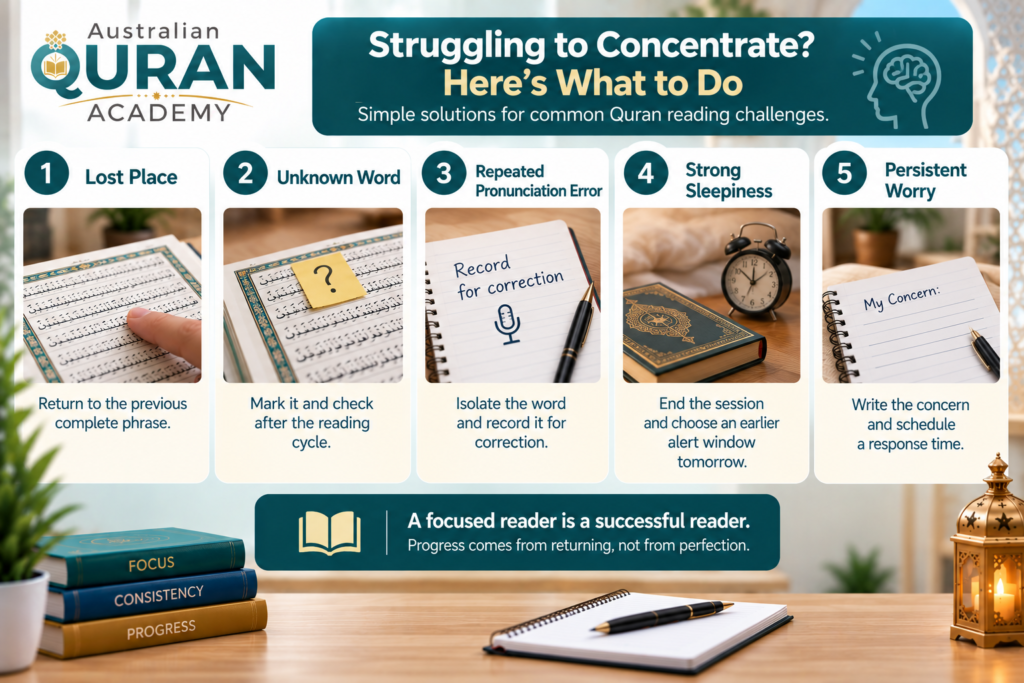
- Lost place: Return to the previous complete phrase.
- Unknown word: Mark it and check after the reading cycle.
- Repeated pronunciation error: Isolate the word and record it for correction.
- Strong sleepiness: End the session and choose an earlier alert window tomorrow.
- Persistent worry: Write the concern and schedule a response time.
Concentration improves through repeated returns, not through forcing the mind never to wander. A reader who notices quickly and resumes correctly is training attention more effectively than one who continues reciting without awareness.
Inside Our Virtual Classrooms
We believe in full transparency and proven quality. Take a look at these actual snippets from our live classes to experience our modern learning platform, patient instructors, and interactive student participation.
Start Your Quranic Journey in Australia
Join our leading online academy and learn with expert tutors through a structured, personalized curriculum.
Book Your Free Trial8. Review Focus with a Qualified Quran Teacher
Arrange regular recitation feedback so that attention is not consumed by uncertainty about pronunciation. A qualified teacher identifies errors quickly, selects an appropriate practice target, and prevents repeated mistakes from becoming familiar and difficult to hear.
Self-study cannot reliably detect every error because the reader hears the pronunciation they intended. Teacher correction separates an attention problem from a reading-skill problem, allowing the next session to focus on one confirmed weakness.
Bring one short recording and one precise question to the lesson. Ask where the recitation became rushed, which letter or rule repeatedly failed, and what passage should be practised before the next meeting.
Online instruction is particularly practical across Australia, where learners may live far from a mosque program or a suitable teacher. It also allows sessions to be scheduled around local work, school, and family commitments.
Choose a teacher who listens closely rather than interrupting every few seconds. Effective correction identifies priority errors, demonstrates the right sound, asks for immediate repetition, and leaves the student with a limited practice assignment.
Track feedback in three columns:
| Date | Priority correction | Next practice target |
| Session 1 | One repeated articulation error | Five words containing the same letter |
| Session 2 | Rushing before stop signs | Half a page with marked Waqf points |
| Session 3 | Losing meaning during longer verses | Translation preview and phrase pauses |
Australian Quran Academy offers Quran Recitation Classes in Australia with live teacher feedback that can turn unfocused independent reading into a defined cycle of correction, practice, and review.

Book your FREE recitation assessment
Seven Day Quran Focus Plan for Australia
Use this seven-day plan after completing the eight steps once. It converts the method into short daily practice while measuring attention honestly, without repeating pages merely to create the feeling of productivity.
Keep the same passage length for the full week unless it is clearly unsuitable. Changing the quota every day makes comparison unreliable; stable conditions reveal whether the reading method is improving concentration.
| Day | Main task | Session length | Evidence of focus |
| 1 | Choose the place, cue, purpose, and five-verse target | 10 minutes | Session begins at the planned cue |
| 2 | Remove the phone and read aloud while tracking words | 12 minutes | No unrelated screen checking occurs |
| 3 | Preview the translation before measured recitation | 15 minutes | One-sentence meaning note is completed |
| 4 | Practise the three-second attention reset | 15 minutes | Every distraction receives a calm return |
| 5 | Record one complete reading of the passage | 15 minutes | Rushed points are identified accurately |
| 6 | Repeat marked pronunciation and attention points | 15 minutes | Fewer corrections are needed than Day 5 |
| 7 | Review the log and prepare one teacher question | 15 minutes | One priority is chosen for the next week |
Measure four indicators after every session. Use numbers rather than impressions so that a difficult day does not hide improvement made across the week.
| Indicator | Recording method | Positive change |
| Planned start | Yes or no | More sessions begin at the chosen cue |
| Unplanned interruptions | Count each interruption | Total falls without extending the session |
| Attention returns | Count each successful reset | Returns become faster and calmer |
| Meaning recall | Write one sentence | Summary becomes clearer and more specific |
Use the checklist below before increasing the passage. If fewer than four statements are true, keep the current length for another week and repair the weak condition first.
- I began at the planned cue on at least five days.
- I protected the session from avoidable phone use.
- I could explain the selected passage in one sentence.
- I noticed wandering within one or two lines.
- I resumed without restarting the entire page.
- I identified one pronunciation issue for teacher review.
If the routine breaks, return at the next normal cue and complete the usual minimum. Do not accumulate missed pages, double the next quota, or redesign the whole plan after one disrupted day.
Read also: How To Memorize The Holy Quran By Skype In Australia
Improve Quran Focus with Australian Quran Academy
Australian Quran Academy helps learners strengthen concentration through live recitation, personalised correction, and structured practice targets. Online scheduling supports adults, children, and families who need qualified instruction fitted around Australian time zones and weekly commitments.
What sets Australian Quran Academy apart:
- Live instruction keeps each session active and accountable.
- Individual correction targets the mistakes affecting accuracy and focus.
- Flexible online access supports learners across different Australian cities.
- A free trial allows students to assess teaching fit before committing.
Our Quran Courses:
- Quran Reading Classes
- Online Tajweed Classes
- Quran Tafsir Course
- Quran Recitation Classes
- Quran Classes for Kids
- Quran Classes for Beginners

Conclusion
Learning how to concentrate while reading Quran depends less on waiting for perfect focus and more on building conditions that support it. A clear purpose, protected time, audible recitation, and accessible meaning keep attention connected to the passage.
Distraction does not mean the session has failed. Each deliberate return trains the mind to remain present for longer periods, while smaller reading portions allow deeper reflection without rushing simply to complete pages.
During your next session, choose five verses, remove the phone, read aloud, and write one sentence about their meaning. Note each distraction calmly, return immediately, and use the result to set a realistic target for tomorrow.
Frequently Asked Questions About Quran Concentration
Why does my mind wander while reading Quran?
Your mind may wander because you are tired, worried, rushing, reading unfamiliar material, or expecting attention to remain automatic. Reduce the passage, remove external prompts, preview the meaning, and use a brief reset whenever awareness slips.
How long should a focused Quran session last?
A focused Quran session can begin at 10 to 15 minutes. Extend it only when attention remains active and comprehension does not fall. A short daily session usually builds a stronger habit than an occasional hour of tired reading.
Should I read Quran aloud to improve concentration?
Yes, quiet audible recitation can improve concentration by engaging speech, hearing, and visual tracking together. Read slowly enough to monitor each word, but keep the voice natural so that volume or melody does not become another distraction.
Does reading a translation improve Quran focus?
Yes, an accessible translation gives the passage a clear subject and helps the mind follow connected ideas. Read it briefly before recitation, then return to the Arabic and recall the main meaning at suitable stopping points.
What should I do when distracting thoughts return?
Write a one-word reminder if the thought requires later action, then resume from the last understood phrase. Persistent worries should receive a scheduled time after recitation, allowing the mind to postpone them without fearing they will be forgotten.
Can a Quran teacher help improve concentration?
Yes, a qualified teacher can identify whether lost focus comes from weak decoding, uncertain Tajweed, unsuitable material, or poor pacing. Clear correction reduces mental overload and gives each independent session one precise skill to practise.







[…] Read also: How to Concentrate While Reading Quran? […]
[…] Read also: How to Concentrate While Reading Quran? […]