 Arabic
Building a strong Arabic vocabulary starts with simple words children can hear, understand, and use in everyday life. Family members, colours, numbers, animals, food, and daily activities are natural starting points because children can connect these words to the people, objects, and routines around them.
This guide brings together easy Arabic words for kids, organized by topic with English meanings and simple transliterations. You’ll also find practical games and activities to help children remember new vocabulary and gradually move from individual words to short Arabic phrases and everyday conversation.
What Is Arabic Vocabulary for Kids?
Arabic vocabulary for kids is the collection of Arabic words that young learners encounter and use in their everyday life — words for family members, common objects, colours, numbers, animals, food, and daily activities.
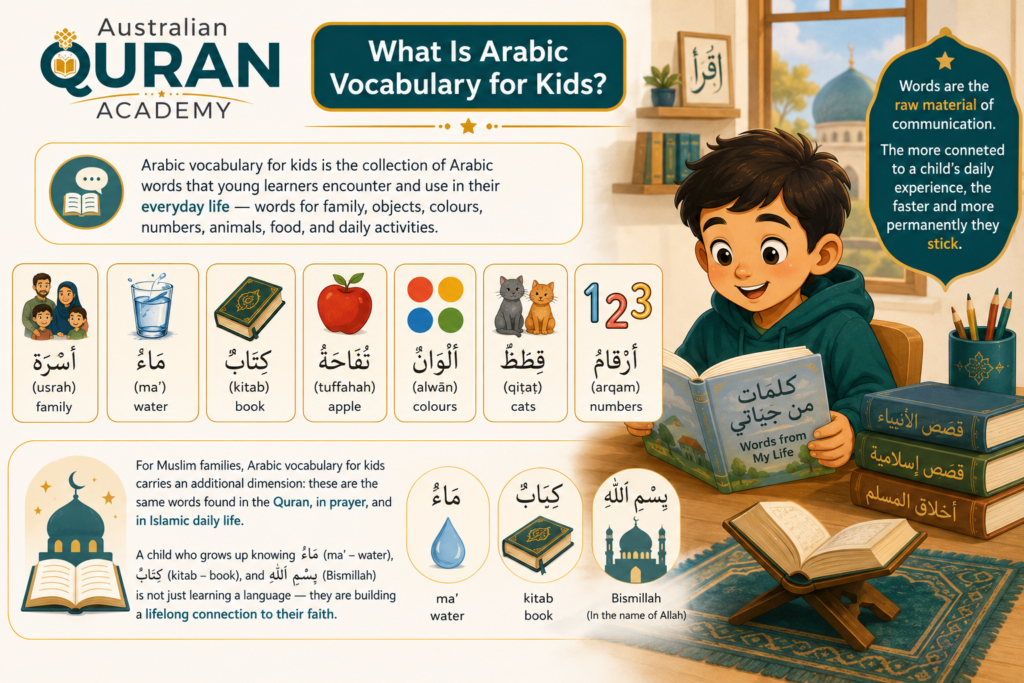
It is the starting point for all Arabic language learning. Before grammar rules, before sentence structure, before reading — a child needs words. Words are the raw material of communication, and the more connected those words are to a child’s real daily experience, the faster and more permanently they stick.
For Muslim families, Arabic vocabulary for kids carries an additional dimension: these are the same words found in the Quran, in prayer, and in Islamic daily life. A child who grows up knowing مَاء (ma’ — water), كِتَاب (kitab — book), and بِسْمِ اللَّهِ (Bismillah) is not just learning a language — they are building a lifelong connection to their faith.
Basic Arabic Words for Kids: The First Words to Teach
Before moving into topic-based vocabulary, every child benefits from a small set of foundational words that appear across almost every conversation. These are the words children will hear and use every single day.
| Arabic | Transliteration | English |
| نَعَم | Na’am | Yes |
| لَا | La | No |
| مِن فَضلِك | Min fadlik | Please |
| شُكرًا | Shukran | Thank you |
| عَفوًا | Afwan | You’re welcome |
| مَرحَبًا | Marhaban | Hello |
| مَع السَّلَامَة | Ma’a as-salama | Goodbye |
| نَعَم، أَفهَم | Na’am, afham | Yes, I understand |
| لَا أَعرِف | La a’rif | I don’t know |
| مَاذَا؟ | Matha? | What? |
| أَين؟ | Ayna? | Where? |
Teach these first. They give children the scaffolding to participate in any conversation, even before they know topic-specific words.
Arabic Vocabulary for Kids by Topic
This is the core of any strong Arabic vocabulary programme for children. Organizing words by topic mirrors how children naturally build mental categories — and makes review and practice far more effective than random word lists.
Family Members in Arabic for Kids
Family is the emotional centre of a young child’s world, which is exactly why family vocabulary is always the most memorable.
| Arabic | Transliteration | English |
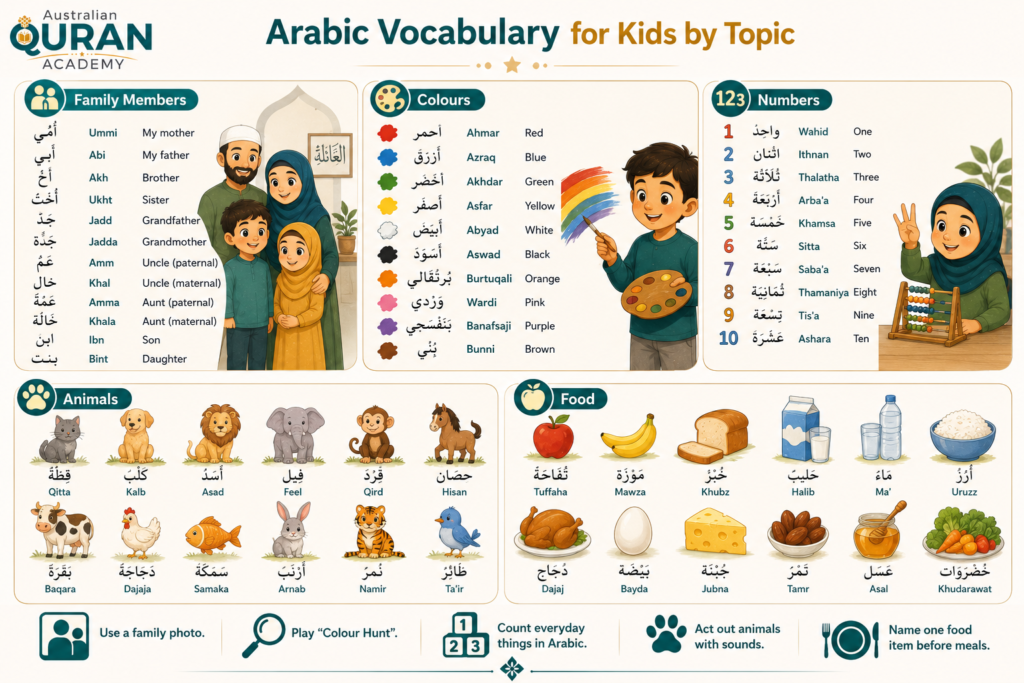
| أُمِّي | Ummi | My mother |
| أَبِي | Abi | My father |
| أَخ | Akh | Brother |
| أُخت | Ukht | Sister |
| جَدّ | Jadd | Grandfather |
| جَدَّة | Jadda | Grandmother |
| عَمّ | Amm | Uncle (paternal) |
| خَال | Khal | Uncle (maternal) |
| عَمَّة | Amma | Aunt (paternal) |
| خَالَة | Khala | Aunt (maternal) |
| ابن | Ibn | Son |
| بِنت | Bint | Daughter |
Teaching tip: Use a family photo during practice. Point to each person, say the Arabic word, and have your child repeat. “هَذِهِ أُمِّي” (Hathihi ummi — “This is my mother”) creates an emotional anchor for the word that no flashcard can replicate.
Colours in Arabic for Kids
Colours are naturally gameable — which makes them some of the easiest vocabulary for children to retain.
| Arabic | Transliteration | English |
| أَحمَر | Ahmar | Red |
| أَزرَق | Azraq | Blue |
| أَخضَر | Akhdar | Green |
| أَصفَر | Asfar | Yellow |
| أَبيَض | Abyad | White |
| أَسوَد | Aswad | Black |
| بُرتُقَالِي | Burtuqali | Orange |
| وَردِي | Wardi | Pink |
| بَنَفسَجِي | Banafsaji | Purple |
| بُنِّي | Bunni | Brown |
Teaching tip: Play the “Colour Hunt” — call out an Arabic colour and have your child race to find an object of that colour around the house. Five minutes of this beats any colour worksheet.
Numbers in Arabic for Kids
Numbers appear in daily life constantly: counting snacks, telling time, reading the date. Building number vocabulary early gives children practical tools they use every day.
| Arabic | Transliteration | English |
| وَاحِد | Wahid | One |
| اثنَان | Ithnan | Two |
| ثَلَاثَة | Thalatha | Three |
| أَربَعَة | Arba’a | Four |
| خَمسَة | Khamsa | Five |
| سِتَّة | Sitta | Six |
| سَبعَة | Saba’a | Seven |
| ثَمَانِيَة | Thamaniya | Eight |
| تِسعَة | Tis’a | Nine |
| عَشَرَة | Ashara | Ten |
Teaching tip: Count everyday objects in Arabic during meals, bedtime, or bath time. “كَم تُفَّاحَة؟” (Kam tuffaha? — “How many apples?”) turns a routine moment into Arabic practice.
Animals in Arabic for Kids
Children universally love animals — which makes animal vocabulary one of the most enjoyable entry points into Arabic vocabulary for kids.
| Arabic | Transliteration | English |
| قِطَّة | Qitta | Cat |
| كَلب | Kalb | Dog |
| أَسَد | Asad | Lion |
| فِيل | Feel | Elephant |
| قِرد | Qird | Monkey |
| حِصَان | Hisan | Horse |
| بَقَرَة | Baqara | Cow |
| دَجَاجَة | Dajaja | Chicken |
| سَمَكَة | Samaka | Fish |
| أَرنَب | Arnab | Rabbit |
| نَمِر | Namir | Tiger |
| طَائِر | Ta’ir | Bird |
Teaching tip: Act out each animal with a sound or movement. Children aged 4–8 retain vocabulary paired with physical action at dramatically higher rates than repetition alone. Say أَسَد (asad) with a roar — they’ll never forget it.
Food Words in Arabic for Kids
Food vocabulary is practical, memorable, and comes up at every single meal — making it one of the easiest themes to reinforce daily without any extra effort.
| Arabic | Transliteration | English |
| تُفَّاحَة | Tuffaha | Apple |
| مَوزَة | Mawza | Banana |
| خُبز | Khubz | Bread |
| حَلِيب | Halib | Milk |
| مَاء | Ma’ | Water |
| أُرُزّ | Uruzz | Rice |
| دَجَاج | Dajaj | Chicken |
| بَيضَة | Bayda | Egg |
| جُبنَة | Jubna | Cheese |
| تَمر | Tamr | Dates |
| عَسَل | Asal | Honey |
| خُضرَوَات | Khudarawat | Vegetables |
Before every meal, name one food item in Arabic together. Over the course of a month, your child will have encountered the full list more than thirty times — in context, not in a worksheet.
For families wanting structured vocabulary instruction alongside Quran learning, the Arabic Fusha course at Australian Quran Academy builds reading vocabulary using Modern Standard Arabic — the same language found in the Quran and Islamic texts.

Body Parts in Arabic for Kids
Body vocabulary is concrete, immediately accessible, and endlessly practisable — because children are always with their bodies.
| Arabic | Transliteration | English |
| رَأس | Ra’s | Head |
| عَين | Ayn | Eye |
| أُذُن | Udhun | Ear |
| أَنف | Anf | Nose |
| فَم | Fam | Mouth |
| يَد | Yad | Hand |
| رِجل | Rijl | Foot / Leg |
| بَطن | Batn | Stomach |
| ظَهر | Zahr | Back |
| أَسنَان | Asnan | Teeth |
Teaching tip: Play an Arabic version of “Head, Shoulders, Knees and Toes” — point to each body part while saying its Arabic name. This is one of the most effective methods for teaching Arabic vocabulary for kids to young children because it pairs language with movement and music simultaneously.
Read also: 10 Arabic Poems for Kids That Make Language Learning Stick
See Us in Action!
Curious about what our online classrooms look like? Watch the short clips below to see how our interactive, one-on-one sessions bring learning to life with real-time feedback and engaging teaching methods.
Start Your Quranic Journey in Australia
Join our leading online academy and learn with expert tutors through a structured, personalized curriculum.
Book Your Free TrialSchool Vocabulary in Arabic for Kids
School is where children spend a significant portion of their waking hours, so school vocabulary is immediately relevant and frequently used.
| Arabic | Transliteration | English |
| مَدرَسَة | Madrasa | School |
| كِتَاب | Kitab | Book |
| قَلَم | Qalam | Pen / Pencil |
| حَقِيبَة | Haqiba | Bag |
| مُعَلِّم | Mu’allim | Teacher (male) |
| مُعَلِّمَة | Mu’allima | Teacher (female) |
| فَصل | Fasl | Classroom |
| سَبُّورَة | Sabbura | Whiteboard |
| وَرَقَة | Waraqa | Paper / Sheet |
| مِسطَرَة | Mistara | Ruler |
| مِقَصّ | Miqass | Scissors |
| حَقِيبَة ظَهر | Haqibat zahr | Backpack |
Daily Routine Words in Arabic for Kids
Daily routine vocabulary is the bridge between single words and real sentences. These are the action words — verbs — that describe what a child does from morning to night.
| Arabic | Transliteration | English |
| يَستَيقِظ | Yastayqiz | He wakes up |
| يَأكُل | Ya’kul | He eats |
| يَشرَب | Yashrab | He drinks |
| يَذهَب | Yadhhab | He goes |
| يَلعَب | Yal’ab | He plays |
| يَدرُس | Yadrus | He studies |
| يُصَلِّي | Yusalli | He prays |
| يَنَام | Yanam | He sleeps |
| يَقرَأ | Yaqra’ | He reads |
Narrate your child’s day in Arabic: “أَنتَ تَأكُلُ الآن” (Anta ta’kulu al-an — “You are eating now”). This constant low-level exposure is how Arabic vocabulary for kids moves from memorized lists into genuinely usable language.
Common Arabic Phrases for Kids: From Single Words to Real Speech
Once a child has a bank of vocabulary words, the natural next step is linking them into short phrases. These are the bridges between knowing Arabic vocabulary for kids and actually speaking Arabic.
| Arabic Phrase | Transliteration | English |
| أَنَا جَائِع | Ana ja’i’ | I am hungry |
| أُرِيدُ مَاءً | Uridu ma’ | I want water |
| أَينَ أُمِّي؟ | Ayna ummi? | Where is my mother? |
| أُحِبُّ اللَّعِب | Uhibbu al-la’ib | I love playing |
| هَذَا كِتَابِي | Hatha kitabi | This is my book |
| بِسمِ اللَّهِ | Bismillah | In the name of Allah |
| الحَمدُ لِلَّهِ | Alhamdulillah | Praise be to Allah |
| سُبحَانَ اللَّهِ | SubhanAllah | Glory be to Allah |
| صَبَاحُ الخَير | Sabah al-khayr | Good morning |
| تَصبَحُ عَلَى خَير | Tisbahu ala khayr | Good night |
The Islamic phrases here — Bismillah, Alhamdulillah, SubhanAllah — deserve special attention. These are not just vocabulary items; they are living Arabic used multiple times every day. When a child says Bismillah before eating and Alhamdulillah after, they are practising Arabic vocabulary for kids in the most natural possible context.
If your child is ready to move beyond phrases into structured conversation, the Arabic Speaking Course at Australian Quran Academy is designed specifically to build this skill with a qualified native-speaking teacher.

Read also: How to Teach Kids Arabic in Australia? – 10 Practical Steps That Actually Work
Arabic Vocabulary Activities for Kids
Knowing the words is step one. Making those words stick requires practice — and for children, the most effective practice is play.
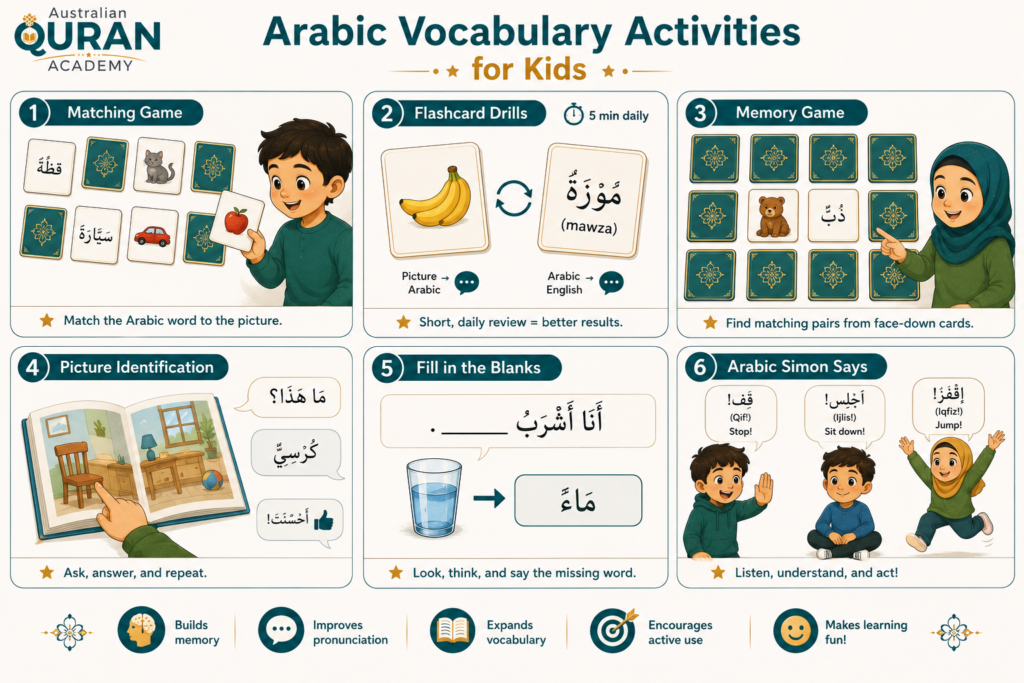
Matching Game
Create two sets of cards: one with Arabic words written on them, one with pictures of what those words mean. Shuffle and lay them face down in a grid. Children flip two cards at a time, trying to match the Arabic word to its picture. When a match is found, the child must say the Arabic word aloud before keeping the pair.
This game works from age 4 upward. It develops word recognition, pronunciation, and vocabulary recall simultaneously — with zero boredom.
Flashcard Drills (5-Minute Daily Review)
Flashcards work best when kept short and consistent. Five minutes of daily flashcard review beats a single weekly session of an hour. Show the picture side, ask for the Arabic word. Show the Arabic script, ask for the English meaning. Rotate older cards back in to prevent forgetting.
Memory Game
Similar to the matching game but played with all cards face down. The memory challenge adds cognitive load, which actually improves vocabulary retention. Children who have to work slightly harder to recall a word remember it significantly longer.
Picture Identification
Open any picture book or show your child an illustrated scene. Point to objects and ask: “What is this in Arabic?” For known words, your child answers. For unknown words, you supply the Arabic vocabulary and ask for a repeat. Any illustrated book — even one in English — becomes an Arabic vocabulary for kids resource.
Fill in the Blanks
Write simple Arabic sentences with one word missing, replaced by a picture clue. “أَنَا أَشرَبُ ـــ” with a picture of water. Your child supplies “مَاءً.” This is the most effective transition from passive vocabulary recognition to active vocabulary use.
Arabic Simon Says
Call commands in Arabic — “قِف!” (Qif! — Stop!), “اِجلِس!” (Ijlis! — Sit down!), “اِقفِز!” (Iqfiz! — Jump!) — and children respond with their bodies. For children aged 4–8, this is one of the highest-engagement Arabic vocabulary activities available, because the meaning is physically demonstrated every time the word is heard.
How to Help Kids Learn Arabic Vocabulary?
You do not need to be fluent in Arabic to teach Arabic vocabulary for kids at home. You need a method, consistency, and the right resources.
Start with 5–7 words at a time
More than this overwhelms a child’s working memory. Master a small set before expanding. Depth of retention beats breadth of exposure every time.
Connect every word to a real object or action
Saying كُرسِي (kursi — chair) while pointing at the actual chair creates a direct neural link that abstract repetition cannot replicate. Label household objects with sticky notes in Arabic and leave them up for two weeks.
Correct pronunciation from the start
Arabic has sounds that don’t exist in English — ع (Ayn), خ (Kha), ق (Qaf). Mispronounced early, these become habits that are difficult to undo — especially when the same sounds appear in Quran recitation. Use audio recordings from native speakers alongside your teaching.
Use Arabic in your daily routine without making it feel like a lesson
Say مَاء before handing your child a glass of water. Say تَفَضَّل (Tafaddal — here you go) when passing them something. These micro-moments of Arabic vocabulary exposure are cumulatively more powerful than formal sessions.
Make it consistent, not long
Ten minutes of Arabic vocabulary practice every day outperforms one hour per week. Children’s retention declines sharply after about fifteen minutes of focused learning — so short and regular is always the winning strategy.
For younger children just beginning their journey, the Arabic for Kindergarten course at Australian Quran Academy provides structured, age-appropriate vocabulary instruction led by native Arabic teachers — the ideal complement to what you’re building at home.
Read also: 10 Arabic Games for Kids – Fun Activities That Actually Teach the Language
Inside Our Virtual Classrooms
We believe in full transparency and proven quality. Take a look at these actual snippets from our live classes to experience our modern learning platform, patient instructors, and interactive student participation.
Build Your Child’s Arabic Vocabulary with Australian Quran Academy
Everything in this guide works. Home practice, sticky note labels, matching games, and daily routine narration all produce real results. But there is a ceiling to what self-guided learning can reach — and expert instruction is what breaks through it.
At Australian Quran Academy, qualified native Arabic teachers work with children at every level: from kindergarten beginners encountering Arabic vocabulary for the first time, to older students ready to read Quranic Arabic independently. Lessons are live, structured around the same thematic vocabulary categories in this guide, and taught by teachers who specialize in making Arabic genuinely enjoyable for young learners.
Book your child’s free trial lesson today
Our Arabic Courses
- Online Arabic Academy
- Online Arabic Course
- Classical Arabic Course
- Arabic Course for Beginners
- Advanced Arabic Course
- Quranic Arabic Course
- Arabic Grammar Course
- Modern Standard Arabic Course
- Arabic Conversation / Speaking Course
- Intensive Arabic Course
- Online Arabic Classes for Kids
- Arabic Classes for Adults
- Arabic Classes for Ladies
- Fusha Arabic Course
- Business Arabic Course
- Al-Azhar Arabic Course
- Madinah Arabic Course
- Learning Arabic for Non-Arabic Speakers
- Arabic Elementary School
- Arabic Intermediate School
- Arabic Lessons for Kindergarten
Start Your Quranic Journey in Australia
Join our leading online academy and learn with expert tutors through a structured, personalized curriculum.
Book Your Free Trial
Conclusion
Arabic vocabulary for kids is the foundation every child needs before grammar, reading, or Quranic study can fully take root. Start with the basics — family, colours, numbers, animals, food, body parts, school, and daily routine — and teach those words in context, through play, and in short daily sessions. Move from single words to simple phrases as soon as your child is ready. Correct pronunciation from day one. And make Arabic a part of ordinary life, not a separate subject that appears only at lesson time.
The child who knows 300 well-practised Arabic vocabulary words — and uses them daily — is far ahead of the child who has been exposed to 3,000 words but retains none of them. Consistency and depth always win.
Frequently Asked Questions About Arabic Vocabulary for Kids
What are the most important Arabic vocabulary words for kids to learn first?
The first words to teach children are high-frequency, everyday words they will encounter repeatedly: family members (أُمِّي ummi — mother, أَبِي abi — father), basic objects (مَاء ma’ — water, كِتَاب kitab — book), greetings (مَرحَبًا marhaban — hello, شُكرًا shukran — thank you), and Islamic phrases (Bismillah, Alhamdulillah). These words appear constantly in a child’s daily life, which means endless natural repetition without extra effort.
How many Arabic vocabulary words can a child realistically learn per week?
Five to ten new words per week is the right pace for most children aged 4–10. Introducing more than this reduces retention significantly. The goal is mastery — being able to recall and use the word without prompting — not exposure. A child who firmly knows 50 Arabic words is better positioned than one who vaguely recognises 200.
Do children need to learn Arabic script to build Arabic vocabulary?
No. Children can build strong spoken Arabic vocabulary before they learn to read Arabic script. However, introducing script alongside vocabulary — even at a basic level — accelerates overall language development. Seeing كِتَاب on a page while already knowing it means “book” makes Arabic reading feel familiar rather than foreign.
What is the best activity to help kids remember Arabic vocabulary?
The matching game consistently produces strong results across age groups: Arabic word cards matched to picture cards, with the child required to say the Arabic word aloud before claiming a pair. It combines visual recognition, recall, and pronunciation in a format that feels competitive and fun rather than like study.
Is it too late to start teaching Arabic vocabulary to older children?
No. Children aged 8–12 are still in a strong language-acquisition window and can build Arabic vocabulary rapidly when taught with the right methods. Older children benefit from slightly more structured approaches — clear word lists, fill-in-the-blank exercises, and short sentences — rather than purely game-based methods designed for younger learners.
How is Arabic vocabulary for kids different from learning colloquial Arabic?
Arabic vocabulary for kids taught in educational programmes typically focuses on Modern Standard Arabic (Fusha) — the language of the Quran, Islamic texts, and formal education. Colloquial dialects vary significantly by country and are not used in Quranic contexts. For Muslim children whose long-term goal includes Quranic understanding, Fusha vocabulary provides the most valuable and transferable foundation.





Leave a Reply