 Quran
Most adults who want to learn to read the Quran face one consistent obstacle: not a lack of dedication, but a lack of method. Starting without a structured path produces frustration and slow progress.
Learning to read the Quran for adults in Australia follows a teachable sequence that any motivated adult can complete. The steps below cover each stage, from the first Arabic letter to confident, daily Quran reading.
1. Start with Noorani Qaida Before Reading Any Quran
Noorani Qaida is the foundational primer that introduces Arabic letters, their sounds, and their combinations to new readers. Every serious Quran reading program begins here before touching any Quranic text.
Adult Quran Learning in Australia Starts with Letters
Many adult learners in Australia attempt to begin with Quranic text before securing the Arabic alphabet. This approach creates pronunciation errors that deepen with every page read and require significant correction later.
Noorani Qaida covers the alphabet in structured stages: letter recognition, vowel attachment, letter-joining rules, and short word reading. Each stage builds the specific reading skill that the next stage requires.
Correct Letter Forms Before Moving to Rules
Arabic letters take four distinct shapes depending on their position in a word: standalone, beginning, middle, and final. Noorani Qaida drills all four forms before any Tajweed rule is introduced to the learner.
Adult learners who complete Noorani Qaida with a qualified teacher arrive at their first Quranic surah already pronouncing letters correctly. Skipping this stage means every subsequent Tajweed rule sits on an unstable base.
Australian Quran Academy offers a Noorani Qaida Course in Australia that guides adult beginners through every stage of Arabic letter recognition, from initial shapes to combined reading, with a certified instructor correcting each sound.
Start Your Free Noorani Qaida Trial Today
2. Learn Makharij to Produce Each Arabic Letter Correctly
Makharij al-Huruf refers to the precise articulation points where each Arabic letter originates. Without correct Makharij, no Tajweed rule can be executed accurately, no matter how well the rule itself is known.
Practice Letter Sounds with Daily Audio Drills
Each Arabic letter has a distinct origin point: some form at the lips, others at the back of the tongue, and several originate deep in the throat. Adult learners must train each location deliberately.
The most effective method pairs audio from a certified reciter with active imitation, repeating each letter until both sounds match. A qualified teacher then confirms when each articulation point is correct.
Avoid Mispronunciations That Adult English Speakers Make
English speakers consistently mispronounce several Arabic letters when learning to read the Quran. Among the most common are the emphatic Sad (ص), the guttural Ayn (ع), the deep Kha (خ), and the Qaf (ق).
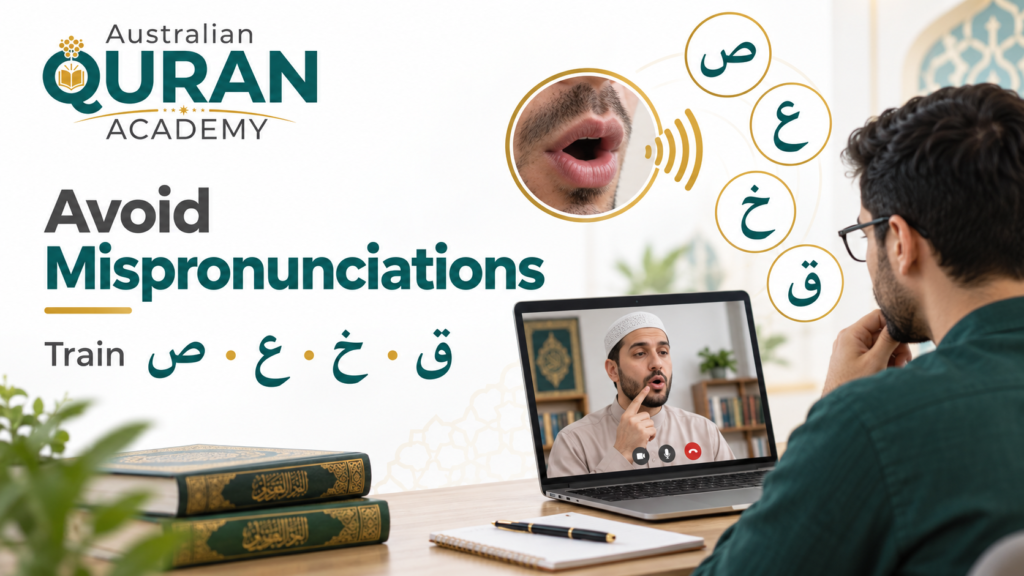
Each of these letters requires training a muscle movement that does not exist in English speech. Correcting these early, under teacher supervision, prevents them from becoming permanent habits in Quranic recitation.
Adult learners who struggle with Arabic pronunciation should know that striving to produce correct sounds carries its own spiritual reward. Working through articulation difficulty is recognized in the prophetic tradition as a sign of genuine commitment.
Consistent daily practice of difficult sounds produces measurable accuracy within weeks of focused effort. No letter is permanently beyond an adult learner’s reach with deliberate, guided practice.
3. Apply Core Tajweed Rules When Reading Quran Aloud
Tajweed is the set of rules governing how each Arabic letter is pronounced in context with surrounding letters. Applying Tajweed transforms careful letter-by-letter reading into accurate, measured Quranic recitation.
Allah commanded measured recitation in the Quran directly:
وَرَتِّلِ الْقُرْآنَ تَرْتِيلًا
(Wa rattilil-Qur’āna tartīlā)
Five foundational Tajweed rules govern the behavior of Noon Sakinah and Tanween across the Quran. Understanding these rules is the first practical layer of accurate recitation for adult learners:
| Rule | Trigger Condition | Pronunciation |
| Idhar (Clear) | Noon Sakinah or Tanween before a throat letter (ء ه ع ح غ خ) | Noon is pronounced clearly with no nasal sound |
| Idgham (Merge) | Noon Sakinah or Tanween before ي ر م ل و ن | Noon merges into the following letter |
| Iqlab (Convert) | Noon Sakinah or Tanween before ب | Noon converts to a meem-like nasal sound |
| Ikhfa (Conceal) | Noon Sakinah or Tanween before 15 specific letters | A soft nasal sound is held for two counts |
| Ghunnah (Nasal) | Shaddah on meem or noon | Nasal resonance held for two full counts |
Adult learners benefit most from applying one rule at a time to short Quranic passages before layering the next. Attempting all five rules at once produces inconsistent pronunciation rather than steady, measurable accuracy.
Australian Quran Academy offers Online Tajweed Classes in Australia that teach each Tajweed rule through live, one-on-one sessions with certified instructors who correct application errors in real time during actual Quranic recitation.
4. Build a Consistent Daily Quran Reading Habit
Adults who read the Quran for 15 minutes daily retain more than those who study for one hour once a week. Consistency at a shorter daily interval creates stronger Arabic reading pathways than infrequent longer sessions.
Set a Fixed Time That Fits Your Daily Routine
Morning reading immediately after Fajr works best for most adult learners because the mind is rested and interruptions are minimal. Evening reading after Isha serves as an effective alternative for adults with demanding daytime schedules.
Choosing a fixed time removes the daily decision of when to read. Fixed-time practice, sustained for three consecutive weeks, becomes automatic and no longer requires active scheduling effort from the adult learner.
Use a Progress Tracker to Stay Consistent
A simple written log recording the date, the surah reached, and any errors noted provides the feedback loop that keeps adult learners on track over weeks and months. Visible progress is a powerful motivator.
Setting a weekly milestone, such as completing one new surah from Juz Amma, creates short-term targets within the longer learning journey. Weekly milestones prevent the feeling that progress is invisible or moving too slowly.
See Us in Action!
Curious about what our online classrooms look like? Watch the short clips below to see how our interactive, one-on-one sessions bring learning to life with real-time feedback and engaging teaching methods.
Start Your Quranic Journey in Australia
Join our leading online academy and learn with expert tutors through a structured, personalized curriculum.
Book Your Free Trial5. Find a Certified Quran Teacher for Adults in Australia
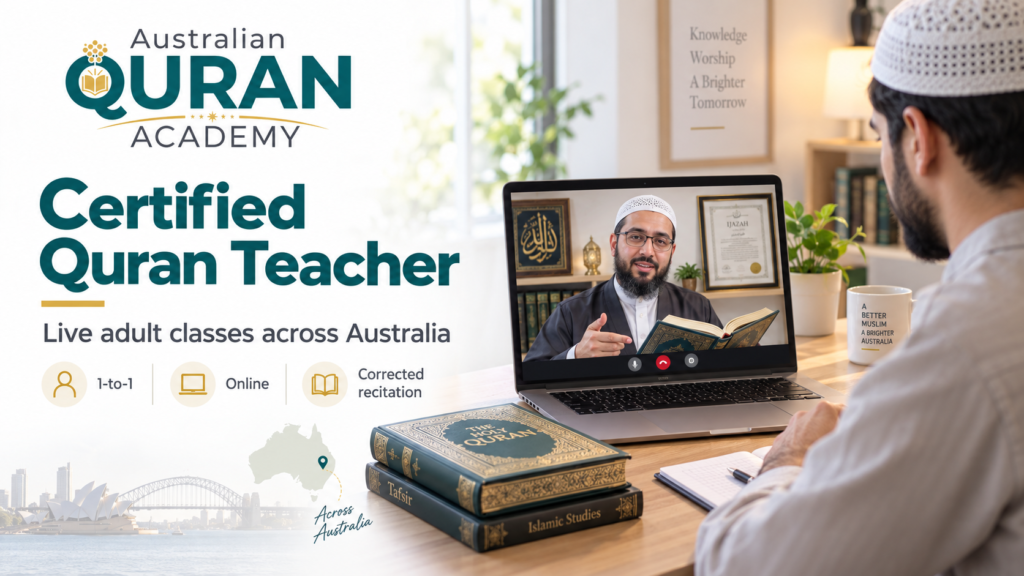
A certified Quran teacher is not optional for adult readers working toward accurate recitation. Self-study can build familiarity with letter shapes, but it cannot identify the subtle articulation errors that compound silently over months.
What a Qualified Ijazah Teacher Provides
Ijazah is the certification granted through an unbroken chain of transmission reaching the Prophet Muhammad (peace be upon him). A teacher holding Ijazah has had every recitation error corrected before being permitted to teach.
An Ijazah-certified teacher can identify errors the learner’s own ear cannot hear. Having this correction capacity in every session is what produces accurate, lasting Quran reading ability in adult students.
The Prophet Muhammad (peace be upon him) placed learning and teaching the Quran at the highest level of human virtue:
خَيْرُكُمْ مَنْ تَعَلَّمَ الْقُرْآنَ وَعَلَّمَهُ
(Khairukum man ta’allamal-Qur’āna wa ‘allamah)
“The best among you are those who learn the Quran and teach it.”
Every session with a qualified Quran teacher places the adult learner inside this prophetic tradition. Receiving correct instruction and progressing toward accurate recitation is itself an act of worship that carries this reward.
Read also: How To Start Reading Quran Daily?
Online Quran Classes Available for Australian Adults
Most adult learners in Australia balance work, family, and community commitments that make in-person Quran classes difficult to attend. Online classes solve this by delivering live, one-on-one instruction at any scheduled time.
Australian Quran Academy runs sessions across time zones suited to adult learners in Sydney, Melbourne, Brisbane, and Perth. Each session is live, not pre-recorded, so the teacher hears and corrects every recitation error.
Australian Quran Academy offers Online Quran Classes for Adults in Australia that deliver structured Quran reading instruction through certified teachers, with flexible scheduling designed around the commitments adult learners carry.
6. Begin with Short Surahs Before Moving to Longer Passages
Short surahs from Juz Amma are the correct starting point for adult learners who have completed Noorani Qaida. These surahs contain shorter ayahs and familiar letter combinations that reinforce earlier learning.
Juz Amma includes surahs such as Al-Fatiha, Al-Ikhlas, Al-Falaq, Al-Nas, Al-Asr, and Al-Kawthar. These surahs appear in every Salah, which means regular prayer simultaneously reinforces the Quranic text being studied.
Adult learners should commit each short surah to full accuracy before advancing to the next one. Reading ten surahs with consistent errors produces a weaker reader than reading three surahs with complete pronunciation accuracy.
Each surah should be recited aloud multiple times per session rather than read silently. Silent reading does not train the mouth, throat, and tongue to produce Arabic sounds correctly under Tajweed rules.
Progress from Juz Amma moves naturally toward Juz Tabarak (Part 29), then onward through the Quran. Adult learners who follow this progression gain genuine confidence at each stage before the text grows more complex.
7. Use Revision Cycles to Lock In What You Have Learned
New Quranic material fades within 24 to 48 hours without deliberate revision. Adult learners must build a revision schedule alongside new material sessions to prevent the gradual erosion that unstructured practice cannot stop.
A Weekly Revision Schedule for New Adult Readers
A practical revision structure divides each session into two portions: new material covering approximately 40% of the session and review of previous material covering approximately 60%. This ratio prevents accumulation of forgotten passages over time.
The recommended weekly pattern for adult beginners works as follows:
- Monday to Thursday: Read new material and review the previous two days’ content.
- Friday: Full review of all material covered during that week.
- Saturday: Light recitation of the week’s material without adding new passages.
- Sunday: Rest or optional recitation at a comfortable, unhurried pace.
This structure ensures no passage goes unreviewed for longer than seven days, which is the threshold beyond which significant retention loss begins for most adult learners.
Read also: How To Memorize Quran Online In Australia
How Spaced Repetition Prevents Quran Forgetting
Spaced repetition involves reviewing material at increasing intervals: the next day, three days later, a week later, then a month later. Each review extends the retention window for that passage.
For Quran reading, spaced repetition means a surah learned in week one reappears for review in weeks two, four, and eight. Each review confirms accuracy and rebuilds fading memory before forgetting becomes permanent.
Australian Quran Academy offers Quran Reading Classes in Australia that build revision cycles into each student’s personalized study plan, ensuring no passage is lost to the gradual forgetting that unstructured self-study cannot prevent.
8. Join a Quran Learning Community in Australia for Support
Learning in isolation is the fastest route to abandoning the practice. Adult Quran learners in Australia who connect with a study community maintain consistent practice significantly longer than those studying alone.
Community support for Quran reading takes several practical forms. Online Quran circles, mosque programs, and Islamic center classes all provide the accountability and shared motivation that sustain adult learning.
A study partner at a similar level creates mutual accountability: both learners arrive at each weekly check-in having completed their practice. Accountability partnerships reduce the dropout rate that unstructured solo learning consistently produces.
Many Islamic centers across Australian cities, including Sydney, Melbourne, Brisbane, and Perth, offer free or low-cost Quran circles specifically for adults. These groups provide community alongside instruction at no additional cost to the learner.
Inside Our Virtual Classrooms
We believe in full transparency and proven quality. Take a look at these actual snippets from our live classes to experience our modern learning platform, patient instructors, and interactive student participation.
Start Your Quranic Journey in Australia
Join our leading online academy and learn with expert tutors through a structured, personalized curriculum.
Book Your Free TrialStart Quran Learning with Australian Quran Academy
Australian Quran Academy connects adult learners across Australia with certified Ijazah teachers who deliver live, one-on-one instruction through flexible online sessions. Every teacher is assessed for recitation accuracy before being authorized to teach.
Students choose session times that fit their work and family commitments, with morning, afternoon, and evening slots across all Australian time zones. Removing the commute removes the most common barrier adult learners face.
What sets Australian Quran Academy apart:
- Certified Ijazah teachers trained through verified chains of transmission.
- Live, one-on-one sessions with real-time recitation correction every lesson.
- Flexible scheduling across all Australian time zones for working adults.
Our Quran Courses
- Quran Qirat Learning Course
- Quran Tafsir Course
- Online Quran Classes for Adults in Australia
- Online Tajweed Classes in Australia
- Noorani Qaida Course in Australia
Conclusion
Learning to read the Quran as an adult requires method before motivation. Every step in this sequence, from Noorani Qaida through daily revision cycles, removes a specific barrier between the adult learner and accurate recitation.
Adults who begin structured Quran reading find the process more manageable than it appears. The Arabic alphabet, letter articulation, and Tajweed rules are teachable skills, not gifts reserved for childhood or native Arabic speakers.
Choosing a certified teacher and committing to a daily reading habit makes the difference between learning that stalls and reading that grows. Australian Quran Academy guides adult learners from first lesson to confident Quran recitation.
Frequently Asked Questions About Learning to Read Quran
How long does it take to learn to read Quran as an adult?
Most adults studying consistently with a qualified teacher can read simple Quranic text within three to six months of starting Noorani Qaida. Reaching fluent recitation with Tajweed takes an additional six to twelve months of daily practice.
Can I learn to read Quran without knowing Arabic?
Yes, reading the Quran does not require knowledge of Arabic grammar or vocabulary. Quran reading instruction covers Arabic script and pronunciation rules only, not the full language. Most adult beginners start with zero Arabic background and succeed.
Is Noorani Qaida suitable for adult beginners?
Yes, Noorani Qaida was originally developed for young children, but it is equally effective for adults. The structured letter progression suits any learner starting from zero Arabic reading ability, regardless of age or prior educational background.
Do I need a teacher to learn Quran reading as an adult?
Yes, a certified teacher is required for accurate Quran reading. Self-study can build familiarity with letter shapes, but it cannot identify or correct the subtle mispronunciation errors that only a trained ear detects during live recitation.
How many Tajweed rules do I need before reading Quran?
Beginners need to understand the five core rules governing Noon Sakinah and Tanween before reading independently. Full Tajweed competency develops progressively through practice and teacher feedback over six to twelve months of consistent daily study.





Leave a Reply