 Quran
Reading the Quran accurately is not achieved by simply following Arabic text with the eyes. A learner must recognise letters, produce their sounds correctly, connect words, and apply each rule with patience.
For Muslims seeking how to read Quran online in Australia, a structured sequence prevents confusion and builds confidence from the first lesson. The ten steps below create a practical path from Arabic letters to clear Quran recitation.
1. Learn Arabic Letter Sounds Before Quranic Words
Begin with the 29 Arabic letters before attempting full Quranic words. Each letter has a name, shape, sound, and articulation point that must become familiar through repeated listening and speaking.
Arabic letters change shape when they connect. Learn isolated, initial, medial, and final forms so a letter remains recognisable inside a Quranic word.
Several sounds have no exact English equivalent. Letters such as ح, خ, ع, ص, ض, ط, ظ, and ق need careful imitation from a qualified reader.
Avoid relying on transliteration for more than a temporary introduction. English letters cannot consistently show Arabic pronunciation, vowel length, or the difference between similar Quranic sounds.
Quick exercise: Choose five Arabic letters each day. Listen to each sound, repeat it five times, write the letter once, then identify it in a simple Quranic word.
2. Use Noorani Qaida Lessons in Australia
Noorani Qaida is a foundational reading text that introduces Arabic letters, Harakaat, joined forms, Sukoon, Shaddah, and basic Quranic reading patterns in a gradual sequence. Harakaat are short vowel marks. Fathah creates an “a” sound, Kasrah creates an “i” sound, and Dammah creates an “u” sound.
Do not skip vowel drills because they seem elementary. Incorrect vowels can change the sound of a word and make later Tajweed lessons much harder.
| Reading Element | Purpose | Daily Practice |
| Arabic letters | Identifies each written sound | Name and pronounce ten letters |
| Harakaat | Shows short vowels | Read simple syllables aloud |
| Sukoon | Marks a letter without a vowel | Stop the consonant cleanly |
| Shaddah | Doubles a consonant | Hold the letter correctly |
| Tanween | Adds final vowel sounds | Read short word endings |
A beginner should repeat one Qaida lesson until it feels effortless. Moving quickly through pages often hides weak recognition that later interrupts Quran reading.
Australian Quran Academy offers a Noorani Qaida Course in Australia that takes learners from individual letters to complete Quranic words through live instruction.
3. Learn How to Read Quran Online in Australia
Online Quran learning works best when every lesson has a clear aim. One lesson may focus on letter sounds, while another focuses on vowel marks, short Surahs, or a single Tajweed rule.
Choose a teacher who listens to your recitation rather than only explaining theory. Reading aloud is the point where hidden pronunciation errors become audible.
Prepare before every class by revising the previous lesson for ten minutes. This gives the teacher time to correct new difficulties instead of repeating material already covered.
Keep a notebook for teacher feedback. Write the word or rule that needs correction, the proper pronunciation, and one example to revise before the next session.
A reliable online lesson should include listening, repetition, correction, and a small task for independent practice. Passive watching alone does not develop confident recitation.
See Us in Action!
Curious about what our online classrooms look like? Watch the short clips below to see how our interactive, one-on-one sessions bring learning to life with real-time feedback and engaging teaching methods.
Start Your Quranic Journey in Australia
Join our leading online academy and learn with expert tutors through a structured, personalized curriculum.
Book Your Free Trial4. Read Short Surahs Before Longer Quran Passages
Short Surahs allow beginners to practise familiar Quranic passages without feeling overwhelmed by long lines of Arabic. Al-Fatihah, Al-Ikhlas, Al-Falaq, and An-Nas are useful early choices.
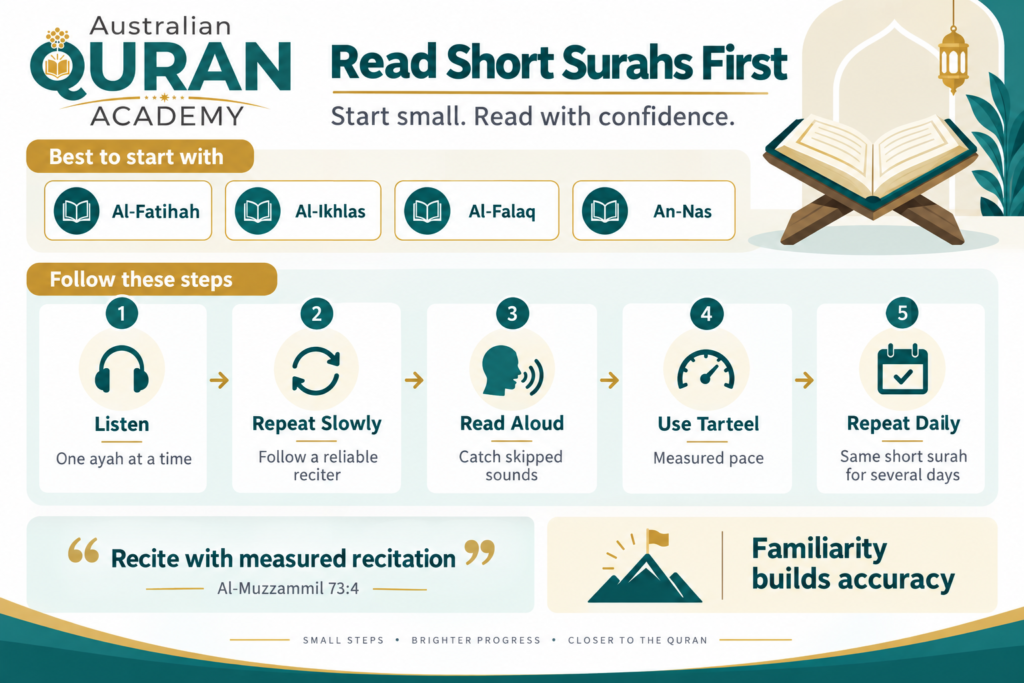
Listen to one ayah from a reliable reciter, then repeat it slowly while looking at the Arabic text. Continue until you can read the ayah without checking transliteration.
Read aloud rather than silently whenever possible. Your ears can notice skipped vowels, unclear letters, and rushed sounds that silent reading may conceal.
Allah commands Muslims to recite the Quran with care and measured pace:
وَرَتِّلِ الْقُرْآنَ تَرْتِيلًا
(Wa rattilil-Qur’ana tartila)
(“And recite the Quran with measured recitation.”)
Tarteel means measured recitation. It requires the learner to give each letter enough time instead of chasing a page target or copying a reciter’s speed too early.
Repeat one short Surah across several days. Familiarity creates space for accuracy, while constantly changing passages can distract from the sounds that need correction.
Read also: How To Memorize Quran By Yourself In Australia
5. Correct Makharij Before Building Recitation Speed
Makharij are the articulation points from which Arabic letters emerge. Correct Makharij help a learner distinguish letters that may sound similar to an English-speaking ear.
For example, ص and س are not interchangeable, just as ط and ت are not interchangeable. Each pair comes from a different area of the mouth and carries a distinct quality.
Ask your teacher to correct one or two sounds at a time. Trying to repair every issue in a single lesson can make recitation tense and difficult to retain.
Record a short passage on your phone after each class. Compare it with the teacher’s model, identify one mistake, then repeat the word until the sound improves.
Australian Quran Academy offers Online Tajweed Classes in Australia for students who need live correction of Makharij, Madd, Ghunnah, and Quranic stopping rules.
6. Apply Tajweed Rules Inside Familiar Quran Passages
Tajweed means giving every Arabic letter its correct right during Quran recitation. Beginners should learn its rules gradually while applying them to passages they already know.
Start with Madd, the required lengthening of selected vowel sounds. Then add Ghunnah, the nasal resonance found in particular Quranic letter combinations.
Waqf means stopping at a suitable point in recitation. Correct stops protect the meaning and help the reader resume a passage without breaking its message.
| Tajweed Rule | What the Learner Does | Practice Method |
| Madd | Lengthens the sound correctly | Count the required beats slowly |
| Ghunnah | Produces nasal resonance | Repeat the sound with teacher feedback |
| Qalqalah | Gives selected letters a clear echo | Practise words ending in Sukoon |
| Waqf | Stops at appropriate places | Follow approved pause signs |
| Idgham | Merges selected sounds correctly | Read examples repeatedly in context |
Learn rules through actual recitation rather than memorising definitions alone. A rule becomes useful only when the tongue can apply it naturally inside an ayah.
Quick exercise: Select one ayah containing Madd. Mark the elongation, listen once, then recite the ayah three times at a calm pace.
7. Plan Australian Quran Lessons Around Real Commitments
A Quran routine should fit your real week. Australian Muslims may balance work shifts, university, school runs, family responsibilities, and different local prayer times.
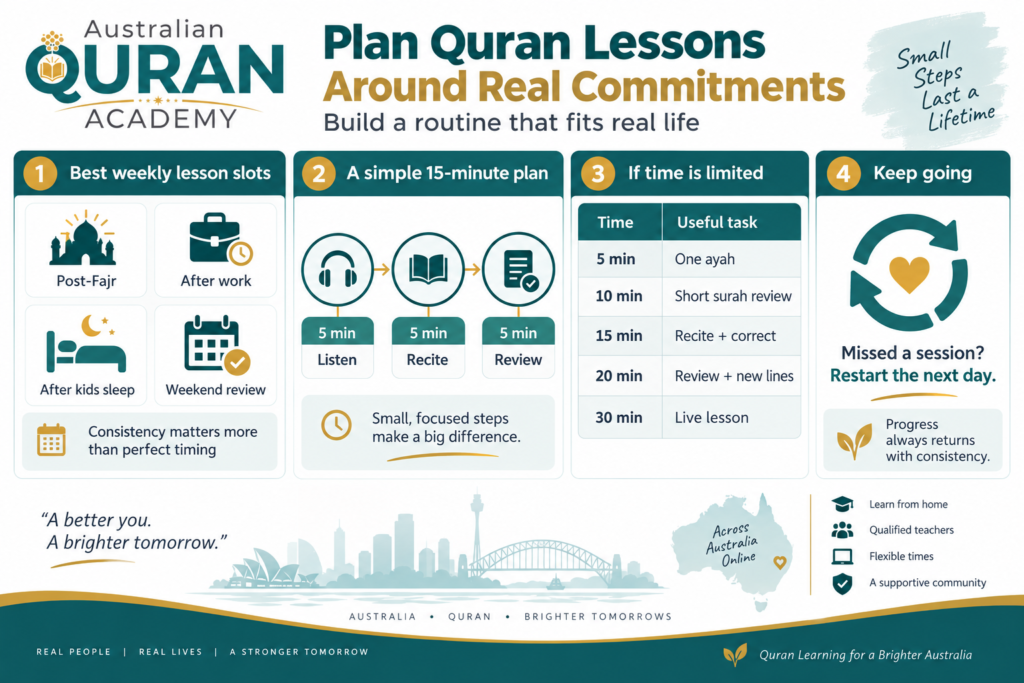
Choose a fixed lesson slot that you can protect every week. Consistency matters more than selecting the perfect time and missing classes when when life becomes busy.
Adults often find success with a brief post-Fajr review or a lesson after children sleep. Families may prefer a shared recitation period after Maghrib or on weekends.
Use a modest daily target. Fifteen minutes can include five minutes of listening, five minutes of recitation, and five minutes of reviewing teacher corrections.
| Available Time | Useful Quran Task |
| 5 minutes | Listen to one ayah and repeat it |
| 10 minutes | Review a Qaida page or short Surah |
| 15 minutes | Recite and correct one passage |
| 20 minutes | Revise old material and learn new text |
| 30 minutes | Attend a live lesson plus revision |
Do not miss an entire week because one session is missed. Resume with a smaller task on the next day and rebuild the routine immediately.
Read also: Quran Memorization Certificate In Australia
8. Review One Recitation Error Before Adding New Text
Revision prevents small errors from becoming permanent habits. A learner who adds new Quranic lines every day without review can repeat the same mistake for months.
Create a correction list after every lesson. Include the incorrect word, the corrected sound, the relevant rule, and the Surah where the mistake appeared.
Review old material before opening a new page. This simple order keeps previously learned Quranic words strong while allowing new reading skills to develop steadily.
The Prophet Muhammad, peace be upon him, encouraged learning and teaching the Quran:
خَيْرُكُمْ مَنْ تَعَلَّمَ الْقُرْآنَ وَعَلَّمَهُ
(Khairukum man ta’allama al-Qur’ana wa ‘allamahu)
(“The best of you are those who learn the Quran and teach it.”)
Make correction a normal part of learning rather than a sign of failure. Every corrected sound is progress towards clearer, more careful recitation.
Australian Quran Academy offers Quran Reading Classes in Australia that give beginners a structured route from Arabic literacy to independent Quran reading.
9. Find Australian Quran Teachers Who Give Live Feedback
A qualified Quran teacher gives more than encouragement. Live feedback identifies the exact letter, vowel, lengthening, or stopping point that needs attention.
Ask whether lessons include individual recitation time. Group lessons can be beneficial, but every learner still needs direct correction from a teacher.
Female learners who prefer a female instructor should look for that option before enrolling. Children may need shorter sessions, visual prompts, and regular parent updates.
A good teacher sets a realistic goal for each lesson. One accurate Qaida page or one corrected Surah is more valuable than rushing through several uncorrected pages.
Look for steady progress rather than promises of instant fluency. Quran reading improves through regular practice, clear feedback, and patient revision over time.
Inside Our Virtual Classrooms
We believe in full transparency and proven quality. Take a look at these actual snippets from our live classes to experience our modern learning platform, patient instructors, and interactive student participation.
Start Your Quranic Journey in Australia
Join our leading online academy and learn with expert tutors through a structured, personalized curriculum.
Book Your Free Trial10. Protect Daily Quran Reading Through Measurable Goals
Set goals that show whether your reading habit is actually growing. Examples include completing four live lessons each month, revising one Surah weekly, or correcting one recurring sound.
Track your practice on a simple calendar. Mark the day when you listened, read aloud, received correction, or revised previously learned material.
Keep new learning smaller than revision during the first months. Strong foundations make future progress faster because letter recognition and pronunciation no longer require constant effort.
When a goal becomes easy, increase it gradually. Add one new line, one extra review day, or a longer session instead of making sudden changes that are difficult to sustain.
Australian Quran Academy offers Weekend Quran Classes in Australia for learners who need live Quran instruction around weekday work, study, and family schedules.
Start Quran Reading With Australian Quran Academy Instructors
Australian Quran Academy provides live online Quran lessons for beginners, adults, children, and sisters. Students can begin with Arabic letters, receive direct recitation correction, and progress through a clear sequence.
What sets Australian Quran Academy apart:
- Live lessons with direct correction during recitation.
- Beginner pathways from Noorani Qaida to Quran reading.
- Flexible online schedules for Australian families and adults.
Our Quran Courses
- Quran Classes for Adults
- Quran Classes for Female/Sisters
- Learn Quran Course for Beginners
- Quran Reading Classes in Australia
- Online Tajweed Classes in Australia
- Noorani Qaida Course in Australia
Conclusion
Learning how to read Quran online in Australia becomes much easier when you follow a clear progression rather than trying to master everything at once.
Start with Arabic letters and vowel marks, strengthen your reading through Noorani Qaida and short Surahs, then gradually introduce Makharij, Tajweed, and correct stopping while receiving live feedback from a qualified teacher.
The key is consistency, not speed. A short daily session spent reading aloud, reviewing previous corrections, and fixing one recurring mistake can build a stronger foundation than occasionally attempting long passages without guidance.
As your pronunciation and recognition improve, increase your reading gradually while keeping revision part of your routine.
If you are starting from the beginning or want to correct weaknesses in your current recitation, Australian Quran Academy provides structured online lessons with direct teacher feedback and schedules designed for learners across Australia.
Frequently Asked Questions About Quran Reading Online
Can Adults Learn Quran Reading Online Without Arabic?
Yes, adults can learn Quran reading online without prior Arabic knowledge. A structured course begins with letter recognition, sounds, Harakaat, and connected forms before introducing Quranic words and short Surahs.
How Long Does Quran Reading Take for Beginners?
Most beginners need several months of steady lessons and daily practice to read simple Quranic passages independently. Progress depends on lesson frequency, revision quality, previous Arabic exposure, and direct teacher correction.
Is Tajweed Necessary for Quran Reading?
Yes, Tajweed is necessary for accurate Quran recitation because it teaches correct articulation, vowel length, nasal sounds, and stopping points. Beginners should apply basic rules gradually under qualified teacher supervision.
Can Children Learn Quran Reading Through Online Lessons?
Yes, children can learn Quran reading through online lessons when sessions are short, interactive, and suited to their age. Regular practice, parent support, and teacher feedback help children retain sounds and reading patterns.





Leave a Reply