 Quran
| Key Takeaways |
| Correct recitation begins with accurate letters and vowels, not a beautiful voice. |
| A teacher should hear unseen reading because memorised passages can conceal weak decoding. |
| Fifteen to twenty focused minutes daily usually builds more control than one long weekly session. |
| Record one short passage each week and compare the same passage after four weeks. |
Learning how to Learn Quran Recitation In Australia requires more than playing recordings and copying an appealing voice. Accurate progress comes from diagnosing your present reading, repairing letter production, applying Tajweed in a controlled order, and receiving correction before repeated errors become automatic.
Online lessons make that process practical for Muslims across Australia, including learners whose nearest suitable teacher is far from home. The method below moves from accurate decoding to fluent, measured recitation through ten steps that can be followed without wasting practice on skills introduced too early.
1. Assess Your Quran Reading Level in Australia
Begin with a recorded diagnostic rather than choosing lessons from a general label such as “beginner” or “intermediate”. Read one familiar passage and one unseen passage for two minutes each, without rehearsing either immediately before the assessment or copying an audio recording.
Mark errors in five columns: letter recognition, short vowels, joined words, pronunciation, and stopping. Familiar reading shows what you have memorised, while unseen reading reveals whether you can actually decode new text. That distinction determines where effective instruction should begin.
Ask a qualified teacher to review the recording and identify the two errors that most affect accuracy. A learner who confuses letters needs reading repair before advanced rules; a fluent reader with weak nasalisation or elongation can begin focused Tajweed practice immediately.
| Diagnostic result | Correct starting point | First measurable target |
| Letters or vowels are frequently guessed | Arabic reading foundation | Read ten new words without guessing |
| Words are decoded slowly but correctly | Guided fluency practice | Read three lines with fewer than three pauses |
| Reading is fluent but rules are inconsistent | Applied Tajweed | Apply one rule accurately in a short passage |
| Rules are sound but delivery is unstable | Advanced recitation coaching | Maintain pace, stopping, and breath control |
2. Repair Letter Sounds Before Studying Tajweed Rules
Learn each letter from its Makhraj, the point in the mouth or throat where its sound originates. Rule names cannot correct a letter produced from the wrong place. Start with contrasts that expose confusion, such as س and ص, ت and ط, ح and ه, or ذ and ظ.
Practise one contrast at a time using short vowels, then place each sound at the beginning, middle, and end of simple words. Use a mirror for lip and tongue position, but rely on a teacher’s hearing because several throat sounds cannot be judged accurately by sight.
A useful drill takes five minutes: produce the target letter ten times with fatḥah, kasrah, and ḍammah, read five words containing it, then recite one line. Stop if the sound deteriorates; additional faulty repetitions strengthen the wrong movement rather than correcting it.
Australian Quran Academy offers an Online Quran Reading Course that develops letter recognition, joining, vowel accuracy, and controlled passage reading before learners move into detailed Tajweed application.

Build an accurate Quran reading foundation
3. Build a Daily Recitation Routine Across Australia
Choose a daily slot that survives work, school, and family commitments rather than an ideal time you rarely protect. Fifteen to twenty minutes after Fajr, before the school run, or after ʿIshā’ is sufficient when the task remains narrow and measurable.
Seasonal prayer times change substantially, especially in southern cities, so avoid tying practice permanently to a clock time. Attach it to a stable event instead, such as after a prayer, before breakfast, or immediately after children complete their evening routine.
Use the same short structure each day: three minutes of sound drills, ten minutes of passage work, and five minutes reviewing corrected errors. On busy days, complete a five-minute minimum session. Maintaining the habit matters more than occasionally doubling the duration.
| Session part | Time | Exact task |
| Sound preparation | 3 minutes | Repeat one difficult letter pair or quality |
| Guided passage | 10 minutes | Read four to eight lines slowly and accurately |
| Error review | 5 minutes | Repeat corrected words in and out of context |
| Session note | 2 minutes | Record one error and the next practice target |
See Us in Action!
Curious about what our online classrooms look like? Watch the short clips below to see how our interactive, one-on-one sessions bring learning to life with real-time feedback and engaging teaching methods.
Start Your Quranic Journey in Australia
Join our leading online academy and learn with expert tutors through a structured, personalized curriculum.
Book Your Free Trial4. Learn Tajweed in the Order Recitation Requires
To Learn Quran Recitation In Australia with Tajweed efficiently, study rules in the order you encounter them while reading. Begin with vowels, sukūn, shaddah, and basic elongation, then progress to nūn sākinah, tanwīn, mīm sākinah, Qalqalah, heavier letters, and stopping rules.
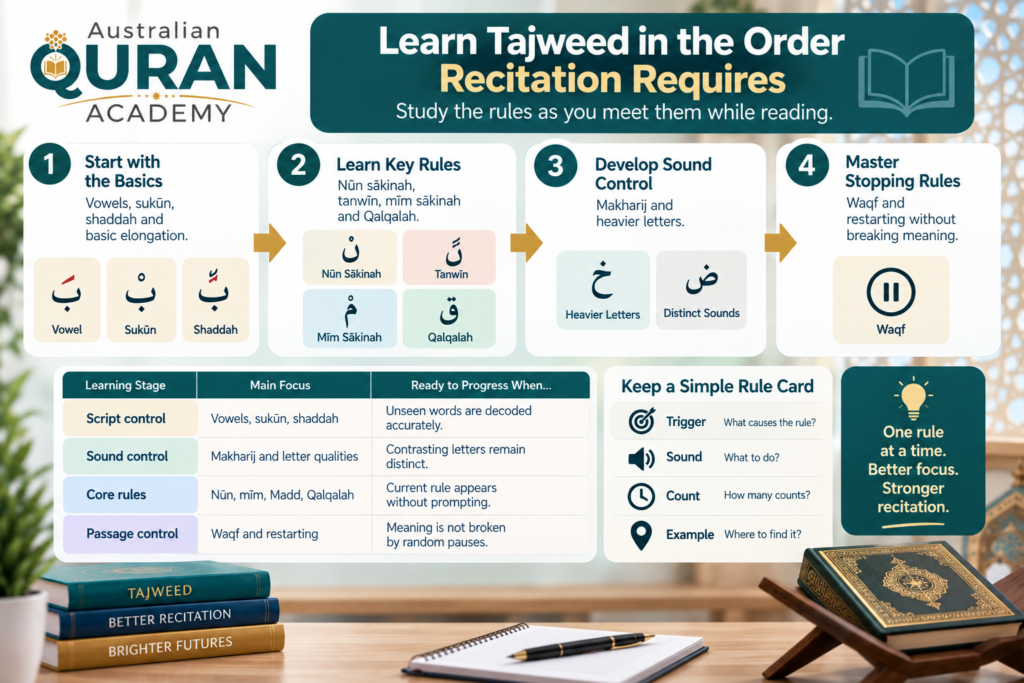
Define every rule through sound and application, not through terminology alone. Ghunnah is controlled nasal resonance, while Madd is measured vowel extension. A learner has not acquired either skill until it appears correctly in an unfamiliar passage without a prompt.
Keep a compact rule card containing the trigger, required sound, count, and one example location. During recitation, mark only the rule currently being trained. Highlighting every feature at once divides attention and usually reduces both reading fluency and accurate application.
| Learning stage | Main focus | Evidence of readiness to progress |
| Script control | Vowels, sukūn, shaddah | Unseen words are decoded accurately |
| Sound control | Makharij and letter qualities | Contrasting letters remain distinct |
| Core rules | Nūn, mīm, Madd, Qalqalah | Current rule appears without prompting |
| Passage control | Waqf and restarting | Meaning is not broken by random pauses |
Read also: How to Concentrate While Reading Quran?
5. Practise One Tajweed Rule in Real Passages
The safest way to learn to read Quran with Tajweed is to move each rule through three stages: recognition, isolated production, and passage application. Do not study five definitions in one sitting. Keep one rule active until you can hear and produce it.
First, scan half a page and identify every occurrence of the target. Next, read only the relevant words, including the word before and after each location. Finally, recite the full passage while preserving normal flow and record whether the rule survives without visual prompting.
Use a simple accuracy threshold before progressing. Apply the chosen rule correctly in at least eight of ten occurrences across two separate sessions. If results vary sharply, return to word-level practice rather than adding another rule and increasing the number of uncontrolled errors.
Australian Quran Academy offers an Online Quran Tajweed Course that connects rule study with live passage correction, helping learners apply Tajweed while reading rather than merely recalling definitions.

Practise Tajweed with live teacher correction
6. Choose an Online Quran Teacher Who Serves Australia
When deciding how to Learn Quran Recitation In Australia online, assess the lesson method before committing to a timetable. A suitable teacher should listen more than lecture, interrupt repeated errors promptly, model the corrected sound clearly, and require you to reproduce it independently.
Request a trial using an unseen passage and observe the feedback. Useful correction identifies the exact sound, explains what caused it, demonstrates the repair, and checks the same feature elsewhere. General comments such as “improve your Tajweed” do not create an actionable practice target.
Confirm that lesson times remain workable across Australian time zones and daylight-saving changes. A Brisbane learner and a Perth learner may need different schedules with the same overseas teacher. Reliable rescheduling and lesson continuity matter because irregular correction slows skill retention.
Use these criteria during the trial lesson:
- The teacher diagnoses reading rather than assuming your level.
- Corrections are specific, demonstrated, and checked again.
- Lesson notes identify what to practise between sessions.
- The pace changes when an error needs deeper repair.
- The schedule remains sustainable for at least three months.
7. Train Your Ear with Active Listening and Shadowing
Listening supports recitation only when it has a defined task. Choose one proficient reciter and a passage of three to five āyāt.
Listen once for the overall phrasing, then replay short segments to notice letter quality, elongation, nasalisation, and permissible stopping points.
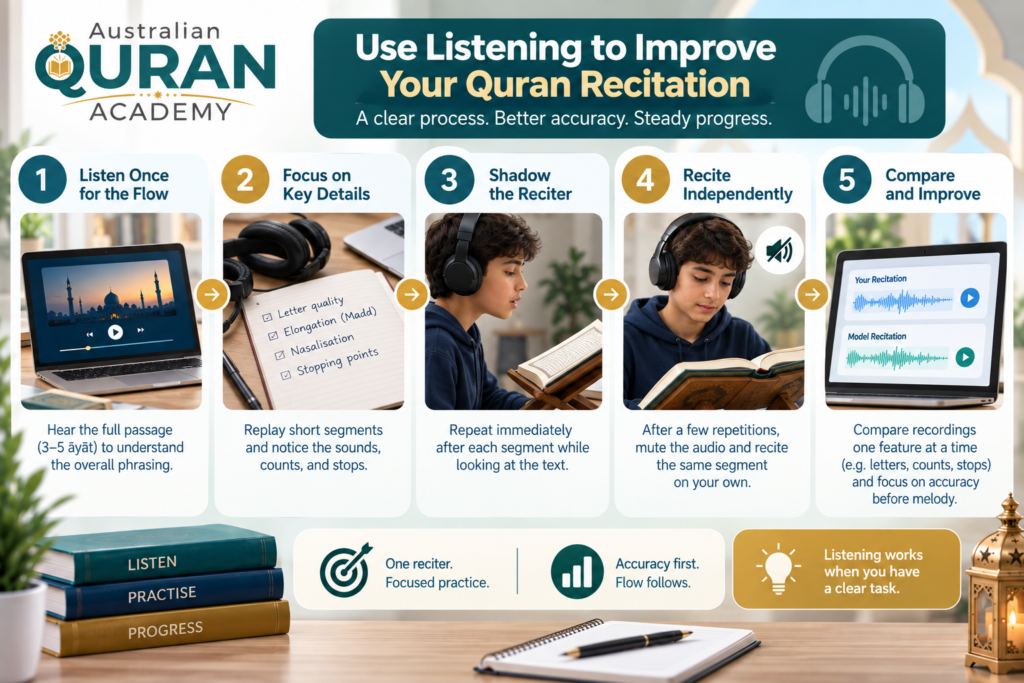
Use shadowing, which means repeating immediately after a short audio segment while matching its sounds and timing. Keep the text visible so imitation does not replace reading. After three repetitions, mute the audio and recite the same segment independently from the page.
Compare your recording against the model for one feature at a time. On the first replay, inspect letter accuracy; on the second, check counts; on the third, examine stops. Trying to judge pitch, breath, rhythm, and every Tajweed rule simultaneously produces unreliable self-correction.
Avoid copying a reciter’s vocal ornamentation before your sounds and counts are stable. A pleasant melody can conceal clipped vowels, exaggerated nasalisation, or forced pauses. Accuracy leads, measured flow follows, and individual vocal character develops without deliberate imitation.
8. Record Weekly Evidence of Recitation Progress
Fluency improves when practice produces evidence rather than impressions. Record the same eight to ten lines once a week under identical conditions, without warming up on that passage. Keep the first recording so improvement can be judged against a real baseline.
Score four features from zero to five: accurate letters, correct Tajweed, smooth joining, and controlled stopping. Add the number of teacher prompts. A higher score with fewer prompts demonstrates independence; a smoother voice with unchanged errors does not demonstrate accurate progress.
Every fourth week, add an unseen passage. Repeated material measures correction and control, while unseen material tests transfer. If performance collapses on new text, reduce memorised repetition and increase decoding practice until the same skills appear beyond familiar verses.
Australian Quran Academy offers an Online Quran Recitation Course focused on supervised reading, precise feedback, smoother delivery, and dependable application across both familiar and unfamiliar passages.

Develop clearer and more fluent Quran recitation
9. Protect Recitation Fluency During Breaks in Australia
School holidays, travel, Ramadan routines, and changing work rosters can interrupt a plan unless a reduced version exists in advance. Define a maintenance session of five minutes: one sound drill, three lines of recitation, and repetition of the week’s main correction.
Do not compensate for missed days with an exhausting weekend session. Resume the normal schedule at the next available slot and retain the current passage until accuracy returns. Large catch-up targets encourage speed, weaken attention, and turn a temporary break into avoidable frustration.
For interstate or overseas travel, store lesson notes, a clean legal digital Mushaf, and approved audio before departure. Practise with headphones where appropriate and schedule a brief remote check-in if the interruption will exceed two weeks. Continuity needs a small repeatable action, not perfect conditions.
Read also: How To Start Reading Quran Daily?
Use a traffic-light rule to control progression:
| Status | Evidence | Next action |
| Green | At least 90% accurate without prompts | Add a small new passage |
| Amber | Several recurring errors remain | Hold the passage and isolate errors |
| Red | Letters or rules are being guessed | Stop progression and request correction |
Inside Our Virtual Classrooms
We believe in full transparency and proven quality. Take a look at these actual snippets from our live classes to experience our modern learning platform, patient instructors, and interactive student participation.
Start Your Quranic Journey in Australia
Join our leading online academy and learn with expert tutors through a structured, personalized curriculum.
Book Your Free Trial10. Pursue Ijazah Only After Recitation Is Stable
An Ijazah is formal authorisation transmitted through a qualified teacher, commonly after a student completes a disciplined recitation pathway. It should follow stable reading and Tajweed, not replace them. Seeking certification too early turns foundational repair into a longer and more frustrating process.
Ask your teacher whether you can recite unseen passages accurately, maintain rules across longer sittings, stop and restart appropriately, and correct slips when identified. These abilities matter more than how many surahs you have prepared or how polished one favourite passage sounds.
Set the next goal according to evidence. A developing reader may need three months of sound repair; a competent reader may need sustained full-Quran review; an advanced student may be ready for formal assessment. Honest placement shortens the path because practice addresses the actual gap.
Australian Quran Academy offers an Online Quran Ijazah Course for qualified learners who are ready to refine complete recitation under direct supervision and work towards a recognised chain of transmission.

Ask whether your recitation is ready for Ijazah
Start Quran Recitation with Australian Quran Academy
Australian Quran Academy provides live online instruction with individual correction, level-based starting points, and lesson times suited to learners across different states. Students can build reading accuracy, apply Tajweed, develop fluency, or pursue Ijazah according to demonstrated ability.
What sets Australian Quran Academy apart:
- Live correction from qualified Quran teachers.
- One-to-one instruction based on current reading ability.
- Flexible online scheduling for Australian families and adults.
Our Quran Courses:
- Online Quran Reading Course
- Online Quran Tajweed Course
- Online Quran Recitation Course
- Online Quran Ijazah Course
- Quran Qirat Course
- Online Quran Classes for Adults
Conclusion
The reliable answer to how to Learn Quran Recitation In Australia is to build the skills in order: assess unseen reading, repair sounds, learn one rule at a time, practise it in context, and let a qualified teacher correct what you cannot hear yourself.
Fluency is not speed. It is accurate reading that remains controlled across unfamiliar passages, longer sessions, and ordinary interruptions. A short daily routine, weekly recordings, and measurable targets make improvement visible while preventing attractive delivery from hiding unresolved errors.
Begin at the level your diagnostic evidence supports, not the level you hope to claim. Once letters, Tajweed, stopping, and independent correction remain stable, advanced recitation and Ijazah become meaningful next stages rather than shortcuts around unfinished foundations.
FAQs
How to Get Fluent in Quran Recitation?
Build fluency through fifteen to twenty minutes of daily accurate reading, weekly teacher correction, and regular unseen passages. Increase speed only when letters, Tajweed counts, and stopping remain correct. Fluency means controlled continuity, not rushing through familiar verses.
How to Learn Quran Recitation with Tajweed?
Start with Makharij and basic script control, then study one Tajweed rule at a time. Identify the rule in a passage, practise its words separately, apply it during full recitation, and ask a qualified teacher to correct errors you cannot hear.
Can Beginners Learn Quran Recitation Online?
Yes, beginners can learn Quran recitation online when lessons include live listening, precise correction, and structured practice between sessions. A teacher should first assess letters, vowels, and joined reading, then select work appropriate to the learner’s demonstrated level.
How Long Does Quran Recitation Take to Improve?
Noticeable improvement may appear within several weeks of consistent practice, but the timeline depends on starting accuracy, lesson frequency, and correction quality. Measure progress through fewer repeated errors and stronger unseen reading rather than relying on a general completion date.
How Often Should a Teacher Hear Your Recitation?
A teacher should usually hear your recitation at least once or twice weekly while you practise independently each day. Learners correcting established pronunciation errors may need more frequent checks so faulty repetitions do not become stronger between lessons.
Can You Learn to Read Quran with Tajweed Alone?
You can study terminology and listen independently, but reliable Tajweed requires a qualified listener. Several articulation and timing errors sound normal to the person producing them. Teacher feedback identifies the fault, demonstrates the repair, and confirms whether the corrected sound is stable.







[…] Read also: How To Learn Quran Recitation In Australia? […]
[…] Read also: How To Learn Quran Recitation In Australia? […]