 Quran
Quran

| Key Takeaway |
| No specific, fixed dua before starting Quran class has been authenticated from the Prophet ﷺ — but the Isti’adhah and Basmalah are prescribed by Quranic command. |
| Muslims may freely add general supplications for understanding, memory, and ease before a lesson. |
| The dua before starting Quran class serves to shift your mental state from distraction into presence and intention. |
| Each dua below addresses a different need: clarity, retention, ease, protection from sins, or a deeper bond with the Quran. |
| Building a consistent pre-class dua routine produces cumulative spiritual benefit over time — not a one-time result. |
The dua before starting Quran class is one of the most overlooked steps in a student’s routine — and one of the most rewarding to build. Opening a session without preparing your heart first is like opening a conversation with someone you deeply respect while your mind is still somewhere else. The transition matters.
For students at Australian Quran Academy — and for every Muslim seeking to engage with the words of Allah — the question of what to say before beginning a Quran class is one worth answering carefully and honestly.
Here is the honest scholarly position: no single, specific dua has been authentically transmitted from the Prophet ﷺ for the purpose of beginning a Quran lesson or recitation session.
What is established — confirmed by Sheikh Ibn Baz — is the Isti’adhah and Basmalah, along with general permission to supplicate for ease, understanding, and retention using any sincere words you choose.
This article collects those established supplications, explains what each one asks for, and gives you a practical routine to build around them.
Not every supplication serves the same purpose. Some open the heart, some protect the memory, some ask for ease in difficulty, and some extend the benefit of learning across a lifetime. The duas below are organized by purpose so you can choose what fits your moment — and build toward using them all with time.
Dua 1 — The Isti’adhah
The Isti’adhah is the first and most essential act before any Quran recitation or class. It is not a recommendation — it is a direct Quranic instruction, and it sets the entire tone of what follows.
أَعُوذُ بِاللَّهِ مِنَ الشَّيْطَانِ الرَّجِيمِ
A’udhu billahi mina ash-shaytani ar-rajim
“I seek refuge in Allah from Satan, the accursed.”
Say this once before beginning any recitation or class. Allah commands it directly in the Quran:
“So when you recite the Quran, seek refuge in Allah from Satan, the accursed.” — Surah An-Nahl (16:98)
Its purpose is functional, not ceremonial. Shaytan’s primary goal during your Quran class is to let your tongue move while your heart stays absent. The Isti’adhah is a conscious act of resistance against that distraction.
Dua 2 — The Basmalah
Immediately after the Isti’adhah, the Basmalah completes the opening. Together these two phrases form the prescribed threshold — the point at which ordinary speech ends and engagement with Allah’s words begins.
بِسْمِ اللَّهِ الرَّحْمَنِ الرَّحِيمِ
Bismillah ir-Rahman ir-Rahim
“In the name of Allah, the Entirely Merciful, the Especially Merciful.”
Recite the Basmalah before every Surah except Surah At-Tawbah. Together, the Isti’adhah and Basmalah form the non-negotiable opening of every recitation session — the threshold between ordinary speech and engagement with Allah’s words.
Dua 3 — For An Open Heart And Ease In Recitation
Before the words of the Quran can settle, the heart needs to be open to receive them. This supplication asks Allah for exactly that — spiritual insight alongside practical ease — making it the natural first addition after the Isti’adhah and Basmalah.
اللَّهُمَّ افْتَحْ لِي بَصِيرَتِي بِالْقُرْآنِ وَيَسِّرْ لِي تِلَاوَتَهُ
Allahumma-ftah lee bil-Qur’ani baseerati, wa yassir lee tilawatah
“O Allah, open my insight with the Quran, and make its recitation easy for me.”
This dua asks for baseerah (spiritual insight — the ability to see meaning, not just letters) and ease in the physical act of recitation.
For students working through Tajweed rules, this is exactly the right supplication to begin with. Recite it before opening your Mushaf or before your online class begins.
Read Also: What We Learn From Quran
Dua 4 — For Knowledge That Comes From Allah
Simple in form but profound in source, this is the supplication Allah commanded His own Prophet ﷺ to make.
Every student — from a child in their first Quran class to an adult returning to their studies — can anchor their session with these three words.
رَّبِّ زِدْنِي عِلْمًا
Rabbi zidni ‘ilma “My Lord, increase me in knowledge.” — Surah Ta-Ha (20:114)
This two-word supplication is the shortest dua before starting Quran class and among the most layered. It is one of the only requests Allah explicitly commanded His Prophet ﷺ to make — placing it in a category of its own.

For children and adult students alike at Australian Quran Academy, Rabbi zidni ‘ilma is a practical anchor: three seconds long, usable before any class, and carrying the full weight of Quranic authority.
Dua 5 — For Ease When the Material Feels Difficult
Every student reaches a point where a verse, a rule, or a lesson simply will not move. This supplication is the direct response to that moment — a declaration that difficulty is not permanent, because what Allah makes easy becomes easy.
اللَّهُمَّ لَا سَهْلَ إِلَّا مَا جَعَلْتَهُ سَهْلًا وَأَنْتَ تَجْعَلُ الْحَزْنَ إِذَا شِئْتَ سَهْلًا
Allahumma la sahla illa ma ja’altahu sahlan, wa anta taj’alul hazna idha shi’ta sahlan
“O Allah, nothing is easy except what You make easy, and You make the difficult — when You will — easy.” (Hisn al-Muslim)
Use this specifically when you are about to begin a challenging portion — a difficult Surah, a rule that keeps slipping, or a lesson that has been frustrating. It reframes difficulty not as personal failure but as something Allah is capable of resolving the moment He wills it.
See Us in Action!
Curious about what our online classrooms look like? Watch the short clips below to see how our interactive, one-on-one sessions bring learning to life with real-time feedback and engaging teaching methods.
Start Your Quranic Journey in Australia
Join our leading online academy and learn with expert tutors through a structured, personalized curriculum.
Book Your Free TrialDua 6 — For Memory And Retention
Forgetting what has been learned is one of the most discouraging experiences in Quran study. This supplication addresses it directly — placing both the act of remembering and the act of understanding under Allah’s care rather than the student’s effort alone.
اللَّهُمَّ ذَكِّرْنِي مِنْهُ مَا نَسِيتُ وَعَلِّمْنِي مِنْهُ مَا جَهِلْتُ
Allahumma dhakkirni minhu ma nasitu, wa ‘allimni minhu ma jahiltu “O Allah, remind me of what I have forgotten from it (the Quran), and teach me from it what I am ignorant of.”
This supplication has two clearly defined requests: restoration of what was forgotten and teaching of what was never understood. The word minhu (“from it”) tethers this dua specifically to the Quran, making it ideal before any class focused on memorization or revision.
Dua 7 — For A Deeper Bond With The Quran
When recitation starts to feel like a task rather than a connection, the problem is not technique — it is the heart’s relationship with the Quran. This supplication asks Allah to restore that relationship at its root.
اللَّهُمَّ اجْعَلِ الْقُرْآنَ رَبِيعَ قَلْبِي وَنُورَ صَدْرِي وَجَلَاءَ حُزْنِي وَذَهَابَ هَمِّي
Allahumma-j’alil-Qur’ana rabi’a qalbi, wa nura sadri, wa jala’a huzni, wa dhahaba hammi
“O Allah, make the Quran the spring of my heart, the light of my chest, the remover of my grief, and the reliever of my distress.” (Hisn al-Muslim )

Use this when memorization has begun to feel mechanical. “Spring of the heart” (rabi’a qalbi) is a precise image: spring is when things that were dormant come alive. Reciting this before class reorients the session from a task to a relationship — the only sustainable basis for long-term Quran study.
Dua 8 — For Protecting The Heart From Sins And Distractions
Classical scholars — including Imam Shafi’i — were direct about the link between sins and weakened memory. This supplication addresses that connection head-on, asking Allah to protect the student from the internal obstacles that no study technique can remove.
اللَّهُمَّ ارْحَمْنِي بِتَرْكِ الْمَعَاصِي أَبَدًا مَا أَبْقَيْتَنِي، وَارْحَمْنِي أَنْ أَتَكَلَّفَ مَا لَا يَعْنِينِي، وَارْزُقْنِي حُسْنَ النَّظَرِ فِيمَا يُرْضِيكَ عَنِّي
Allahumma arhamni bitarkil ma’asi abadan ma abqaytani, warhamni an atakallafa ma la ya’nini, warzuqni husnan-nazari fima yurdika ‘anni
“O Allah, have mercy on me by helping me abandon sins as long as I live. Have mercy on me by preventing me from engaging in what does not concern me. Grant me the ability to see what pleases You.”
Imam Shafi’i famously complained to his teacher Waki’ about his poor memory and was advised to abandon sins — because disobedience dims the heart’s receptivity to knowledge.
This supplication is therefore not only a spiritual act; it is a memorization technique grounded in Islamic scholarship. Use it before any class, especially when you feel spiritually disconnected from your studies.
Dua 9 — For Memorization, Understanding Of The Quran
This is one of the most comprehensive supplications a student of the Quran can make. It does not ask for just one thing — it asks for the complete arc of Quranic engagement: memorize, understand, act, and ultimately become someone the Quran defines.
اللَّهُمَّ إِنِّي أَسْأَلُكَ أَنْ تَرْزُقَنِي حِفْظَ الْقُرْآنِ، وَفَهْمَ الْقُرْآنِ، وَالْعَمَلَ بِالْقُرْآنِ، اللَّهُمَّ إِنِّي أَسْأَلُكَ أَنْ تَجْعَلَنِي مِنْ أَهْلِ الْقُرْآنِ وَخَاصَّتِكَ، وَأَنْ تُقَرِّبَنِي إِلَيْكَ، وَتَرْضَى عَنِّي
Allahumma inni as’aluka an tarzuqani hifdha al-Qur’an, wa fahma al-Qur’an, wal-‘amala bil-Qur’an. Allahumma inni as’aluka an taj’alani min ahlil-Qur’an wa khasstika, wa an tuqarribani ilayka, wa tarda ‘anni
“O Allah, I ask You to bless me with memorizing the Quran, understanding it, and acting upon it. O Allah, I ask You to make me among the people of the Quran, Your chosen ones, to bring me close to You and be pleased with me.”
It asks for three things in sequence — hifdh (memorization), fahm (understanding), and ‘amal (action) — reflecting the correct order of Quranic engagement recognized by scholars: memorize first, understand what you memorize, then act on what you understand.
Recite it at the start of any class at Australian Quran Academy where your intention is not just to read but to carry the Quran into your life.
Dua 10 — For The Quran To Remain In Your Heart
Most duas for Quran study focus on the individual student in the present session. This one lifts the horizon entirely — asking Allah to make the Quran a living presence across the family and down through the generations.
اللَّهُمَّ لَا تَقْطَعِ الْقُرْآنَ مِنْ قُلُوبِنَا وَلَا مِنْ بُيُوتِنَا، وَاجْعَلْهُ مِيرَاثًا لَنَا فِي أَوْلَادِنَا مِنْ بَعْدِنَا
Allahumma la taqta’ al-Qur’an min qulubina wa la min buyutina, waj’alhu mirathan lana fi awladina min ba’dina
“O Allah, do not remove the Quran from our hearts or our homes, and make it an inheritance for our children after us.”
This dua carries a dimension that most pre-class supplications do not: it extends the intention beyond the individual and beyond the present session.
For Muslim families in Australia raising children in a non-Muslim-majority environment, this supplication is especially meaningful. It is the prayer of a parent who understands that Quran education is not a single class but a legacy.
Read Also: Quran Learning Apps
Dua 11 — For the Heart to Firmly Retain the Quran
This is the most majestic supplication in this collection. It opens by addressing Allah through His greatest names and attributes before making its request — following the scholarly etiquette of dua and asking not just for memory, but for recitation that genuinely pleases Allah.
اللَّهُمَّ بَدِيعَ السَّمَوَاتِ وَالْأَرْضِ، ذَا الْجَلَالِ وَالْإِكْرَامِ وَالْعِزَّةِ الَّتِي لَا تُرَامُ، أَسْأَلُكَ يَا اللَّهُ يَا رَحْمَنُ بِجَلَالِكَ وَنُورِ وَجْهِكَ أَنْ تُلْزِمَ قَلْبِي حِفْظَ كِتَابِكَ كَمَا عَلَّمْتَنِي، وَارْزُقْنِي أَنْ أَتْلُوَهُ عَلَى النَّحْوِ الَّذِي يُرْضِيكَ عَنِّي
Allahumma Badi’a as-samawati wal-ard, Dhal-Jalali wal-Ikram, wal-‘izzati allati la turam. As’aluka ya Allahu ya Rahmanu bijalalika wa noori wajhika an tulzima qalbi hifdha Kitabika kama ‘allamtani, warzuqni an atluwahu ‘alan-nahwi alladhi yurdika ‘anni
“O Allah, the Originator of the heavens and the earth, the Lord of Glory and Honor and Might that none can resist — I ask You, O Allah, O Most Merciful, by Your Glory and the Light of Your Countenance, to make my heart firmly retain Your Book as You have taught me, and to grant me the ability to recite it in a manner that pleases You.”
The request itself has two parts: that the heart firmly retain what has been learned (tulzima qalbi), and that recitation be performed in a way that pleases Allah, not merely satisfies a standard.
Use this as the closing supplication of your pre-class routine, or recite it specifically before a revision session where you are reviewing previously memorized material.
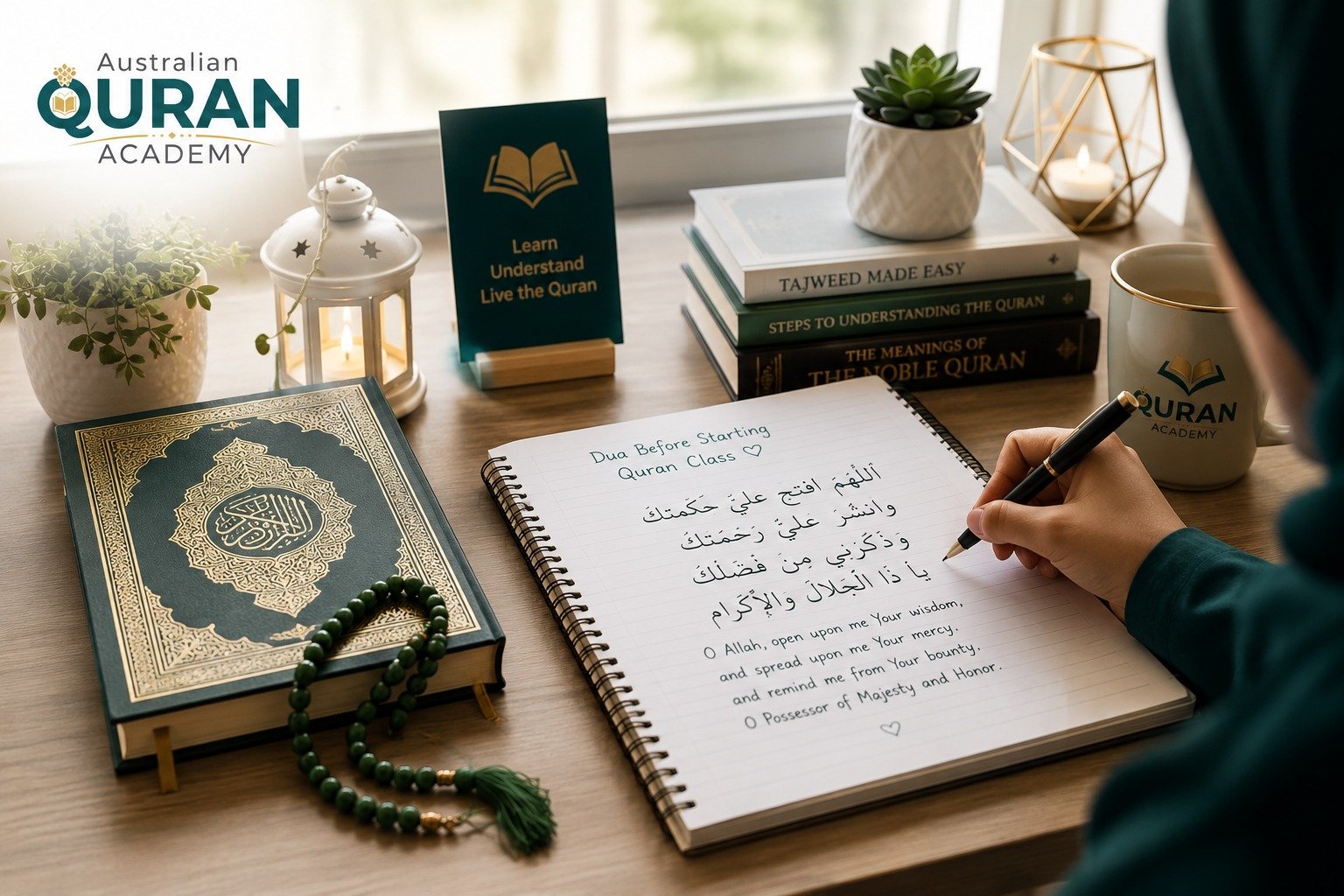
What Scholars Say About the Dua Before Starting Quran Class?
Before selecting any supplication to add to your routine, it helps to understand the scholarly framework — what is obligatory, what is recommended, and where the flexibility lies. This clarity prevents confusion and ensures the practice rests on solid ground.
Many students assume there must be a specific, narrated supplication for this moment — the way there is a dua for eating or for entering the masjid. Scholars including Sheikh Ibn Baz have clarified that no particular dua has been established for this purpose. What is prescribed are the Isti’adhah and Basmalah.
Beyond these two, a Muslim may supplement with personal supplication tailored to their actual need. The scholars cite examples such as:
“Allahumma iftah li abwaba rahmatik wa yassir li hifza kitabika wa fahimahu wal-‘amala bih”
“O Allah, open for me the doors of Your mercy, and make easy for me the memorization, understanding, and application of Your Book.”
This flexibility is a mercy, not a gap. It means the dua before starting Quran class can match exactly where you are: struggling with retention, beginning a new Surah, preparing for a recitation test, or simply trying to focus.
Every student enrolling in Quran Classes in Australia at Australian Quran Academy is guided by instructors on building these pre-class habits from their very first session.
Inside Our Virtual Classrooms
We believe in full transparency and proven quality. Take a look at these actual snippets from our live classes to experience our modern learning platform, patient instructors, and interactive student participation.
Start Your Quranic Journey in Australia
Join our leading online academy and learn with expert tutors through a structured, personalized curriculum.
Book Your Free TrialHow To Build A Pre-Class Dua Routine That Actually Sticks?
Knowing the duas is one thing — building a consistent habit around them is another. The key is not to memorize all eleven at once, but to match each supplication to the moment that calls for it, and to add new ones gradually as the routine becomes familiar.
The most common mistake is attempting all eleven supplications at once and giving up when it feels too long. The better approach is to match one dua to one situation and build gradually.
- Before every session (always): Isti’adhah → Basmalah → Dua 3 (open heart and ease)
- When starting something new: add Rabbi zidni ‘ilma (Dua 4)
- When revising memorized material: add Dua 6 (memory and retention) + Dua 11 (firm retention)
- When the lesson feels hard: add Dua 5 (ease in difficulty)
- When motivation is low: use Dua 7 (spring of the heart) before opening the Mushaf
- When feeling spiritually distant or aware of sins: add Dua 8 (abandoning sins and distractions)
- When your intention is full Quran engagement — memorization, understanding, and action: use Dua 9
- For parents learning alongside their children or enrolling them in class: add Dua 10 (inheritance for children)
The key principle: each supplication answers exactly one question — what do I need from Allah right now? Identifying that need before class begins is itself a form of presence, and presence is what separates productive recitation from mechanical repetition.
Students in Learn Quran for Beginners in Australia at Australian Quran Academy are helped by qualified teachers to build exactly this kind of intentional pre-class habit, so it becomes second nature rather than an added burden.
Read Also:Can I Learn Quran Without Wudu?
Why the Dua Before Quran Class Matters Beyond the Words?
The duas above are valuable on their own — but their deeper benefit only becomes clear when you understand what they are actually doing to the heart and mind before a session begins. This is not a spiritual abstraction; it has a practical effect on focus, retention, and consistency.
Reciting a dua before starting Quran class shifts your psychological state — from the mental chatter of daily life into deliberate attention. Scholars describe this as hudur al-qalb (presence of the heart), and it is the condition under which recitation benefits the most.
This is especially relevant for online learners and busy adults who move from a work call or household task directly into a Quran session. The dua is the bridge. It tells your nervous system that the context has changed, and it tells Allah that you are arriving with intention, not just habit.
Students at Australian Quran Academy studying through Islamic Studies Courses for Adults in Australia often report that this pre-class ritual is one of the small changes that most noticeably improves their focus and retention — more than any technique or tool.
For Arabic learners, the same principle applies. Whether you are in Learning Arabic for Non-Arabic Speakers in Australia or Arabic Lessons for Kindergarten in Australia, beginning with conscious supplication signals to the heart that the language you are learning carries a purpose beyond communication.
Start Your Quran Journey With Australian Quran Academy
A dua before starting Quran class is the first step — the path needs structure, qualified teachers, and consistent accountability to truly progress.
Australian Quran Academy offers expert-led, personalised Quran and Arabic courses for students across Australia, from complete beginners to those seeking to deepen their understanding and memorization.

Whether you are starting recitation, building Hifz, studying Tajweed, or learning to understand the Quran directly in Arabic — qualified teachers are ready to guide you at every stage.
Our Quran Courses:
- Quran Recitation Classes
- Quran Reading Classes
- Online Quran Classes for Kids
- Quran Classes for Adults
- Quran Classes for Female/Sisters
- Learn Quran Course for Beginners
- Quran Memorization (Hifz) Course
- Hifz Classes for Adults
- Quran Memorization and Hifz Course for Kids
- Quran Hifz Course for Ladies
- Quran Ijazah Program
- Quran Qirat Learning Course

Start Your Quranic Journey in Australia
Join our leading online academy and learn with expert tutors through a structured, personalized curriculum.
Book Your Free TrialConclusion
The dua before starting Quran class is not a single fixed text — it is a practice of intentional preparation. The Isti’adhah and Basmalah are established and prescribed.
The nine supplementary duas in this article give students a toolkit for every situation: opening the heart, asking for more knowledge, requesting ease, protecting memorized material, guarding the heart from sins, deepening the bond with the Quran, and extending that bond across generations and into the lives of your children.
The most important thing any student can do is choose one or two of these supplications, learn their meaning completely, and use them consistently before every class. A dua recited with full presence and understanding does more than a long list recited mechanically. The Quran deserves preparation. So does your heart before you meet it.

Frequently Asked Questions
Here are the questions students at Australian Quran Academy most commonly ask about the dua before starting Quran class — along with direct answers grounded in scholarly guidance.
1. Is there a specific authenticated dua before starting Quran class from the Prophet ﷺ?
No authenticated dua specifically for beginning a Quran class has been transmitted from the Prophet ﷺ. Scholars including Sheikh Ibn Baz confirm that the prescribed acts are the Isti’adhah and Basmalah. Students may add any sincere supplication for understanding and retention alongside these two.
2. What is the minimum I should say before beginning my Quran class?
The minimum is the Isti’adhah — A’udhu billahi mina ash-shaytani ar-rajim — followed by the Basmalah. These are Quranic commands, not recommendations. Everything else in this article is a recommended and rewarded addition.
3. Can children use the same duas before their Quran lessons?
Yes. Rabbi zidni ‘ilma is particularly suited for children because it is two words long and immediately understandable. Teachers at Australian Quran Academy introduce it early so children build the habit of beginning every lesson with a direct request to Allah — not just an adult practice handed down to them.
4. Can I make the dua in English if I don’t know the Arabic yet?
Yes. Scholars are unanimous that personal supplication may be made in any language. The Arabic restriction applies to Salah and Quranic recitation specifically. “O Allah, help me understand and remember what I learn today” is a valid and accepted dua. Students inIslamic Studies Courses for Adults in Australia often start this way while gradually learning the Arabic forms.
5. Does making dua before class apply to Arabic lessons too?
Yes. Seeking beneficial knowledge is an act of worship regardless of the subject, and supplications for understanding and ease apply to any learning connected to the Quran and deen. Students inLearning Arabic for Non-Arabic Speakers in Australia andArabic Lessons for Kindergarten in Australia benefit from beginning each session with the same intentional preparation.
6. How do I know if my dua is being accepted?
Scholars describe signs of acceptance not as instant results but as gradual shifts: increased peace (sakinah) during study sessions, unexpected ease with difficult material, a growing love for the Quran, and consistency (tawfiq) in returning to learn. The fact that you are asking is itself a sign of Allah’s attention.








Leave a Reply