 Quran
Quran
| Key Takeaway |
| Children can begin Quran exposure through listening from age 3 — structured reading typically starts between ages 5 and 7. |
| The correct sequence is: listening → Arabic letters (Noorani Qaida) → basic Tajweed → reading short Surahs → Hifz. |
| Short daily sessions (5–20 minutes) consistently outperform long occasional ones at every age. |
| Australian families have two main options: local mosque/Islamic centre programs, or flexible online one-on-one academies. |
| Praise, stories, and connection to meaning build lasting Quran love — pressure and harsh correction do the opposite. |
Learning how to learn Quran for kids in Australia is one of the most common challenges Muslim parents face today — raising children in English-speaking households, often hours from a mosque, with packed school schedules and limited local options.
The answer isn’t finding one perfect method. It’s understanding the right sequence — what to start with, when to introduce each skill, and how to keep your child engaged every step of the way.
This guide gives you exactly that: a practical, stage-by-stage roadmap for how to learn Quran for kids in Australia, whether you’re starting with a toddler or catching up with an older child.
1. Start With Listening Before Any Formal Lesson Begins
The first step in learning how to learn Quran for kids in Australia is not a lesson — it’s an environment. Before letters, before Noorani Qaida, before sitting at a desk, a child needs to hear the Quran as a normal, beautiful part of daily life.
Play a consistent reciter during mealtimes, car rides, and before sleep. Keep the same Qari every day so your child’s ear becomes familiar with a single voice and style. Within weeks, most children begin echoing sounds and phrases naturally — entirely without being asked.
Readiness matters more than a fixed birthday. Some children are ready for structured learning at 5, others at 7.
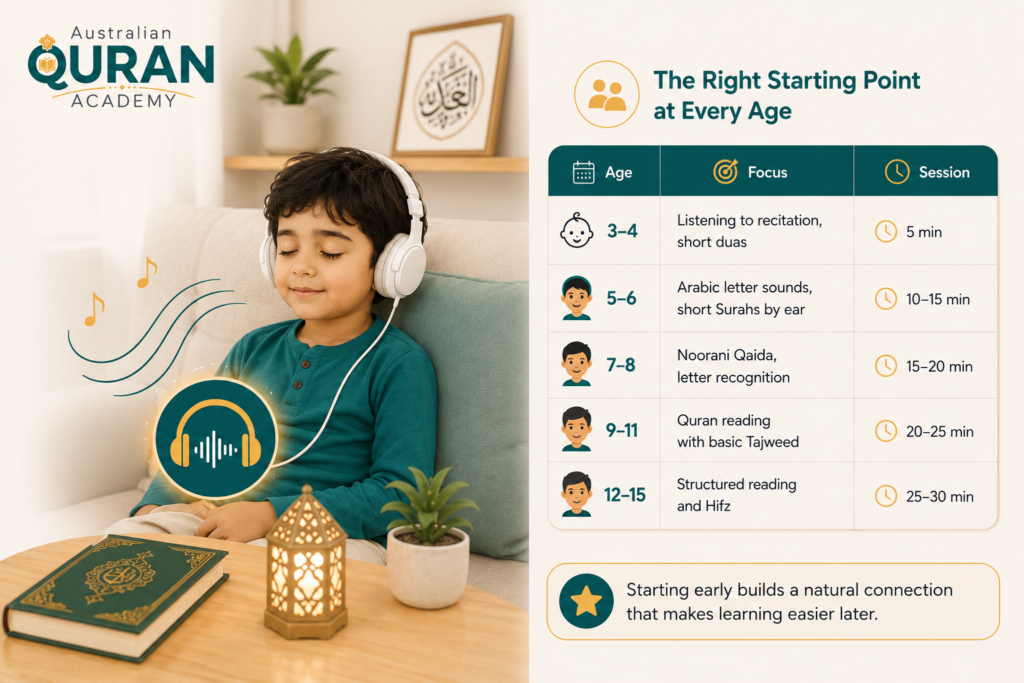
Watching for signs like curiosity about prayer, ability to repeat phrases, and basic listening skills tells you more than age alone. The table below shows what to focus on at each stage and how long each session should realistically last.
| Age | Recommended Focus | Session Length |
| 3–4 | Listening to recitation, short duas | 5 min daily |
| 5–6 | Arabic letter sounds, short Surahs by ear | 10–15 min |
| 7–8 | Noorani Qaida, letter recognition | 15–20 min |
| 9–11 | Quran reading with basic Tajweed | 20–25 min |
| 12–15 | Structured reading and Hifz | 25–30 min |
Starting early — even with just background listening — gives children a natural familiarity with Quranic sounds that makes every later stage faster and easier.
Children who hear Quranic recitation regularly before formal instruction begins absorb pronunciation and rhythm at a level that structured lessons alone cannot replicate.
Why Listening First Works Better Than Starting With Letters?
This passive exposure does real neurological work — the brain builds sound maps for unfamiliar Arabic phonemes without any pressure or correction.
A common parenting mistake at this stage is turning listening sessions into “sit down and pay attention” moments. Background listening during natural daily activities works better because children absorb sound passively while their stress levels stay low.
Choose one trusted Qari and stay consistent — Mishary Rashid Alafasy and Abdul Basit Abdus-Samad are widely used with young children.
Ten to fifteen minutes of daily background recitation is enough. Start with Juz 30 Surahs your child will later memorize so the sounds become familiar before formal study begins.
2. Begin Formal Learning With Noorani Qaida, Not the Mushaf Directly
When your child is ready for structured learning — typically between ages 5 and 7 — the correct starting point is Noorani Qaida, not the Quran itself. For Australian families wondering how to learn Quran for kids in Australia, Noorani Qaida is always the correct and proven starting point.
Jumping straight to the Mushaf before letter foundations are secure is the most common source of persistent reading errors that take years to undo.
Noorani Qaida teaches Arabic letter recognition, correct Makharij (articulation points), basic vowels, and the joining rules that allow letters to be read inside words. Most children complete it in 3 to 6 months with 15–20 minutes of daily practice.
What Noorani Qaida Covers Stage by Stage?
The book moves through isolated letter recognition first, then letter forms in different positions (beginning, middle, end of a word), then vowels and sukoon, then joining rules. Each stage builds directly on the previous one — rushing through any layer creates confusion in every layer that follows.
Australian Quran Academy’s Learn Quran for Beginners in Australia course is built directly around this foundation, with instructors trained to help English-speaking children master sounds that have no equivalent in English — like ح, ع, and خ — using phonics-based methods and physical demonstration.
Sit beside your child during practice — not in front of them. Side-by-side positioning creates safety and shared experience rather than the evaluative pressure of a face-to-face setup. Keep sessions under 20 minutes and end while your child still wants to continue.
Read Also: Learn Quran Alphabet In Australia
3. Introduce Three Basic Tajweed Rules Early Before Habits Form
Many parents assume Tajweed is an advanced topic for older students. This is a costly mistake.
Three foundational rules are worth introducing the moment a child begins reading short Surahs, because correcting pronunciation habits after they’ve solidified takes far more time than teaching them correctly from the start.
| Tajweed Rule | What It Means | Child-Friendly Cue |
| Madd (مَدّ) | Lengthening of vowel sounds | “Stretch that sound like a rubber band” |
| Ghunna (غُنَّة) | Nasal sound on ن and م | “Hum through your nose for two counts” |
| Qalqala (قَلْقَلَة) | Bouncing sound on 5 letters | “Give it a little bounce at the end” |
Physical cues work far better with children under 10 than technical explanations. “Stretch it,” “hum it,” and “bounce it” give children a body-based anchor that sticks immediately.
Why Early Tajweed Correction Matters in Australia?
For children raised in English-speaking households, Arabic pronunciation errors are particularly persistent because English provides no natural reinforcement for correct Quranic sounds.
A child who learns to flatten the Qalqala sound in their first month of reading will still be flattening it at age 14 without deliberate correction.
Australian Quran Academy instructors correct Tajweed errors in real time during live one-on-one sessions — a level of precision that group classes and pre-recorded courses simply cannot offer. Families across Australia access this through the Academy’s Online Tajweed Classes.
4. Memorize Short Surahs Before Full Reading Is Established
Children typically memorize portions of the Quran before they can read Arabic fluently — and this is both normal and intentional. Young children learn through listening and repetition, the same way they acquired their first spoken language before reading it.
Surah Al-Ikhlas is the near-universal starting point: four short, rhythmic ayahs that most children can internalize within one to two weeks of daily repetition. Follow it with Al-Falaq, then An-Nas.
The Three-Day Memorization Cycle That Prevents Forgetting
Most children don’t forget Surahs because they lack ability — they forget because new material gets added before old material is secure. This simple three-day cycle solves that directly, without adding extra time to your daily routine.
- Day 1: Read the target verse aloud together 10 times.
- Day 2: Recite it from memory with gentle correction — model the correct sound once, then let your child try again without pressure.
- Day 3: Review all previously memorized material before introducing anything new.
This simple cycle prevents the most common memorization problem: adding new Surahs while old ones slip away. The review day is not optional — it is the mechanism that makes everything else stick.
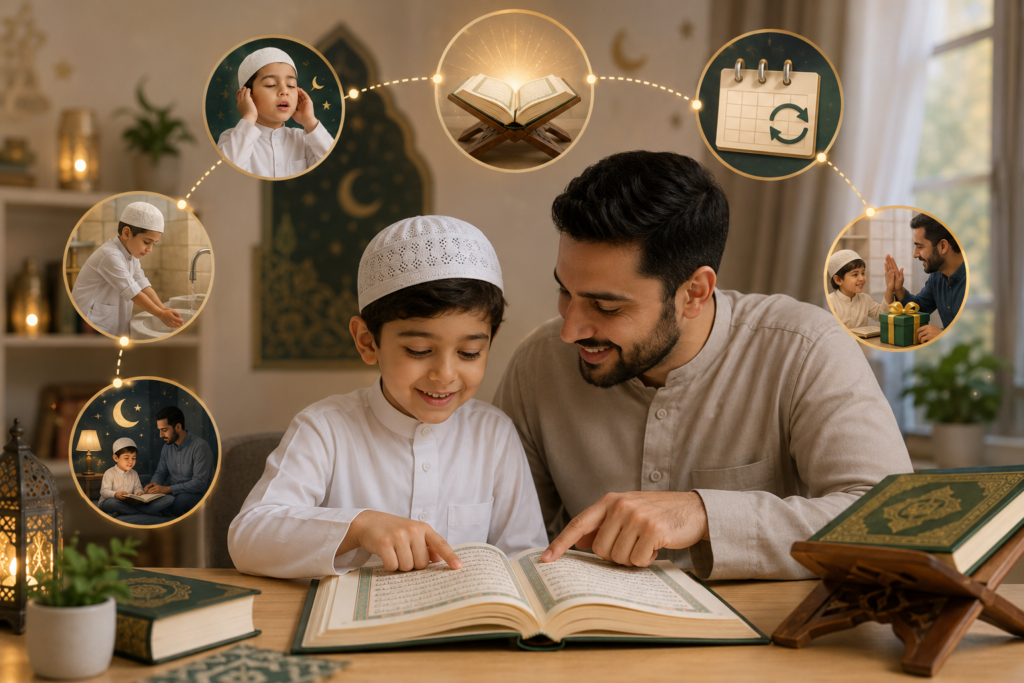
Children who associate memorization with warmth and fun retain Quranic material across years, not just weeks. Recite together during wudu, before meals, or during bedtime.
Celebrate each completed Surah with something your child loves — a special meal, a phone call to grandparents, or simply enthusiastic specific praise: “You got the Madd in the third ayah perfectly — that’s exactly what we practiced, Masha’Allah.”
See Us in Action!
Curious about what our online classrooms look like? Watch the short clips below to see how our interactive, one-on-one sessions bring learning to life with real-time feedback and engaging teaching methods.
Start Your Quranic Journey in Australia
Join our leading online academy and learn with expert tutors through a structured, personalized curriculum.
Book Your Free Trial5. Connect Each Surah to Its Story and Meaning
Children who understand even one sentence of context behind a Surah memorize it faster, retain it longer, and recite it with feeling rather than mechanical repetition. Meaning is not an optional add-on — it is one of the most powerful retention tools available to any parent.
Before starting Surah Al-Fil, spend three minutes telling the story of the army of the elephant and the birds sent by Allah.
Before Al-Kawthar, explain that this Surah was a personal gift of comfort revealed to the Prophet ﷺ during a time of grief — and that kawthar means an abundance of good. One sentence of context is enough to transform a sound sequence into something personal.
Children raised in Australia inevitably encounter the question — from classmates, from their own curiosity — of why they’re memorizing words they don’t understand.
A child who knows the story of Al-Fil, who understands that Al-Ikhlas describes Allah’s absolute uniqueness, has an answer rooted in meaning rather than obligation.
Australian Quran Academy integrates meaning and context into every lesson alongside recitation practice, building a relationship with the Quran that carries through teenage years and beyond.
Understanding meaning is one of the most overlooked answers to how to learn Quran for kids in Australia effectively — and one of the most impactful.
Parents who want to go deeper can explore the Academy’s Islamic Studies Courses for Adults in Australia to learn alongside their children.
Read Also: Quran Learning Apps
6. Keep Sessions Short Enough That Your Child Always Wants More
Five focused minutes every day produces more progress than a one-hour session once a week. Children’s memory consolidates during sleep, meaning daily short exposures give the brain multiple consolidation cycles every week. This is not a compromise — it is the most effective structure available for young learners.
| Age | Maximum Session Length |
| 3–5 | 5–10 minutes |
| 6–8 | 15–20 minutes |
| 9–12 | 20–25 minutes |
| 13+ | 25–30 minutes |
The practical rule: end each session before your child is ready to stop. A child who finishes wanting to continue returns willingly the next day. A child pushed past their limit begins to resist Quran time — and that resistance is far harder to undo than a shorter session.
Children who learn Quran at the same time every day build the habit faster and resist it less. After Fajr prayer, after school before screen time, or after Maghrib — pick one anchor and stay with it.
Within ten to fourteen days, most children sit for Quran without reminders because the routine feels normal.
Read Also: Quran Learning Tools For Kids
7. Build a Weekly Revision Day to Lock In What’s Already Memorized
Adding new material before old material is secure is the single most common reason children lose previously memorized Surahs. A single structural fix prevents most of this: designate one day per week as revision-only.
No new Surahs. No new verses. Just reciting all previously memorized material from memory, in order, within 10 minutes. Friday is a natural choice for many Australian Muslim families.
This weekly retrieval forces the brain to actively recall older Surahs before they fade — which is the mechanism that converts short-term memorization into long-term retention.
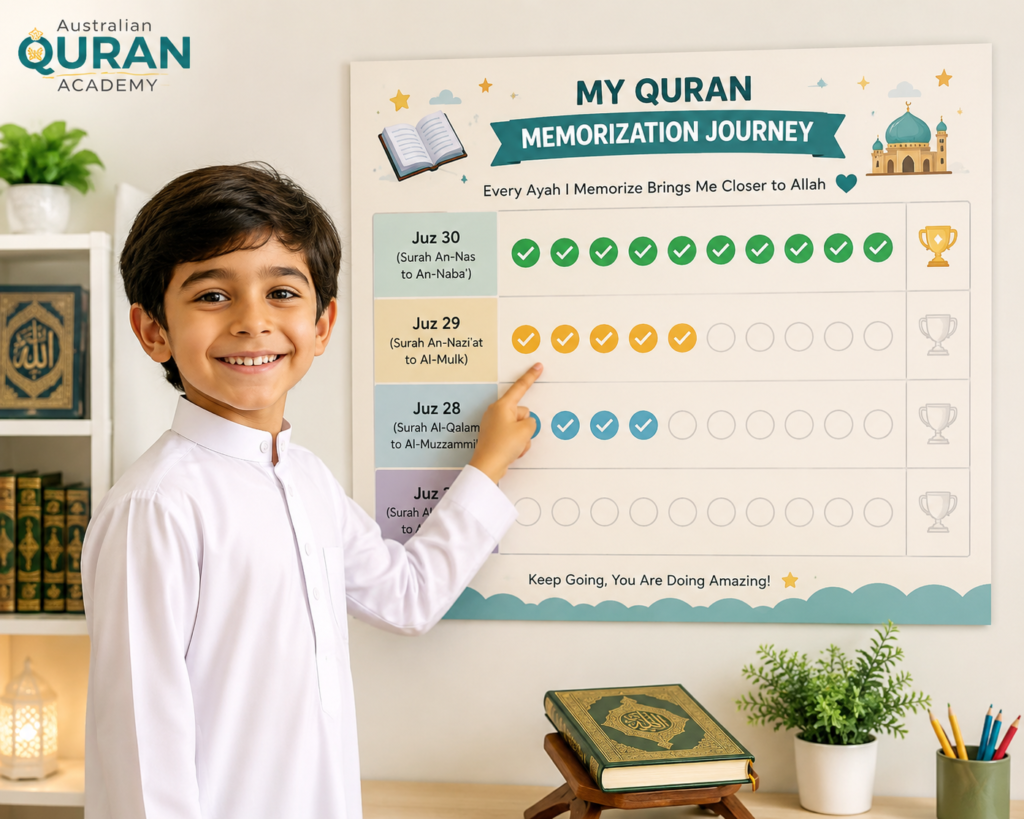
A simple sticker chart on the wall — one sticker per Surah memorized, one per successful revision day — gives children a visual record of their own progress. Children aged 5 to 10 respond strongly to seeing their achievements accumulate. The chart also makes revision feel like an achievement rather than a chore.
Read Also: Free Online Quran Classes for Beginners in Australia
Inside Our Virtual Classrooms
We believe in full transparency and proven quality. Take a look at these actual snippets from our live classes to experience our modern learning platform, patient instructors, and interactive student participation.
Start Your Quranic Journey in Australia
Join our leading online academy and learn with expert tutors through a structured, personalized curriculum.
Book Your Free Trial8. Choose the Right Learning Environment for Your Australian Family
Australian Muslim parents have more choices today than any previous generation — local mosque programs, weekend Islamic schools, private tutors, and online academies. Understanding the tradeoffs helps you choose what actually fits your family’s life.
A. Local Mosque and Islamic Centre Programs
Most major suburbs in Sydney, Melbourne, and Brisbane host weekend Quran schools or after-school programs.
Institutions like ISRA Quran Academy in NSW run structured onsite programs, and organisations like the National Zakat Foundation’s Recite to Rise program offer financial assistance for families facing hardship.
The strength of local programs is community — children learn alongside peers, build friendships, and develop shared Islamic identity. The limitation is inflexibility: fixed locations, fixed timetables, and teacher quality that varies significantly between centres.
B. Online One-on-One Academies
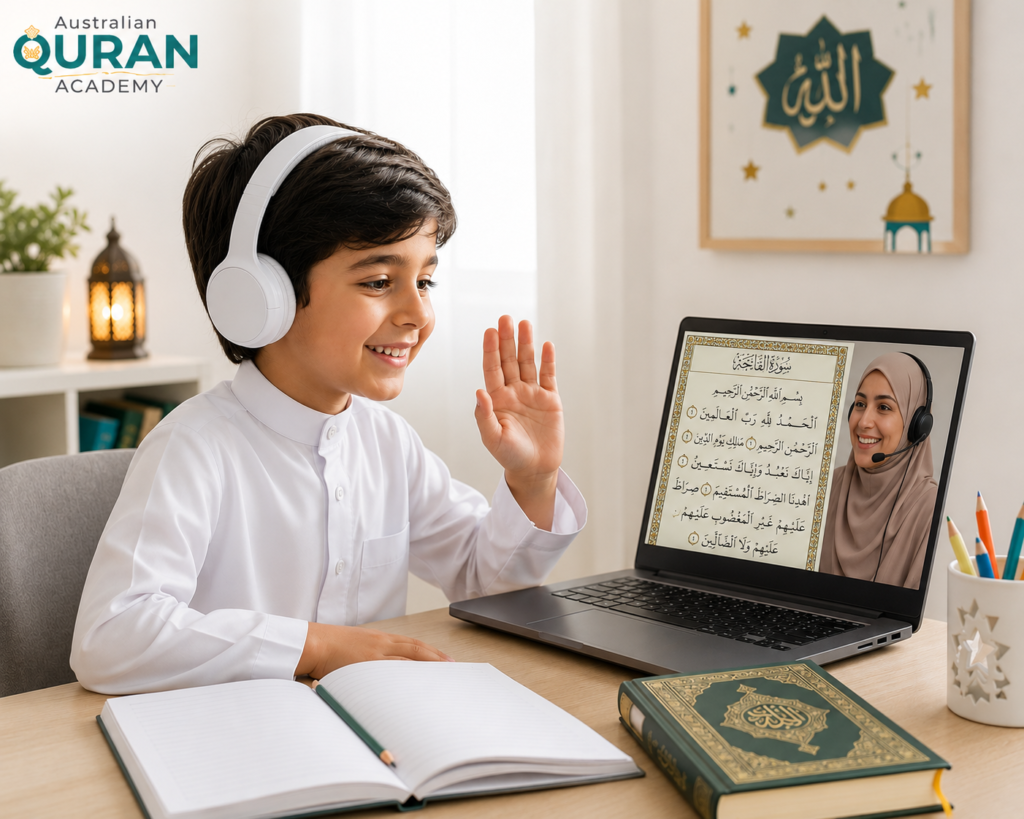
A growing number of Australian Muslim families are choosing dedicated online academies for their children’s Quran education. Live one-on-one sessions with certified instructors offer flexible scheduling,
pacing tailored to each child, and real-time Tajweed correction that group classes cannot match.
Australian Quran Academy serves families across Australia through exactly this model — from inner-city Sydney to regional Western Australia.
Children access the same qualified instruction regardless of postcode. The Academy also offers Arabic Lessons for Kindergarten in Australia for young beginners and Learning Arabic for Non-Arabic Speakers in Australia for older children and parents learning alongside their kids.
Start Your Child’s Quran Journey With Australian Quran Academy
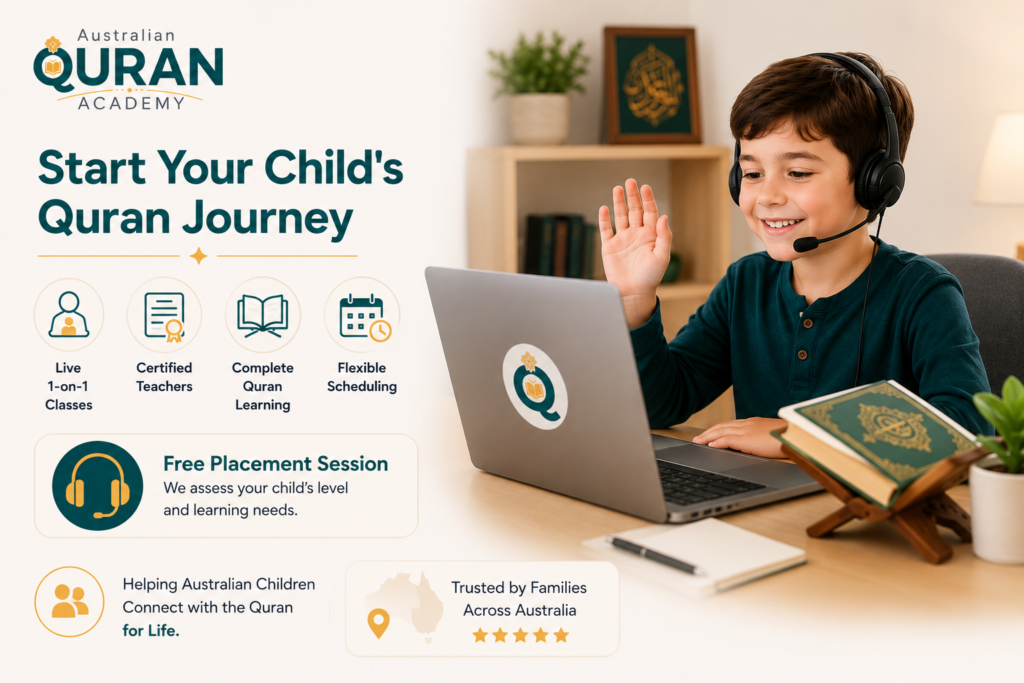
Australian Quran Academy provides live one-on-one Quran instruction for children across Australia — flexible, certified, and built for English-speaking families. Every child begins with a free placement session to identify exactly where they are and what they need next.

Courses cover the complete journey: Noorani Qaida for beginners, Tajweed correction, Quran reading, and structured Hifz programs.
Parents who want to grow alongside their children can explore the full range of Quran Classes in Australia available through the Academy.
Give your child the gift of the Quran — from wherever you are in Australia.
Our Quran Courses:
- Online Quran Classes for Kids
- Learn Quran Course for Beginners
- Quran Memorization (Hifz) Course
- Hifz Classes for Adults
- Quran Memorization and Hifz Course for Kids
- Quran Hifz Course for Ladies
- Quran Ijazah Program
- Quran Qirat Learning Course
- Quran Tafsir Course
- Noorani Qaida Course
- Noorani Qaida Course for Kids
- Tajweed Course for Kids
Start Your Quranic Journey in Australia
Join our leading online academy and learn with expert tutors through a structured, personalized curriculum.
Book Your Free TrialConclusion
Learning how to learn Quran for kids in Australia comes down to sequence and consistency: start with listening, build letter foundations through Noorani Qaida, introduce Tajweed early, memorize short Surahs with daily repetition, and keep sessions short enough that your child finishes each one wanting more.
Australian families have real advantages today — flexible online academies, certified instructors accessible from anywhere in the country, and structured programs built for children raised in English-speaking homes. The challenge is simply choosing a clear path and staying on it.
The Prophet Muhammad ﷺ said: “The best of you is the one who learns the Quran and teaches it.” That journey starts with five minutes, one Surah, and one decision to begin.
Frequently Asked Questions About How to Learn Quran for Kids in Australia
Learning Quran for kids in Australia raises similar questions for most Muslim parents — around timing, methods, language barriers, and the right programs. Here are the most common ones, answered directly.
1. What age should my child start learning the Quran in Australia?
Children can begin through listening from age 3. Structured learning with Arabic letters through Noorani Qaida typically starts between ages 5 and 7, when children can focus for short periods and repeat sounds consistently. Readiness matters more than a fixed age — look for curiosity about prayer and the ability to repeat simple Arabic phrases.The best results in how to learn Quran for kids in Australia come from starting the listening phase early — before formal instruction begins.
2. Does my child need Arabic to start learning the Quran?
No. Noorani Qaida is specifically designed for children with zero Arabic background, teaching letter sounds and pronunciation before any reading begins. Many children at Australian Quran Academy start with no prior Arabic exposure and are reading short Surahs within a few months.
3. How many minutes a day should my child practice?
Ages 3–5 need only 5–10 minutes. Ages 6–9 work well with 15–20 minutes. Teenagers can handle 25–30 minute sessions. Daily consistency matters far more than session length — five minutes every day produces dramatically better results than one hour on weekends.
4. Is online Quran learning effective for children?
Yes, when delivered as live one-on-one sessions with a qualified instructor. Real-time Tajweed correction, personalized pacing, and flexible scheduling are advantages that recorded video courses and many local group classes cannot offer. Australian Quran Academy delivers exactly this model for families across the country.
5. What is the best first Surah for a child to memorize?
Surah Al-Ikhlas — four short, rhythmic ayahs that most children can memorize in one to two weeks of daily repetition. Follow it with Al-Falaq and then An-Nas. These three Surahs form a natural, spiritually meaningful starting point for any young learner.
6. How do I stop my child from forgetting what they’ve already memorized?
Designate one day per week as revision-only — no new material, just reciting all previously memorized Surahs from memory. This single habit, done consistently, is more effective than any other retention strategy available to parents at home.




Leave a Reply