 Quran
How to learn Quran reading with Tajweed for beginners in Australia becomes much clearer when the process is treated as progressive skill training. Beginners need accurate letters, controlled listening, limited rules, guided correction, and consistent review.
Learners who try to study every rule immediately often know terminology but cannot apply it while reading. A better sequence develops the ear, tongue, and visual recognition together. The nine steps below follow that sequence.
1. Learn Quran Reading With Tajweed for Beginners
Begin by checking whether you can recognise joined Arabic letters, short vowels, Sukoon, Shaddah, and Tanween without guessing. Tajweed cannot stabilise while basic decoding still consumes all your attention.
Read a short unfamiliar passage aloud and mark every hesitation. If you pause mainly because letters change shape within words, rebuild reading fluency before adding detailed recitation rules.
Use the following readiness check to identify the correct starting point. The goal is an honest baseline, not a pass or fail result, because different weaknesses require different first lessons.
| Skill | Ready to progress | Foundation still needed |
| Letter recognition | Identifies letters in all word positions | Recognises only isolated forms |
| Harakaat | Reads short vowels without prompting | Confuses fatha, kasra, or damma |
| Sukoon and Shaddah | Produces both signs distinctly | Omits stillness or consonant doubling |
| Joined words | Reads slowly but accurately | Guesses from the first letter |
| Short passage | Maintains a steady basic pace | Stops after nearly every letter |
Start with five to seven lines, not a familiar Surah you may have memorised by sound. An unfamiliar sample reveals actual reading ability instead of testing whether memory can cover decoding gaps.
Record the baseline and keep it for four weeks. Comparing the same passage later will show whether pronunciation, pace, and independent error detection have improved more clearly than a completed-page total.
2. Rebuild Arabic Letter Accuracy Across Australia
Rebuild letter accuracy before studying rule lists, especially when similar sounds merge during recitation. Arabic letters must be distinguished by both articulation point and sound quality, not English approximations.
Makharij al-Huruf means the articulation points from which Arabic letters emerge. Beginners should first separate commonly confused pairs such as س and ص, ت and ط, ح and ه, or د and ض.
Practise one pair at a time using isolated letters, vowel combinations, short words, and Quranic phrases. Moving through those four levels prevents a correct isolated sound from disappearing when reading connected text.
A useful drill follows this order:
- Listen to one accurate model of the target letter three times.
- Repeat the letter with fatha, kasra, and damma at a slow pace.
- Contrast the letter with its closest sound partner in alternating pairs.
- Read three words containing the sound at different word positions.
Avoid forcing unfamiliar sounds through exaggerated jaw or throat tension. Clear articulation depends on correct placement and controlled airflow; strain usually produces a harsher sound rather than a more accurate one.
Australian Quran Academy offers a Noorani Qaida Course in Australia that builds joined-letter reading, vowels, and pronunciation through guided lessons suited to genuine beginners.

Book a free Quran reading assessment
3. Train Your Ear Before Naming Tajweed Rules
Train your ear to notice sound differences before expecting instant rule application. Beginners reproduce pronunciation more reliably when they can hear length, nasal resonance, clarity, and merging in a controlled example.
Choose one principal reciter with a measured teaching pace and keep the same audio style for several weeks. Constantly switching voices changes rhythm, pitch, and pausing patterns while your listening framework remains fragile.
Use short audio segments containing one phrase or a single Ayah. Listen without reading first, follow with your eyes during the second play, then repeat after the third play.
Complete each listening cycle in four stages:
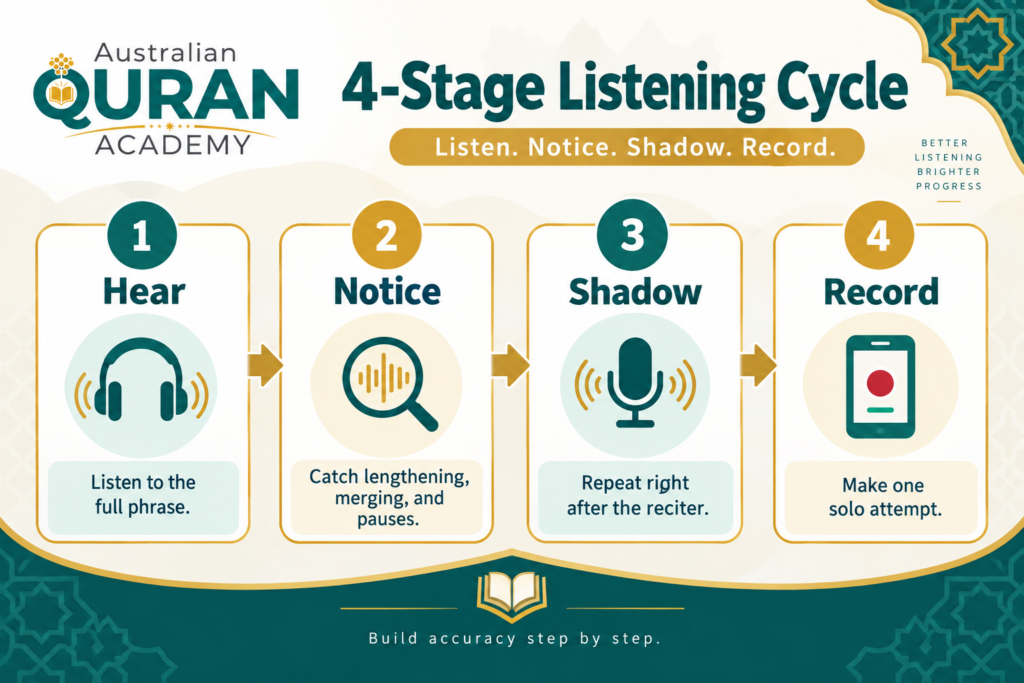
- Hear the full phrase without speaking.
- Identify where the reciter lengthens, merges, or pauses.
- Shadow the phrase immediately after the model.
- Record one independent attempt without the model playing.
Compare one feature at a time instead of judging whether the whole recording sounds beautiful. Begin with letter accuracy, then vowel length, Ghunnah, and stopping, because broad self-criticism gives no usable correction target.
Listening is preparation rather than proof of correct recitation. A beginner can imitate the melody while missing a consonant, shortening Madd, or adding nasal sound where no Ghunnah applies.
See Us in Action!
Curious about what our online classrooms look like? Watch the short clips below to see how our interactive, one-on-one sessions bring learning to life with real-time feedback and engaging teaching methods.
Start Your Quranic Journey in Australia
Join our leading online academy and learn with expert tutors through a structured, personalized curriculum.
Book Your Free Trial4. Study Core Tajweed Rules for Beginners in Australia
Study a small rule set in practical order instead of memorising a full textbook. Each rule should be recognised visually, heard in recitation, produced in examples, and then applied inside connected reading.
Begin with rules that appear frequently and produce noticeable reading changes. Noon Sakinah and Tanween, Meem Sakinah, Ghunnah, Madd, Qalqalah, and basic Waqf provide a workable beginner curriculum.
The Quran commands measured recitation in a concise verse that establishes the manner beginners are working towards:
أَوْ زِدْ عَلَيْهِ وَرَتِّلِ الْقُرْآنَ تَرْتِيلًا
(Aw zid ‘alayhi wa rattili al-Qur’ana tartila)
(“Or add to it, and recite the Quran with measured recitation.”)
Use this sequence to organise the first rules:
| Rule | Beginner focus | Practical listening cue |
| Ghunnah | Nasal resonance held for two counts | Sound resonates through the nose |
| Noon Sakinah and Tanween | Clear, merged, changed, or concealed noon sound | Sound changes with the following letter |
| Meem Sakinah | Clear meem, concealment, or merging | Lips close differently by context |
| Madd | Required vowel extension | Long vowel lasts beyond a short vowel |
| Qalqalah | Controlled echo on five letters | Brief rebound without adding a full vowel |
| Waqf | Safe stopping and restarting | Meaning and final vowel may affect the stop |
Do not learn every subdivision during the first pass. Study the condition, target sound, and two clear examples, then practise until you can recognise the rule before the teacher names it.
Australian Quran Academy offers Online Tajweed Classes in Australia that connect rule explanations with live recitation correction instead of leaving beginners with terminology alone.

5. Apply One Tajweed Rule to Short Surahs
Apply one target rule to a short Surah before combining several rules. Narrow practice reduces mental overload and lets the teacher identify whether the error comes from recognition, pronunciation, timing, or breath.
Print or display a clean passage and mark only examples of the current rule. Read the marked words separately, connect each word to its phrase, and finally recite the full passage.
Use a four-session rotation for every new rule. Session one covers recognition, session two isolates production, session three applies the rule in phrases, and session four tests independent recitation.
| Session | Main task | Success measure |
| 1 | Locate five examples | Identifies the trigger correctly |
| 2 | Repeat each example | Produces the target sound consistently |
| 3 | Read complete phrases | Keeps the rule during connected reading |
| 4 | Recite without markings | Applies the rule without a visual prompt |
Choose short passages with repeated exposure to the target pattern. Al-Fatiha is valuable because of daily Salah, while short Surahs allow multiple complete repetitions without fatigue or rushed breath control.
Quick exercise: Circle every Madd sign in five lines, listen to those lines once, and recite them slowly. On the second attempt, remove the circles and check whether the elongations remain.
Read also: Is It Mandatory To Memorize The Quran?
6. Build a Daily Recitation Practice That Prevents Drift
Practise for fifteen to twenty minutes daily at a stable time. Short, attentive sessions protect pronunciation patterns better than irregular hour-long practice that leaves several days for old errors to return.
Divide each session between review, one improvement target, and independent reading. This structure prevents new rules from replacing older skills and reveals whether corrections survive after the model audio stops.
A practical twenty-minute session can follow this schedule:
| Time | Activity | Purpose |
| 5 minutes | Review corrected lines | Stabilise previous feedback |
| 4 minutes | Listen and shadow | Refresh the target sound |
| 6 minutes | Read new lines slowly | Transfer the rule to unfamiliar text |
| 3 minutes | Record one attempt | Create evidence for comparison |
| 2 minutes | Note one correction | Define tomorrow’s priority |
Keep the daily target deliberately small. Three accurate lines that improve across several attempts contribute more than two hurried pages containing the same uncorrected Makharij and timing mistakes.
Missed days should not trigger an oversized catch-up session. Resume the normal duration, review the last corrected passage, and reduce new material until fluency returns to its previous level.
Australian Quran Academy offers Quran Reading Classes in Australia for learners who need structured decoding practice, steady pacing, and direct correction while moving towards independent reading.

7. Arrange Tajweed Lessons Around Australian Schedules
Arrange live correction around school, work, Salah, and household responsibilities rather than relying on leftover time. A repeatable weekly slot makes guided recitation part of ordinary life instead of an occasional project.
Australian learners may need sessions that account for different state time zones, daylight-saving changes, weekend commitments, and early starts. Confirm the displayed lesson time whenever clocks change in your state.
Choose a slot when your voice and attention are fresh. Children may respond better before evening fatigue, while adults can test early morning, lunch-break, or quiet post-Isha sessions.
Use this planning table before selecting a lesson time:
| Learner | Useful lesson window | Planning concern |
| School student | After a short rest from school | Avoid tired late-evening sessions |
| Working adult | Early morning or fixed evening | Protect the slot from overtime |
| Parent | School hours or post-bedtime | Keep practice materials prepared |
| Shift worker | Rotating pre-agreed times | Book around the roster early |
| Family group | Weekend morning | Separate individual correction time |
Place independent practice within twenty-four hours after each lesson. Prompt review helps the mouth reproduce the corrected sound while the teacher’s model and explanation are still easy to recall.
Families should avoid making one child practise while siblings create constant interruption. A quiet corner, headphones for model audio, and a visible fifteen-minute timer establish a stronger learning cue.
Read also: How To Help Kids Memorise Quran In Australia
8. Use Recording and Teacher Feedback to Fix Errors
Use recordings to expose repeated errors, then let a qualified teacher decide which correction comes first. Self-recording provides evidence, but expert feedback distinguishes significant pronunciation problems from minor stylistic differences.
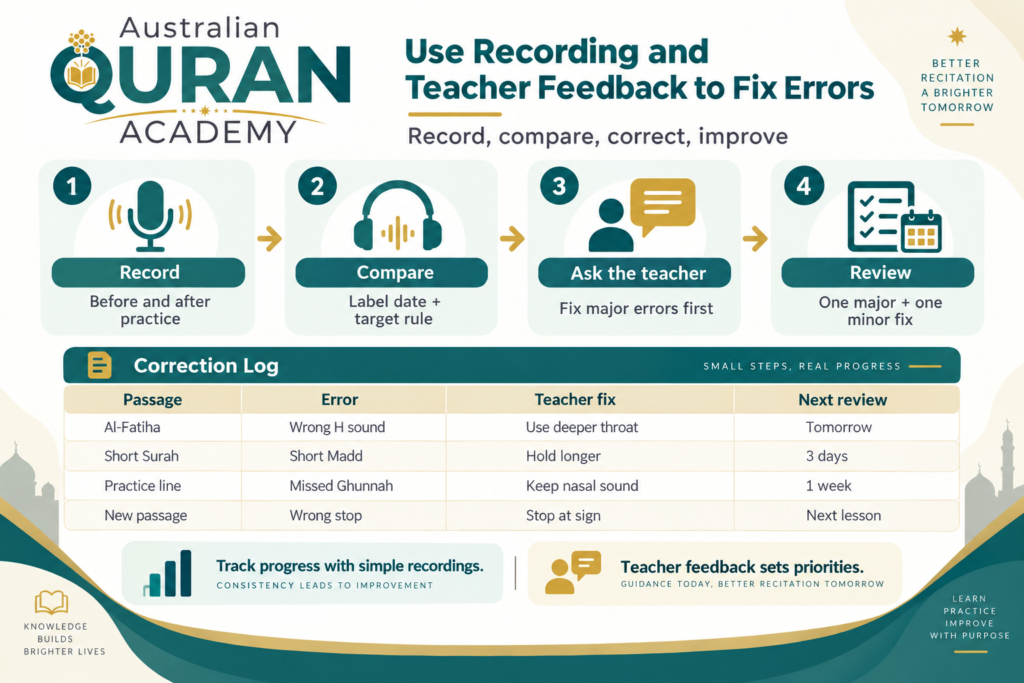
Record the same passage before practice and after three focused attempts. Label each file with the date and target rule so improvement can be compared rather than judged from memory.
Ask the teacher to classify corrections by priority. Errors that change or obscure a letter deserve attention before optional beautification, advanced timing refinements, or attempts to copy a reciter’s personal melody.
Use a simple correction log with four fields:
| Passage | Repeated error | Teacher correction | Next review |
| Al-Fatiha line 2 | ح sounds like ه | Lower throat placement | Tomorrow |
| Short Surah | Madd shortened | Hold required count | Three days |
| Practice phrase | Ghunnah omitted | Maintain nasal resonance | One week |
| New passage | Unsafe stopping point | Stop at marked sign | Next lesson |
Limit each practice session to one major and one minor correction. Trying to repair every issue simultaneously often slows reading so severely that previously stable skills also begin to break down.
At Australian Quran Academy, instructors can use recurring recordings to track which errors disappear, which return under pressure, and which need isolated drills before further rule study continues.
Inside Our Virtual Classrooms
We believe in full transparency and proven quality. Take a look at these actual snippets from our live classes to experience our modern learning platform, patient instructors, and interactive student participation.
Start Your Quranic Journey in Australia
Join our leading online academy and learn with expert tutors through a structured, personalized curriculum.
Book Your Free Trial9. Test Independent Quran Recitation Across Australia
Test independent recitation every four weeks using an unseen passage and a familiar passage. Together, they reveal whether Tajweed skills transfer to new text and remain stable in reviewed material.
Read the unseen passage without colour prompts or model audio, but allow a brief visual scan first. The purpose is to measure real application, not surprise the learner with avoidable pressure.
Track progress with observable evidence rather than impressions. Useful measures include fewer teacher interruptions, more accurate letter contrasts, steadier Madd counts, correct rule recognition, safer stopping, and successful self-correction.
| Measure | Weak evidence | Strong evidence |
| Accuracy | Passage sounds generally better | Repeated error count decreases |
| Independence | Follows audio successfully | Reads new text without audio |
| Tajweed recall | Names rule definitions | Detects and applies rules in context |
| Correction | Repeats after the teacher | Repairs the error independently |
| Fluency | Reads faster | Reads steadily without sacrificing accuracy |
Increase difficulty only when older work remains stable. Add longer passages, denser rule combinations, or less familiar vocabulary gradually, while continuing weekly review of material that previously produced repeated mistakes.
Australian Quran Academy offers Quran Recitation Classes in Australia that help beginners turn foundational reading and Tajweed knowledge into controlled, teacher-reviewed recitation.

Start Accurate Tajweed With Australian Quran Academy
Australian Quran Academy provides live instruction for beginners who need more than recorded explanations. Teachers can assess reading foundations, model precise sounds, correct recitation immediately, and adjust practice to the learner’s pace.
What sets Australian Quran Academy apart:
- Live teacher correction for Makharij, rule application, and Waqf.
- Beginner pathways covering Qaida, Quran reading, Tajweed, and recitation.
- Flexible online study that can accommodate Australian family routines.
Our Quran Courses
- Weekend Quran Classes
- Intensive Quran Course
- Al-Azhar Quran Course
- Quran Reading Classes in Australia
- Online Tajweed Classes in Australia
- Noorani Qaida Course in Australia
Conclusion
Learning Quran reading with Tajweed for beginners works best as a sequence of foundation, listening, limited rule study, short-passage application, daily practice, teacher correction, and regular testing.
Beginners should value accuracy before speed and evidence before impressions. When every correction is reviewed until it survives independent reading, Tajweed becomes a usable recitation skill rather than memorised theory.
For learners in Australia, online instruction can provide continuity across changing schedules and distance from local classes. Begin at your actual reading level, protect a small daily routine, and seek qualified feedback early.
Frequently Asked Questions About Beginner Tajweed Reading
How long does beginner Tajweed learning usually take?
Most beginners need several months to stabilise foundational rules, although the timeline depends on Arabic reading fluency, practice frequency, and access to correction. Consistent daily work usually matters more than finishing a rule book quickly.
Can beginners learn Tajweed without an Arabic background?
Yes, beginners can learn Tajweed without previous Arabic study, but they must first recognise letters, joined forms, vowels, Sukoon, Shaddah, and Tanween. A structured Qaida stage prevents rule learning from becoming confused with basic decoding.
Can Tajweed be learned entirely through recorded lessons?
Recorded lessons can explain rules and provide accurate models, but they cannot reliably diagnose an individual learner’s articulation. Live teacher feedback is needed to identify unnoticed Makharij, timing, nasalisation, and stopping errors.
How often should Australian beginners practise Tajweed?
Australian beginners should practise for fifteen to twenty focused minutes on most days and attend regular guided lessons. Scheduling practice around school, work, and daylight-saving changes makes consistency more realistic across different states.
Should beginners use a colour-coded Tajweed Mushaf?
A colour-coded Tajweed Mushaf can help beginners locate rules quickly, provided they also learn what each colour means. It should become a temporary visual aid rather than the learner’s only way to recognise rule conditions.
Which Tajweed rule should a beginner learn first?
A beginner should start after basic letter accuracy with Ghunnah and common Noon Sakinah, Tanween, Meem Sakinah, Madd, and Qalqalah patterns. The best first rule may change when a teacher identifies a more urgent recurring error.








Leave a Reply