 Quran
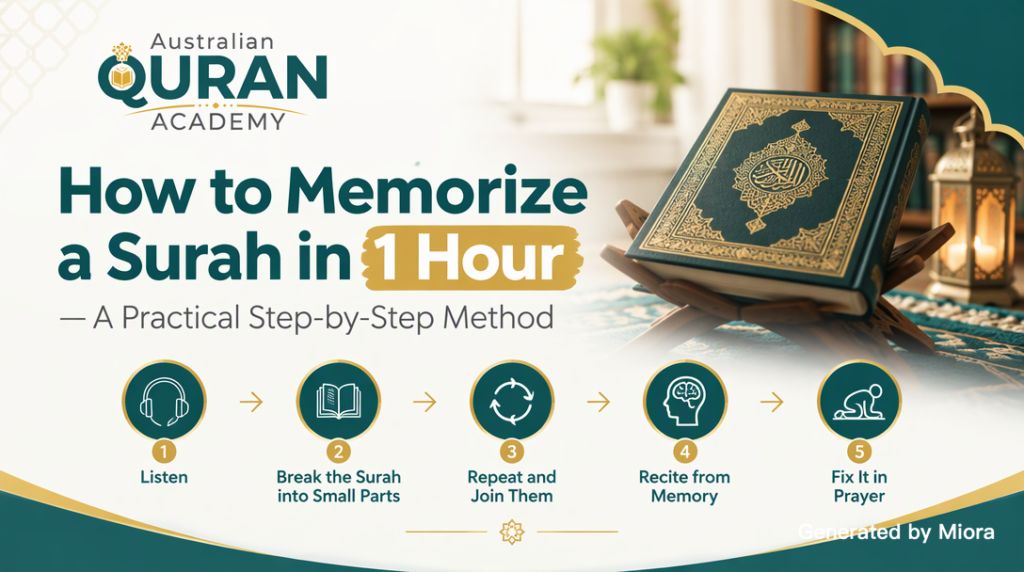
How to memorize a surah in 1 hour comes down to one structured session: listen, break the surah into small parts, repeat and join them, recite from memory, then fix it in prayer. This works best for short surahs. A fixed order and a clear time budget matter more than rushing.
Many learners sit down with a mushaf, read the surah over and over, and still blank out after ten minutes. The problem is rarely memory. It is the lack of a method. The Quran itself says it was made easy to remember, and a one-hour plan puts that ease to work.
1. Renew Your Intention Before You Begin to Earn Great Reward
Memorization lasts longer when it is driven by a purpose beyond simply completing the Quran. A sincere intention gives your efforts meaning, strengthens your commitment, and reminds you that every verse you learn is an act of worship.
The Prophet ﷺ said: “Actions are judged by intentions” (Sahih al-Bukhari 1) Before you begin, renew your intention to memorize for the sake of Allah, draw closer to Him, understand His words, and recite them in your daily prayers.
Dr. Ali Al-Rabiei lists sincere intention and strong willpower among the first foundations of successful memorization. This also means accepting that motivation may fluctuate, especially at the beginning.
Rather than waiting until you feel motivated, commit to a small, manageable daily portion and maintain it consistently. Treat the first few minutes of effort as the hardest part, and remember that regular practice gradually makes memorization easier and more rewarding.
2. Choose a surah that fits a one-hour window
A surah that can reasonably be memorized in one hour is usually a short surah of around 3 to 10 brief verses, such as Al-Ikhlas, Al-Falaq, An-Nas, Al-Asr, or Al-Kawthar. These surahs are manageable because their verses are relatively short and can be divided into small portions for repetition and review.
The one-hour method can also be applied to longer surahs by memorizing a few verses at a time, although completing a longer surah in one session does not necessarily mean the memorization is firmly established.
The Quran-first order recommended by Dr. Ali Al-Rabiei provides a practical starting point. Begin with Al-Fatihah, as it is essential for daily prayers, then move on to the shorter surahs in Juz Amma before gradually progressing to longer passages.
This sequence allows you to build confidence, develop a consistent memorization routine, and strengthen your recall before taking on more demanding sections.
If you are unsure which surah to choose, start with the shortest one you have not yet memorized. Completing a small surah with accurate pronunciation and reliable recall is more valuable than rushing through a longer one and struggling to remember it later. You can always move forward once you have reviewed it enough to recite it confidently without looking at the Mushaf.
Not sure you can read the surah fluently yet? Join the Quran Reading Classes at Australian Quran Academy, where a qualified teacher helps you read each verse correctly before you start memorizing.

3. Set up your time, place, and mushaf
Three choices made before the timer starts protect the full hour from distraction.
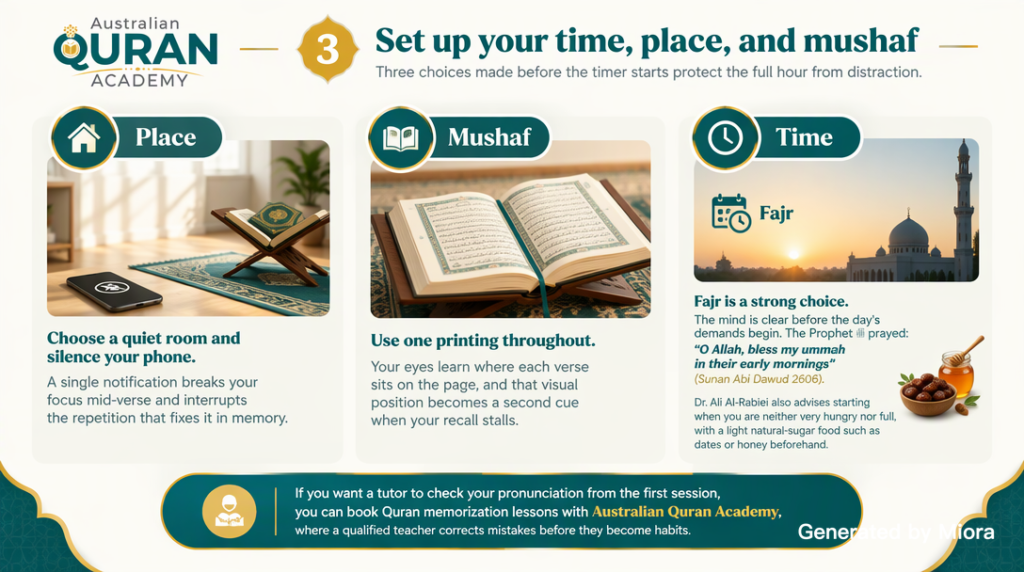
- Place. Choose a quiet room and silence your phone. A single notification breaks your focus mid-verse and interrupts the repetition that fixes it in memory.
- Mushaf. Use one printing throughout. Your eyes learn where each verse sits on the page, and that visual position becomes a second cue when your recall stalls.
- Time. Fajr is a strong choice because the mind is clear before the day’s demands begin. The Prophet ﷺ prayed: “O Allah, bless my ummah in their early mornings” (Sunan Abi Dawud 2606). Dr. Ali Al-Rabiei also advises starting when you are neither very hungry nor full, with a light natural-sugar food such as dates or honey beforehand.
If you want a tutor to check your pronunciation from the first session, you can book Quran memorization lessons with Australian Quran Academy, where a qualified teacher corrects mistakes before they become habits.
4. Listen to the full surah first (10 minutes)
Listen to the whole surah three times in a row from a reciter you enjoy, such as Sheikh Al-Husary or Sheikh Al-Minshawi. Follow along in the mushaf and focus on letter articulation and elongation (madd).
Allah says: “So when the Quran is recited, then listen to it and pay attention that you may receive mercy” (Quran 7:204). Listening first means your tongue already knows the melody before it has to produce it.
Allah also instructs: “and recite the Quran with measured recitation” (Quran 73:4). Do not speed up to save time. Measured recitation is the method, and a correct first impression saves you from relearning errors later.
5. Divide the surah and repeat each part (30 minutes)
Split the surah into groups of 3 to 5 verses, then memorize cumulatively. This is the core of the hour.
- Read the first verse aloud 15 to 20 times, looking at the mushaf.
- Do the same with the second verse.
- Join verse one and verse two and repeat them together several times.
- Add the next verse and join it to the chain.
- Repeat until the whole group is secure, then move to the next group.
Two well-known variations suit different learners. In the 3×3 method, you read each verse three times, join it to the next, and read the whole page three times at the end. In the 3-10 method, you read each verse 10 times from the mushaf and then recite it three times from memory.
The Quran says: “And We have certainly made the Quran easy for remembrance, so is there any who will remember?” (Quran 54:17). Repetition is how that ease becomes visible in practice.
A practical timing rule: divide your 30 minutes by the number of verses, and move on when a verse is recited correctly twice from memory, not when the clock says so. Slow verses get extra time, and easy ones get less.
See Us in Action!
Curious about what our online classrooms look like? Watch the short clips below to see how our interactive, one-on-one sessions bring learning to life with real-time feedback and engaging teaching methods.
Start Your Quranic Journey in Australia
Join our leading online academy and learn with expert tutors through a structured, personalized curriculum.
Book Your Free Trial6. Recite from memory and review weak verses (10 minutes)
Close the mushaf and recite the whole surah from memory. When you stall, glance at the verse, then repeat that verse alone several times before you continue. This is active recall: pulling the words out of memory, not just recognizing them on the page.
Make a pencil mark on any verse you stumbled on, and repeat those verses first. Most errors cluster in two places: verses that begin with similar words, and the joins between verses.
This step matters because memory fades without effort. The Prophet ﷺ said: “Keep refreshing your knowledge of the Quran. By Him in Whose hand is my soul, it escapes faster than camels from their hobbles” (Sahih Muslim 791).
7. Recite the surah in two rak’ahs to fix it (10 minutes)
Praying the surah is the strongest test of the hour, because it forces you to retrieve every verse without the mushaf, in a calm and focused state. Recalling a verse from memory strengthens it far more than rereading it, and tying the surah to prayer turns it into a daily habit.
Stand and pray two rak’ahs, reciting Al-Fatiha and then the surah you just memorized. If the surah is short, recite it in both rak’ahs. Keep the mushaf closed until you finish.
If you stumble, pause, continue from the next verse you remember, and mark the weak spot in your mind. After the prayer, open the mushaf, review only the verses where you hesitated, and recite them once more.
Allah says: “so recite what is easy from it” (Quran 73:20). Each letter you recite is also rewarded. The Prophet ﷺ said that whoever recites a letter from the Book of Allah receives a good deed, and each good deed is multiplied by ten (Jami at-Tirmidhi 2910).
8. Study the Tafsir to Link Each Verse to Its Meaning and Strengthen Recall
Read a simple translation or tafsir of the surah’s words before or after your session. Understanding links each verse to an idea, so you recall by meaning as well as by sound. Dr. Ali Al-Rabiei lists understanding the meaning among his core methods for faster, smoother memorization.
Allah says: “Then do they not reflect upon the Quran, or are there locks upon [their] hearts?” (Quran 47:24), and “[This is] a blessed Book which We have revealed to you… that they might reflect upon its verses” (Quran 38:29).
Learners who cannot read Arabic can book a Quran tafsir class with Australian Quran Academy to understand the surah they are memorizing.
If you want a tutor to check your pronunciation from the first session, you can book Quran memorization lessons with Australian Quran Academy, where a qualified teacher corrects mistakes before they become habits.
If you want to understand the meaning of what you memorize, join the Quran Tafsir Course.
9. Review with spaced repetition to keep the surah in memory longer
Spaced repetition is the practice of revising at growing gaps instead of all at once. Each review comes just as the memory begins to fade, so recalling it then strengthens it and pushes the next forgetting point further away.
A surah that is not reviewed this way often fades within days, even if it felt solid at the end of the hour.
A simple schedule is to recite the surah again a few hours after the session, then the next day, then after three days, and then after a week. At each review, recite from memory first and open the mushaf only afterward to check. Give extra passes to the verses where you hesitated in prayer, since those are the weakest links.
Add the surah to your prayers for the next week so that review becomes part of your day instead of a separate task. The Prophet ﷺ would review the Quran with Jibril every Ramadan (Sahih al-Bukhari 6), which shows that revision is part of the Sunnah of memorization.
10. Avoid the common mistakes that undo your progress
Five mistakes can erase the work of the hour. Each one has a simple fix.
- Skipping revision. New verses fade without repeat visits. Follow the spaced schedule from step 9 instead of leaving the surah until you “have time”.
- Rushing. Speed damages accuracy and Tajweed, and a fast but flawed recitation is harder to correct later. Recite at a steady pace and increase speed only after the verses are accurate.
- Ignoring meaning. Words without understanding are harder to hold, because meaning gives each verse a thread that links it to the next. Read a short tafsir or translation of the surah before you start.
- Repeating mistakes. Every wrong repetition trains the error into memory, so correct it before you repeat. When a verse keeps coming out wrong, slow down, listen to the reciter again, and say it correctly several times before moving on.
- Changing mushaf editions. Switching layouts weakens the visual memory of verse positions. Stay with the one printing you chose in step 3 until the surah is firmly fixed.
The 60-minute method for memorizing a surah
The method has four timed parts: 10 minutes of listening, 30 minutes of chunked repetition, 10 minutes of recitation and review, and 10 minutes of prayer.
The order matters, because each part prepares the next. Before the hour begins, spend 3 to 5 minutes reading a short translation or tafsir of the surah so you know what you are about to memorize. This preparation sits outside the 60 minutes.
| Minutes | Step | Goal |
| Before the hour (3–5) | Read the meaning | Link each verse to an idea so recall is easier |
| 1–10 | Listen | Absorb sound, rhythm, and Tajweed |
| 11–40 | Divide and repeat | Memorize each verse, then join them |
| 41–50 | Recite and review | Find and fix weak verses |
| 51–60 | Pray | Fix the surah in memory |
Use the times in the table as a guide, not a strict rule. In the repetition stage, move to the next verse when you can recite the current one correctly twice from memory, even if the clock says otherwise. Give more time to difficult verses and less to easy ones.
If you memorize after Fajr, do the final prayer after the sun has risen and cleared the horizon (the Duha time), since voluntary prayer is not permitted between the Fajr prayer and sunrise. If you prefer, use the prayer step during another time of day, such as qiyam at night.
Inside Our Virtual Classrooms
We believe in full transparency and proven quality. Take a look at these actual snippets from our live classes to experience our modern learning platform, patient instructors, and interactive student participation.
Start Your Quranic Journey in Australia
Join our leading online academy and learn with expert tutors through a structured, personalized curriculum.
Book Your Free TrialStart your Hifz with expert guidance
A one-hour method is powerful, but accuracy is where learners most often need help. A teacher hears Tajweed errors you cannot hear in yourself, and correcting them early costs far less than unlearning them later.
At Australian Quran Academy, you can build a personal memorization plan and recite to a qualified tutor, at your own pace and in your own schedule.
Book your Hifz lesson today and memorize your next surah with confidence
Our Quran Courses
- Quran Online Academy
- Quran Recitation Classes
- Online Quran Classes for Kids
- Quran Classes for Adults
- Quran Classes for Female/Sisters
- Learn Quran Course for Beginners
- Quran Memorization (Hifz) Course
- Hifz Classes for Adults
- Quran Memorization and Hifz Course for Kids
- Quran Hifz Course for Ladies

Conclusion
Memorizing a surah in an hour is realistic for a short surah when the hour is organized: 10 minutes of listening, 30 minutes of verse-by-verse repetition, 10 minutes of recall, and 10 minutes of prayer. The Quran calls itself easy to remember, and the Sunnah teaches a clear pattern of intention, repetition, and revision.
The hour gives you the surah, but revision keeps it. Understand the meaning, review within hours and again the next day, and recite it in your prayers. That is how to memorize a surah in 1 hour and still know it a month later.
FAQs
Can you really memorize a surah in 1 hour?
Yes, if the surah is short and you follow a structured method. A surah of about 3 to 10 short verses can be learned in an hour with listening, repetition, and recall. Longer surahs need multiple sessions and daily revision.
Which surah should I memorize first?
Start with Al-Fatihah, then the short surahs at the end of the Quran, such as An-Nas and Al-Falaq. This is the order recommended by Dr. Ali Al-Rabiei before moving on to Al-Baqarah and the remaining surahs.
How do I stop forgetting what I memorized?
Revise on a schedule. Recite the surah a few hours later, the next day, and again after several days, and include it in your prayers. The Prophet ﷺ warned that the Quran escapes the heart quickly without regular review (Sahih al-Bukhari 5033).
What is the best time of day to memorize?
Fajr is widely recommended because the mind is rested and distractions are fewer. The Prophet ﷺ asked Allah to bless his ummah in their early mornings (Sunan Abi Dawud 2606).
Is memorizing the Quran obligatory?
Memorizing the whole Quran is a communal obligation (fard kifayah), not an individual one. Every Muslim should memorize enough to perform their prayers and worship correctly, as Dr. Ali Al-Rabiei explains in answering this question.








Leave a Reply