 Quran
| Key Takeaways |
| Beginners should read the Arabic letters fluently before memorizing, because memorizing by sound alone locks in pronunciation errors that take months to correct. |
| Short surahs from Juz Amma, such as Al-Ikhlas, Al-Falaq, and An-Nas, give new students quick wins and are already recited daily in Salah. |
| Fifteen to thirty minutes of focused daily memorization, followed by revision of older portions, retains far more than one long weekly session. |
| Reciting every new portion to a qualified teacher catches hidden Tajweed mistakes that self-study and audio recordings cannot detect on their own. |
Many Muslim families and adult learners ask how to start memorizing Quran in Australia when local classes are far away, school and work schedules are full, and nobody has explained what the very first lesson should be.
Most beginners stall for the same few reasons. Some try to memorize before they can read, others chase long surahs too early, and many skip revision until earlier verses fade. A clear order removes that confusion.
This guide covers where to begin, whether Tajweed and meaning matter on day one, and how to fit Hifz into Australian routines. Each step builds on the one before it. The steps are as follows.
1. Set a Sincere Intention Before Your First Hifz Lesson
Hifz begins in the heart before it reaches the tongue. Two authentic narrations show beginners why the effort is worth it and what keeps motivation alive on difficult days.
Sahih al-Bukhari 5027 on Learning and Teaching the Quran
Every new student needs a reason that survives busy weeks. This hadith places the learner of the Quran among the best of the Ummah, which turns a first lesson on Al-Fatihah into an act of real honor.
خَيْرُكُمْ مَنْ تَعَلَّمَ الْقُرْآنَ وَعَلَّمَهُ
(Khayrukum man ta’allama al-Qur’ana wa ‘allamahu)
“The best among you are those who learn the Quran and teach it.”
Notice that the hadith praises learning, not finishing. A beginner who memorizes three short verses this week already belongs to the group the Prophet ﷺ described, which removes the pressure of comparing yourself to completed Huffaz.
Sunan Abu Dawud 1464 on Rank in Jannah
The Quran is not only a source of guidance in this life. The Sunnah also describes a lasting honor waiting for those who learn and memorize it, giving beginners a powerful picture of what each verse they memorize builds.

يُقَالُ لِصَاحِبِ الْقُرْآنِ اقْرَأْ وَارْتَقِ وَرَتِّلْ كَمَا كُنْتَ تُرَتِّلُ فِي الدُّنْيَا فَإِنَّ مَنْزِلَكَ عِنْدَ آخِرِ آيَةٍ تَقْرَأُهَا
(Yuqaalu li-saahib-il-Qur’aani: iqra’ wartaqi wa rattil kamaa kunta turattilu fid-dunyaa, fa’inna manzilaka ‘inda aakhiri aayatin taqra’uhaa)
“It will be said to the companion of the Quran: Recite and ascend, and recite as you used to recite in the world, for indeed your rank will be at the last verse you recite.”
Write your intention down before the first session. Mention the reward you seek, the portion you hope to complete this year, and the person who will hear your recitation. Reading that note on tired evenings restores focus quickly.
Keep the goal realistic for your life stage. A university student, a working parent, and a ten-year-old child will progress at different speeds, and each of them earns reward for every sincere verse they recite.
2. Learn Arabic Letters Before Start Memorizing Quran in Australia
Reading ability decides how fast and how accurately a beginner memorizes. Students who skip this stage often depend entirely on audio, which slows revision and hides errors.
Should I Start With Arabic or With Repeating Verses?
Start with Arabic reading, then use repetition to memorize. Repeating after a reciter works for very young children, yet older beginners who cannot read the Mushaf struggle to revise alone and cannot check their own mistakes.
In our experience at Australian Quran Academy, adults who learn the letters first memorize their first Juz faster than those who began by ear, because every revision session becomes independent rather than tied to a recording.
Use Noorani Qaida to Read Quranic Words Independently
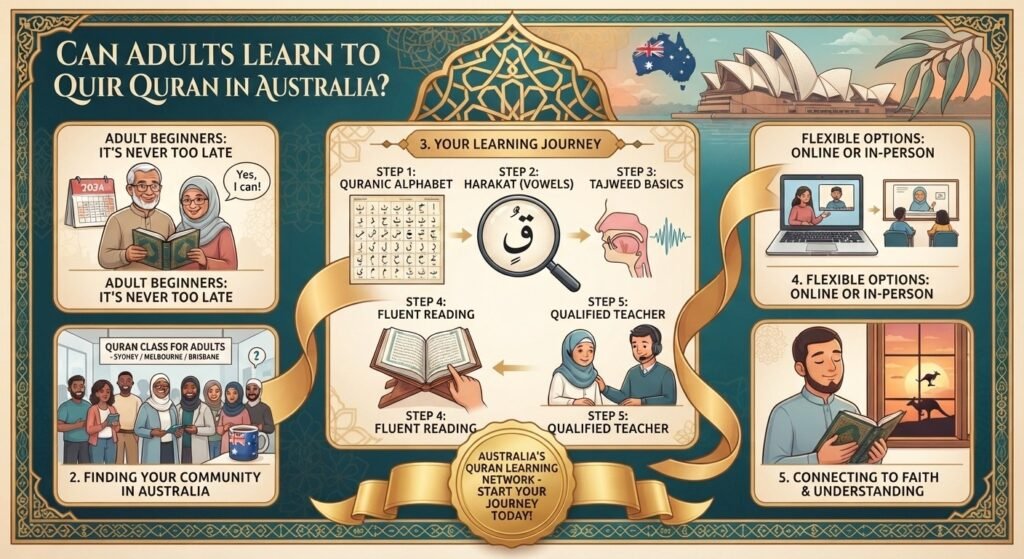
Noorani Qaida is a graded primer that moves from single letters to joined words and full Quranic phrases. Adult beginners usually complete it in eight to twelve weeks with three short lessons each week.
The Qaida moves through these stages in order:
- Isolated letters and their correct Makharij, the articulation points of each sound.
- Joined letter forms at the start, middle, and end of words.
- Short vowels, Tanween, and Sukoon on real Quranic words.
- Madd letters, Shaddah, and complete verses from Juz Amma.
Australian Quran Academy offers a Noorani Qaida Course that takes adult and child beginners from the first letter to fluent verse reading through live one-on-one lessons with patient tutors.

Start Reading the Quran With a Qualified Tutor
3. Build Basic Tajweed Accuracy Before Your First Sabaq
Yes, beginners should care about Tajweed from the start, though only the essential rules. A Sabaq, the new portion memorized each day, is stored exactly as it is first recited, mistakes included.
Allah commands measured, careful recitation in Surah Al-Muzzammil. This verse sets the standard that beginners should aim for, even while memorizing their very first short surahs:
أَوْ زِدْ عَلَيْهِ وَرَتِّلِ الْقُرْآنَ تَرْتِيلًا
(Aw zid ‘alayhi wa rattili al-Qur’ana tartila)
“Or add to it, and recite the Quran with measured recitation.”
Full Tajweed study can wait for later. The table below lists the core rules a beginner needs before memorizing, because these rules appear in almost every short surah of Juz Amma.
| Rule | What It Controls | Example in Juz Amma |
| Makharij al-Huruf | Correct articulation point for each letter | ح in أَحَدٌ versus ه in اللَّهُ, Surah Al-Ikhlas |
| Ghunnah | Nasal sound held two counts on noon and meem with Shaddah | إِنَّا in Surah Al-Kawthar |
| Qalqalah | Echo on ق ط ب ج د when carrying Sukoon | Stopping on أَحَدْ in Surah Al-Ikhlas |
| Madd Tabee’i | Natural two-count lengthening | أَعُوذُ in Surah Al-Falaq |
| Waqf | Correct stopping at verse endings | Stopping on الْفَلَقْ with Sukoon |
Recording yourself once a week and comparing it with a trusted reciter, such as Mahmoud Khalil Al-Husary, reveals errors in rhythm and vowel length before they settle permanently into memory.
Read also: How To Learn To Read Quran Online For Kids In Australia?
4. Start With Short Juz Amma Surahs for Early Momentum
Juz Amma, the thirtieth part of the Quran, is the clearest answer to where to start memorizing Quran. Its surahs are short, frequently recited in Salah, and already partly familiar to most Muslims.
Allah promises ease for anyone who sincerely turns to the Quran for remembrance, and He repeats this promise four times in Surah Al-Qamar to reassure hesitant beginners:
وَلَقَدْ يَسَّرْنَا الْقُرْآنَ لِلذِّكْرِ فَهَلْ مِن مُّدَّكِرٍ
(Wa laqad yassarna al-Qur’ana lidh-dhikri fahal min muddakir)
“And We have certainly made the Quran easy for remembrance, so is there any who will remember?”
A sensible first sequence moves from the shortest surahs upward. The table below shows a common beginner order used by many teachers, with verse counts to help set realistic weekly targets.
| Order | Surah | Verses | Suggested Time |
| 1 | Al-Fatihah | 7 | 1 week |
| 2 | Al-Ikhlas | 4 | 3 days |
| 3 | Al-Falaq | 5 | 3 to 4 days |
| 4 | An-Nas | 6 | 4 days |
| 5 | Al-Kawthar | 3 | 2 days |
| 6 | Al-Asr | 3 | 2 days |
| 7 | Al-Fil | 5 | 4 days |
| 8 | Quraysh | 4 | 3 days |
After these eight surahs, most students continue backward through Juz Amma toward An-Naba. Moving from shorter to longer surahs keeps every week achievable while gradually stretching memory and concentration.
See Us in Action!
Curious about what our online classrooms look like? Watch the short clips below to see how our interactive, one-on-one sessions bring learning to life with real-time feedback and engaging teaching methods.
Start Your Quranic Journey in Australia
Join our leading online academy and learn with expert tutors through a structured, personalized curriculum.
Book Your Free Trial5. Learn Simple Verse Meanings Alongside Memorization
Yes, you should focus on understanding at the beginning, though only the general meaning of each verse. Knowing what a verse says connects its words into one idea, which speeds recall and deepens concentration in Salah.
Before memorizing each new portion, follow this short sequence:
a. Read a reliable English translation of the verses once, slowly and attentively.
b. Note two or three repeated Arabic words, such as رَبّ (Lord) or قُلْ (say).
c. Recite the portion while recalling the meaning of each line.
Over months, these repeated words build a working Quranic vocabulary. Many high-frequency words return across hundreds of verses, so early attention to meaning keeps paying off long after the first Juz is complete.
Australian Quran Academy offers a Quranic Arabic Course that teaches the core vocabulary and basic grammar of the Quran, helping memorizers recognize what they recite instead of repeating unfamiliar sounds.

Book a Free Quranic Arabic Lesson Today
6. Follow One Proven Memorization Method Consistently
The strategy for memorizing Quran for beginners matters more than raw talent. Switching methods every week confuses memory, while one repeated system trains the brain to absorb verses faster.
a. Apply the 6446 Repetition Method to Each New Verse
The 6446 method divides repetition between looking and recalling, which moves a verse from short-term into long-term memory. Complete these rounds for each verse before moving on:
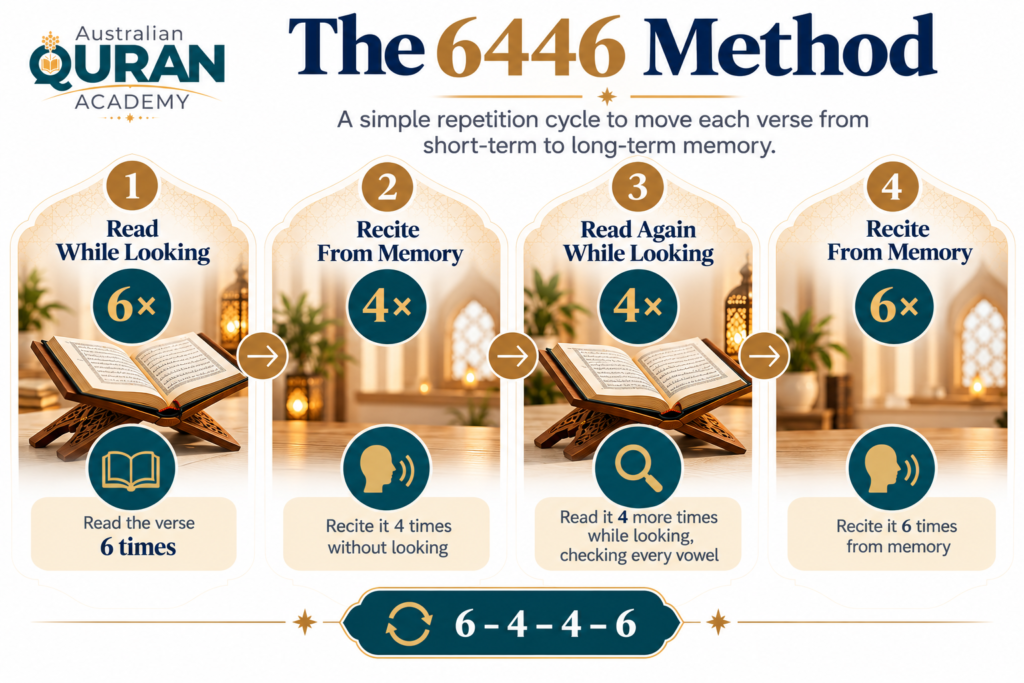
- Read the verse 6 times while looking at the Mushaf.
- Recite it 4 times without looking.
- Read it 4 more times while looking, checking every vowel.
- Recite it 6 times from memory.
After two verses are secure, join them and recite both together five times. This linking step prevents the common problem of knowing every verse alone but freezing at the transition between them.
b. Use the 10-3 Method When Daily Time Is Limited
The 10-3 method suits busy students and working adults. Read a verse ten times while looking, then recite it three times from memory; if no mistake appears, move to the next verse and link both.
Whichever method you choose, use the same printed Mushaf every day. Hifz relies partly on visual memory of page layout, so the familiar 15-line Madani print keeps each verse in a fixed place in your mind.
7. Recite New Verses to a Qualified Hifz Teacher in Australia
Every new portion should be heard by a qualified teacher before it joins your revision. Teachers catch subtle errors, such as a shortened Madd or a softened letter, that learners cannot hear in their own voice.
Struggling at this stage is normal and carries its own reward. The Prophet ﷺ described two kinds of reciters, and the second description fits most beginners in their early months:
مَثَلُ الَّذِي يَقْرَأُ الْقُرْآنَ وَهْوَ حَافِظٌ لَهُ مَعَ السَّفَرَةِ الْكِرَامِ الْبَرَرَةِ، وَمَثَلُ الَّذِي يَقْرَأُ وَهْوَ يَتَعَاهَدُهُ وَهْوَ عَلَيْهِ شَدِيدٌ فَلَهُ أَجْرَانِ
(Mathalu alladhi yaqra’u al-Qur’ana wa huwa hafidhun lahu ma’a as-safarati al-kirami al-bararah, wa mathalu alladhi yaqra’u wa huwa yata’ahaduhu wa huwa ‘alayhi shadidun falahu ajran)
“The example of the one who recites the Quran and has memorized it is that he will be with the noble, righteous scribes. And the example of the one who recites it, striving to retain it while finding it difficult, is that he will have a double reward.”
Finding a qualified Hifz teacher locally can be difficult outside major city centers. Online one-on-one classes connect students in Perth, Brisbane, Adelaide, and regional towns with certified tutors at times that suit their routines.
Australian Quran Academy offers Hifz Classes for Adults that pair each student with a certified tutor who listens to every new portion, corrects mistakes live, and builds revision around work commitments.

Recite Your First Portion to a Certified Tutor
8. Protect Memorized Portions With Daily and Weekly Revision
Revision decides whether memorized verses stay or fade. New memorizers often add verses faster than they review them, so earlier surahs slip away within weeks and confidence drops along with them.
Divide each session into three tracks: Sabaq is the new lesson, Sabqi is recent revision, and Manzil is long-term revision of older portions. The table below shows how a beginner can split a 30-minute session:
| Track | What It Covers | Time | Frequency |
| Sabaq | New verses for today | 10 minutes | Daily |
| Sabqi | Portions memorized in the last 7 days | 10 minutes | Daily |
| Manzil | Older surahs memorized earlier | 10 minutes | Daily, rotating |
| Weekly Review | Full recitation of the week’s portion to a teacher or family member | 20 to 30 minutes | Once a week |
Reciting revision portions in Sunnah and nafl prayers adds a second layer of review. Even two short surahs in each Sunnah prayer give older memorization regular exposure without requiring extra study time.
9. Choose How to Start Memorizing Quran in Australia
Your learning format shapes consistency, so choose it deliberately. Families across the country generally pick between mosque madrasah classes, weekend Islamic schools, and online one-on-one lessons, each with clear strengths.
| Format | Best For | Schedule | Teacher Attention |
| Mosque Madrasah | Children living near an active mosque | Weekday evenings or weekends | Shared with a group |
| Weekend Islamic School | Families wanting community and Islamic studies | Saturday or Sunday | Shared with a class |
| Online One-on-One | Adults, sisters, regional students, busy families | Flexible, any day | Full attention every lesson |
Time zones matter when booking online classes. Learners in Sydney and Melbourne follow AEST, Perth runs two hours behind on AWST, and daylight saving shifts several states each October, so confirm lesson times with your teacher.
Anyone weighing how to start memorizing Quran in Australia should also protect one fixed daily slot. After Fajr suits many students, while working adults often prefer the quiet hour after Isha when the household settles.
Read also: How To Learn Quran Recitation In Australia?
10. Track Weekly Hifz Progress to Recover From Missed Days
Tracking progress turns vague effort into visible results. A simple log shows which surahs are solid, which need extra revision, and how many verses you complete each week.
Keep a notebook or spreadsheet with five columns: date, new verses, revision portion, mistakes noticed, and teacher feedback. Reviewing it every Friday reveals patterns, such as recurring errors in similar verses.
Missed days happen to every student. When you miss a session, do not double the next day’s Sabaq; instead, spend that session on revision only, then resume your normal pace the following day.
Families wondering how to start Hifz Quran lessons for children can use the same log with stickers or small rewards. Children aged five to ten respond well to visible milestones, such as finishing each surah.
Australian Quran Academy offers Hifz Classes for Kids that combine short, engaging memorization sessions with progress reports for parents, so every child moves steadily through Juz Amma with qualified guidance.
Book Your Child’s Free Hifz Trial Lesson
Inside Our Virtual Classrooms
We believe in full transparency and proven quality. Take a look at these actual snippets from our live classes to experience our modern learning platform, patient instructors, and interactive student participation.
Start Your Quranic Journey in Australia
Join our leading online academy and learn with expert tutors through a structured, personalized curriculum.
Book Your Free TrialBegin Your Hifz With Australian Quran Academy Tutors
Australian Quran Academy helps beginners read, memorize, and revise the Quran through live one-on-one classes with certified tutors, flexible scheduling across Australian time zones, and male and female teachers for every age group.
Explore the courses that support each stage of this guide, from the first Arabic letters to full Hifz, and choose the one that matches your goals:
Our Quran Courses
- Noorani Qaida Course
- Quranic Arabic Course
- Hifz Classes for Adults
- Hifz Classes for Kids
- Tajweed Classes
- Hifz Classes for Ladies
Start Your Quranic Journey in Australia
Join our leading online academy and learn with expert tutors through a structured, personalized curriculum.
Book Your Free TrialConclusion
Knowing how to start memorizing Quran in Australia comes down to order. Read the letters first, secure basic Tajweed, begin with Juz Amma, and learn simple meanings so every verse carries sense as well as sound.
Method and revision keep that strong start alive. One consistent technique, a teacher who hears each portion, and daily Sabaq, Sabqi, and Manzil tracks protect what you memorize while steadily adding new verses.
Small sessions done every day outperform ambitious plans abandoned after a month. Choose a format that fits your city and schedule, record your progress weekly, and let each completed surah motivate the next one.
FAQs
Here is the FAQ section opening with the new bridge line added:
Where to Start Memorizing Quran as a Complete Beginner?
Start with Noorani Qaida if you cannot read Arabic yet, then memorize Al-Fatihah and the shortest surahs of Juz Amma. This order lets you revise independently and builds confidence through quick early completions.
Should You Care About Tajweed at the Beginning?
Yes, you should care about Tajweed at the beginning, focusing on Makharij, Ghunnah, Qalqalah, and natural Madd. Memorized mistakes are hard to remove later, so correct pronunciation must come before speed or quantity.
Should You Focus on Verse Meanings at the Beginning?
Yes, learning the general meaning of each verse helps from day one. Reading a translation before memorizing connects ideas, improves recall, and makes recitation in Salah more focused, without requiring full Arabic grammar.
How Easy Is It to Start Memorizing and Reading the Quran?
Starting is easier than most people expect when the steps stay small. Most adults read basic Quranic text after three to four months of regular Noorani Qaida lessons, and the first short surahs take only days.
What Are the Best Surahs to Start With for Hifz?
The best surahs to start with are Al-Fatihah, Al-Ikhlas, Al-Falaq, An-Nas, Al-Kawthar, and Al-Asr. They are short, recited often in prayer, and give beginners motivating progress before longer Juz Amma surahs.
How Long Does It Take Adults to Memorize Juz Amma?
Most adults memorize Juz Amma in six to twelve months with daily sessions of 20 to 30 minutes and consistent revision. Students who already read fluently and recite to a regular teacher usually finish sooner.






Leave a Reply