 Quran
Quran
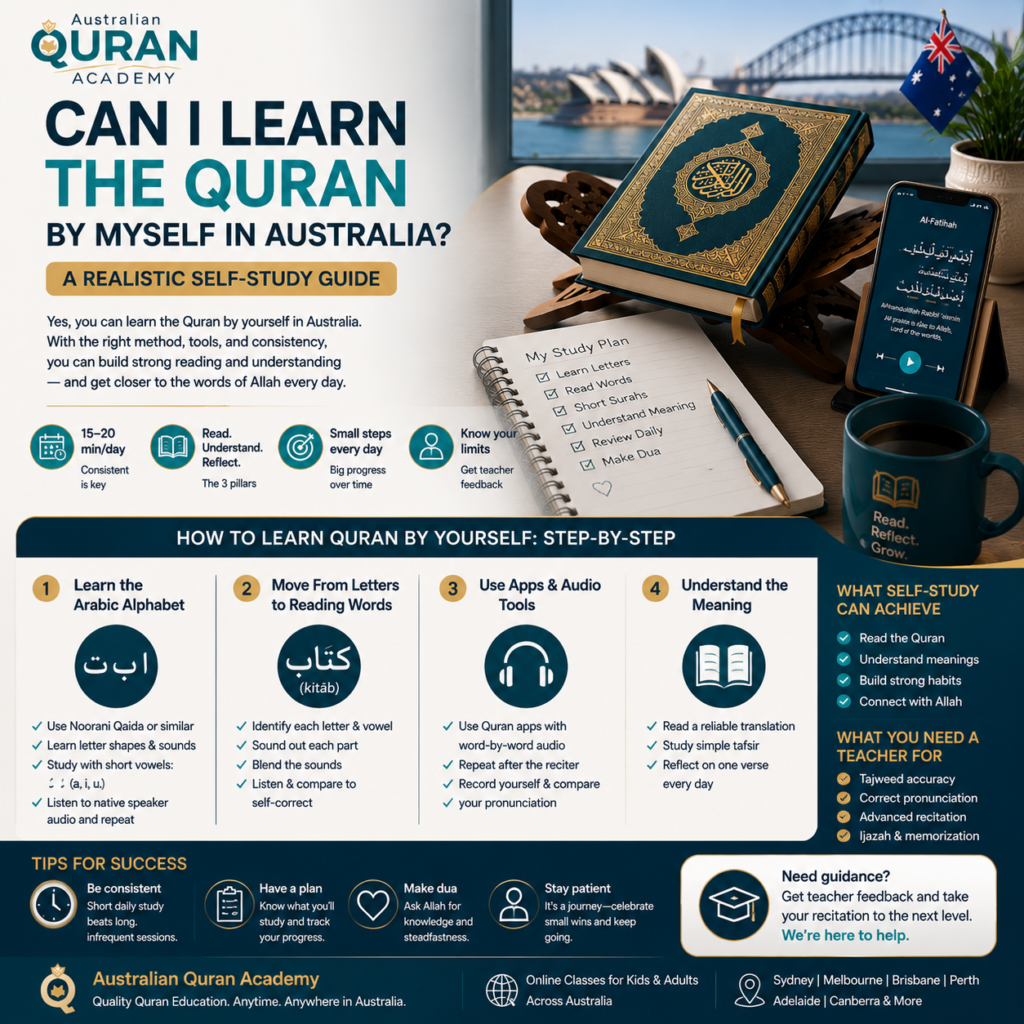
| Key Takeaways |
| Solo Quran learning in Australia is possible but requires structured daily practice and a verified pronunciation baseline. |
| Self-study reliably covers the Arabic alphabet, word reading, and understanding meaning through translation. |
| Without a teacher, self-taught learners risk locking in mispronounced letters that become harder to correct over time. |
| A consistent 15–20 minute daily routine outperforms occasional long study sessions for building reading fluency. |
| Tajweed accuracy is the one stage self-study cannot fully deliver — it requires a live teacher’s ear for correction. |
| Pairing self-study with periodic teacher feedback, even monthly, significantly improves accuracy and long-term progress. |
Yes, you can learn Quran by yourself in Australia. Thousands of Muslims across Sydney, Melbourne, Perth, and regional communities have started their Quran journey alone — with an app, a Mushaf, and quiet determination — before ever sitting with a teacher.
The real question isn’t whether it’s possible. It’s whether you’re doing it in a way that actually holds up long-term.
This guide gives you an honest roadmap: what you can genuinely achieve solo, which tools work, and the exact point where self-study hits a wall that only a qualified teacher can get you past.
If you’re asking “can I learn Quran by myself in Australia” because you don’t know where to start, or because you’re not sure it’s realistic with work and family life, this article answers both.
Can You Learn the Quran by Yourself in Australia?
Yes, with the right structure. Self-study can take you through the Arabic alphabet, basic word reading, and an understanding of the Quran’s meaning through translation.
So if you’re wondering can I learn Quran by myself in Australia starting from zero, the answer is yes, provided you follow a structured path rather than a scattered one. What self-study cannot fully deliver on its own is Tajweed accuracy, the precise science of correct recitation, because it depends on a trained ear correcting your pronunciation in real time.
What You Can Achieve Alone
With a structured plan, you can learn to recognise all 28 Arabic letters, connect them into words, read slowly from a Mushaf, and follow a reliable translation to understand core meanings.
Many self-taught learners in Australia reach a functional reading level within a few months of consistent daily practice.
What Requires A Teacher’s Guidance
Tajweed is an oral tradition passed from teacher to student, not something a book or recording can fully teach. A recording can model a sound, but it can’t hear your attempt and tell you your tongue placement is off.
This is the one area where every serious self-study guide, including ours at Australian Quran Academy, draws a clear line.
Read Also:How to Learn Quran in Australia?
How to Learn Quran by Yourself: A Step-by-Step Method
Self-study works best as a sequence, not a scattered set of resources. The four steps below take you from recognising individual Arabic letters to reading full verses with understanding — each step builds directly on the one before it.
1. Learn the Arabic Alphabet on Your Own
Your independent journey begins with the 28 letters of the Arabic alphabet. This is the most achievable stage of self-study, and getting it right sets up everything that follows.
Start with a Foundational Guidebook: Begin with a structured resource like the Noorani Qaida, a booklet designed specifically to teach letters, vowels, and letter-joining in a logical sequence built for self-study.
If you’d rather have that structure taught to you directly, our Learn Quran for Beginners in Australia course walks new students through the same foundation with live correction from day one.
Group Letters by Shape: Rather than memorising letters alphabetically, learn them in shape groups. For example, ب (Baa), ت (Taa), and ث (Thaa) all share the same base “boat” shape and differ only by their dots. This shortcut means you’re really only learning a handful of shapes, not 28 unrelated symbols.
Focus on Pronunciation Using Native Speaker Audio: Use recordings from native Arab speakers to hear the correct sound for each letter, and watch for subtle differences — for instance, the light ‘s’ sound of س (Seen) versus the heavier ص (Saad), where the tongue position changes noticeably.
Learn Vowels Alongside Each Letter: Don’t learn a letter’s name in isolation — learn it with its short vowels immediately: بَ (ba), بِ (bi), بُ (bu). This builds functional reading ability from the very first letter, not just letter recognition.
2. Move From Letters To Reading Words
Once letters are familiar, a systematic blending method turns them into words you can actually read.
The Three-Step Blending Method: First, deconstruct the word by identifying each letter and its vowel mark. Second, sound out each letter-vowel pair individually. Third, blend the sounds together from right to left. This method works on any word, no matter how long.
Listen and Compare to Self-Correct: After attempting a word or short verse, immediately check yourself against a verified recitation.
This listen-and-compare loop is the single most useful self-correction habit for anyone learning Quran independently in Australia, where access to native Arabic speakers may be limited outside a structured course.
3. Use Apps And Audio Tools To Support Self-Study
Word-by-word Quran apps act as a practical pronunciation checker during the early stages. Look for apps offering verse-by-verse and word-by-word audio from a qualified reciter — this lets you tap any word you’re unsure of and hear it repeated as many times as needed.
A practical routine: open a short surah, tap the first word, listen to the reciter, repeat it aloud five times, then move to the next word. This word-level repetition builds accurate reading habits far faster than reading a full verse straight through and guessing at unfamiliar words.
Apps are genuinely useful, but they have a fixed limitation: they can model correct sound, but they can’t listen to your attempt and tell you what’s wrong. That gap is exactly where structured courses such as our Quran Classes in Australia are designed to pick up.
4. Understand The Quran’s Meaning While Learning To Read It
Understanding meaning fuels the motivation needed to keep reading Arabic consistently.
Read a Reputable Translation: Choose a clear, widely accepted English translation and read it alongside the surah you’re currently learning to read. This gives you context for the words you’re sounding out letter by letter.
Start with an Accessible Tafsir: An introductory Tafsir (explanation of the Quran’s verses) deepens your understanding beyond a literal translation.
Learners who want to go further with structured meaning-based study, rather than piecing it together alone, often move into our Islamic Studies Courses for Adults in Australia, which build on this exact stage.
Inside Our Virtual Classrooms
We believe in full transparency and proven quality. Take a look at these actual snippets from our live classes to experience our modern learning platform, patient instructors, and interactive student participation.
Start Your Quranic Journey in Australia
Join our leading online academy and learn with expert tutors through a structured, personalized curriculum.
Book Your Free TrialWhy Tajweed Is Difficult to Learn by Yourself?
Tajweed is a precise, practical science. Subtle auditory and physical differences in pronunciation can only be reliably corrected by a trained, listening ear — not by a recording or an app.
1. Distinguishing Similar Sounds
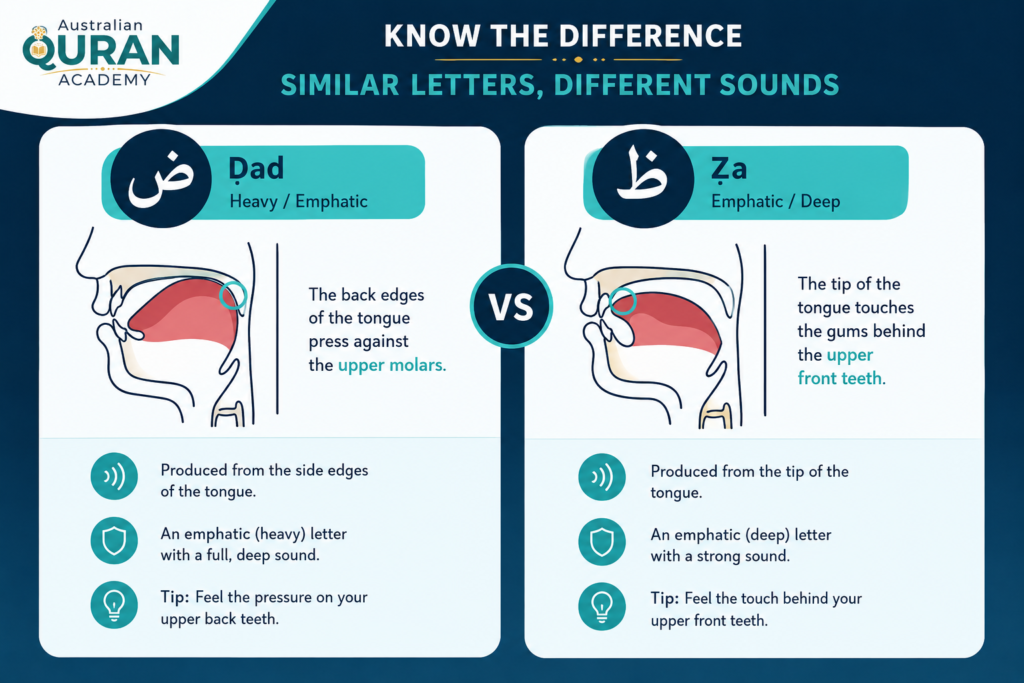
Untrained ears struggle to hear the difference between letters that sound alike but are articulated differently — the light ت (Taa) versus the heavy ط (Taw), or the soft ذ (Dhal) versus the heavy ظ (Dhaa).
A recording can play you the correct sound, but only a live teacher can watch your mouth and tell you your tongue is flat when it needs to be raised.
2. Honouring the Oral Tradition
Quran recitation was transmitted orally, teacher to student, in an unbroken chain (Sanad) stretching back to the Prophet Muhammad ﷺ.
Learning correct recitation from a certified teacher connects you to that same chain — something a book or app cannot replicate.
3. Hidden Rules of Timing and Flow
Tajweed governs rhythm and elongation as much as individual letters. The rule of Ikhfa, for example, requires lightly hiding the ‘n’ sound before certain letters — too much or too little changes the recitation.
A Madd (elongation) might need exactly four counts; holding it for three or five is a common, hard-to-self-detect error. A teacher’s trained ear catches these timing mistakes that a beginner simply cannot hear in their own recitation.
Read Also: learn quran alphabet in Australia
When to Find a Teacher to Guide You?
The ideal moment to find a teacher is once you can slowly sound out words on your own. At that point, a teacher can begin correcting pronunciation before mistakes turn into habits — which is far easier than un-learning an ingrained error months later.
A teacher builds on what you’ve already learned rather than replacing it, adding correct Tajweed rules and the live, personalised feedback self-study cannot provide.
This is precisely the stage where many Australian learners reach out to Australian Quran Academy — not to start over, but to correct and formalise the foundation they built alone.
How to Track Your Progress While Learning Quran By Yourself?
When you’re learning independently, you have to be your own accountability system.
A. Keep a Progress Journal
Note weekly milestones — “I mastered three new letters” or “I can now read the first verse of Surah Al-Falaq.” Written proof of progress keeps motivation steady over months.
B. Set Small, Measurable Goals
Build a checklist, such as the surahs in Juz’ Amma, and tick each one off as you learn to read it. This visual record is one of the simplest ways to sustain momentum when learning Quran by yourself in Australia without a fixed class schedule to keep you accountable.
Families teaching children alongside themselves often find it easier to formalise this stage early.
Our Arabic Lessons for Kindergarten in Australia programme is built for exactly this kind of household learning journey, giving young children the same letter-and-sound foundation in a structured, age-appropriate way.
See Us in Action!
Curious about what our online classrooms look like? Watch the short clips below to see how our interactive, one-on-one sessions bring learning to life with real-time feedback and engaging teaching methods.
Start Your Quranic Journey in Australia
Join our leading online academy and learn with expert tutors through a structured, personalized curriculum.
Book Your Free TrialBuild Your Foundation, Then Let Australian Quran Academy Take You Further
Starting your Quran journey by yourself is a genuine act of commitment. When you’re ready to turn that foundation into accurate, confident recitation, Australian Quran Academy provides the live, one-on-one guidance self-study cannot offer.
Our tutors give real-time correction on the exact pronunciation and timing errors a recording can’t catch, so the habits you build from here on are correct the first time.
Whether you’re continuing your own Arabic reading journey through our Learning Arabic for Non-Arabic Speakers in Australia course, or ready to formalise your Quran reading with structured Tajweed correction, we build on the effort you’ve already put in — we don’t ask you to start over.
Book your free trial lesson with Australian Quran Academy today and turn your self-study foundation into confident, correct recitation.
Our Quran Courses:
- Quran Recitation Classes
- Quran Reading Classes
- Online Quran Classes for Kids
- Quran Classes for Adults
- Quran Classes for Female/Sisters
- Learn Quran for Beginners
- Quran Memorization (Hifz) Course
- Hifz Classes for Adults
- Online Tajweed Classes
- Tajweed Course for Kids
- Tajweed Course for Adults
- Tajweed Course for Ladies/Sisters
Start Your Quranic Journey in Australia
Join our leading online academy and learn with expert tutors through a structured, personalized curriculum.
Book Your Free TrialConclusion
Self-study genuinely covers the basics: recognising letters, learning vowels, and sounding out words using resources like Noorani Qaida, native-speaker audio, and word-by-word apps. This independent effort builds real skill and, just as importantly, builds motivation through a personal connection to the text.
But Tajweed is where self-study reaches its limit. Its subtle sounds, precise timing, and oral tradition can only be corrected through live feedback from a trained teacher — something no app or recording replicates.
So yes, can I learn Quran by myself in Australia — you can, and you should start today with the alphabet and basic reading.
The most effective path is beginning independently, then transitioning to guided learning with a teacher once you can read words and short verses, giving you both a strong personal foundation and accurate, lasting recitation.
Frequently Asked Questions
Below are common questions Australian learners ask when starting Quran study independently, covering timing, tools, and when to bring in a teacher.
1. Can I really learn Quran by myself in Australia without joining a class?
Yes, you can learn the alphabet, basic word reading, and translated meaning entirely by yourself using structured resources like Noorani Qaida and word-by-word apps. Tajweed accuracy, however, needs a live teacher’s correction, so most self-taught learners eventually pair their independent study with a course.
2. How long does it take to learn to read Quran by yourself?
Most self-taught beginners can reach basic reading fluency — sounding out words and short verses — within a few months of consistent daily practice of 15–20 minutes. Reaching accurate Tajweed-level recitation typically requires a teacher’s involvement rather than self-study alone.
3. What’s the best way to start learning the Arabic alphabet on my own?
Start with a structured guide like Noorani Qaida, group letters by shared shape rather than alphabetical order, and learn each letter with its short vowels immediately so you build functional reading skills from day one.
4. Do I need to understand Arabic to start reading the Quran?
No. You can begin sounding out Arabic letters and words while reading a reliable English translation alongside them to understand meaning. Understanding the text and learning to read it are separate skills that develop in parallel.
5. When should I move from self-study to a teacher?
The right time is once you can slowly sound out individual words. At that stage, a teacher corrects pronunciation before mistakes become habits, which is far easier than correcting ingrained errors later.
6. Can adults in Australia learn Quran online with a teacher instead of in person?
Yes, online one-on-one Quran classes are widely available in Australia and offer the same live correction and Tajweed feedback as in-person lessons, without requiring travel — a practical option for busy adults who started with self-study and now want structured guidance.


Leave a Reply