 Quran
How to read the Quran is a skill you build in a fixed order: Arabic letters, vowel marks, joined words, tajweed rules, and then meaning. You have probably opened the Quran, admired the script, and closed it again because the letters felt like a code you could not crack.
That reaction is common, and it says nothing about your ability. Learning to read the Quran is a graded sequence of skills, and each one prepares you for the next.
The word Quran derives from the Arabic root meaning “to read” or “to recite.” Reading it well means moving through the letters, the vowels, the joining of words, and the rules of recitation, then adding translation and tafsir once your reading is accurate.
The Prophet ﷺ said that the one who recites the Quran and struggles with it, finding it difficult, will have a double reward (Sahih Muslim 798a). A slow start does not disqualify you. It counts.
Step 1: Learn the 28 Arabic letters and how they connect
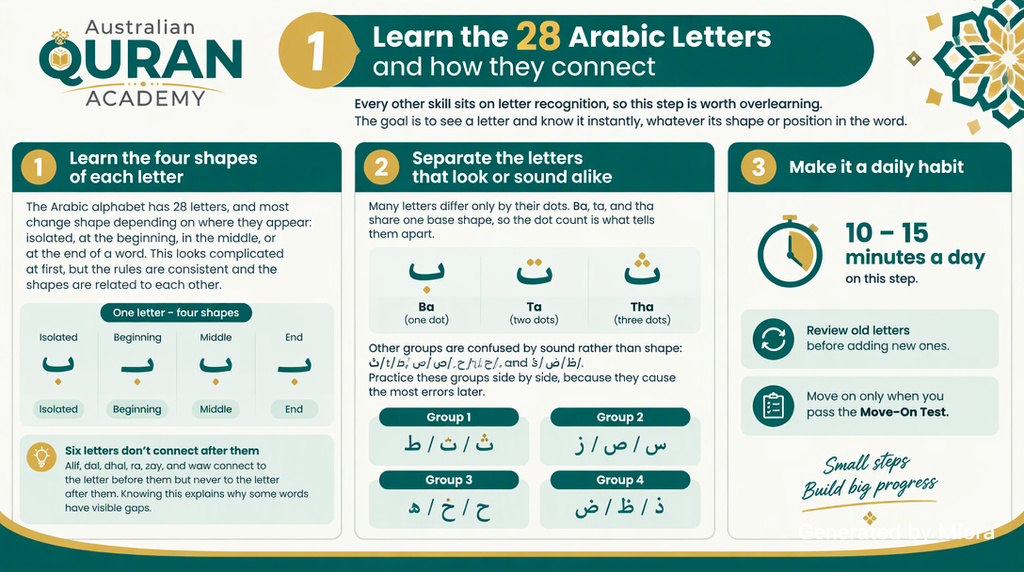
Every other skill sits on letter recognition, so this step is worth overlearning. The goal is to see a letter and know it instantly, whatever its shape or position in the word.
Learn the four shapes of each letter
The Arabic alphabet has 28 letters, and most change shape depending on where they appear: isolated, at the beginning, in the middle, or at the end of a word. This looks complicated at first, but the rules are consistent and the shapes are related to each other.
Six letters connect to the letter before them but never to the letter after them: alif, dal, dhal, ra, zay, and waw. Knowing this explains why some words have visible gaps.
Separate the letters that look or sound alike
Many letters differ only by their dots. Ba, ta, and tha share one base shape, so the dot count is what tells them apart.
Other groups are confused by sound rather than shape: ث/ت/ط, س/ص/ز, ح/خ/ه, and ذ/ظ/ض. Practice these groups side by side, because they cause the most errors later.
Spend 10 to 15 minutes a day on this step. Review old letters before adding new ones, and move on only when you pass the Move-On Test.
Step 2: Learn the vowel marks (harakat) and reading signs
The letters alone do not tell you how to pronounce a word. The vowel marks do, and the Quran is fully vowelized, which makes it easier to read than everyday Arabic.
The three short vowels
Fatha is a small stroke above the letter and gives an “a” sound. Kasra is a small stroke below the letter and gives an “i” sound. Damma is a small curl above the letter and gives a “u” sound.
Practice each letter with all three vowels: ba, bi, bu, then ta, ti, tu, and so on. Say each one aloud, because your mouth needs to learn the shapes too.
Sukoon, shadda, tanween, and madd letters
Sukoon is a small circle that means the letter carries no vowel. Shadda doubles the letter, so you pronounce it twice as one pressed sound.
Tanween is a doubled vowel mark at the end of a word that adds an “n” sound. Alif, waw, and ya, when they follow a matching vowel, lengthen it. This is the start of madd, which you will refine in Step 4.
Soft step: if a sign confuses you, keep a one-page cheat sheet of the marks beside your mushaf. The Online Arabic Course in Australia at Australian Quran Academy can help beginners build this foundation through guided lessons and teacher support, making it easier to recognize Arabic letters, understand harakat, and read Quranic words with confidence.
Step 3: Join letters into words with the Noorani Qaida
Knowing letters and vowels separately is different from reading connected words. This step closes that gap, and a structured primer does it best.
The Noorani Qaida is a step-by-step primer that builds letter recognition and basic word formation in a fixed order. It was not designed only for children, and many adult beginners and converts use it to start from zero.
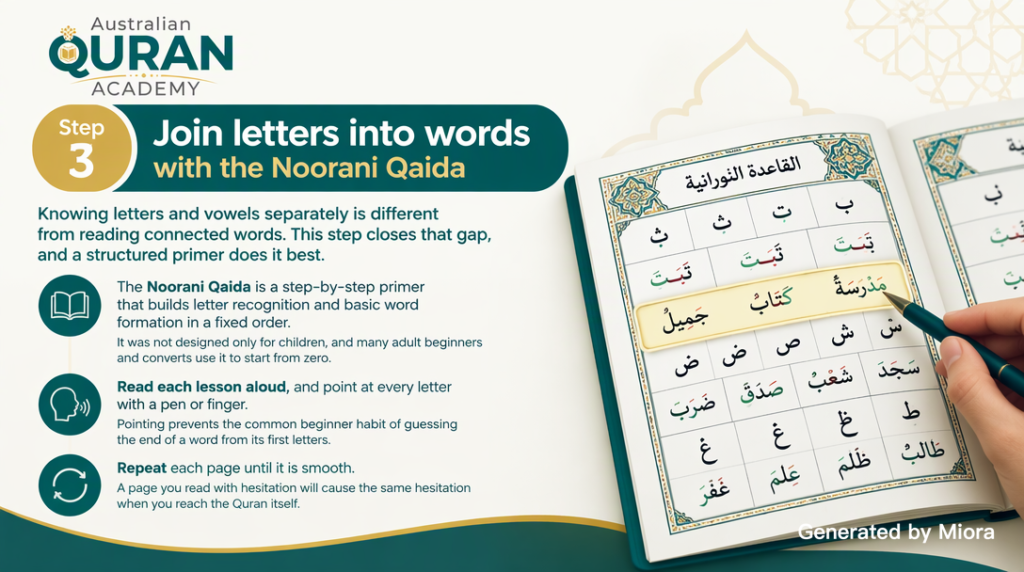
Practice connecting letters in different positions
Start by learning how each Arabic letter looks in its initial, middle, and final positions. For example, the letter ب (Ba) changes its shape depending on where it appears:
- Initial: بَـ as in بَاب (Baab).
- Medial: ـبـ as in حَبْل (Habl).
- Final: ـب as in كِتَاب (Kitaab).
Next, practice joining two and three letters with different harakat. For example, combine بَ + تَ to read بَتَ, then move to longer combinations such as كَتَبَ (Kataba). This helps you recognize connected letters without stopping to identify each one separately.
Read each Noorani Qaida lesson aloud while following every letter with your finger or a pen. Pay attention to the direction of the connections, the position of vowel marks, and letters that do not connect to the following letter, such as ا، د، ذ، ر، ز، و.
Repeat each exercise until you can read it smoothly without guessing or relying on memorized shapes. Mastering these combinations will make your transition to Quranic words much easier and help you avoid common mistakes when reading directly from the Mushaf.
See Us in Action!
Curious about what our online classrooms look like? Watch the short clips below to see how our interactive, one-on-one sessions bring learning to life with real-time feedback and engaging teaching methods.
Start Your Quranic Journey in Australia
Join our leading online academy and learn with expert tutors through a structured, personalized curriculum.
Book Your Free TrialStep 4: Learn tajweed foundations to read the Quran correctly
Tajweed means “to perfect” or “to beautify,” and it is the set of rules for reciting the Quran as it was taught. Even a beginner should apply the basics from the start, rather than leaving them for an advanced stage.
Makharij al-huruf: where each letter comes from
Makharij are the articulation points of the letters: the throat, the tongue, the lips, and the nasal passage. Knowing them stops confusable letters from blurring together.
A practical test: say an alif with fatha, then the letter with sukoon, such as “ab,” to feel where the sound lands. You can also learn the heavy letters (خ ص ض غ ط ق ظ), which are pronounced with the back of the tongue raised, giving a fuller sound.
Ghunnah, madd, and noon sakinah rules
Ghunnah is the nasal sound held for two counts. Madd is the lengthening of a vowel for two, four, or six counts, depending on the rule.
Noon sakinah and tanween follow four rules based on the letter that comes next:
- Izhar: the noon is pronounced clearly.
- Idgham: the noon merges into the next letter.
- Iqlab: the noon turns into a light meem before ba.
- Ikhfa: the noon is concealed with ghunnah.
Add qalqalah, the slight echo on ق ط ب ج د when they carry sukoon. These few rules appear on nearly every page, so learning them first gives the biggest accuracy gain.
Step 5: Start with short surahs and read along with audio
Once you can read connected words and apply basic rules, move from the primer to the Quran itself. Start small so each win comes quickly.
Begin with Surah Al-Fatiha, then move to the short surahs in Juz Amma, the 30th part. They are short, you may already know many from prayer, and that gives your ear a reference point.
Use a three-part loop for each short passage: listen to a clear reciter, read it yourself, then compare. Platforms like Quran.com let you follow the text on screen while the audio plays, which connects what you hear to what you see.
Choose reciters known for clarity. Sheikh Mahmoud Al-Husary is widely used for his clear teaching style, and Sheikh Minshawi and Sheikh Abdul Basit are also common references.
Begin with three ayahs a day rather than a page. Short, repeated passes build accuracy faster than long, rushed ones.
Step 6: Build a daily routine to read the Quran fluently
Fluency is the result of accurate repetition, and speed follows accuracy. Recite slowly, focus on one rule at a time, and let pace increase on its own.
Fix a time and a trigger
Dedicate 10 to 15 minutes a day. Fifteen minutes daily produces more than two hours once a week, because the skill is physical as well as mental.
Attach the habit to something you already do, such as reading after Fajr or before you open your phone. Track your days, and if you miss one, return the next day at your normal pace rather than doubling up.
Learn where to stop and start
Waqf is stopping and ibtida is restarting. The signs printed in the Quran show where a pause is permitted, required, or discouraged, and stopping in the wrong place can break the meaning of a verse.
To read fluently, keep your eyes one word ahead of your voice. This gives your mouth time to prepare the next word, which smooths your rhythm.
Step 7: Get a teacher to correct your recitation
Tajweed is an oral tradition, and you cannot hear your own mistakes. Without feedback, small errors become habits that are harder to fix later.
A recording of a skilled reciter helps, but it cannot listen to you. A teacher can, and the practice of learning the Quran with a teacher goes back to the Prophet ﷺ, who reviewed the Quran with Jibril every year.
Here is a decision rule: use apps and recordings freely for Steps 1 to 3, but arrange a teacher by Step 4 at the latest. That is when makharij and heavy letters need a trained ear.
If you want live correction, a teacher at Australian Quran Academy can listen to your recitation, point out the exact letters that need work, and give you a plan matched to your level. Even a few minutes of feedback a week speeds up progress.
Step 8: Understand the meaning with translation and tafseer
Reading the Arabic accurately is the first goal. Understanding what you recite changes recitation from a sound exercise into a conversation.
Pair your reading with a reliable translation. A translation is at best an interpretation of the Arabic, and styles vary, so compare more than one if a verse feels unclear.
Add a basic commentary (tafseer) to explain the historical context. The Quran is not arranged in chronological order, and its themes are woven across chapters, so commentary helps a lot.
Ask questions of knowledgeable Muslims, such as a teacher or an imam. The Quran invites reflection, and learning never stops.
Common mistakes that slow down Quran reading
Most delays come from a short list of habits. Knowing them early saves weeks.
- Starting too fast. Reading a full page a day at the beginning leads to burnout within a week. Start with 3 to 5 lines.
- Waiting for perfect pronunciation. Accuracy comes from reading, not before it. Read imperfectly and consistently, and correct as you go.
- Skipping letter review. If you still work out letters slowly after a month, return to Step 1.
- Practicing without feedback. Errors you cannot hear will stay. Bring in a teacher by Step 4.
- Reading without meaning. Keep a translation open so the words connect to their message.
Inside Our Virtual Classrooms
We believe in full transparency and proven quality. Take a look at these actual snippets from our live classes to experience our modern learning platform, patient instructors, and interactive student participation.
Start Your Quranic Journey in Australia
Join our leading online academy and learn with expert tutors through a structured, personalized curriculum.
Book Your Free TrialBook your Quran reading lesson and start reading correctly
Every step above works faster with someone listening to you. Without correction, the same mistake can repeat for months, and a missed makhraj or a short madd is hard to notice alone.
Australian Quran Academy helps you learn how to read the Quran step by step, from the first letter to confident recitation. You get a plan matched to your level and a teacher who corrects you while you read.
Stop restarting alone. Pick your level and begin this week.
Our Quran Courses
- Quran Online Academy
- Quran Recitation Classes
- Quran Reading Classes
- Online Quran Classes for Kids
- Quran Classes for Adults
- Quran Classes for Female/Sisters
- Hifz Classes for Adults
- Quran Memorization and Hifz Course for Kids
Conclusion
Learning how to read the Quran is a graded path: letters, vowels, joined words, tajweed basics, short surahs, a daily routine, teacher feedback, and finally meaning. Each step is small, and each prepares you for the next.
Use the Move-On Test to avoid rushing, keep your practice to 10 to 15 minutes a day, and bring in a teacher early so errors do not settle. Reading the Quran correctly, properly, and fluently comes from steady repetition, not from speed.
FAQs
How long does it take to learn to read the Quran as a beginner?
Most beginners recognize the Arabic letters in 2 to 4 weeks with consistent daily practice. Reading simple Quranic words usually takes 2 to 3 months, and fluent reading with tajweed takes about 6 to 18 months, depending on how much you practice.
Do I need to speak Arabic to read the Quran?
No. You need to learn the Arabic script, the vowel marks, and how letters connect. Many Muslims read the Quran fluently without speaking Arabic conversationally, and learning the meaning alongside reading deepens the experience.
Do beginners need tajweed?
Yes, the basics. Tajweed is the set of rules for correct pronunciation, lengthening, nasal sounds, and stopping. Beginners should learn the foundations gradually as they learn to read, instead of leaving them for later.
What is the best resource for a complete beginner?
The Noorani Qaida is the most widely recommended starting point, because it teaches letters, vowel marks, and basic word formation in a fixed order. The best resource is the one you will use consistently, ideally with a teacher to correct you.
Do I need wudu to read the Quran?
Most scholars require wudu to touch a printed mushaf, while views differ on reading from a screen or from memory. Being in a state of purity is always recommended, and you can ask a qualified scholar for the ruling that applies to you.







Leave a Reply