 Quran
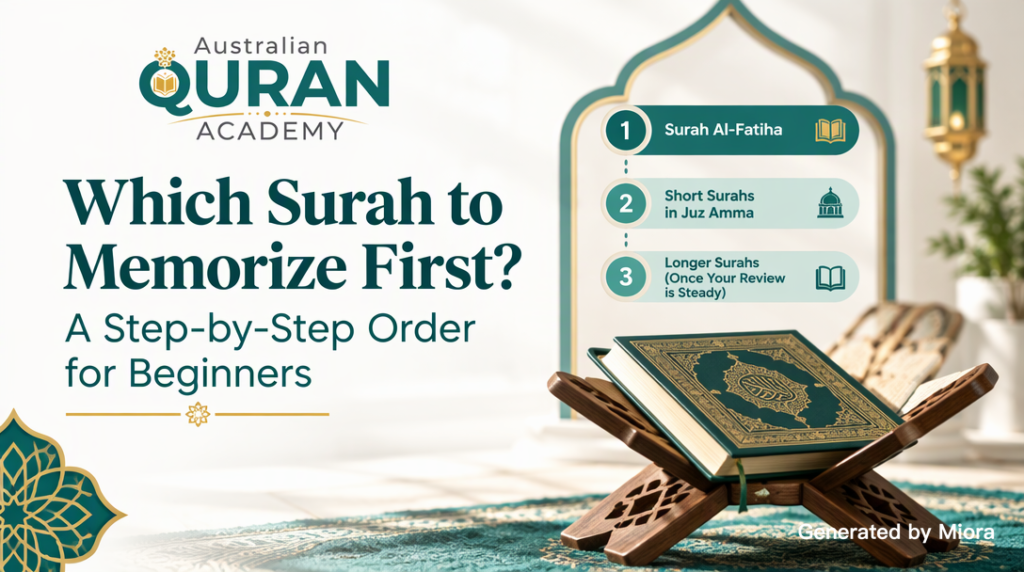
Which surah to memorize first is the question that decides whether your hifz journey starts with momentum or stalls in the first fortnight. The answer is Surah Al-Fatiha, then the short surahs in Juz Amma at the end of the Quran, with longer surahs added only once your daily review is steady.
Many beginners open the Mushaf at Surah Al-Baqarah, 286 verses long, and try to start there. Within a couple of weeks the daily load outgrows the habit they have built, and they stop. The problem is rarely motivation. It is the order they chose.
This order isn’t a religious rule. It is a practical sequence based on how memory works: quick wins build the habit, daily recitation keeps verses fresh, and length comes last. Below, each stage comes with the reason behind it, plus a simple check for choosing your next surah.
Why does Al-Fatiha comes before everything else?
Al-Fatiha is the first surah to memorize because you recite it in every unit of every prayer, and the Prophet ﷺ said:
«لَا صَلَاةَ لِمَنْ لَمْ يَقْرَأْ بِفَاتِحَةِ الْكِتَابِ»
“There is no prayer for the one who does not recite the Opening of the Book” (Sahih al-Bukhari 756).
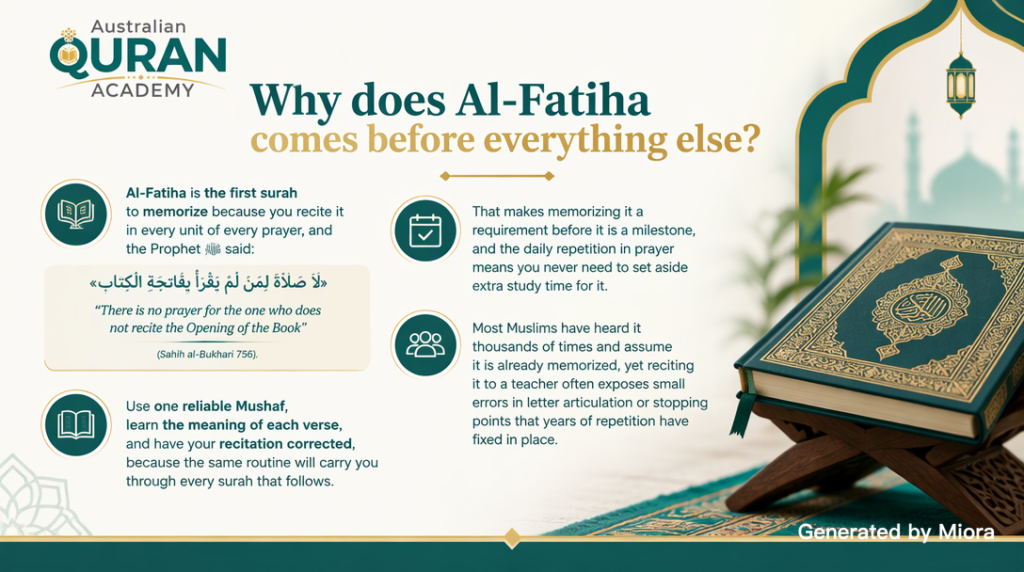
That makes memorizing it a requirement before it is a milestone, and the daily repetition in prayer means you never need to set aside extra study time for it.
Most Muslims have heard it thousands of times and assume it is already memorized, yet reciting it to a teacher often exposes small errors in letter articulation or stopping points that years of repetition have fixed in place.
Use one reliable Mushaf, learn the meaning of each verse, and have your recitation corrected, because the same routine will carry you through every surah that follows.
If you want a teacher to check your Al-Fatiha and guide your first steps, join our Learn Quran Course for Beginners.
Which Short Surahs to Memorize After Al-Fatiha?
The best surahs to memorize after Al-Fatiha are the short ones in Juz Amma, the thirtieth and final part of the Quran. Their verses are brief, you already hear them in prayer, and each one finished gives you a visible win while your routine is still forming.
Within Juz Amma, the order below moves from the shortest and most familiar toward the slightly longer.
Start with the Three Quls
Begin with Al-Ikhlas, Al-Falaq and An-Nas. The Prophet ﷺ described Surah Al-Ikhlas as equal to one-third of the Quran (Sahih al-Bukhari 5013). Al-Falaq and An-Nas are the two protection surahs, known as Al-Mu’awwidhatayn.
They are also useful straight away. Many Muslims recite them in the morning and evening adhkar and before sleep. That daily recitation counts as review, so these three surahs stay strong without extra effort.
Then add the shortest surahs of Juz Amma
Once the Three Quls are steady, move through the other brief surahs. If you want something small to learn today, open Al-Kawthar. It has only three verses.
| Surah | Verses | Why it suits an early stage |
| Al-Kawthar | 3 | The shortest surah, so an easy first win |
| Al-Asr | 3 | Short, with a tight structure that trains accurate recall |
| An-Nasr | 3 | Short and often recited in prayer |
| Al-Ikhlas | 4 | Short, with a well-known virtue |
| Al-Falaq | 5 | One of the two protection surahs |
| An-Nas | 6 | The second protection surah |
| Al-Fil | 5 | A short narrative that gives you a story to hold the verses together |
| Al-Ma’un | 7 | A bridge toward slightly longer surahs |
Difficulty is personal. A surah that one student finds simple can trip up another because of unfamiliar words or similar-sounding verses. If one surah keeps catching you, leave it and return later.
How to choose your next surah the use, length and familiarity check?
When the obvious short surahs are done, choose the next one with three questions: how often will I recite it, how long is it, and how familiar is it already? A surah that scores well on all three will stay in your memory.
This is the Use-Length-Familiarity check, and it replaces guesswork so you don’t pick surahs simply because they come next in the book.
Use matters most. Surahs you recite in prayer or daily adhkar are reviewed for free, while a surah you never say aloud outside your lesson depends on dedicated review time alone, so it fades faster.
For length and familiarity, pick a surah you can complete within a few weeks of steady work. Surahs you have heard often take less effort because your ear already knows the rhythm.
A common mistake is memorizing every short surah in order and staying there for months. Chapter-by-chapter learning can leave you unprepared for the jump to long surahs, where you have to work line by line.
See Us in Action!
Curious about what our online classrooms look like? Watch the short clips below to see how our interactive, one-on-one sessions bring learning to life with real-time feedback and engaging teaching methods.
Start Your Quranic Journey in Australia
Join our leading online academy and learn with expert tutors through a structured, personalized curriculum.
Book Your Free TrialWhich surahs with special virtues come next?
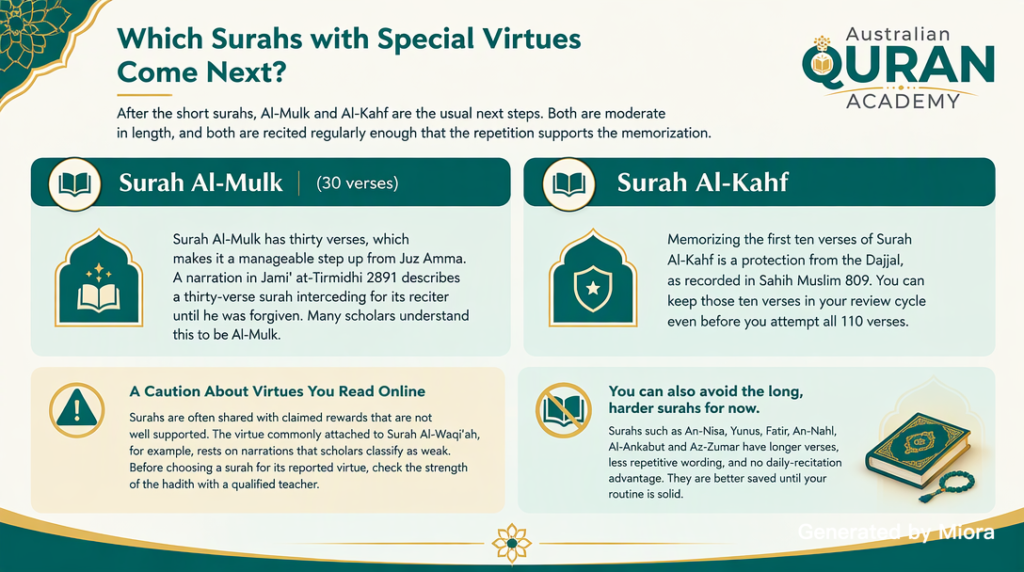
After the short surahs, Al-Mulk and Al-Kahf are the usual next steps. Both are moderate in length, and both are recited regularly enough that the repetition supports the memorization.
1. Surah Al-Mulk (30 verses)
Surah Al-Mulk has thirty verses, which makes it a manageable step up from Juz Amma. A narration in Jami’ at-Tirmidhi 2891 describes a thirty-verse surah interceding for its reciter until he was forgiven. Many scholars understand this to be Al-Mulk.
2. Surah Al-Kahf
Memorizing the first ten verses of Surah Al-Kahf is a protection from the Dajjal, as recorded in Sahih Muslim 809. You can keep those ten verses in your review cycle even before you attempt all 110 verses.
3. A caution about virtues you read online
Surahs are often shared with claimed rewards that are not well supported. The virtue commonly attached to Surah Al-Waqi’ah, for example, rests on narrations that scholars classify as weak. Before choosing a surah for its reported virtue, check the strength of the hadith with a qualified teacher.
You can also avoid the long, harder surahs for now. Surahs such as An-Nisa, Yunus, Fatir, An-Nahl, Al-Ankabut and Az-Zumar have longer verses, less repetitive wording, and no daily-recitation advantage. They are better saved until your routine is solid.
When should you memorize Al-Baqarah and Al-Imran?
Memorize Al-Baqarah and Al Imran once you have a working daily routine and some surahs you can review without strain. They are not beginner surahs, but they are a strong mid-stage goal.
Sahih Muslim 804 describes them as two bright surahs that will plead for their reciters on the Day of Judgment. The next two sections cover why waiting helps and how to prepare.
Why a routine matters before you start
Al-Baqarah has 286 verses and Al Imran has 200. Without a steady daily slot and a review habit, the early pages fade while you are still memorizing the later ones.
Learn the storyline before the verses
Both surahs are easier once you know their structure. Al-Baqarah moves from the story of Bani Israel and Prophet Musa into rulings on fasting, pilgrimage, debt and charity.
Al Imran addresses the objections of the People of the Book and recounts the Battle of Uhud. Reading a short summary first gives each verse a place in a sequence, which makes recall easier.
Planning to take on Al-Baqarah and Al-Imran? A teacher-led start makes the long surahs far easier to manage. Explore our Quran Qirat Learning Course to build accurate, confident recitation before you begin.

Which starting path fits your goal?
The right path depends on what you are memorizing for. Some teachers recommend starting Al-Baqarah first for students committed to the whole Quran, so that line-by-line memorization begins early. Others recommend Juz Amma first. Neither is wrong.
| Your goal | Suggested path |
| Learn surahs for daily prayer | Al-Fatiha, the Three Quls, then other short surahs of Juz Amma |
| Guide a young child | An-Nas backward through Juz Amma, one short surah at a time |
| Memorize the whole Quran | Build the habit with Juz Amma, then move into longer surahs under a teacher’s plan |
| Return after a long gap | Re-secure what you knew, then continue from where your memory is strongest |
You can also begin with the traditional path and switch to a freer choice once the basics are in place. What matters is a method that keeps you coming back each day.
See Us in Action!
Curious about what our online classrooms look like? Watch the short clips below to see how our interactive, one-on-one sessions bring learning to life with real-time feedback and engaging teaching methods.
Start Your Quranic Journey in Australia
Join our leading online academy and learn with expert tutors through a structured, personalized curriculum.
Book Your Free TrialStart memorizing your first surah today
Choosing the first surah is the easy part. Staying consistent is harder, especially when no one is correcting your pronunciation or noticing when you slip.
Australian Quran Academy pairs you with a qualified teacher who listens to your recitation, corrects Tajweed, and builds a memorization plan around your goal and schedule. You get the order, the accountability and the feedback in one place.
Book your first lesson and start with Al-Fatiha this week.
Our Quran Courses
- Quran Online Academy
- Quran Recitation Classes
- Quran Reading Classes
- Online Quran Classes for Kids
- Quran Classes for Adults
- Quran Classes for Female/Sisters
- Quran Memorization (Hifz) Course
- Hifz Classes for Adults
- Quran Memorization and Hifz Course for Kids
Conclusion
The question of which surah to memorize first has a clear starting answer. Begin with Al-Fatiha, add the Three Quls, then work through the short surahs of Juz Amma. After that, step up to Al-Mulk and Al-Kahf, and keep Al-Baqarah and Al Imran for when your routine is stable.
The surah matters less than what happens after day one. Use one Mushaf, protect a daily slot, review before adding new material, and get your recitation checked. The Prophet ﷺ said, “The best among you are those who learn the Quran and teach it” (Sahih al-Bukhari 5027).
FAQs
Which surah should a beginner memorize first?
A beginner should memorize Surah Al-Fatiha first, because it is recited in every unit of prayer. After it, Al-Ikhlas, Al-Falaq and An-Nas give manageable early milestones before you move through the rest of Juz Amma.
What is the easiest surah to memorize?
Surah Al-Kawthar is the easiest surah to memorize by length, with only three verses. Al-Asr and An-Nasr also have three verses, and Al-Ikhlas has four.
Should I start memorizing the Quran from Juz Amma?
Yes, if you are a beginner, a child, or an adult who wants more surahs for prayer. Juz Amma gives quick milestones that build the habit. If your goal is the whole Quran, use it as an early phase and then move on rather than staying with short surahs for too long.
Do I need to learn Tajweed before memorizing?
Ideally, learn the basic Tajweed rules first, because correcting a memorized mistake is harder than learning correctly from the start. You do not have to wait for perfection. You can begin simple surahs while you study Tajweed, as long as a teacher checks your recitation.







Leave a Reply