 Quran
Why do Muslims memorize the Quran? It is a question many people ask when they learn that millions of Muslims, including children as young as five or six, carry the entire text in their hearts, word for word, often in a language they do not speak at home.
The answer goes beyond tradition. Muslims memorize the Quran to draw closer to Allah, follow the example of the Prophet Muhammad ﷺ, and keep the revelation preserved in hearts as well as on paper. A person who has memorized the whole Quran is called a hafiz (or hafiza for a woman).
Memorization also has a practical side. It lets you recite in prayer without a book, brings calm in hard moments, and gives your family a share in the reward. The Prophet ﷺ even promised a double reward to those who find it difficult, so this path is open to you whatever your starting point.
This guide explains why Muslims memorize the Quran through twelve reasons, each backed by evidence from the Quran and the authentic Sunnah.
1. Memorising the Quran is the Sunnah of the Prophet ﷺ
Memorizing the Quran is a way of following the Sunnah of Prophet Muhammad ﷺ, who carefully memorized the revelations as they were sent down and regularly reviewed them to preserve their words and meanings.
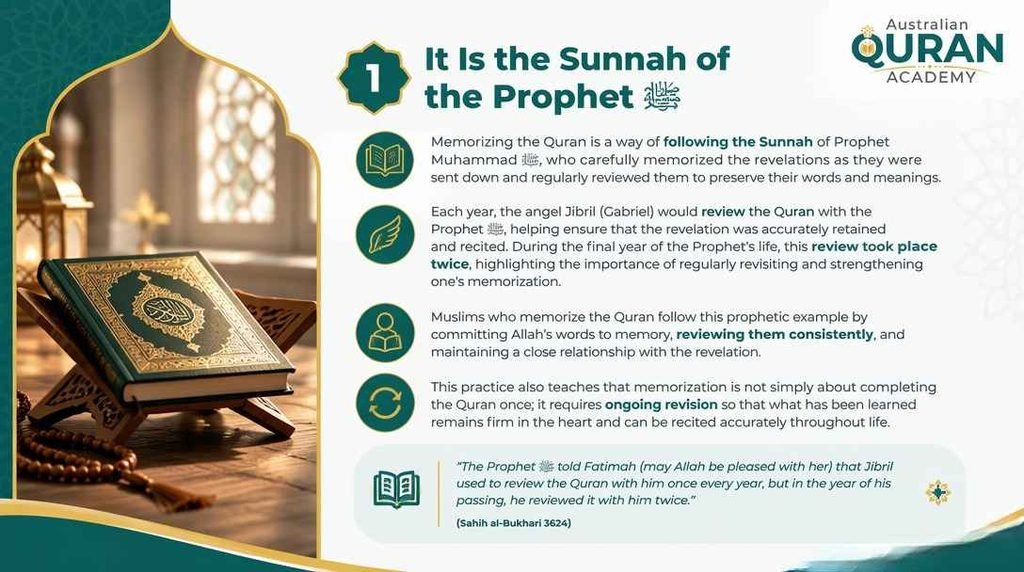
Each year, the angel Jibril (Gabriel) would review the Quran with the Prophet ﷺ, helping ensure that the revelation was accurately retained and recited. During the final year of the Prophet’s life, this review took place twice, highlighting the importance of regularly revisiting and strengthening one’s memorization.
Muslims who memorize the Quran follow this prophetic example by committing Allah’s words to memory, reviewing them consistently, and maintaining a close relationship with the revelation.
This practice also teaches that memorization is not simply about completing the Quran once; it requires ongoing revision so that what has been learned remains firm in the heart and can be recited accurately throughout life.
The Prophet ﷺ told Fatimah (may Allah be pleased with her) that Jibril used to review the Quran with him once every year, but in the year of his passing, he reviewed it with him twice. (Sahih al-Bukhari 3624)
2. Memorization keeps the Quran preserved in hearts as well as in writing
Allah promised to protect the Quran, and memorization is one of the means by which that promise is carried out. The text exists in two independent forms: the written mushaf and the memory of millions of huffaz (plural of hafiz). A mistake in one is caught by the other.
Indeed, it is We who sent down the Quran and indeed, We will be its guardian. (Quran 15:9). Allah also describes the Quran as clear verses within the breasts of those who have been given knowledge. (Quran 29:49)
This cross-checking began in the first generation. After many Quran reciters were killed at the Battle of Yamamah, Umar ibn al-Khattab urged Abu Bakr to have the Quran gathered into one volume. Zayd ibn Thabit, himself a memorizer, compiled it from written fragments and from the men who had learned it. (Sahih al-Bukhari 4986)
Zayd accepted a verse only when memory and writing agreed. He recorded the last verses of Surah at-Tawbah after finding them written with Khuzaymah ibn Thabit, matching what the Companions had memorized. (Sahih al-Bukhari 4679)
Memorization also gives the Quran a living chain of transmission. A serious student recites to a qualified teacher who heard it from his own teacher, and the chain reaches back to the Prophet ﷺ. This is why a hafiz anywhere in the world recites the same wording, and why any attempt to alter the text would be corrected by those who know it by heart.
3. Memorization lets you recite in prayer without a mushaf
Prayer is where memorized Quran is used every day. Every Muslim needs at least some of it memorized to pray, and a hafiz can recite longer passages, in any place and at any time, with no book in hand.
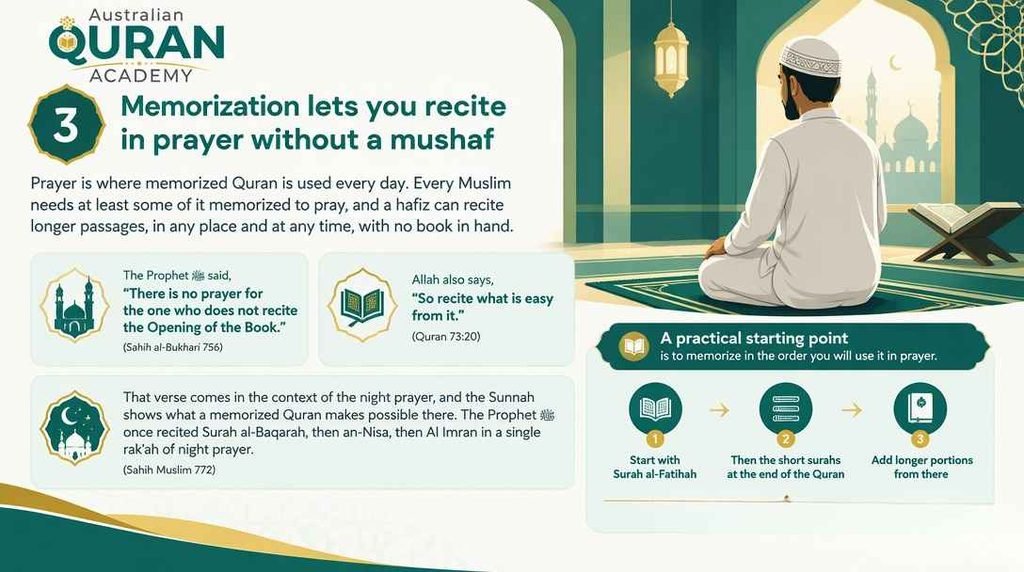
The Prophet ﷺ said, There is no prayer for the one who does not recite the Opening of the Book. (Sahih al-Bukhari 756). Allah also says, “So recite what is easy from it. (Quran 73:20)
That verse comes in the context of the night prayer, and the Sunnah shows what a memorized Quran makes possible there. The Prophet ﷺ once recited Surah al-Baqarah, then an-Nisa, then Al Imran in a single rak’ah of night prayer. (Sahih Muslim 772)
A practical starting point is to memorize in the order you will use it in prayer. Begin with Surah al-Fatihah, then the short surahs at the end of the Quran, and add longer portions from there. Each portion you learn improves your next prayer.
4. The Quran will intercede for its companions on the Day of Judgment
Muslims memorize the Quran because it is promised to speak on behalf of its companions in the Hereafter. A “companion” of the Quran is someone who stays with it through regular recitation, and memorization is one of the strongest ways to do that.
The Prophet ﷺ said, Recite the Quran, for it will come on the Day of Resurrection as an intercessor for its companions. (Sahih Muslim 804)
The same hadith singles out two surahs: Recite the two bright ones, al-Baqarah and Al Imran, for they will come on the Day of Resurrection like two clouds shading their companions. (Sahih Muslim 804)
Intercession is tied to action, not only memory. The Prophet ﷺ said, “The Quran is a proof for you or against you.” (Sahih Muslim 223). This is why Hifz students are taught to revise regularly and to live by what they memorize.
You can take your Quran memorization journey further with the guidance of a qualified teacher. The Quran Ijazah Program at Australian Quran Academy offers structured Quran recitation and memorization with live teacher guidance, helping you refine your recitation, strengthen your Hifz, and work toward earning an Ijazah with a connected chain of narration.
5. Your rank in Paradise rises with what you recite
The Sunnah links a person’s rank in Paradise to the Quran they carried and recited in this life. This is a strong motivation to keep going when memorization feels slow, because each new portion you learn and recite carefully is part of that rank.
Evidence: The Prophet ﷺ said, “It will be said to the companion of the Quran: recite and ascend, and recite carefully as you used to recite in the world, for your rank will be at the last verse you recite.” (Sunan Abi Dawud 1464)
The hadith says “recite carefully as you used to recite in the world,” which matches Allah’s command to “recite the Quran with measured recitation.” (Quran 73:4). Careful, accurate recitation counts, so a student who memorizes slowly with correct Tajweed is not at a disadvantage.
Because rank follows what you recite, a steady daily portion that you revise and recite well is worth more than a large portion that fades.
6. Those who hold the Quran are described as “the people of Allah”
The Prophet ﷺ gave the people of the Quran a title of honour. It refers to those devoted to learning, reciting, and living by the Quran, and memorization is among the most direct ways to belong to that group.
Evidence: The Prophet ﷺ said, “Allah has people among mankind.” The Companions asked who they were, and he replied, “The people of the Quran are the people of Allah and His chosen ones.” (Sunan Ibn Majah 215)
Scholars understand “people of Allah” as a phrase of closeness and honour, not of ownership. The title belongs to those who keep a daily relationship with the Quran, which is why Hifz teachers stress regular recitation and revision more than a one-time achievement.
The Prophet ﷺ also linked this honour to teaching. He said, “The best among you are those who learn the Quran and teach it.” (Sahih al-Bukhari 5027). A hafiz can pass on what they have learned to their children, their family, and their community.
7. A learner who struggles still earns a double reward
Many non-Arabic speakers hesitate to start Hifz because they expect it to be slow. The Sunnah gives them a specific promise: the one who is fluent is with the angels, and the one who recites with difficulty receives two rewards.
The Prophet ﷺ said, “The one who recites the Quran and is proficient in it is with the noble, obedient angels, and the one who recites it with difficulty, stammering through it, will have two rewards.” ( Sahih Muslim 798)
Scholars explain the two rewards as one for the recitation itself and one for the effort of struggling with it. This does not mean difficulty is the goal. The fluent reciter holds the higher rank, so the struggling learner is encouraged to keep improving while knowing that no effort is wasted.
Allah also says, “We have certainly made the Quran easy for remembrance, so is there any who will remember?” (Quran 54:17). The ease comes from Allah, not from natural talent, which is why a slow start should not stop you.
See Us in Action!
Curious about what our online classrooms look like? Watch the short clips below to see how our interactive, one-on-one sessions bring learning to life with real-time feedback and engaging teaching methods.
Start Your Quranic Journey in Australia
Join our leading online academy and learn with expert tutors through a structured, personalized curriculum.
Book Your Free Trial8. Memorization brings honour in this life, including leading prayer
Knowledge of the Quran carries real status in Muslim communities. A person who knows the most Quran is given preference to lead the prayer, and the Prophet ﷺ gave honour to those with more Quran even in how the martyrs of Uhud were buried.
The Prophet ﷺ said, “Allah elevates some people by this Book and lowers others by it.(Sahih Muslim 817). He also said, “The one most versed in the Book of Allah should lead the people in prayer.
At Uhud, he asked which of two companions knew more Quran and placed that one first in the grave. (Sahih al-Bukhari 1343)
The honour is tied to responsibility. The Prophet ﷺ listed among the signs of honouring Allah “honouring the bearer of the Quran who is neither excessive in it nor neglectful of it.” (Sunan Abi Dawud 4843). A hafiz earns respect by balancing recitation with good conduct, not by the title alone.
9. Your parents are given a crown of honour
Muslims often begin memorizing for their families as well as themselves. The Sunnah describes a crown of light for the parents of one who recites and acts on the Quran.
Evidence: The Prophet ﷺ said that whoever recites the Quran and acts on it, his parents will be given a crown on the Day of Resurrection whose light is better than the light of the sun in the houses of this world. He then added, “So what do you think of the one who acted by this?” (Sunan Abi Dawud 1453)
The hafiz is honoured too. The Quran will come on the Day of Resurrection and ask Allah to adorn its companion, who will be given a crown of dignity and then a robe of honour. (Jami’ at-Tirmidhi 2915)
The reward reaches parents because they supported the child through years of daily effort. This is why many parents enrol their children in Hifz early. Australian Quran Academy’s Online Arabic Course in Australia helps children build the Arabic reading foundation that makes memorizing the Quran easier, with short, consistent sessions that fit around school.

10. Every letter earns a good deed, and each good deed is multiplied by ten
Memorizing means reciting the same verses again and again, and each repetition counts as worship. This reward is attached to the act of reciting, so the work of memorizing is itself rewarded, not only the finished result.
The Prophet ﷺ said, “Whoever recites a letter from the Book of Allah will have a good deed, and each good deed is multiplied by ten.” (Jami’ at-Tirmidhi 2910)
He ﷺ also said that learning or reciting even two verses in the mosque is better than two she-camels, which were among the most valued possessions of the time. (Sahih Muslim 803)
11. The Quran calms the heart and shapes character
Memorized verses are available in moments of fear, grief, or stress. This is a practical reason Muslims memorize: the verses are already in the heart when you need them, with no book or phone required.
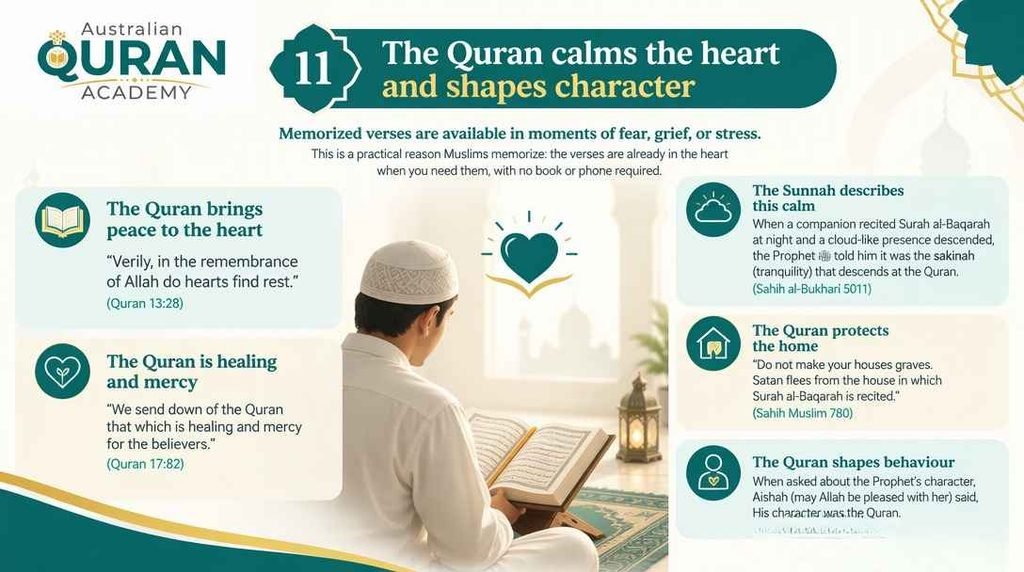
“Verily, in the remembrance of Allah do hearts find rest.” (Quran 13:28). Allah also says, “We send down of the Quran that which is healing and mercy for the believers.” (Quran 17:82)
The Sunnah describes this calm. When a companion recited Surah al-Baqarah at night and a cloud-like presence descended, the Prophet ﷺ told him it was the sakinah (tranquility) that descends at the Quran. (Sahih al-Bukhari 5011)
The Quran also protects the home. The Prophet ﷺ said, “Do not make your houses graves. Satan flees from the house in which Surah al-Baqarah is recited.” (Sahih Muslim 780)
The Quran also shapes behaviour. When asked about the Prophet’s character, Aishah (may Allah be pleased with her) said, His character was the Quran.
12. Memorization is a lifelong commitment, so revision matters most
Muslims treat memorization as a long-term relationship with the Quran, not a one-time project. A common mistake is rushing to memorize large portions and neglecting revision, so earlier pages fade.
The Prophet ﷺ said, “Keep up your recitation of the Quran, for by the One in whose hand is my soul, it escapes faster than camels from their ropes.” (Sahih al-Bukhari 5033; Sahih Muslim 791)
Many Hifz teachers organize revision into three layers: the new lesson, recent revision of the last few days, and old revision of everything memorized before. As a rule of thumb, protect revision time first and add new lines only after it is done. Understanding the meaning of what you memorize also helps verses stay in memory.
Inside Our Virtual Classrooms
We believe in full transparency and proven quality. Take a look at these actual snippets from our live classes to experience our modern learning platform, patient instructors, and interactive student participation.
Start Your Quranic Journey in Australia
Join our leading online academy and learn with expert tutors through a structured, personalized curriculum.
Book Your Free TrialStart memorizing the Quran with a teacher who tracks your progress
Memorizing alone is hard. Mistakes in pronunciation go uncorrected, revision slips, and motivation fades after a few weeks. A qualified teacher fixes these problems early, so what you learn stays with you.
Australian Quran Academy offers Hifz lessons for children and adults with a personalized plan and regular revision built in. Book a lesson and take your first step toward carrying the words of Allah in your heart.
Our Quran Courses
- Quran Online Academy
- Quran Recitation Classes
- Quran Reading Classes
- Online Quran Classes for Kids
- Quran Classes for Adults
- Quran Classes for Female/Sisters

Conclusion
Why do Muslims memorize the Quran? Because it follows the Sunnah of the Prophet ﷺ, keeps the revelation preserved in hearts as well as in writing, and strengthens every prayer. The Quran and Sunnah also promise lasting rewards: intercession on the Day of Judgment, a higher rank in Paradise, the title of “the people of Allah,” and a crown of honour for the hafiz and their parents.
Memorization also benefits this life. It brings calm to the heart, shapes character, and gives you the Quran as a companion in every situation. The reward does not depend on speed or talent, since the one who struggles is promised two rewards.
Whether you start as a child or as an adult, begin with a small portion, protect your revision, and ask Allah for ease. The Quran stays with those who stay with it.
FAQs
Is it obligatory for every Muslim to memorize the whole Quran?
No, memorizing the whole Quran is not obligatory for every individual. Scholars, including Dar al-Ifta al-Misriyyah, classify it as a communal obligation (fard kifayah): the community must always have people who have memorized it. Every Muslim must learn enough to pray, including Surah al-Fatihah.
Do you need to understand Arabic to memorize the Quran?
No, but understanding helps. Many hafiz memorize without speaking Arabic, and the Prophet ﷺ promised a double reward to the one who recites with difficulty (Sahih al-Bukhari 4937). Learning the meaning, even at a basic level, makes verses easier to retain.
What is the best age to start memorizing the Quran?
Ages 5 to 12 are generally considered ideal, as children have fewer distractions and form lasting habits. Adults can also memorize successfully. They usually bring stronger discipline, understanding, and motivation.
How long does it take to memorize the whole Quran?
Pace varies by person. With full-time daily effort, memorization can take around 1 to 3 years. With part-time study, many students take 5 to 7 years. Consistent revision matters more than speed.
Why do Muslims memorize the Quran in Arabic and not a translation?
Because the Quran’s wording was revealed in Arabic, and a translation is an interpretation of the meaning, not the Quran itself. Prayer is also performed with the Arabic recitation. A translation is useful for understanding and should be studied alongside the Arabic.
Does memorizing the Quran protect a person from the Fire?
Some narrations speak of the Quran as a protection for its companion, such as the hadith in Musnad Ahmad about the Quran placed in a hide. Scholars understand this in light of sincere recitation and living by the Quran, not memorization alone.







Leave a Reply